Page 582 of 700
582 5-1. Essential information
4RUNNER_U
Using a flatbed truckIf you use chains or cables to tie
down your vehicle, the angles
shaded in black must be 45.
Do not overly tighten the tie
downs or the vehicle may be
damaged.
CTH51AS011
■ Before emergency towing
Vehicles without a smart key system: Turn the engine switch to the
“ACC” (engine off) or “ON” position.
Vehicles with a smart key system: Turn the “ENGINE START STOP” switch to ACCESSORY (engine off) or IGNITION ON mode
(engine running).
Part-time 4WD models: Shift the front-wheel drive control lever to
H2.
Full-time 4WD models: Put the four-wheel drive control switch in
H4F. (The center differential is unlocked.)
Shift the shift lever to N.
Release the parking brake.
STEP 1
STEP 2
STEP 3
STEP 4
Page 583 of 700

5
When trouble arises
583
5-1. Essential information
4RUNNER_U
CAUTION
■
Caution while towing
● Use extreme caution when towing the vehicle.
Avoid sudden starts or erratic driving maneuvers which place excessive
stress on the emergency towing eyelets and the cables or chains. Always
be cautious of the surroundings and other vehicles while towing.
● Vehicles with a smart key system: Do not turn the “ENGINE START
STOP” switch off.
Doing so will lock the steering wheel and prevent operation, possibly caus-
ing an accident and resulting in death or serious injury.
● If the engine is not running, the power assist for the brakes and steering
will not function, making steering and braking more difficult.
NOTICE
■To prevent causing serious damage to the transmission and transfer
(4WD models) when towing using a wheel-lift type truck
2WD models: Never tow this vehicle from the front with the rear wheels on
the ground.
4WD models: Never tow this vehicle with any of the wheels in contact with
the ground.
■ To prevent damage to the vehicle when towing using a wheel-lift type
truck
● 2WD models without a smart key system: Do not tow the vehicle from the
rear when the engine switch is in the “LOCK” position or the key is
removed. The steering lock mechanism is not strong enough to hold the
front wheels straight.
● 2WD models with a smart key system: Do not tow the vehicle from the rear
when the “ENGINE START STOP” switch is off. The steering lock mecha-
nism is not strong enough to hold the front wheels straight.
● When raising the vehicle, ensure adequate ground clearance for towing at
the opposite end of the raised vehicle. Without adequate clearance, the
vehicle could be damaged while being towed.
Page 585 of 700
5
When trouble arises
585
5-1. Essential information
4RUNNER_U
If you think something is wrong
If you notice any of the following symptoms, your vehicle probably
needs adjustment or repair. Contact your Toyota dealer as soon as
possible.
■ Visible symptoms
●Fluid leaks under the vehicle
(Water dripping from the air cond itioning after use is normal.)
● Flat-looking tires or uneven tire wear
● Engine coolant temperature g auge needle continually points
higher than normal
● Voltmeter (if equipped) continua lly points higher or lower than
normal
■ Audible symptoms
●Changes in exhaust sound
● Excessive tire squeal when cornering
● Strange noises related to the suspension system
● Pinging or other noises related to the engine
■ Operational symptoms
●Engine missing, stumbling or running roughly
● Appreciable loss of power
● Vehicle pulls heavily to one side when braking
● Vehicle pulls heavily to one side when driving on a level road
● Loss of brake effectiveness, s pongy feeling, pedal almost
touches the floor
Page 587 of 700
5
When trouble arises
587
4RUNNER_U
5-2. Steps to take in an emergency
If a war ning light turns on or a war ning buzzer sounds
Stop the vehicle immediately. Continuing to drive the vehicle
may be dangerous.The following warning indicates a possible problem in the brake sys-
tem. Immediately stop the vehicle in a safe place and contact your
Toyota dealer.
*: Parking brake engaged warning buzzer: A buzzer will sound if the vehicle is driven at a speed of approxi-
mately 3 mph (5 km/h) or more.
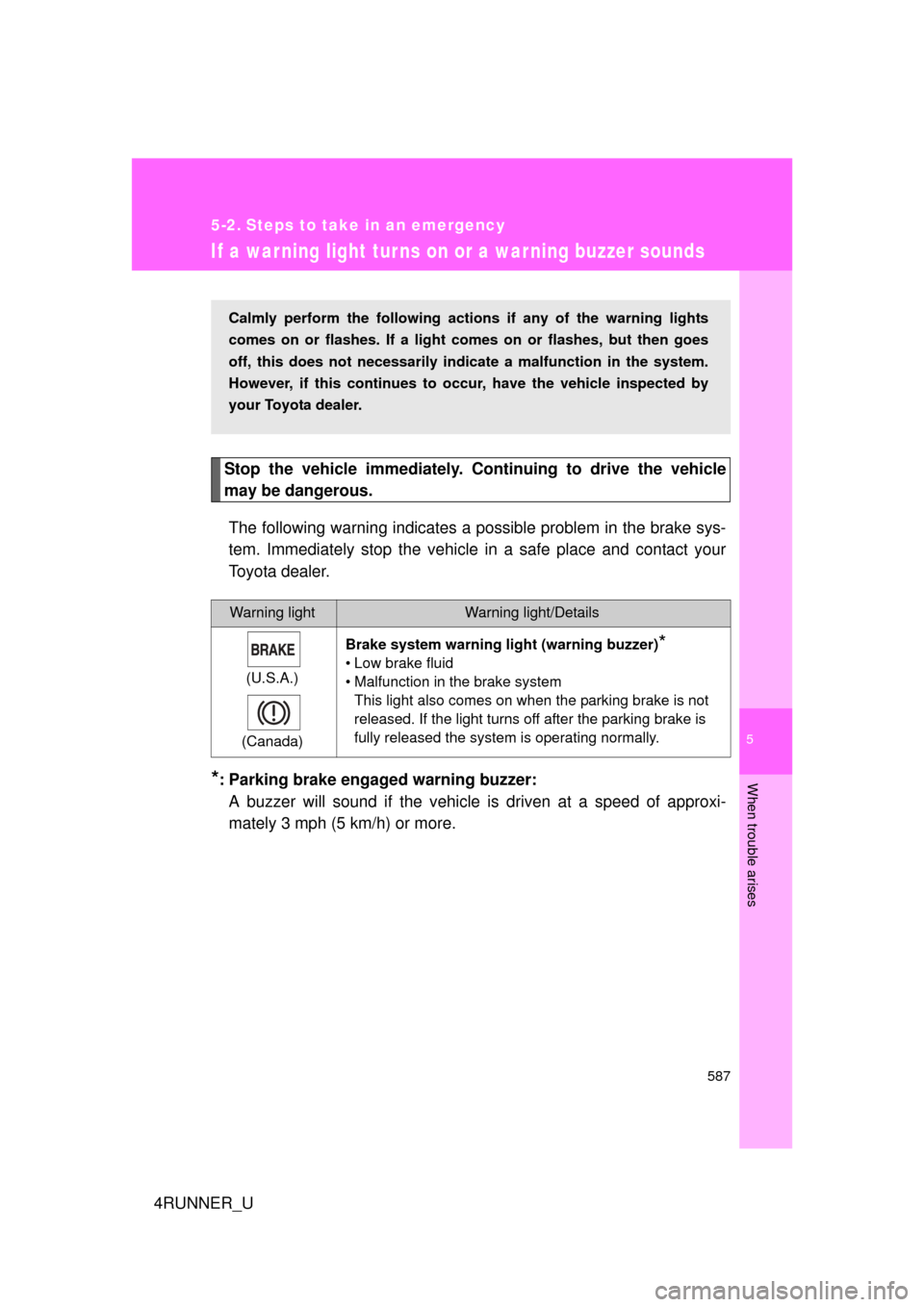
Warning lightWarning light/Details
(U.S.A.)
(Canada) Brake system warning light (warning buzzer)
*
• Low brake fluid
• Malfunction in the brake system
This light also comes on when the parking brake is not
released. If the light turns off after the parking brake is
fully released the system is operating normally.
Calmly perform the following actio ns if any of the warning lights
comes on or flashes. If a light comes on or flashes, but then goes
off, this does not necessarily indicate a malfunction in the system.
However, if this continues to o ccur, have the vehicle inspected by
your Toyota dealer.
Page 589 of 700
5
When trouble arises
589
5-2. Steps to take in an emergency
4RUNNER_U
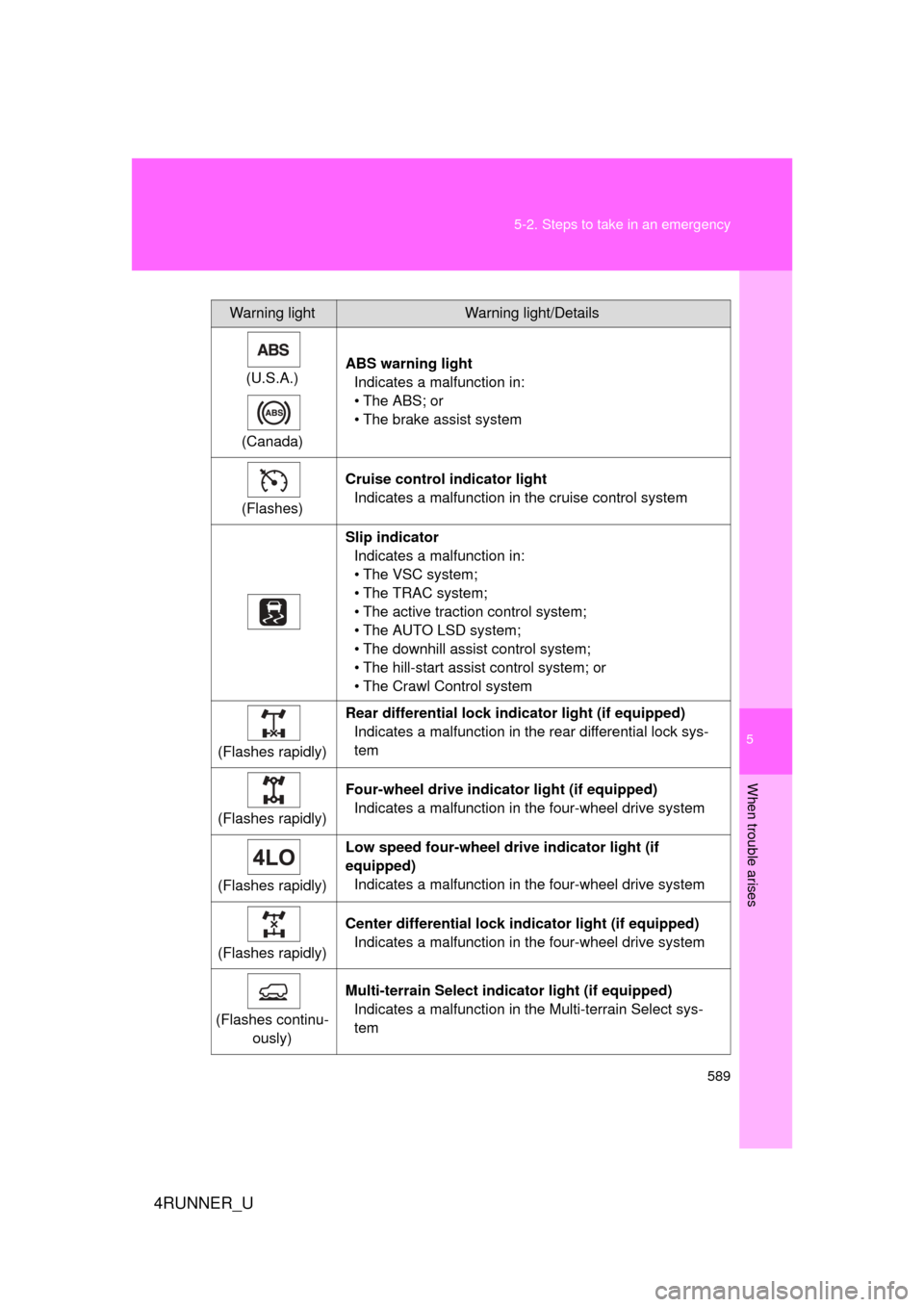
Warning lightWarning light/Details
(U.S.A.)
(Canada) ABS warning light
Indicates a malfunction in:
• The ABS; or
• The brake assist system
(Flashes) Cruise control indicator light
Indicates a malfunction in the cruise control system
Slip indicator Indicates a malfunction in:
• The VSC system;
• The TRAC system;
• The active traction control system;
• The AUTO LSD system;
• The downhill assist control system;
• The hill-start assist control system; or
• The Crawl Control system
(Flashes rapidly) Rear differential lock indicator light (if equipped)
Indicates a malfunction in the rear differential lock sys-
tem
(Flashes rapidly) Four-wheel drive indicator light (if equipped)
Indicates a malfunction in the four-wheel drive system
(Flashes rapidly) Low speed four-wheel drive indicator light (if
equipped)
Indicates a malfunction in the four-wheel drive system
(Flashes rapidly) Center differential lock indicator light (if equipped)
Indicates a malfunction in the four-wheel drive system
(Flashes continu- ously) Multi-terrain Select indicator light (if equipped)
Indicates a malfunction in the Multi-terrain Select sys-
tem
Page 600 of 700
600 5-2. Steps to take in an emergency
4RUNNER_U
CAUTION
■If the tire pressure warning light comes on
Be sure to observe the following precautions. Failure to do so could
cause a loss of vehicle control and result in death or serious injury.
●Stop your vehicle in a safe place as soon as possible. Adjust the tire
inflation pressure immediately.
●If the tire pressure warning light comes on even after tire inflation pres-
sure adjustment, it is pr obable that you have a flat tire. Check the tires.
If a tire is flat, change it with th e spare tire and have the flat tire
repaired by the nearest Toyota dealer.
●Avoid abrupt maneuvering and braking. If the vehicle tires deteriorate,
you could lose control of the steering wheel or the brakes.
■If a blowout or sudden air leakage should occur
The tire pressure warning syste m may not activate immediately.
Page 603 of 700
5
When trouble arises
603
5-2. Steps to take in an emergency
4RUNNER_U
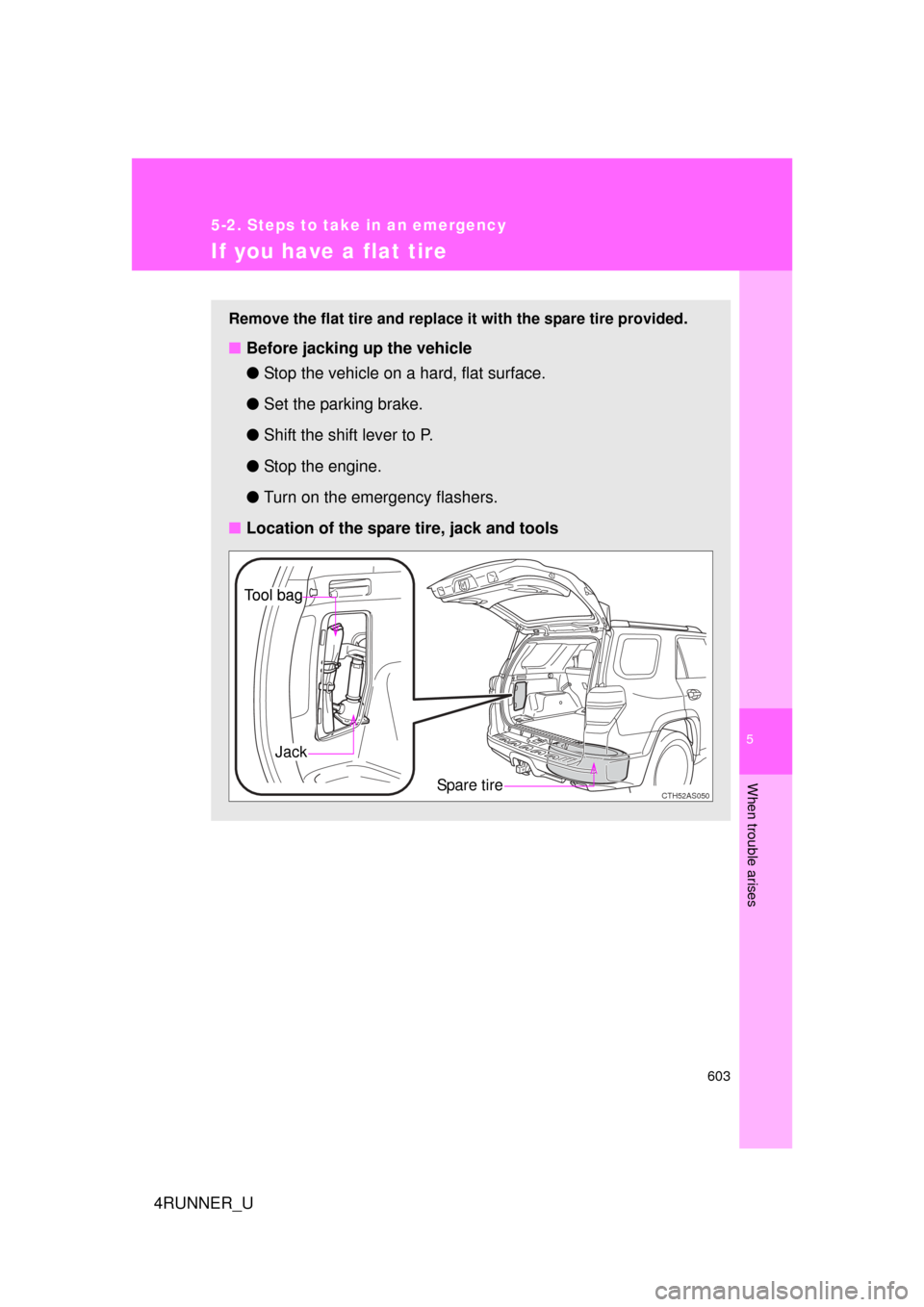
If you have a flat tire
Remove the flat tire and replace it with the spare tire provided.
■Before jacking up the vehicle
●Stop the vehicle on a hard, flat surface.
● Set the parking brake.
● Shift the shift lever to P.
● Stop the engine.
● Turn on the emergency flashers.
■ Location of the spare tire, jack and tools
CTH52AS050Spare tire
Jack
Tool bagTool bag
Page 614 of 700
614 5-2. Steps to take in an emergency
4RUNNER_U
CAUTION
■Using the jack handle
Tighten all the jack handle bolts securely using a Phillips-head screw-
driver, to prevent the extension parts from coming apart unexpectedly.
■Replacing a flat tire
●Observe the following precautions.
Failure to do so may result in serious injury:
• Lower the spare tire completely to the ground before removing it from
under the vehicle.
• Do not try to remove the wheel ornament by hand. Take due care in handling the ornament to avoid unexpected personal injury.
• Do not attach a heavily damaged wheel ornament, as it may fly off the wheel while the vehicle is moving.
• Do not touch the disc wheels or the area around the brakes immedi- ately after the vehicle has been driven.
After the vehicle has been driven the disc wheels and the area around
the brakes will be extremely hot. Touching these areas with hands, feet
or other body parts while changing a tire, etc. may result in burns.
● Failure to follow these precautions could cause the wheel nuts to loosen
and the tire to fall off, resulting in death or serious injury.
• Have the wheel nuts tightened with a torque wrench to 81 ft•lbf (110
N•m, 11.2 kgf•m) as soon as possible after changing wheels.
• When installing a tire, only use wheel nuts that have been specifically designed for that wheel.
• If there are any cracks or deformations in the bolt screws, nut threads or bolt holes of the wheel, have the vehicle inspected by your Toyota
dealer.
• When installing the wheel nuts, be sure to install them with the tapered ends facing inward. ( P. 548)