Page 497 of 700

497
3-7. Other interior features
3
Interior features
4RUNNER_U
■
Stolen Vehicle Location
If your vehicle is stolen, Safety Connect can work with local author-
ities to assist them in locating and recovering the vehicle. After fil-
ing a police report, call the Safe ty Connect response center at 1-
800-331-4331 and follow the prompts for Safety Connect to initiate
this service.
In addition to assisting law enforc ement with recovery of a stolen
vehicle, Safety-Connect-equipped vehicle location data may, under
certain circumstances, be shared with third parties to locate your
vehicle. Further information is available at Toyota.com.
■ Emergency Assistance Button (“SOS”)
In the event of an emergency on the road, push the “SOS” button
to reach the Safety Connect response center. The answering
agent will determine your vehicl e’s location, assess the emer-
gency, and dispatch the necessary assistance required.
If you accidentally press the “SOS” button, tell the response-center agent
that you are not experiencing an emergency.
■ Enhanced Roadside Assistance
Enhanced Roadside Assistance adds GPS data to the already
included warranty-based Toyota roadside service.
Subscribers can press the “SOS” button to reach a Safety Connect
response-center agent, who can help with a wide range of needs,
such as: towing, flat tire, fuel deliv ery, etc. For a description of the
Enhanced Roadside Assistance se rvices and their limitations,
please see the Safety Connec t Terms and Conditions, which are
available at Toyota.com.
Page 560 of 700

560 4-3. Do-it-yourself maintenance
4RUNNER_U
15H-LP RH-HI10 ARight-hand headlight (high
beam)
16H-LP LH-HI10 ALeft-hand headlight (high
beam)
17HTR50 A
Air conditioning system
18400W INV 80 APower outlets
19ST30 AStarter system
20H-LP HI20 A
H-LP RH-HI, H-LP LH-HI fuses
21ALT-S7.5 A Charging system
22TURN&HAZ15 ATurn signal lights, emergency
flashers
23ETCS10 AMultiport fuel injection system/
sequential multiport fuel injec-
tion system
24PRB30 A
Automatic running boards sys-
tem
25TOWING30 A
Trailer stop/turn lights
26SHORT PIN
No circuit
27RAD NO.1 10 A Audio system
28AM27.5 A Starter system
29MAYDAY 7.5 AMAYDAY
30AMP30 A
Audio system
31ABS NO.150 AABS, VSC
32ABS NO.230 AABS, VSC
33DOME10 A
Interior lights, vanity lights
34ECU-B10 AMultiplex communication sys-
tem, meter and gauge
35H-LP RH-LO10 ARight-hand headlight (low
beam)
36H-LP LH-LO10 A
Left-hand headlight (low beam)
37INJ10 AMultiport fuel injection system/
sequential multiport fuel injec-
tion system
38EFI NO.27.5 A Multiport fuel injection system/
sequential multiport fuel injec-
tion system
FuseAmpereCircuit
Page 579 of 700
5
When trouble arises
579
5-1. Essential information
4RUNNER_U
If your vehicle needs to be towed
Before towingThe following may indicate a problem with your transmission. Contact
your Toyota dealer before towing.
● The engine is running but the vehicle will not move.
● The vehicle makes an abnormal sound.
Emergency towing
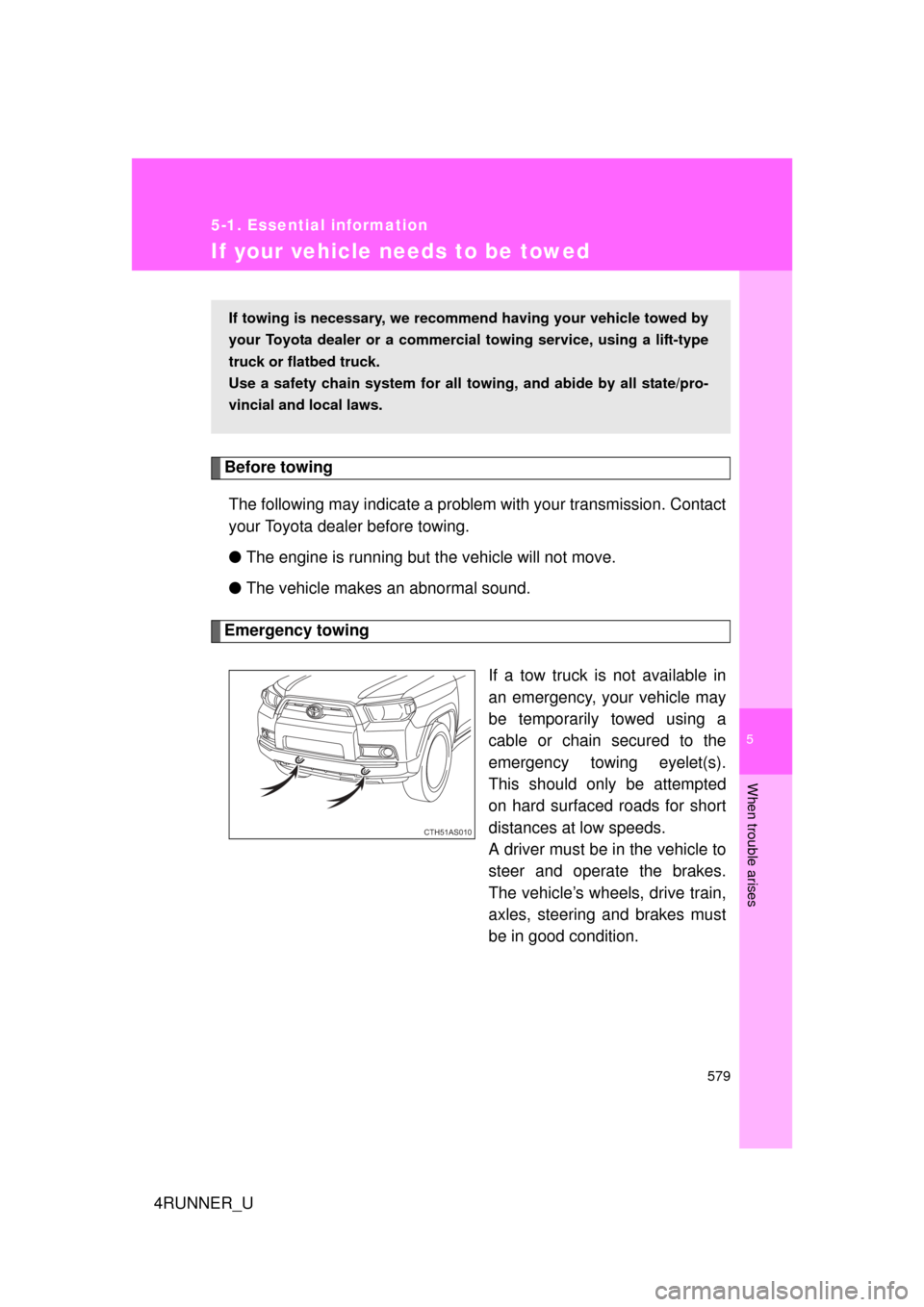
If a tow truck is not available in
an emergency, your vehicle may
be temporarily towed using a
cable or chain secured to the
emergency towing eyelet(s).
This should only be attempted
on hard surfaced roads for short
distances at low speeds.
A driver must be in the vehicle to
steer and operate the brakes.
The vehicle’s wheels, drive train,
axles, steering and brakes must
be in good condition.
If towing is necessary, we recommend having your vehicle towed by
your Toyota dealer or a commerci al towing service, using a lift-type
truck or flatbed truck.
Use a safety chain system for all to wing, and abide by all state/pro-
vincial and local laws.
CTH51AS010
Page 582 of 700
582 5-1. Essential information
4RUNNER_U
Using a flatbed truckIf you use chains or cables to tie
down your vehicle, the angles
shaded in black must be 45.
Do not overly tighten the tie
downs or the vehicle may be
damaged.
CTH51AS011
■ Before emergency towing
Vehicles without a smart key system: Turn the engine switch to the
“ACC” (engine off) or “ON” position.
Vehicles with a smart key system: Turn the “ENGINE START STOP” switch to ACCESSORY (engine off) or IGNITION ON mode
(engine running).
Part-time 4WD models: Shift the front-wheel drive control lever to
H2.
Full-time 4WD models: Put the four-wheel drive control switch in
H4F. (The center differential is unlocked.)
Shift the shift lever to N.
Release the parking brake.
STEP 1
STEP 2
STEP 3
STEP 4
Page 583 of 700

5
When trouble arises
583
5-1. Essential information
4RUNNER_U
CAUTION
■
Caution while towing
● Use extreme caution when towing the vehicle.
Avoid sudden starts or erratic driving maneuvers which place excessive
stress on the emergency towing eyelets and the cables or chains. Always
be cautious of the surroundings and other vehicles while towing.
● Vehicles with a smart key system: Do not turn the “ENGINE START
STOP” switch off.
Doing so will lock the steering wheel and prevent operation, possibly caus-
ing an accident and resulting in death or serious injury.
● If the engine is not running, the power assist for the brakes and steering
will not function, making steering and braking more difficult.
NOTICE
■To prevent causing serious damage to the transmission and transfer
(4WD models) when towing using a wheel-lift type truck
2WD models: Never tow this vehicle from the front with the rear wheels on
the ground.
4WD models: Never tow this vehicle with any of the wheels in contact with
the ground.
■ To prevent damage to the vehicle when towing using a wheel-lift type
truck
● 2WD models without a smart key system: Do not tow the vehicle from the
rear when the engine switch is in the “LOCK” position or the key is
removed. The steering lock mechanism is not strong enough to hold the
front wheels straight.
● 2WD models with a smart key system: Do not tow the vehicle from the rear
when the “ENGINE START STOP” switch is off. The steering lock mecha-
nism is not strong enough to hold the front wheels straight.
● When raising the vehicle, ensure adequate ground clearance for towing at
the opposite end of the raised vehicle. Without adequate clearance, the
vehicle could be damaged while being towed.
Page 584 of 700
584 5-1. Essential information
4RUNNER_U
NOTICE
■To prevent body damage when towing with a sling-type truck
Do not tow with a sling-type truck, either from the front or rear.
■ To prevent causing serious damage to the transmission and transfer
(4WD models) in emergency towing
Never tow a vehicle from the rear with four wheels on the ground. This may
cause serious damage to the transmission and transfer.
Page 612 of 700
612 5-2. Steps to take in an emergency
4RUNNER_U
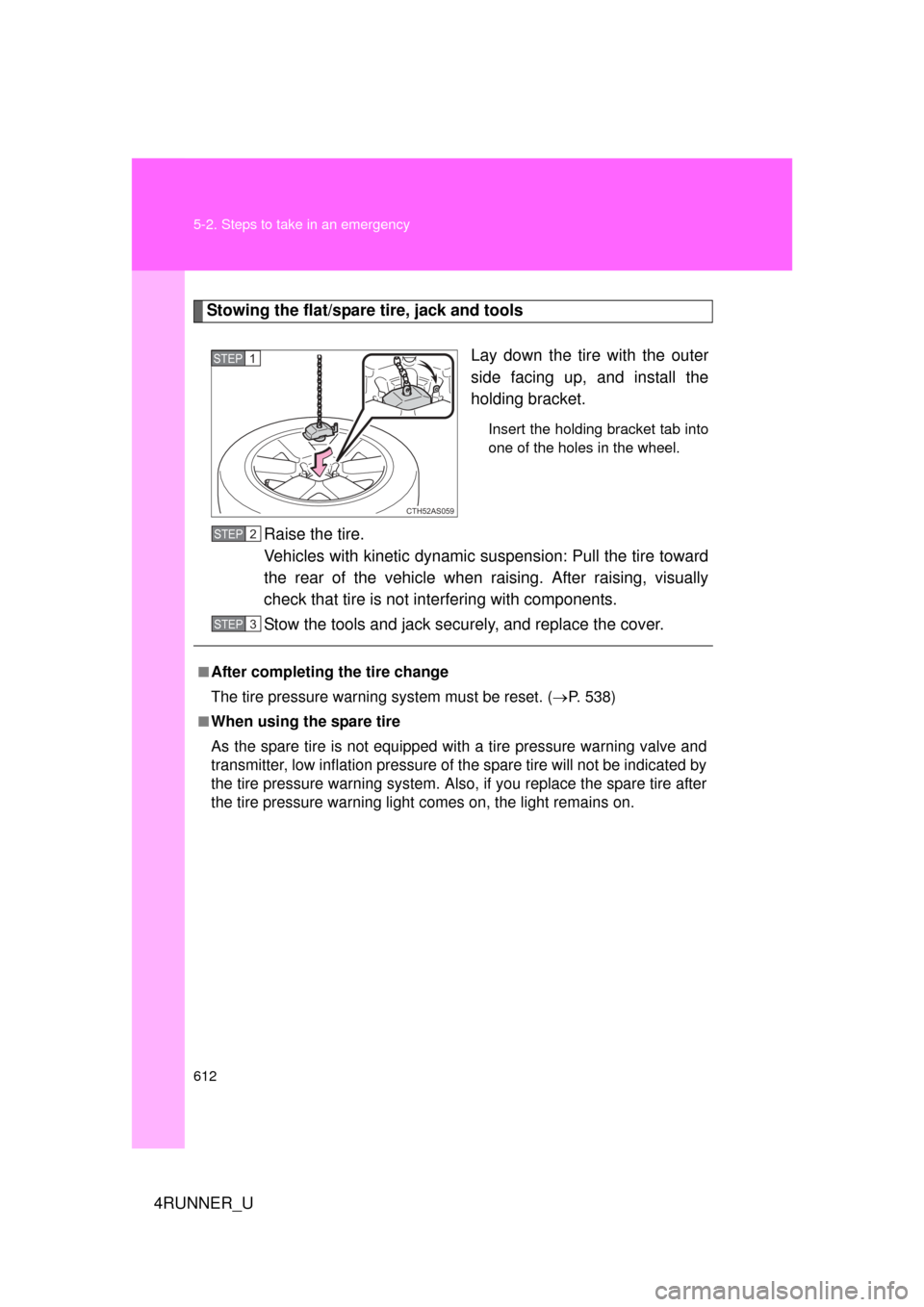
Stowing the flat/spare tire, jack and toolsLay down the tire with the outer
side facing up, and install the
holding bracket.
Insert the holding bracket tab into
one of the holes in the wheel.
Raise the tire.
Vehicles with kinetic dynamic suspension: Pull the tire toward
the rear of the vehicle when raising. After raising, visually
check that tire is not interfering with components.
Stow the tools and jack securely, and replace the cover.
CTH52AS059
STEP 1
■After completing the tire change
The tire pressure warnin g system must be reset. ( P. 538)
■When using the spare tire
As the spare tire is not equipped with a tire pressure warning valve and
transmitter, low inflation pressure of the spare tire will not be indicated by
the tire pressure warning system. Also, if you replace the spare tire after
the tire pressure warning light comes on, the light remains on.
STEP 2
STEP 3
Page 615 of 700
5
When trouble arises
615
5-2. Steps to take in an emergency
4RUNNER_U
NOTICE
■Do not drive the vehicle with a flat tire
Do not continue driving with a flat tire.
Driving even a short distance with a flat tire can damage the tire and the
wheel beyond repair.
■When stowing the flat tire
Ensure that there is no object cau
ght between the tire and the vehicle
underbody.
■When replacing the tires
●When removing or fitting the wheels, tires or the tire pressure warning
valve and transmitter, contact your Toyota dealer as the tire pressure
warning valve and transmitter may be damaged if not handled cor-
rectly.
●Replace the grommets for the tire pressure warning valves and trans-
mitters as well.
■ To avoid damage to the tire pressure warning valves and transmitters
When a tire is repaired with liquid sealants, the tire pressure warning valve
and transmitter may not operate properly. If a liquid sealant is used, contact
your Toyota dealer or other qualified service shop as soon as possible. Make
sure to replace the tire pressure warning valve and transmitter when replac-
ing the tire. ( P. 538)