Page 603 of 700
5
When trouble arises
603
5-2. Steps to take in an emergency
4RUNNER_U
If you have a flat tire
Remove the flat tire and replace it with the spare tire provided.
■Before jacking up the vehicle
●Stop the vehicle on a hard, flat surface.
● Set the parking brake.
● Shift the shift lever to P.
● Stop the engine.
● Turn on the emergency flashers.
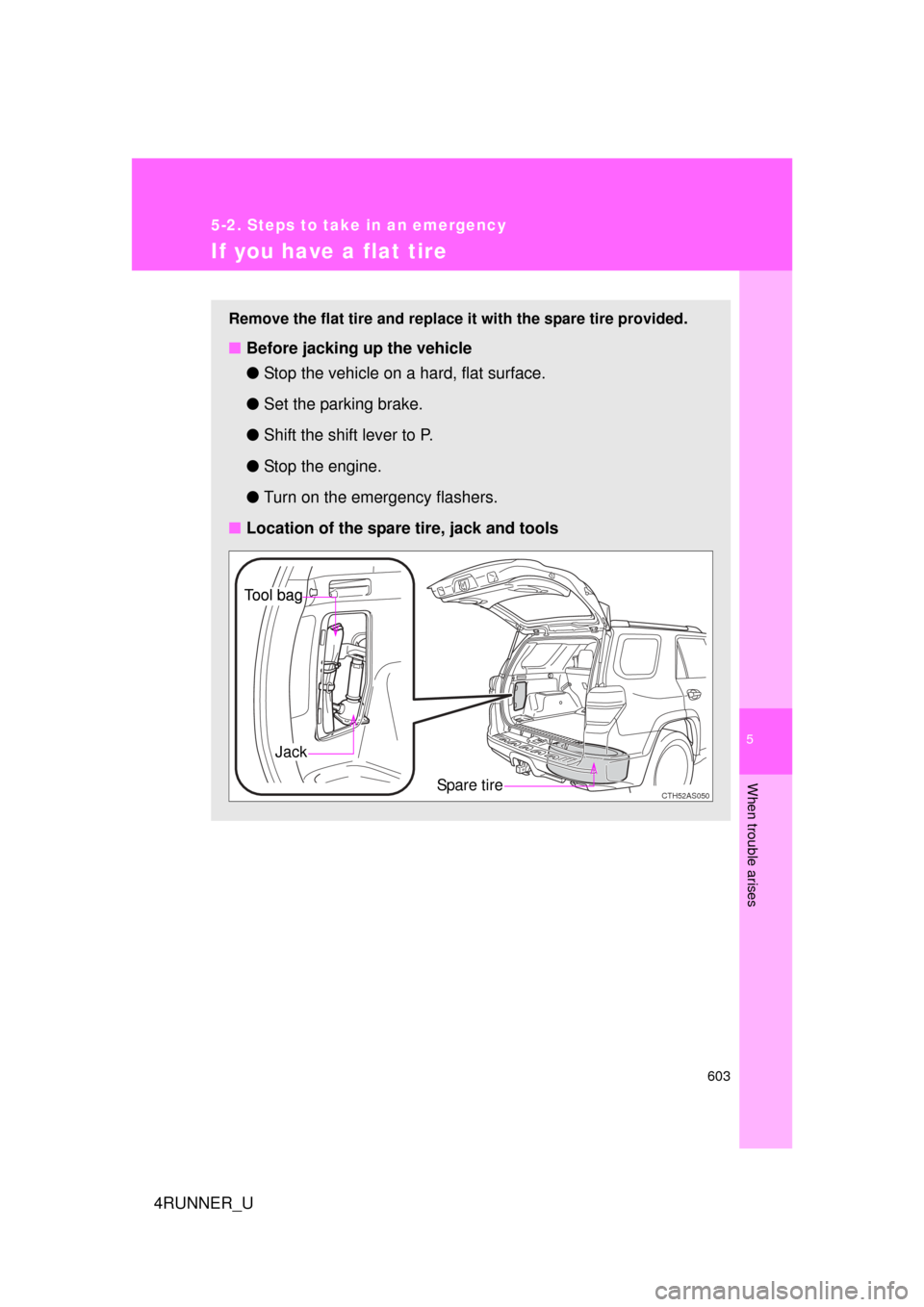
■ Location of the spare tire, jack and tools
CTH52AS050Spare tire
Jack
Tool bagTool bag
Page 607 of 700
5
When trouble arises
607
5-2. Steps to take in an emergency
4RUNNER_U
Replacing a flat tire
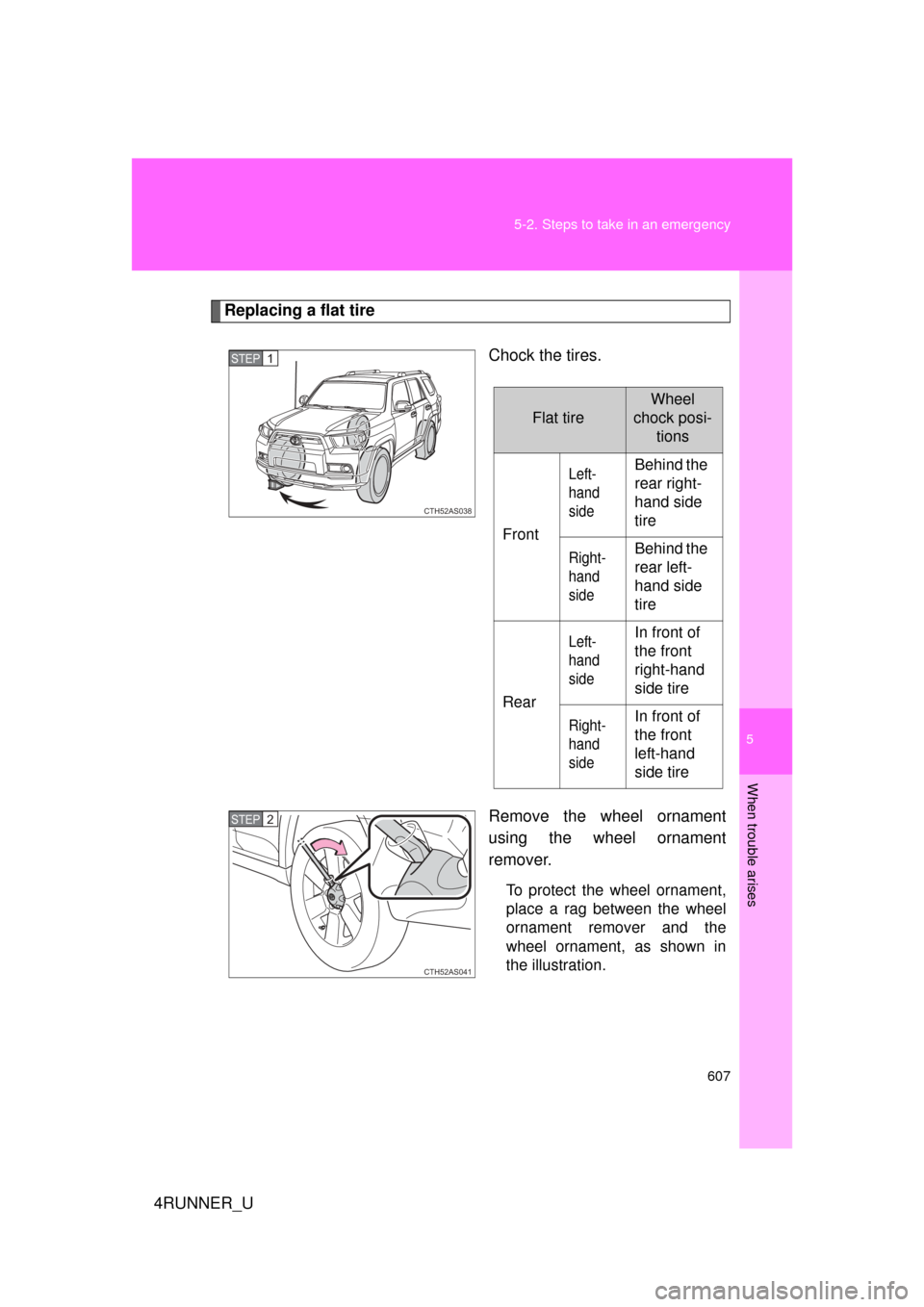
Chock the tires.
Remove the wheel ornament
using the wheel ornament
remover.
To protect the wheel ornament,
place a rag between the wheel
ornament remover and the
wheel ornament, as shown in
the illustration.
CTH52AS038
STEP 1
Flat tire
Wheel
chock posi- tions
Front
Left-
hand
sideBehind the
rear right-
hand side
tire
Right-
hand
sideBehind the
rear left-
hand side
tire
Rear
Left-
hand
sideIn front of
the front
right-hand
side tire
Right-
hand
sideIn front of
the front
left-hand
side tire
CTH52AS041
STEP 2
Page 612 of 700
612 5-2. Steps to take in an emergency
4RUNNER_U
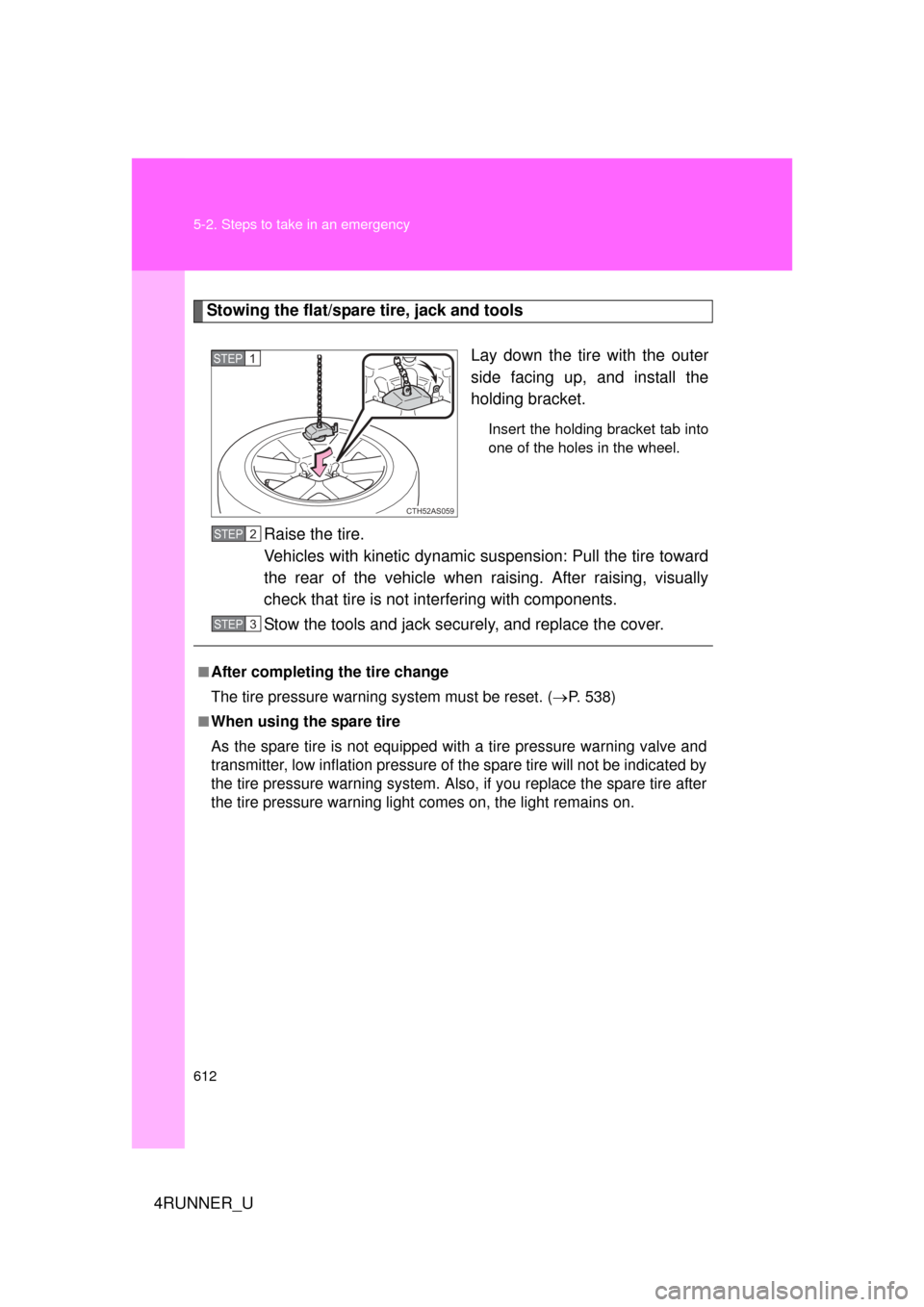
Stowing the flat/spare tire, jack and toolsLay down the tire with the outer
side facing up, and install the
holding bracket.
Insert the holding bracket tab into
one of the holes in the wheel.
Raise the tire.
Vehicles with kinetic dynamic suspension: Pull the tire toward
the rear of the vehicle when raising. After raising, visually
check that tire is not interfering with components.
Stow the tools and jack securely, and replace the cover.
CTH52AS059
STEP 1
■After completing the tire change
The tire pressure warnin g system must be reset. ( P. 538)
■When using the spare tire
As the spare tire is not equipped with a tire pressure warning valve and
transmitter, low inflation pressure of the spare tire will not be indicated by
the tire pressure warning system. Also, if you replace the spare tire after
the tire pressure warning light comes on, the light remains on.
STEP 2
STEP 3
Page 613 of 700

5
When trouble arises
613
5-2. Steps to take in an emergency
4RUNNER_U
CAUTION
■Using the tire jack
Improper use of the tire jack may cause the vehicle to suddenly fall off the
jack, leading to death or serious injury.
●
Do not use the tire jack for any pu
rpose other than replacing tires or
installing and removing tire chains.
●Only use the tire jack that comes wi th this vehicle for replacing a flat
tire.
Do not use it on other vehicles, and do not use other tire jacks for
replacing tires on this vehicle.
●Always check that the tire jack is securely set to the jack point.
●Do not put any part of your body under the vehicle while it is supported
by the jack.
●Do not start or run the engine while your vehicle is supported by the
jack.
●Do not raise the vehicle while someone is inside.
●When raising the vehicle, do not put an object on or under the jack.
●Do not raise the vehicle to a hei ght greater than that required to
replace the tire.
●Use a jack stand if it is necessary to get under the vehicle.
Vehicles with Automatic running boards
● Observe the following precautions. Failure to do so may result in serious
injury:
•
When jacking up the vehicle, always turn the Automatic running
boards switch off.
•When jacking up the vehicle, do not use an Automatic running
board as a jack point. The Automatic running board may break,
causing injuries.
Take particular care when lowering the vehicle to ensure that no one
working on or near the vehicle may be injured.
Page 614 of 700

614 5-2. Steps to take in an emergency
4RUNNER_U
CAUTION
■Using the jack handle
Tighten all the jack handle bolts securely using a Phillips-head screw-
driver, to prevent the extension parts from coming apart unexpectedly.
■Replacing a flat tire
●Observe the following precautions.
Failure to do so may result in serious injury:
• Lower the spare tire completely to the ground before removing it from
under the vehicle.
• Do not try to remove the wheel ornament by hand. Take due care in handling the ornament to avoid unexpected personal injury.
• Do not attach a heavily damaged wheel ornament, as it may fly off the wheel while the vehicle is moving.
• Do not touch the disc wheels or the area around the brakes immedi- ately after the vehicle has been driven.
After the vehicle has been driven the disc wheels and the area around
the brakes will be extremely hot. Touching these areas with hands, feet
or other body parts while changing a tire, etc. may result in burns.
● Failure to follow these precautions could cause the wheel nuts to loosen
and the tire to fall off, resulting in death or serious injury.
• Have the wheel nuts tightened with a torque wrench to 81 ft•lbf (110
N•m, 11.2 kgf•m) as soon as possible after changing wheels.
• When installing a tire, only use wheel nuts that have been specifically designed for that wheel.
• If there are any cracks or deformations in the bolt screws, nut threads or bolt holes of the wheel, have the vehicle inspected by your Toyota
dealer.
• When installing the wheel nuts, be sure to install them with the tapered ends facing inward. ( P. 548)
Page 615 of 700

5
When trouble arises
615
5-2. Steps to take in an emergency
4RUNNER_U
NOTICE
■Do not drive the vehicle with a flat tire
Do not continue driving with a flat tire.
Driving even a short distance with a flat tire can damage the tire and the
wheel beyond repair.
■When stowing the flat tire
Ensure that there is no object cau
ght between the tire and the vehicle
underbody.
■When replacing the tires
●When removing or fitting the wheels, tires or the tire pressure warning
valve and transmitter, contact your Toyota dealer as the tire pressure
warning valve and transmitter may be damaged if not handled cor-
rectly.
●Replace the grommets for the tire pressure warning valves and trans-
mitters as well.
■ To avoid damage to the tire pressure warning valves and transmitters
When a tire is repaired with liquid sealants, the tire pressure warning valve
and transmitter may not operate properly. If a liquid sealant is used, contact
your Toyota dealer or other qualified service shop as soon as possible. Make
sure to replace the tire pressure warning valve and transmitter when replac-
ing the tire. ( P. 538)
Page 618 of 700
618
5-2. Steps to take in an emergency
4RUNNER_U
If the shift lever cannot be shifted from P
If the shift lever cannot be shifted with your foot on the brake pedal,
there may be a problem with the shift lock system (a system to pre-
vent accidental operation of the shift lever). Have the vehicle
inspected by your Toyo ta dealer immediately.
The following steps may be used as an emergency measure to
ensure that the shift lever can be shifted:
Set the parking brake.
Vehicles without a smart key system
Turn the engine switch to the “ACC” position.
Vehicles with a smart key system
Turn the “ENGINE START STOP” switch to ACCESSORY
mode.
Depress the brake pedal.
Pry the cover up with a flat-
head screwdriver or equiva-
lent tool.
Press the shift lock override
button.
The shift lever can be shifted
while the button is pressed.
STEP 1
STEP 2
STEP 3
CTH52AS021
STEP 4
CTH52AS022
STEP 5
Page 643 of 700
643
6-1. Specifications
6
Vehicle specifications
4RUNNER_U
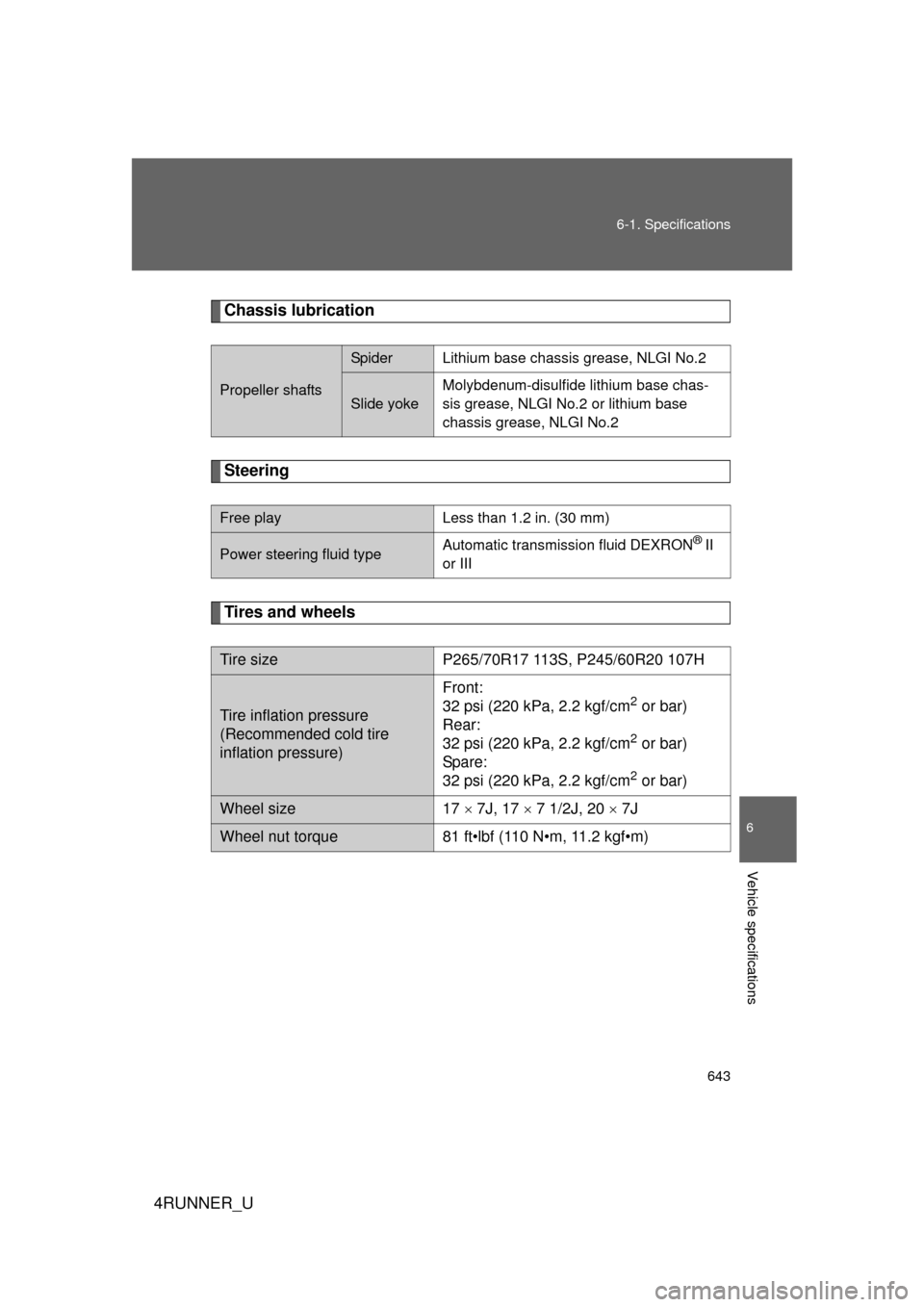
Chassis lubrication
Steering
Tires and wheels
Propeller shafts
SpiderLithium base chassis grease, NLGI No.2
Slide yoke
Molybdenum-disulfide lithium base chas-
sis grease, NLGI No.2 or lithium base
chassis grease, NLGI No.2
Free playLess than 1.2 in. (30 mm)
Power steering fluid typeAutomatic transmission fluid DEXRON® II
or III
Tire sizeP265/70R17 113S, P245/60R20 107H
Tire inflation pressure
(Recommended cold tire
inflation pressure)
Front:
32 psi (220 kPa, 2.2 kgf/cm2 or bar)
Rear:
32 psi (220 kPa, 2.2 kgf/cm
2 or bar)
Spare:
32 psi (220 kPa, 2.2 kgf/cm
2 or bar)
Wheel size17 7J, 17 7 1/2J, 20 7J
Wheel nut torque81 ft•lbf (110 N•m, 11.2 kgf•m)