2012 SUBARU OUTBACK wheel size
[x] Cancel search: wheel sizePage 402 of 474

tire placard. Specifically, inflate them by an
extra 1 psi (6.9 kPa, 0.07 kgf/cm2) for
every difference of 10 8F (5.6 8C) between
the temperature in the garage and the
temperature outside. By way of example,
the following table shows the required tire
pressures that correspond to various out-
side temperatures when the temperature
in the garage is 60 8F (15.6 8C).
Example:
Tire size: P215/70R16 99S, P225/60R17 98T
Standard tire pressures:
Front: 32 psi (220 kPa, 2.2 kgf/cm
2)
Rear: 30 psi (210 kPa, 2.1 kgf/cm2)
Garage temperature: 60 8F (15.6 8C)
Outside
temperature Adjusted pressure
[psi (kPa, kgf/cm
2)]
Front Rear
30 8F( 18C) 35 (240, 2.4) 33 (230, 2.3)
10 8F( 12 8C) 37
(255, 2.55) 35
(240, 2.4)
10 8F
( 23 8C) 39 (270, 2.7)
37 (255, 2.55)
Example:
Tire size: P205/60R16 91V, P215/50R17
90V, P225/50R17 93V, 225/45R18 91W
Standard tire pressures:
Front: 33 psi (230 kPa, 2.3 kgf/cm
2) Rear: 32 psi (220 kPa, 2.2 kgf/cm
2)
Garage temperature: 60 8F (15.6 8C)
Outside
temperature Adjusted pressure
[psi (kPa, kgf/cm
2)]
Front Rear
30 8F( 18C) 36 (250, 2.5) 35 (240, 2.4)
10 8F( 12 8C) 38
(265, 2.65) 37
(255, 2.55)
10 8F
( 23 8C) 40 (280, 2.8)
39 (270, 2.7)
If the low tire pressure warning light
illuminates when you drive the vehicle in
cold outside air after adjusting the tire
pressures in a warm garage, re-adjust the
tire pressures using the method described
above. Then, increase the vehicle speed
to at least 20 mph (32 km/h) and check to
see that the low tire pressure warning light
goes off a few minutes later. If the low tire
pressure warning light does not go off, the
tire pressure monitoring system may not
be functioning normally. In this event, go
to a SUBARU dealer to have the system
inspected as soon as possible.
While the vehicle is driven, friction be-
tween tires and the road surface causes
the tires to warm up. After illumination of
the low tire pressure warning light, any
increase in the tire pressures caused by
an increase in the outside air temperature or by an increase in the temperature in the
tires can cause the low tire pressure
warning light to go off.
System resetting is necessary when the
wheels are changed (for example, a
switch to snow tires) and new TPMS
valves are installed on the newly fitted
wheels. Have this work performed by a
SUBARU dealer following wheel replace-ment.
It may not be possible to install TPMS
valves on certain wheels that are on the
market. Therefore, if you change the
wheels (for example, a switch to snow
tires), use wheels that have the same part
number as the standard-equipment
wheels. Without four operational TPMS
valve/sensors on the wheels, the TPMS
will not fully function and the warning light
in the instrument panel will illuminate
steadily after blinking for approximately
one minute.
When a tire is replaced, adjustments are
necessary to ensure continued normal
operation of the tire pressure monitoring
system. As with wheel replacement, there-
fore, you should have the work performed
by a SUBARU dealer.
Maintenance and service
11-31
– CONTINUED –
Page 407 of 474
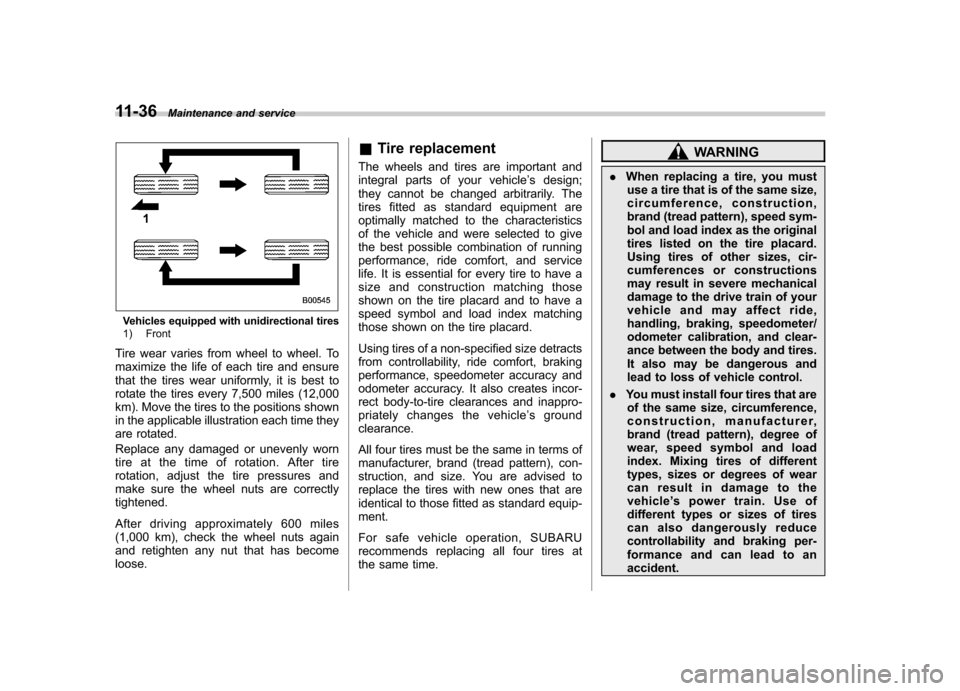
11-36Maintenance and service
Vehicles equipped with unidirectional tires
1) Front
Tire wear varies from wheel to wheel. To
maximize the life of each tire and ensure
that the tires wear uniformly, it is best to
rotate the tires every 7,500 miles (12,000
km). Move the tires to the positions shown
in the applicable illustration each time they
are rotated.
Replace any damaged or unevenly worn
tire at the time of rotation. After tire
rotation, adjust the tire pressures and
make sure the wheel nuts are correctlytightened.
After driving approximately 600 miles
(1,000 km), check the wheel nuts again
and retighten any nut that has become loose. &
Tire replacement
The wheels and tires are important and
integral parts of your vehicle ’s design;
they cannot be changed arbitrarily. The
tires fitted as standard equipment are
optimally matched to the characteristics
of the vehicle and were selected to give
the best possible combination of running
performance, ride comfort, and service
life. It is essential for every tire to have a
size and construction matching those
shown on the tire placard and to have a
speed symbol and load index matching
those shown on the tire placard.
Using tires of a non-specified size detracts
from controllability, ride comfort, braking
performance, speedometer accuracy and
odometer accuracy. It also creates incor-
rect body-to-tire clearances and inappro-
priately changes the vehicle ’s ground
clearance.
All four tires must be the same in terms of
manufacturer, brand (tread pattern), con-
struction, and size. You are advised to
replace the tires with new ones that are
identical to those fitted as standard equip-ment.
For safe vehicle operation, SUBARU
recommends replacing all four tires at
the same time.
WARNING
. When replacing a tire, you must
use a tire that is of the same size,
circumference, construction,
brand (tread pattern), speed sym-
bol and load index as the original
tires listed on the tire placard.
Using tires of other sizes, cir-
cumferences or constructions
may result in severe mechanical
damage to the drive train of your
vehicle and may affect ride,
handling, braking, speedometer/
odometer calibration, and clear-
ance between the body and tires.
It also may be dangerous and
lead to loss of vehicle control.
. You must install four tires that are
of the same size, circumference,
construction, manufacturer,
brand (tread pattern), degree of
wear, speed symbol and load
index. Mixing tires of different
types, sizes or degrees of wear
can result in damage to the
vehicle ’s power train. Use of
different types or sizes of tires
can also dangerously reduce
controllability and braking per-
formance and can lead to anaccident.
Page 436 of 474

&Electrical system
Battery type and capacity (5HR) 75D23R (12V-52AH)
Alternator 2.5 L models 12V-110A
3.6 L models 12V-130A
Spark plugs 2.5 L non-turbo models SIFR6A11 (NGK)
2.5 L turbo models SILFR6B8 (NGK)
3.6 L models SILFR6C11 (NGK)
& Tires
Tire size P205/60R16
91V P215/70R16
99S P225/60R17
98T P215/50R17
90V P225/50R17
93V 225/45R18
91W
Wheel size 1666 1/2JJ
16 66 1/2J 16
66 1/2JJ 17 67J 17 67 1/2J 18 67 1/2J
Pressure Front 33 psi (230 kPa) 32 psi (220 kPa) 33 psi (230 kPa)
Rear 32 psi (220 kPa) 30 psi (210 kPa) 32 psi (220 kPa)
Temporary spare tire Size T135/80R16 T145/80R17 T135/80R16 T135/70R17 Pressure
60 psi (420 kPa)
Wheel nut tightening torque 89 lbf·ft (120 N·m, 12 kgf·m)*
1*2
*1: This torque is equivalent to applying approximately 88 to 110 lbf (40 to 50 kgf) at the end of the wheel nut wrench. If you have tightened the wheel
nuts by yourself, have the tightening torque checked at the nearest automotive service facility as soon as possible.
*2: For the wheel nut tightening procedure, refer to“Changing a flat tire ”F 9-6. Specifications
12-9
Page 452 of 474

sidewall, or innerliner that extends
to cord material..Outer diameter
The overall diameter of an inflated
new tire.. Overall width
The linear distance between the
exteriors of the sidewalls of an
inflated tire, including elevations
due to labeling, decorations, or
protective bands or ribs. . Passenger car tire
A tire intended for use on passen-
ger cars, multipurpose passenger
vehicles, and trucks, that have a
gross vehicle weight rating (GVWR)
of 10,000 lbs (4,535 kg) or less. . Ply
A layer of rubber-coated parallel cords.. Ply separation
A parting of rubber compound
between adjacent plies.. Pneumatic tire
A mechanical device made of rub-
ber, chemicals, fabric and steel or
other materials, that, when mounted on an automotive wheel,
provides the traction and contains
the gas or fluid that sustains the load.
. Production options weight
The combined weight of those
installed regular production options
weighing over 5.1 lbs (2.3 kg) in
excess of those standard items
which they replace, not previously
considered in curb weight or acces-
sory weight, including heavy duty
brakes, ride levelers, roof rack,
heavy duty battery, and specialtrim. . Radial ply tire
A pneumatic tire in which the ply
cords that extend to the beads are
laid at substantially 90 degrees to
the centerline of the tread.. Recommended inflation pres-
sure
The cold inflation pressure recom-
mended by a vehicle manufacturer.. Reinforced tire
A tire designed to operate at higher
loads and at higher inflation pres- sures than the corresponding stan-
dard tire. .
Rim
A metal support for a tire or a tire
and tube assembly upon which the
tire beads are seated.. Rim diameter
Nominal diameter of the bead seat.. Rim size designation
Rim diameter and width.. Rim type designation
The industry of manufacturer ’s des-
ignation for a rim by style or code. . Rim width
Nominal distance between rim flanges.. Section width
The linear distance between the
exteriors of the sidewalls of an
inflated tire, excluding elevations
due to labeling, decoration, or
protective bands. . Sidewall
That portion of a tire between the
tread and bead.. Sidewall separation
The parting of the rubber com-
Consumer information and Reporting safety defects
13-7
– CONTINUED –
Page 471 of 474

14-10Index
SRS Frontal airbag ........................................................ 1-45
SRS airbag (Supplemental Restraint System airbag) ... 4, 1-36
SRS airbag system Monitors. ............................................................... 1-62
Servicing ............................................................... 1-63
Warning light ......................................................... 3-11
Starting the engine ....................................................... 7-8
State emission testing (U.S. only) .................................. 7-6
Steering wheel Power ................................................................... 7-23
Tilt/telescopic ......................................................... 3-52
Stopping the engine ................................................... 7-10
Storage compartment ................................................... 6-5
Sun shade ................................................................ 2-29
Sun visors ................................................................... 6-4
Supplemental Restraint System airbag (SRS) ................ 1-36
Synthetic leather upholstery ........................................ 10-5
T
Tachometer ................................................................. 3-7
Temperature warning light AT OIL TEMP ........................................................ 3-14
Coolant ................................................................. 3-13
Temporary spare tire .................................................... 9-2
Tether (child restraint system) .............................. 1-30, 1-33
Tie-down hooks ......................................................... 9-14
Tire ................................................................. 11-30, 12-9 Chains .................................................................. 8-12
Inspection ............................................................ 11-32
Pressures and wear .............................................. 11-32 Replacement.
....................................................... 11-36
Rotation .............................................................. 11-35
Size and pressure .................................................. 12-9
Types .................................................................. 11-30
Tire pressure monitoring system (TPMS) ....... 7-29, 9-9, 11-30
Warning light .......................................................... 3-15
Tires and wheels ...................................................... 11-30
Tools .......................................................................... 9-3
Top tether anchorages ........................................ 1-30, 1-33
Towing ...................................................................... 9-13
All wheels on the ground ......................................... 9-16
Flat-bed truck ......................................................... 9-16
Hooks ................................................................... 9-14
Weight .................................................................. 8-20
Trailer Connecting ............................................................ 8-18
Hitch ............................................................. 8-17, 8-23
Towing .................................................................. 8-19
Towing tips ............................................................ 8-25
Trip meter ................................................................... 3-6
Trunk lid ............................................................ 2-23, 9-19
Release handle ...................................................... 2-24
Trunk light ............................................................... 11-55
Turn signal Indicator lights ........................................................ 3-22
Lever .................................................................... 3-29
U
Under-floor storage compartment .................................. 6-18
USB storage device operations .................................... 5-33