2012 SKODA YETI ECU
[x] Cancel search: ECUPage 180 of 225

Battery cover
Fig. 146
Engine compartment: Polyester cover of the vehicle battery/plastic
cover of the vehicle battery
First read and observe the introductory information and safety warn-
ings on page 176.
The battery is located in the engine compartment in a polyester cover
1
» Fig. 146 or in a plastic cover 2
» Fig. 146.
› Open the battery cover in the direction of the arrow 1
or press the interlock on
the side of the battery cover in the direction of the arrow 2
» Fig. 146
, fold the
cover up and remove.
› The battery cover is installed in reverse order.
When working on the battery, the edge of the polyester battery cover 1
» Fig. 146 is inserted between the battery and the side wall of the battery cov-
er. ÐChecking the battery electrolyte level
Fig. 147
Vehicle battery: Electrolyte level
indicator
ä
First read and observe the introductory information and safety warn-
ings on page 176.
We recommend you have the electrolyte level checked by a ŠKODA specialist ga-
rage from time to time, especially in the following cases.
› High outside temperatures.
› Long daily drives
› After each charge
» page 179.
On vehicles with a vehicle battery fitted with a colour indicator, the so-called
magic eye » Fig. 147, the electrolyte level can be determined by looking at the
change in colour.
Air bubbles can influence the colour of the indicator. For this reason carefully
knock on the indicator before carrying out the check. › Black colour - electrolyte level is correct.
› Colourless or light yellow colour - electrolyte level too low, the battery must be
replaced. Note
■ The battery electrolyte level is periodically checked by a ŠKODA Service Partner
as part of the Inspection Service. ■ For technical reasons, on vehicles with the description “AGM”, the electrolyte
level cannot be checked. ■ Vehicles with a START-STOP system are fitted with a battery control unit for
checking the energy level for the recurring engine start. Ð Operation in winter
First read and observe the introductory information and safety warn-
ings on page 176.
At low temperatures, the vehicle battery only has part of the initial power output
that it has at normal temperatures.
A discharged vehicle battery may already freeze at temperatures just below 0
°C.
We therefore recommend that you have the battery checked and, if necessary, re-
charged by a ŠKODA Service Partner before the start of the winter. Ð
ä
ä
178 General Maintenance
Page 187 of 225
Full wheel trim
First read and observe the introductory information and safety warn-
ings on page 181.
Pulling off
›
Hook the clamp found in the vehicle tool kit into the reinforced edge of the
wheel trim.
› Push the wheel wrench through the clamp, support on the tyre and pull off the
wheel trim.
Install
› First press the full wheel trim onto the wheel rim at the valve opening provided.
Then press the full wheel trim into the wheel rim until its entire circumference
locks correctly in place. CAUTION
■ Use the pressure of your hand, do not knock the full wheel trim! Heavy knocks
mainly on the points where the full wheel trim has not been inserted into the
wheel, can result in damage to the guide and centring elements of the full wheel
trim.
■ First of all check that the theft-deterrent wheel bolt is located in the hole near
the valve before fitting the full wheel trim onto a steel wheel which is attached
with a theft-deterrent wheel bolt » page 194, Securing wheels against theft .
■ If wheel trims are retrofitted it must be ensured that an adequate flow of air is
assured to cool the brake system. ÐWheel bolts
Fig. 151
Remove the cap
ä
First read and observe the introductory information and safety warn-
ings on page 181.
Pulling off
›
Push the plastic clip sufficiently far onto the cap until the inner catches of the
clip are positioned at the collar of the cap and detach the cap » Fig. 151.
Install
› Push the caps onto the wheel bolts up to the stop.
The wheel bolt caps are housed in a plastic box in the spare wheel or in the stor-
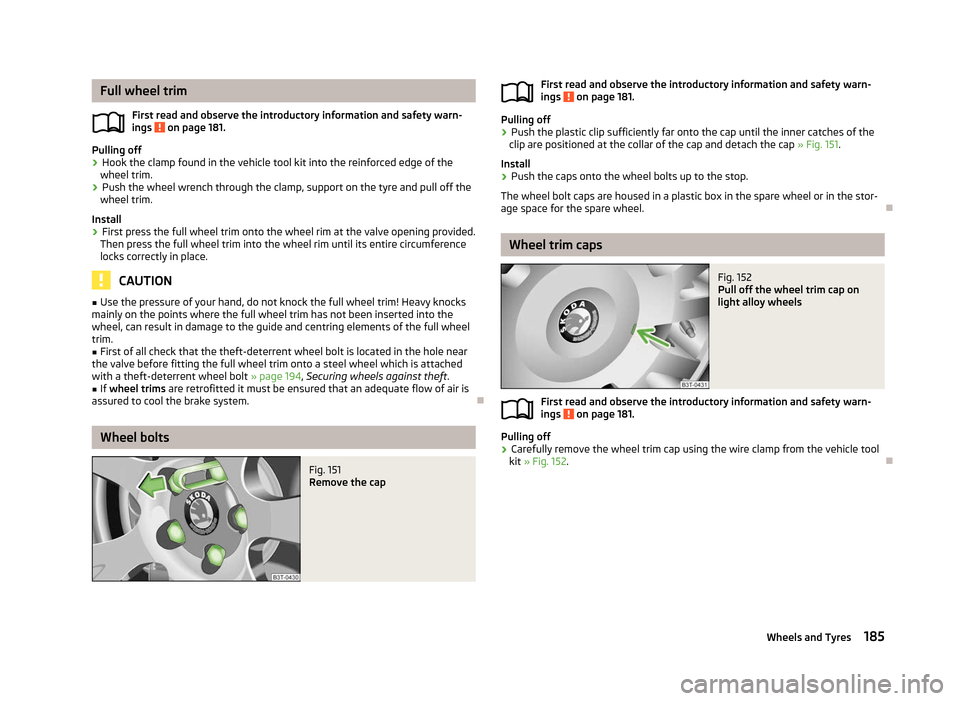
age space for the spare wheel. Ð Wheel trim caps
Fig. 152
Pull off the wheel trim cap on
light alloy wheels
First read and observe the introductory information and safety warn-
ings on page 181.
Pulling off
›
Carefully remove the wheel trim cap using the wire clamp from the vehicle tool
kit » Fig. 152. Ð
ä
ä
185
Wheels and Tyres
Page 192 of 225

Do-it-yourself
Do-it-yourself
First-aid kit and warning triangle
Fig. 154
Placing of the warning triangle/placing of the first-aid box
The warning triangle can be attached to the rear wall trim panel with rubber
straps » Fig. 154 - .
The warning triangle, which is included in the equipment with the spare wheel,
can be stowed in a removable box on the right next to the spare wheel » page 68.
The first-aid box is attached by a strap to the right-hand side of the
boot »
Fig. 154 - . WARNING
The first-aid kit and warning triangle must always be secured safely so that
they do not come loose when making an emergency braking or in a vehicle
collision which could cause injuries to occupants. Note
■ Pay attention to the expiration date of the first-aid kit.
■ We recommend using a first-aid box from ŠKODA Original Accessories available
from a
ŠKODA Service Partner. Ð Fire extinguisher
The fire extinguisher is attached with straps in a holder under the driver seat.
Please read carefully the instructions which are attached to the fire extinguish-
er.
The fire extinguisher must be checked by an authorised person on an annual ba-
sis (the national legal provisions must be observed). WARNING
The fire extinguisher must always be secured safely so that they do not come
loose when making an emergency braking or in a vehicle collision which could
cause injuries to occupants. Note
■ The fire extinguisher must comply with the relevant applicable national legal re-
quirements. ■ Pay attention to the expiration date of the fire extinguisher. If the fire extin-
guisher is used after the expiration date, its proper function is no longer assured.
■ The fire extinguisher is part of the scope of delivery in certain countries only. Ð Vehicle tool kit
Fig. 155
Boot: Example for placing the vehicle tool kit £
190 Do-it-yourself
Page 193 of 225

The vehicle tool kit and the lifting jack, on which a sign is affixed, are stowed in a
box in the boot » Fig. 155
; there is also space here for the detachable ball head of
the towing device. The box is secured with a strap. The placement of the vehicle
tool kit can vary depending on the vehicle equipment.
The vehicle tool kit contains the following parts (depending on equipment fitted):
› wire clamps for removing the full wheel trims;
› wheel wrench;
› towing eye;
› Adapter for anti-theft wheel bolts;
› Extraction pliers for wheel bolt caps;
› Replacement bulb set;
› Torx wrench/flat screwdriver.
Before placing the lifting jack back into its storage area, screw in the arm of the
lifting jack fully. WARNING
■ The factory-supplied lifting jack is only intended for your model of vehicle.
Under no circumstances attempt to lift heavier vehicles or other loads - risk of
injury!
■ Ensure that the vehicle tool kit is safely secured in the boot. Note
Ensure that the box is always secured with the strap. ÐChanging a wheel
ä
Introduction
This chapter contains information on the following subjects:
Preliminary work 192
Changing a wheel 192
Subsequent steps 192
Loosening and tightening wheel bolts 193
Raising the vehicle 193
Securing wheels against theft 194 WARNING
■ If you are in flowing traffic, switch on the hazard warning light system and
set up the warning triangle at the prescribed distance! The national legal re-
quirements must be observed. In this way you are not only protecting yourself
but other road users as well.
■ If the wheel is damaged or in the event of a puncture, park the vehicle as far
away as possible from the flow of traffic. Park on as flat and firm a surface as
possible. ■ If the wheel has to be changed on a slope, first of all block the opposite
wheel with a stone or similar object to prevent the vehicle from unexpectedly
rolling away.
■ If the vehicle is subsequently fitted with tyres which are different to those it
was fitted with at the works, follow these guidelines » page 183, New wheels
and tyres .
■ Always raise the vehicle with the doors closed.
■ Never position any body parts, such as arms or legs under the vehicle, while
the vehicle is raised with a lifting jack. ■ Secure the base plate of the lifting jack with suitable means to prevent pos-
sible moving. A soft and slippery ground under the base plate may move the
lifting jack, causing the vehicle to fall down. It is therefore always necessary to
place the lifting jack on a solid surface or use a wide and stable base. Use a
non-slip base (e.g. a rubber foot mat) if the surface is smooth, such as cobbled
stones, tiled floor, etc. ■ Never start the engine with the vehicle sitting on the raised jack - danger of
suffering injury.
■ Only attach the lifting jack to the attachment points provided for this pur-
pose. CAUTION
■ The prescribed tightening torque of the wheel bolts for steel and light alloy
wheels is 120 Nm.
■ If the anti-theft wheel bolt is fastened too tightly, it can cause damage to the
anti-theft wheel bolt and adapter. Note
■ The anti-theft wheel bolt set and adapter can be purchased from a ŠKODA Serv-
ice Partner. ■ The national legal requirements must be observed when changing a wheel. Ð
191
Do-it-yourself
Page 196 of 225

›
Continue turning up the jack until the wheel is just about lifted off the ground. ÐSecuring wheels against theft
Fig. 159
Principle sketch: Anti-theft
wheel bolt with adapter
First read and observe the introductory information and safety warn-
ings on page 191.
The anti-theft wheel bolts on vehicles fitted with them (one anti-theft wheel bolt
per wheel) can only be loosened or tighten up by using the adapter provided.
›
Pull off the full wheel trim from the wheel rim or the cap from the anti-theft
wheel bolt.
› Insert the adapter B
» Fig. 159
with its toothed side fully into the inner tooth-
ing of the safety wheel bolt A
until the stop so that only the outer hexagon is
jutting out.
› Push the wheel wrench onto the adapter B
up to the stop.
› Loosen or tighten the wheel bolt
» page 193.
› After removing the adapter, reinstall the full wheel trim or place the cap onto
the anti-theft wheel bolt.
› Have the
tightening torque checked with a torque wrench as soon as possible.
It is advisable to make a note of the code number hammered into the rear side of
the adapter or the rear side of the anti-theft wheel bolt. This number can be used
to purchase a replacement adapter from a
ŠKODA Service Partner, if necessary.
We recommend that you always carry the adapter for the wheel bolts with you in
the vehicle. It should be stowed in the vehicle tool kit. Ð
ä Breakdown kit
ä
Introduction
This chapter contains information on the following subjects:
Components of the breakdown kit 195
Preparing to use the breakdown kit 195
Sealing and inflating tyres 196
Check after driving for 10 minutes 196
The breakdown kit is located in a box under the floor covering in the boot.
Use the breakdown kit to reliably repair tyre damage caused by foreign bodies or
a puncture with diameters up to approx. 4
mm. Do not remove foreign bodies, e.g.
screws or nails, from the tyre!
The repair can be undertaken on the vehicle immediately.
Repairs with the breakdown kit do not in any way replace a permanent repair of
the tyre, it only serves to reach the next ŠKODA specialist garage.
The breakdown kit must not be used under the following circumstances:
› if there is damage to the wheels;
› in outside temperatures of less than -20 °C;
› with tears or punctures greater than 4 mm in size;
› if there is damage to the tyre wall;
› when driving with very low tyre pressure or with a completely flat tyre;
› if the use-by-date (see inflation bottle) has passed. WARNING
■ If you are in flowing traffic, switch on the hazard warning light system and
set up the warning triangle at the prescribed distance! The national legal re-
quirements must be observed. In this way you are not only protecting yourself
but other road users as well.
■ If the wheel is damaged or in the event of a puncture, park the vehicle as far
away as possible from the flow of traffic. Park on as flat and firm a surface as
possible. ■ A tyre filled with sealant has the same driving characteristics as a standard
tyre. £
194 Do-it-yourself
Page 207 of 225

Headlights
Fig. 167
Headlights: Removing the bulb arrangement/fixture for the parking
light (Xenon headlight) Fig. 168
Removing the bulb arrangement/fixture for the parking light (Halo-
gen headlight)
First read and observe the introductory information and safety warn-
ings on page 204.
Overview of the location of the bulbs
» Fig. 167.A
- Fog lights and daytime running lights
B
- Parking lights (Xenon headlight)
C
- Parking lights (halogen headlight), low beam lights and main beam lights
Replacing the bulb for the side light (Halogen headlights)
› Turn the rubber cover in the direction of arrow 1
OPEN
» Fig. 168 and remove.
› Remove the fixture in the direction of arrow 2
» Fig. 168
.
ä ›
Remove the faulty bulb from the holder and insert a new one.
› Insert the rubber cover.
Replacing the bulb for the side light (Xenon headlights)
› Remove the rubber cover B
» Fig. 167.
› Remove the fixture in the direction of arrow 3
» Fig. 167.
› Remove the faulty bulb from the holder and insert a new one.
› Insert the rubber cover. Ð Main beam light and low beam light
Fig. 169
Removing the light bulb for main
beam light and low beam light
First read and observe the introductory information and safety warn-
ings on page 204.
Change light bulb for main beam light and low beam light
›
Turn the rubber cover in the direction of arrow 1
OPEN
» Fig. 168 on page 205
and remove.
› Disconnect plug A
» Fig. 169
.
› Press the circlips B
down until they are released from the secured position.
› Remove the light bulb C
and insert a new light bulb in such a way that the fix-
ing lugs of the light bulb socket fit into the recesses at the reflector.
Installation is carried out in the reverse order. Ð
ä
205
Fuses and light bulbs
Page 209 of 225

Removing and installing the tail light
›
Unscrew the light using the Torx key from the car tool kit. The shorter side of
the wrench is used for loosening the screws 1
» Fig. 171 and the longer side for
screwing them out completely.
› Grip the light in the upper and lower area and move backwards somewhat.
› Disconnect the plug connection by pressing the catches in direction of arrow 2
» Fig. 171 and by pulling them in direction of arrow 3
.
› Unscrew the securing screw A
» Fig. 172
with the aid of the Torx wrench and
press the three catches in direction of arrow. Remove the plastic lamp holder.
› When reinstalling, insert the plastic lamp holder into the tail light until the
catches audibly engage and insert the securing screw A
with the Torx key.
› Reconnect the plug connection and put the light into the original position.
› Screw the light with the screws 1
» Fig. 171 into place.
Replacing the bulbs on the tail light
› To replace the lamp 1
, 2
, 3
or 4
» Fig. 172 turn the lamp socket
anti- clock-
wise as far as it goes and remove it from the housing or remove the lamp 5
from the socket.
› Replace the lamp, insert the socket with the bulb into the housing and insert/
turn in a clockwise direction as far as it goes. ÐLicence plate light
Fig. 173
Boot lid: Licence plate light
First read and observe the introductory information and safety warn-
ings on page 204.
›
Insert a flat screwdriver into the opening in the area of the arrow
» Fig. 173 and
carefully press towards the centre of the lamp, by doing so the lamp jumps out
slightly.
› Remove the lamp.
› Remove the faulty bulb from the holder and insert a new one.
ä ›
Replace the glass cover and push in until the stop. Make sure that you install
the glass cover in the correct position. Ð
207
Fuses and light bulbs
Page 221 of 225

The first 1 500 km 146
Tyres 146
S
Safe securing system 28
Safety 128
Child safety 143
Child safety seats 143
Head restraints 59
ISOFIX 145
TOP TETHER 145
Save electrical energy 147
Seat Adjusting 56
Seat belt Indicator light 20
Seat belt height adjuster 135
Seat belts 132
Belt tensioners 135
Cleaning 166
fastening and unfastening 134
Height adjustment 135
Seats folding forward 60
Head restraints 59
Heating 58
Removing seats 61
Selector lever see selector lever positions 110
Selector lever positions 110
Service display 10
Setting Automatic dimming interior mirror 52
Manual air conditioning system 85
Manual dimming interior mirror 52
Steering wheel 93
Setting temperature Heating 82
Setting the clock Clock 11Shifting
Diving economically 147
Gearshift lever 100
Side airbag 140
Slop angle 153
Snow chains 187
Spare wheel 184
Speedometer 9
Stabilisation Control (ESC) 96
START/STOP Function 106
Starting engine Jump-starting 197
Starting the engine 92
START STOP Jump-starting 198
Steering force assistance 93
Steering wheel 93
Stopping off the engine 92
Storage 72
Storage compartment Lighting 46
Storage compartments 72
Sun visors 48
Switching lights on and off 40
T
Taking care of the vehicle Artificial leather 165
Material coverings 165
Materials 165
Natural leather 165
Seat belts 166
Taking care of your vehicle 160
Automatic car wash system 161
Chrome parts 162
Cleaning the wheels 164
Door lock cylinders 163
Headlight lenses 163High-pressure cleaner 161
Plastic parts 162
Polishing the paintwork 162
Preservation 162
Rubber seals 163
Washing 161
Washing by hand 161
Wash system 161
TCS Function 97
Warning light 22
Technical data 208
Telephone 116, 119
Through-loading bag 78
Tiptronic 109
see automatic gearbox 111
Tool 190
TOP TETHER 145
Towing 198
Towing a trailer 157
Towing eye 199
Towing protection 32
Traction control system (TCS) 97
Trailer 157
Towing a trailer 157
Transport Boot 62
Roof rack system 68
Transporting children safely 143
Two-way radio systems 114
Type plate 208
Tyre repair 194
Tyres see Wheels and tyres 183
U
Underbody protection 164
unlock Central locking system 28
219
Index