2012 SKODA YETI ECU
[x] Cancel search: ECUPage 64 of 225

Note
The outer seats are not mutually interchangeable. In the rear area the left seat is
marked with the letter L and the right seat with the letter R.ÐAdjusting seats in crosswise direction
Fig. 53
Locking seats
› Remove the middle seat
» page 61, Unlocking and removing seats .
› Fold the outer seat forward
» page 61 and unlock » Fig. 52 on page 61.
› Move the folded forward and unlocked seat on the guide towards the middle of
the vehicle up to the stop.
› Lock the folded forward seat by pressing the seat locks A
in the direction of
arrow » Fig. 53. ÐMove seats into the initial position
Fig. 54
Folding the seat backrest back
into position
› If the seat is removed, first of all position it on the guide and lock the
seat » Fig. 53 on page 62. Pull the seat upwards to ensure that the seat is
locked correctly. ›
Fold the seat in the horizontal position until it can be heard to click. Check for
yourself that the seat can no longer be lifted by pulling it up.
› Press the lever
» Fig. 54 and fold back the seat backrest. Check for yourself that
the seat backrest is engaged by pulling on it.
› Remove the tongue of the lock from the safety position.
› Secure the guide loop of the seat belt on the side of the outer seats until it is
heard to lock. WARNING
■ The belt locks must be in their original position after folding back the seat
cushions and backrests - they must be ready to use.
■ The seat backrests must be securely interlocked in position so that no ob-
jects in the boot can slide forwards if there is sudden braking - risk of injury! ■ When folding the seat backrest always make sure that it has safely locked
into position, this is confirmed by the position and a visible marking on the
cover of the lever. Note
The seat belts of the outer seats must always be guided through the guide loops
next to the head restraints. Otherwise the seat belts can slip behind the seats. Ð Boot
ä
Introduction
This chapter contains information on the following subjects:
Class
N1 vehicles 63
Fastening elements 64
Folding hooks 64
Fastening strip with moveable hook 64
Fixing nets 65
Boot cover 65
Net partition 66
Please observe the following for the purpose of maintaining good handling char-
acteristics of your vehicle:
› Distribute loads as evenly as possible.
› Place heavy objects as far forward as possible.
£
62 Using the system
Page 65 of 225

›
Attach the items of luggage to the lashing eyes or using the fixing
net » page 64 .
In the event of an accident, there is such a high kinetic energy which is produced
by small and light objects that they can cause severe injuries. The magnitude of
the kinetic energy is dependent on the speed at which the vehicle is travelling
and the weight of the object. The speed at which the vehicle is travelling is in this
case the more significant factor.
Example: In the event of a frontal collision at a speed of 50 km/h, an unsecured
object with a weight of 4.5 kg produces an energy, which corresponds to 20 times
its own weight. This means that it results in a weight of approx. 90 kg “ ”. You can
imagine the injuries that can occur, if this “object” flies through the interior com-
partment and hits an occupant. WARNING
■ Store the objects in the boot and attach them to the lashing eyes.
■ Loose objects in the passenger compartment can be thrown forward during
a sudden manoeuvre or in case of an accident and can injure the occupants or
other oncoming traffic. This risk is still increased, if the objects which are fly-
ing around are hit by a deployed airbag. In this case, the objects which are
thrown back can injure the occupants - hazard. ■ Please note that the handling properties of the vehicle may be affected
when transporting heavy objects as the centre of gravity can be displaced -
risk of accident! The speed and style of driving must be adjusted accordingly. ■ If the items of luggage or objects are attached to the lashing eyes with un-
suitable or damaged lashing straps, injuries can occur in the event of braking
manoeuvres or accidents. To prevent items of luggage from being thrown for-
ward, always use suitable lashing straps which must be firmly attached to the
lashing eyes. ■ The items carried in the boot must be stored in such a way that no objects
are able to slip forward if any sudden driving or braking manoeuvres are un-
dertaken - risk of injury!
■ When transporting fastened objects which are sharp and dangerous in the
boot that has been enlarged by folding the rear seats forward, ensure the
safety of the passengers transported on the other rear seats »
page 130, Cor-
rect seated position for the occupants on the rear seats .
■ If the rear seat next to the folded forward seat is occupied, ensure maxi-
mum safety, e.g. by placing the goods to be transported in such a way that the
seat is prevented from folding back in case of a rear collision. WARNING (Continued)
■ Never drive with the boot lid fully opened or slightly ajar otherwise exhaust
gases may get into the interior of the vehicle - risk of poisoning!
■ Under no circumstances, should the permissible axle loads and permissible
gross weight of the vehicle be exceeded - risk of accident!
■ Never transport people in the boot! CAUTION
Please ensure that the heating elements for the rear window heater are not dam-
aged as a result of abrasive objects. Note
Tyre pressure must be adjusted to the load »
page 182, Service life of tyres .Ð Class N1 vehicles
First read and observe the introductory information and safety warn-
ings on page 62.
On class N1 vehicles, which are not fitted with a protective grille, a lashing set
which complies with the standard EN
12195 (1 - 4) must be used for fastening the
load. Ð
ä
63
Seats and Stowage
Page 67 of 225

›
Fold the hook down in the opposite direction of the arrow 4
until it locks fully.
CAUTION
The maximum permissible load of each hook is 7.5 kg. ÐFixing nets
Fig. 58
Fixing nets
First read and observe the introductory information and safety warn-
ings on page 62.
Fixing examples of the fixing net as double horizontal pockets, floor fixing
net
» Fig. 58
and double vertical pockets » Fig. 58 - . WARNING
Do not exceed the maximum permissible load of the fixing nets. Heavy objects
are not secured sufficiently - risk of injury! CAUTION
■ The maximum permissible load of the fixing nets is 1.5
kg.
■ Do not place any sharp objects in the nets - risk of damaging the net. Ð
ä Boot cover
Fig. 59
Removing the boot cover
First read and observe the introductory information and safety warn-
ings on page 62.
The boot cover can be removed if you wish to transport bulky goods.
›
Folding the seat backrests forward to make it easier to remove the boot cov-
er » page 60, Adjusting the angle of the seat backrest .
› Unhook the support straps 1
» Fig. 59.
› Place the cover in the horizontal position.
› Pull the boot cover out of the holders 2
to the rear or press on the bottom
side of the boot cover in the front area.
› Fold the slackened front part of the boot cover over the head restraints of the
rear seats.
› Slightly tilt the boot cover and remove it to the rear.
› To reinstall, first of all push the boot cover into the holders 2
and then hook
the support straps 1
on the boot lid.
The removed boot cover can be stowed behind the seat backrests. WARNING
No objects should be placed on the boot cover, the vehicle occupants could be
endangered if there is sudden braking or the vehicle collides with something. CAUTION
Please ensure that the heating elements for the rear window heater are not dam-
aged as a result of objects placed in this area. £
ä
65
Seats and Stowage
Page 69 of 225

Remove variable loading floor
Fig. 61
Boot: Fold up variable loading floor/remove
Remove variable loading floor › Fold up the loading floor by moving it in the direction of the arrow 1
» Fig. 61.
› Fold up the variable loading floor in direction of arrow 2
.
› Pull on both sides of the locking levers in direction of arrow 3
.
› Remove the variable loading floor in direction of arrow 4
.
› The variable loading floor is installed in the reverse order.
Secure the variable loading floor in the raised position
› Fold up the hooks on the fastening strip in direction of arrow 1
» Fig. 57 on
page 64
.
› Fold up the variable loading floor behind the rear back backrests.
› Fold down the hooks in direction of arrow 3
as far as the stop.
› Support the variable loading floor on the hooks folded downwards. Ð Removing and installing carrier rails
Fig. 62
Slacken check points/remove carrier rails
Removing
› Slacken the check points B
»
Fig. 62
on the carrier rails using the vehicle key
or a flat screwdriver.
› Grasp the carrier rail A
at position 1
and slacken it by pulling in the direction
of arrow.
› Grasp the carrier rail A
at position 2
and slacken it by pulling in the direction
of arrow.
Install
› Position the carrier rails on the sides of the boot.
› Press both check points on each carrier rail B
up to the stop.
› Check the attachment of the carrier rails by pulling it. WARNING
Pay attention when installing the variable loading floor that the carrier rails
and the variable loading floor are correctly fixed, otherwise the occupants are
at risk. Ð
67
Seats and Stowage
Page 70 of 225
Variable loading floor with spare wheel
Use variable loading floor
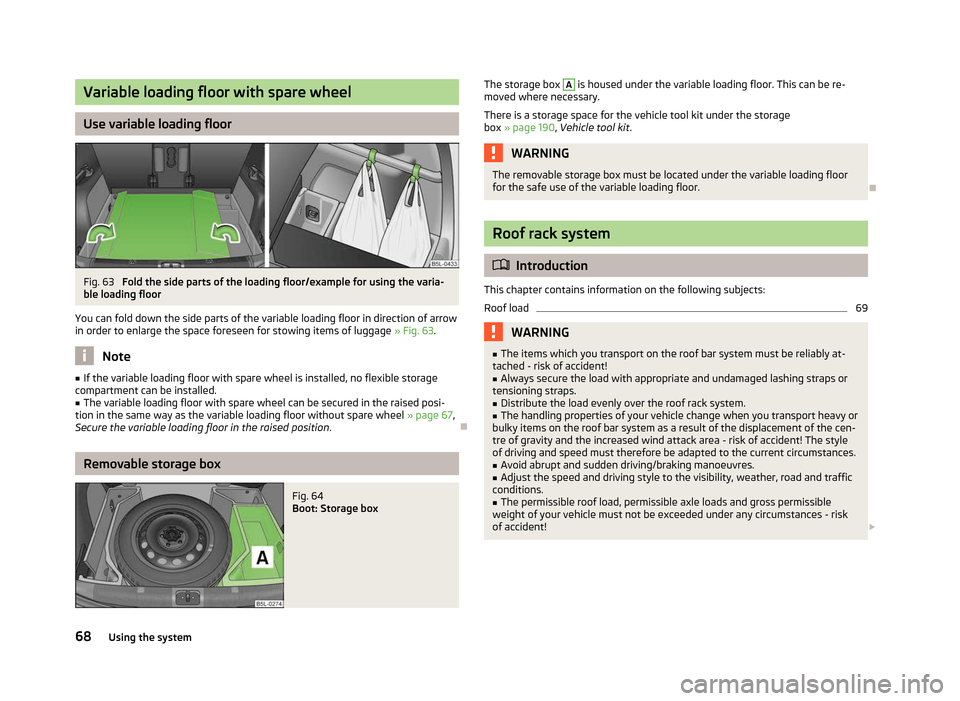
Fig. 63
Fold the side parts of the loading floor/example for using the varia-
ble loading floor
You can fold down the side parts of the variable loading floor in direction of arrow
in order to enlarge the space foreseen for stowing items of luggage » Fig. 63. Note
■ If the variable loading floor with spare wheel is installed, no flexible storage
compartment can be installed. ■ The variable loading floor with spare wheel can be secured in the raised posi-
tion in the same way as the variable loading floor without spare wheel »
page 67,
Secure the variable loading floor in the raised position .ÐRemovable storage box
Fig. 64
Boot: Storage box The storage box A
is housed under the variable loading floor. This can be re-
moved where necessary.
There is a storage space for the vehicle tool kit under the storage
box » page 190 , Vehicle tool kit . WARNING
The removable storage box must be located under the variable loading floor
for the safe use of the variable loading floor. Ð Roof rack system
ä
Introduction
This chapter contains information on the following subjects:
Roof load 69
WARNING
■ The items which you transport on the roof bar system must be reliably at-
tached - risk of accident!
■ Always secure the load with appropriate and undamaged lashing straps or
tensioning straps. ■ Distribute the load evenly over the roof rack system.
■ The handling properties of your vehicle change when you transport heavy or
bulky items on the roof bar system as a result of the displacement of the cen-
tre of gravity and the increased wind attack area - risk of accident! The style
of driving and speed must therefore be adapted to the current circumstances. ■ Avoid abrupt and sudden driving/braking manoeuvres.
■ Adjust the speed and driving style to the visibility, weather, road and traffic
conditions. ■ The permissible roof load, permissible axle loads and gross permissible
weight of your vehicle must not be exceeded under any circumstances - risk
of accident! £
68 Using the system
Page 80 of 225

Through-loading bag
Fig. 85
Securing the removable
through-loading bag
The removable through-loading bag is solely used for transporting skis.
Loading
› Open a rear side door of the vehicle.
› Fold the middle seat backrest forward
» page 60, Rear seats.
› Place the empty removable through-loading bag in the gap between the front
and rear seats in such a way that the end of the bag with the zip lies in the
boot.
› Open the boot lid.
› Push the skis into the removable through-loading bag from the boot
» .
› Close the removable through-loading bag with the zip.
Securing
› Pull the securing belt with both lock tongues out of the pocket of the remova-
ble through-loading bag.
› Insert the lock tongues A
» Fig. 85 in the belt locks of the rear middle seat belt
C
, first of all on the one side and then on the other side.
› Place the securing belt in the middle of the skis between the heel and the tip of
the bindings and pull the securing belt tight at the free end of the belt B
.
WARNING
■ After placing the skis into the through-loading bag, you must secure the
through-loading bag with the securing belt A
.
■ The securing belt must hold the skis tight.
■ Ensure that the securing belt for skis grasps the middle between the tip and
the heel element of the binding (see also imprint on the removable through-
loading bag). ■ The total weight of the skis which are transported must not exceed 10 kg. Note
■ The removable through-loading bag is foreseen for two pairs of skis.
■ Place the skis and sticks in the removable through-loading bag with the tips
facing to the rear. ■ If there are several pairs of skis in the removable through-loading bag, ensure
that the bindings are positioned at the same height.
■ The removable through-loading bag must never be folded together or stowed
when moist. Ð Clothes hooks
The clothes hooks are located on the middle pillar and on the handle of the head-
liner above each of the rear doors. WARNING
■ Ensure that any clothes hanging from the hooks do not impair your vision to
the rear.
■ Only use the hooks for hanging light items of clothing and ensure that there
are no heavy or sharp-edged objects in the pockets.
■ Do not use clothes hangers for hanging up items of clothing otherwise this
may reduce the effectiveness of head airbags. CAUTION
The maximum permissible load of the hooks is 2 kg. Ð
78 Using the system
Page 120 of 225

Note
■ If a suitable adapter is available for your mobile phone, only use your mobile
phone in the adapter inserted in the telephone mount so that the radiation in the
vehicle drops to a minimum. ■ Placing the mobile phone in the adapter inserted in the telephone mount en-
sures optimum sending and receiving power. ÐInserting the mobile phone and adapter
Fig. 111
Universal telephone preinstalla-
tion
Only one telephone mount is factory-fitted. An adapter for the mobile phone can
be purchased from ŠKODA Original Accessories.
Inserting the adapter and mobile phone › First of all push the adapter A
in the direction of the arrow
» Fig. 111 up to the
stop into the mount. Then press the adapter slightly downwards, until it locks
securely into position.
› Insert the mobile phone into the adapter A
(as specified in the instructions
from the manufacturer of the adapter).
Removing the adapter and mobile phone
› Simultaneously press the locks on the mount
» Fig. 111 and remove the adapter
with the mobile phone. CAUTION
Taking the mobile phone out of the adapter during the call can lead to interrup-
tion of the connection. When removing the mobile phone, the connection to the
factory-fitted antenna is interrupted, which reduces the quality of the transmit-
ting and receiving signal. The charging of the mobile phone battery is also inter-
rupted. Ð Managing telephone calls with the help of the adapter
Fig. 112
Principle sketch: Adapter with one button/adapter with two but-
tons
Function overview of the (PTT - “push to talk”) button on the adapter
»
Fig. 112:
› Switch on/off voice control;
› Accept/end a call.
On some adapters include the button SOS A
» Fig. 112 in addition to the button
. After pressing this button for 2 seconds, the number 112 (Emergency call) is
dialled. Note
On vehicles fitted with the Columbus navigation system , the buttons and
SOS do not work.
Ð
118 Using the system
Page 129 of 225

Filling the CD changer with CDs
›
Press and hold the button C
» Fig. 114 for longer than 2
seconds and guide the
CDs one after the other (maximum 6 CDs) into the CD case B
. The indicator
lights in the buttons D
stop flashing.
Inserting a CD at a specific position
› Press the button C
» Fig. 114. The indicator lights in the buttons D
illuminate
the memory spaces that are already assigned and flash in the case of free mem-
ory spaces.
› Touch the desired button D
and guide the CD into the CD-case B
.
Ejecting a CD
› Press the button A
» Fig. 114 to eject a CD. For assigned memory spaces, the
indicator lights now illuminate in the buttons D
.
› Press the corresponding button D
. The CD is ejected.
Ejecting all CDs
› Press and hold the button A
» Fig. 114 for more than 2
seconds. All CDs in the
CD-changer are ejected consecutively. Note
■ Always guide the CD into the CD case B
» Fig. 114 with the printed side facing
upwards.
■ Never force the CD into the CD case as it is drawn in automatically.
■ After loading a CD into the CD changer, wait until the indicator light of the cor-
responding button D
is illuminated. Then the CD case B
is free to load the next
CD.
■ If a position is selected, on which a CD is already located, this CD is ejected. Re-
move the ejected CD and load the desired CD. Ð DVD-preinstallation
Fig. 115
Seat backrest - left front seat/right front seat
Description Openings for attachment of DVD player holder
Audio/video input
Connection input, DVD player
Only one DVD pre-installation is factory-installed in the seat backrest of the front
seat.
The DVD player holder and DVD player can be purchased from
ŠKODA original ac-
cessories. For a description of the use, refer to the operating instructions for
these devices and equipment. WARNING
■ If there are passengers on both of the rear seats, the DVD player holder
must not be used on its own (without the DVD player) - risk of injury!
■ The inclination of the holder can be adjusted to three preset positions. Be
careful not to injure fingers between the holder and the backrest when
changes to the position of the DVD player holder are made.
■ The DVD player holder must not be used when the rear seat backrest or the
rear seat is folded forward or has been removed completely. Note
Follow the instructions given in the operating instructions of the DVD player hold-
er/DVD player. Ð A
B
C
127
Communication