2012 SKODA OCTAVIA lock
[x] Cancel search: lockPage 146 of 222
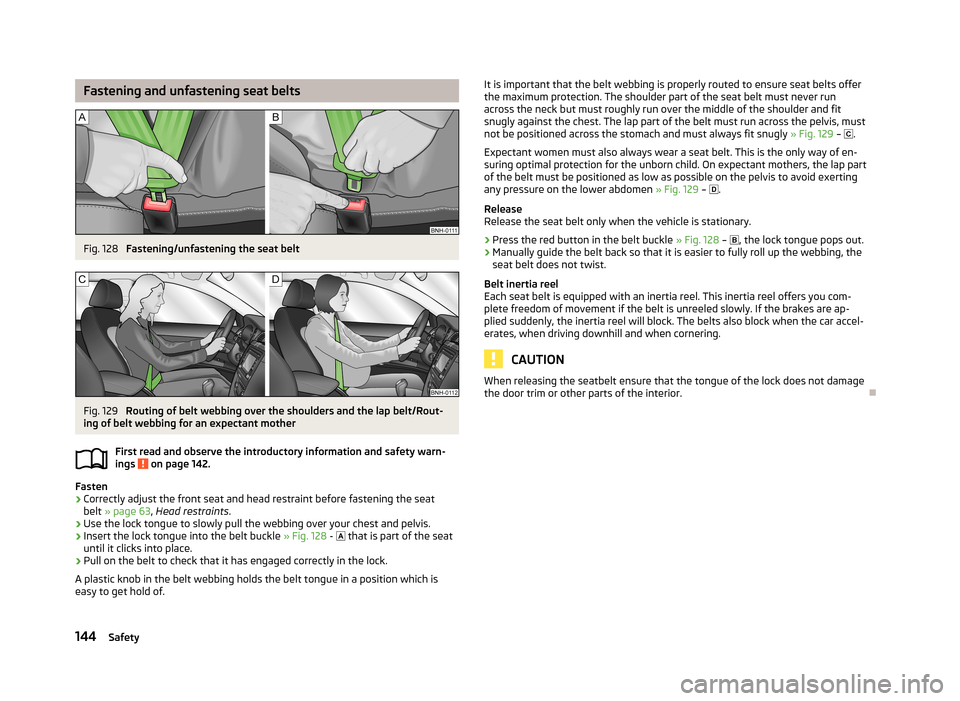
Fastening and unfastening seat beltsFig. 128
Fastening/unfastening the seat belt
Fig. 129
Routing of belt webbing over the shoulders and the lap belt/Rout-
ing of belt webbing for an expectant mother
First read and observe the introductory information and safety warn-
ings
on page 142.
Fasten
›
Correctly adjust the front seat and head restraint before fastening the seat belt » page 63 , Head restraints .
›
Use the lock tongue to slowly pull the webbing over your chest and pelvis.
›
Insert the lock tongue into the belt buckle » Fig. 128 -
that is part of the seat
until it clicks into place.
›
Pull on the belt to check that it has engaged correctly in the lock.
A plastic knob in the belt webbing holds the belt tongue in a position which is
easy to get hold of.
It is important that the belt webbing is properly routed to ensure seat belts offer
the maximum protection. The shoulder part of the seat belt must never run
across the neck but must roughly run over the middle of the shoulder and fit
snugly against the chest. The lap part of the belt must run across the pelvis, must
not be positioned across the stomach and must always fit snugly » Fig. 129 – .
Expectant women must also always wear a seat belt. This is the only way of en-
suring optimal protection for the unborn child. On expectant mothers, the lap part
of the belt must be positioned as low as possible on the pelvis to avoid exerting any pressure on the lower abdomen » Fig. 129 – .
Release
Release the seat belt only when the vehicle is stationary.›
Press the red button in the belt buckle » Fig. 128 –
, the lock tongue pops out.
›
Manually guide the belt back so that it is easier to fully roll up the webbing, the
seat belt does not twist.
Belt inertia reel
Each seat belt is equipped with an inertia reel. This inertia reel offers you com-
plete freedom of movement if the belt is unreeled slowly. If the brakes are ap-
plied suddenly, the inertia reel will block. The belts also block when the car accel-
erates, when driving downhill and when cornering.
CAUTION
When releasing the seatbelt ensure that the tongue of the lock does not damage
the door trim or other parts of the interior.
144Safety
Page 147 of 222

Seat belt height adjuster on the front seatsFig. 130
Front seat: Seat belt height ad-
juster
First read and observe the introductory information and safety warn-
ings on page 142.
The seat belt height adjuster makes it possible to adjust the routing of the front
seat belts in the area of the shoulder to the body size.
›
Press the height adjuster and move up or down in the desired direc- tion » Fig. 130 .
›
Then pull firmly on the belt to ensure that the seat belt height adjuster has cor-
rectly locked in place.
Intertia reel
First read and observe the introductory information and safety warn-ings
on page 142.
Each seat belt is equipped with an inertia reel. When pulling slowly on the seat
belt, the belt can move freely. When pulling sharply on the seat belt, the move-
ment is locked by the inertia reel.
WARNINGIf the seat belt does not lock when pulling sharply on it, have it inspected im-
mediately by a ŠKODA specialist garage.
Belt tensioners
First read and observe the introductory information and safety warn-
ings
on page 142.
Safety for the driver and front passenger wearing their seat belts is enhanced by
the belt tensioners fitted to the inertia reels of the front three-point seat belts.
The three-point seat belts are automatically tensioned in the event of a frontal
collision of a certain severity. The belt tensioners can also be deployed if the seat
belts are not fastened.
The fastened three-point seat belts are automatically tensioned in the event of a frontal or side collision of a certain severity.
Belt tensioners are not activated in the event of minor frontal collisions, side and
rear-end collisions, in the case of a rollover and also not in accidents in which no
major forces are produced from the front.
WARNING■ Any work on the belt tensioner system including removal and installation of
system components because of other repair work, must only be carried out by
a ŠKODA specialist garage.■
The protective function of the system is only adequate for a single accident.
If the belt tensioners have been deployed, it is then necessary to replace the
entire system.
Note
■ Smoke is generated when the belt tensioners are deployed. This is not an indi-
cation of a fire in the vehicle.■
When disposing of the vehicle or parts of the belt tensioner system, it is impor-
tant to comply with national legal requirements. ŠKODA Partners are familiar with
these regulations and will be able to provide you with detailed information.
145Seat belts
Page 149 of 222

during the collision remains below the prescribed reference values specified in
the control unit, the airbags are not deployed although the vehicle may well suf-
fer severe damage to the bodywork as a consequence of the accident.
The following will be deployed in the event of a severe frontal collision: › driver’s front airbag;
› passenger’s front airbag;
› driver’s knee airbag.
The following will be deployed in the event of a severe side collision: › front side airbag on the side of the accident;
› rear side airbag on the side of the accident;
› head airbags on the side of the accident.
In the event of an accident in which the airbags are deployed:
› the interior lighting comes on (if the switch for the interior light is in the door
contact position),
› the hazard warning light is switched on;
› all the doors are unlocked;
› the fuel supply to the engine is interrupted.
Front airbags
Fig. 131
Driver airbag in the steering wheel/front passenger airbag in the
dashboard
Fig. 132
Safe distance to steering wheel/inflated airbags
In the event of a severe frontal collision, the front airbag system offers additional
protection for the head and chest area of the driver and front passenger.
The front airbag for the driver is housed in the steering wheel » Fig. 131 –
.
The front airbag for the front seat passenger is located in the dash panel above
the stowage compartment
– » Fig. 131 .
When the airbags are deployed, they inflate in front of the driver and front pas-
senger » Fig. 132 -
. The forward movement of the driver and of the front pas-
senger is cushioned when they make contact with the fully inflated airbag and
the risk of injury to head and chest is thus reduced.
The airbag allows the gas to flow out of the inflated airbag in a controlled manner(depending on the load of the particular car occupant) in order to cushion head
and chest areas. The airbag then deflates subsequently to such an extent, after
an accident, to again provide a clear view forward.
WARNING■ For the driver and front passenger, it is important to maintain a distance of
at least 25 cm to the steering wheel or dashboard A » Fig. 132 . Not maintain-
ing this minimum distance will mean that the airbag system will not be able to
properly protect you – hazard! The front seats and the head restraints must always also be correctly adjusted to match the body size of the occupant.■
The airbag develops enormous forces when triggered, which can lead to in-
juries if the sitting position or seated position is not correct.
■
There must not by any further persons, animals or objects positioned be-
tween the front seated occupants and the deployment area of the airbag.
147Airbag system
Page 155 of 222

Passenger protection system
Introductory information
The Passenger protection system helps you reduce the impact of a collision with a pedestrian.
The system is activated automatically in the event of a frontal collision with a pe-
destrian at speeds of 30-55 km/h. In the event of an impact, the rear section of
the bonnet is raised by approx. 55 mm thus creating a crumple zone above the
engine.
The system sensors are integrated in the front bumper.
The functional status of the system is indicated by the indicator light
in the in-
strument cluster » page 19.
In some cases, the system may be activated even if the vehicle did not collide
with a pedestrian, e.g.:
› in a frontal collision with a lamppost, a street light, column, etc.;
› in a frontal collision with an animal;
› when driving over a mound of snow;
› when the suspension comes into contact with the road;
› when driving over pronounced corrugations perpendicular to the direction of
travel.
We recommend that any modifications and repairs to the front bumper or body-
work be carried out by a ŠKODA Partner. Further information » page 165.
WARNING■
Work or technical modifications on your vehicle, which have been carried out
unprofessionally, can cause operational faults – risk of accident!■
Do not attach the front number plate in the holder. Instead, screw it onto
the bumper in the area provided. The attached number plate holder impairs
the functioning of the sensors and thus the assessment made to determine
whether to activate the system or not.
NoteWhen disposing of the vehicle or parts of the Passenger protection system, it is
important to comply with national legal requirements. ŠKODA Partners are famili-
ar with these regulations and will be able to provide you with detailed informa-
tion.
Activating the system
Fig. 138
Raised bonnet
If the Passenger protection system was activated:
› the bonnet is raised
» Fig. 138 -
;
› The indicator light
is lit in the instrument cluster.
The bonnet can only be raised after the system has been activated if it was not deformed previously.
WARNING■ After activation, the system no longer meets its protective function. Drive to
your nearest ŠKODA Partner immediately and adopting an appropriately cau-
tious style of driving, who will replace the system. Do not exceed 80 km/h.■
Adjust the height of the seat so that the raised bonnet does not block your
view ahead » Fig. 138 - . Stop driving if the view ahead remains impaired
even at the highest seat position!
153Passenger protection system
Page 156 of 222

Transporting children safely
Child seat
Introduction
This chapter contains information on the following subjects:
Use of a child seat on the front passenger seat
155
Child safety and side airbag
156
Classification of child seats
156
Use of child seats fastened with a seat belt
156
Locking eyes of the ISOFIX system
157
Using child seats with the ISOFIX system
157
Locking eyes of the TOP TETHER system
158
Children are generally safer on the rear seats than on the front passenger seat.
In contrast to adults, the muscles and bone structure of children are not yet fully developed. Thus children are exposed to increased risk of injury.
Children should be transported in accordance with the relevant statutory provi-sions.
Child seats that comply with the ECE-R 44 standard must be used. The ECE-R Norm stands for: Economic Commission for Europe – Regulation.
Child seats that comply with the ECE-R 44 standard have a test seal that cannotbe removed: a large E within a circle with the test number below.
WARNING■ The national legal requirements must be observed when using child seats.■One should never carry children, and also not babies! - on one's lap.■
Never leave children unattended in the vehicle. Certain outside climatic con-
ditions can cause life-threatening temperatures in the vehicle.
■
Under no circumstances allow children to be transported without the use of
a suitable restraint system. In the event of an accident the child will be thrown through the vehicle and may as a result suffer fatal injuries, and also
injure other occupants.
WARNING (Continued)■ Children are exposed to an increased risk of injury in the event of an acci-
dent if they lean forward or adopt an incorrect seated position when the vehi-
cle is moving. This particularly applies to children who are transported on the
front passenger seat as they can suffer severe, or even fatal injuries if the air-
bag system is deployed!■
Pay particular attention to the information provided by the manufacturer of
the child safety seat regarding the correct routing of the belt. Seat belts which are not correctly adjusted can themselves cause injuries even in minor
accidents.
■
Safety belts must be checked to ensure that they are running properly. One
should also ensure that the belt is not damaged by sharp-edged fittings.
■
It is essential to switch off the front passenger airbag if using a child seat in
which the child is carried with its back facing the direction of travel on the front passenger seat. Further information » page 155, Use of a child seat on
the front passenger seat .
CAUTION
When installing a child seat in which the child faces forward, adjust the head re-
straints so that they are as high as possible. If the head restraints still prevent the
child seat from being installed, even in the highest position, you will need to re-
move them » page 63. After removing the child seat, re-install the head re-
straints.
Note
We recommend that you use child seats from ŠKODA Original Accessories. These child seats were developed and also tested for use in ŠKODA vehicles. They fulfil
the ECE-R 44 standard.
154Safety
Page 159 of 222

Locking eyes of the ISOFIX systemFig. 141
Rear seat: ISOFIX
First read and observe the introductory information and safety warn-ings on page 154.
There are two locking eyes between the seat backrest and the seat cushion of
the outer rear seats and front passenger seat for fixing the ISOFIX system child seat in place » Fig. 141.
First remove the caps to access the locking eyes.
After removing the child seat, replace he caps.WARNING■ Always refer to the instructions from the manufacturer of the child seat
when installing and removing a child seat with the ISOFIX system.■
Never attach other child seats, belts or objects to the locking eyes intended
for the installation of a child seat with the ISOFIX system – hazard!
Note
Child seats with the ISOFIX system can be purchased from ŠKODA Original Acces-
sories.
Using child seats with the ISOFIX system
First read and observe the introductory information and safety warn- ings on page 154.Overview of the usefulness of child seats fastened with the ISOFIX system on each of the seats in accordance with the ECE-R 16 standard.GroupSize category
of the child seat a)Front passenger seat b)Rear seats outsideRear seat middle0
up to 10 kgEXIL-SUX0+
up to 13 kgE
XIL-SUX
DC 157Transporting children safely
Page 160 of 222

GroupSize category
of the child seat a)Front passenger seat b)Rear seats outsideRear seat middle
1
9-18 kg
D
XIL-SU IUFX
CBB1Aa)
The size category is shown on the label attached to the child seat.
b)
If the front passenger seat is fitted with fixing eyes for the ISOFIX system, this suits installation of an ISOFIX child seat with the “Semi-Universal” approval.
The seat is suited for installation of an ISOFIX child seat with the “Semi-
Universal” approval. The category “Semi-Universal” means that the child
seat with the ISOFIX system is approved for your vehicle. Observe the in-
formation in the list of vehicles which comes with the child seat.
The seat is suitable for the installation of an ISOFIX child seat with the ap- proval “Universal” and attachment with the TOP TETHER belt.
The seat is not fitted with fixing eyes for the ISOFIX system.
Locking eyes of the TOP TETHER system
Fig. 142
Rear seat: TOP TETHER
First read and observe the introductory information and safety warn-ings on page 154.
The locking eyes for attaching the belt to a child seat with the TOP TETHER sys-
tem are located on the rear side of the outer rear seat backrests » Fig. 142.
IL-SU
IUFXWARNING■
Always refer to the instructions from the manufacturer of the child seat
when installing and removing a child seat with the TOP TETHER system.■
Only use child seats with the TOP TETHER system on the seats with the
locking eyes.
■
Only ever attach one belt from the child seat to a locking eye.
■
On no account should you equip your vehicle, e.g. mount screws or other an-
chorage points.
158Safety
Page 161 of 222

General Maintenance
Taking care of and cleaning the vehicle
Taking care of your vehicle
Introduction
This chapter contains information on the following subjects:
Washing the vehicle
160
Automatic car wash systems
160
Washing by hand
160
Washing with a high-pressure cleaner
161
Preserving and polishing the vehicle paintwork
161
Chrome parts
161
Paint damage
161
Plastic parts
162
De-icing windows and exterior mirrors
162
Radio reception and aerial
162
Headlight lenses
162
Rubber seals
163
Door lock cylinders
163
Wheels
163
Underbody protection
163
Protection of hollow spaces
164
Artificial leather, cloths and Alcantara ®
164
Fabric covers on electrically heated seats
164
Natural leather
164
Seat belts
165
Regular and proper care help to retain the efficiency and
value of your vehicle. It
may also be one of the requirements for the acceptance of warranty claims relat- ing to corrosion damage and paint defects on the bodywork.
We recommend using care products from ŠKODA Original Accessories that areavailable from ŠKODA Partners. The instructions for use on the package must be
observed.
WARNING■ Care products may be harmful to your health if not used according to the in-
structions.■
Always store care products in a safe place, out of the reach of children – risk
of poisoning!
■
Water and ice in the brake system when washing the vehicle in winter can
affect the braking efficiency – risk of accident!
■
Only wash the vehicle when the ignition is switched off – risk of accident!
■
When washing the car by hand, protect your hands and arms from sharp-
edged metal parts (e.g. when cleaning the underfloor, the inside of the wheel
housings or the wheel trims, etc) - risk of cuts!
■
Air fresheners and scents can be hazardous to heath when the temperature
inside the vehicle is high.
CAUTION
■ Be sure to check clothing for colourfastness to avoid any damage or visible
stains on the material (leather), panels and textiles.■
Cleaners containing solvents can damage the material being cleaned.
■
Do not wash your vehicle in bright sunlight – risk of paint damage.
■
If washing the vehicle in the winter using a hose or high-pressure cleaner, en-
sure that the jet of water is not aimed directly at the locking cylinders or the
door/panel joints – risk of freezing!
■
Do not use any insect sponges, rough kitchen sponges or similar cleaning prod-
ucts – risk of damaging the surface of paintwork.
■
Do not stick any stickers on the inside of the rear windows, the rear side win-
dows and in the vicinity of the heating elements on the windscreen or near the
window aerial. These may get damaged. With regard to the antenna, they may in-terfere with the radio or navigation.
■
Do not clean the inside of the windows with sharp-edged objects or corrosive
and acidic cleaning agents – risk of damaging the heating elements or window
aerial.
■
Do not attach scents and air fresheners to the dashboard – risk of damage to
the dashboard.
■
To avoid damaging the parking aid sensors while cleaning with high-pressure
cleaners or steam jets, the sensors must only be directly sprayed for short periods while a minimum distance of 10 cm must be observed.
■
Do not clean the roof trim with a brush – risk of damage to the trim surface.
■
Fold in the exterior mirrors to prevent damage before washing the vehicle in an
automatic car wash system. Never manually fold in electric exterior mirrors - al-
ways use the electric controls.
159Taking care of and cleaning the vehicle