2012 SKODA OCTAVIA roof
[x] Cancel search: roofPage 165 of 222

Rubber sealsFirst read and observe the introductory information and safety warn-
ings
on page 159.
The rubber seals on doors, door panels, and the sliding roof remain smoother and
last longer if the seals are treated regularly with a suitable rubber care product.
This helps to prevent leakages and premature wear of the seals. Rubber seals
which are well cared for also do not stick together in cold winter weather.
Door lock cylinders
First read and observe the introductory information and safety warn-
ings
on page 159.
Specific products must be used for de-icing door lock cylinders.
When washing your vehicle, ensure as little water as possible gets into the lock- ing cylinders.
Note
We recommend that suitable materials from ŠKODA Original Accessories are used for maintaining the door lock cylinders.
Wheels
First read and observe the introductory information and safety warn-
ings
on page 159.
Wheel rims
Also thoroughly wash the wheel rims when washing the vehicle on a regular ba- sis. Regularly remove salt and brake abrasion from the wheel rims otherwise the material will be affected. Damage to the paint layer on the wheel rims must be
touched up immediately.
Light alloy wheels
After washing thoroughly and treat the wheel rims with a protective product for
light alloy wheels. Products which cause abrasion must not be used to treat the
wheel rims.
WARNINGWater, ice and grit in the brake system can affect the braking efficiency – risk
of accident!
CAUTION
Severe layers of dirt on the wheels can also result in wheel imbalance. This may
show itself in the form of a wheel vibration which is transmitted to the steering
wheel which, in certain circumstances, can cause premature wear of the steering.
This means it is necessary to remove the dirt.
Note
We recommend that any repairs to damaged paintwork are carried out by a
ŠKODA Partner.
Underbody protection
First read and observe the introductory information and safety warn-ings
on page 159.
The underside of your vehicle is protected for life against chemical and mechani-
cal influences.
As damage to the protective layer when driving cannot be ruled out completely,
we recommend that you inspect the protective layer on the underside of your ve- hicle and on the chassis at specific intervals – preferably at the beginning and end
of the winter.
ŠKODA Partners have suitable spray products and the necessary equipment
available, and are familiar with the instructions for use. We therefore recommend
that touch-up work or additional corrosion protection measures are carried out by
a ŠKODA Partner.
WARNINGNever use additional underbody protection or anti-corrosion agents for ex-
haust pipes, catalytic converters, diesel particle filters or heat shields. When
the engine reaches its operating temperature, these substances might ignite
– risk of fire!
163Taking care of and cleaning the vehicle
Page 166 of 222

Protection of hollow spacesFirst read and observe the introductory information and safety warn-
ings
on page 159.
All the cavities of your vehicle which are at risk from corrosion are protected for life by a layer of protective wax applied in the factory.
Wax protection does not require to be inspected or re-treated. If any small amount of wax flow out of the cavities at high temperatures, these must be re-
moved with a plastic scraper and the stains cleaned using a petroleum cleaner.
WARNINGSafety regulations should be observed when using petroleum cleaner to re-
move wax – risk of fire!
Artificial leather, cloths and Alcantara ®
First read and observe the introductory information and safety warn- ings
on page 159.
The artificial leather can be cleaned using a damp cloth. If this does not prove suf-
ficient, only use cleaning agents designed specifically for this purpose.
Dust and fine dirt particles in pores, creases and seams may chafe and damagethe surface. If you leave your vehicle parked in the open for lengthy periods, pro-
tect the Alcantara ®
seat covers from the direct rays of the sun to prevent fading.
Minor changes in colour caused by use are normal.
Clean upholstery cover materials and cloth trims on doors, luggage compartment
cover, etc. using specific cleaning agents, e.g., dry foam. Use a soft sponge, brush,
or commercially available microfibre cloth. Use a cloth and a specific cleaning
agent to clean the roof trim.
Some clothing materials, such as dark denim, do, in part, not have sufficient col-
our fastness. This can cause damage or clearly visible discolouration to seat cov-
ers (fabric or leather) even when used correctly. This particularly applies to light
seat covers (fabric or leather). This is not a defect in the seat cover, but poor col-
our fastness of the clothing textiles.
CAUTIONDo not use any leather cleaners on Alcantara ®
seat covers.
Fabric covers on electrically heated seats
First read and observe the introductory information and safety warn-
ings
on page 159.
Do not clean the seat covers using moisture as this can damage the seat heating
system.
Use a specific cleaning agent such as dry foam or similar to clean the covers.
Natural leather
First read and observe the introductory information and safety warn-
ings
on page 159.
Depending on the amount of wear-and-tear, the leather should be cleaned on a
regular basis.
Normal cleaning
Clean soiled areas of the leather with slightly moistened cotton or woollen cloth.
Severe soiling
Ensure that the leather is not soaked through at any point and that no water gets
into the stitching of the seams.
Dry off the leather with a soft, dry cloth.
Removing stains
Remove fresh water-based stains (e.g., coffee, tea, juices, blood) with an absorb-
ent cloth or household cleaning paper. A specific cleaning agent is required for
dried-on stains.
Remove fresh grease-based stains (e.g. butter, mayonnaise, chocolate, etc.) with
an absorbent cloth, household cleaning paper, or use a suitable cleaner if the
stain has not yet penetrated into the surface.
Use a grease solvent to remove grease stains which have dried in .
Remove specific stains (e.g. ball-point pens, marker pen, nail varnish, dispersion
paint, shoe polish, etc.) with a special stain remover suitable for leather.
164General Maintenance
Page 202 of 222

Fuses in the dash panelFig. 171
Storage compartment in the dash panel/schematic diagram of the
fuse box
First read and observe the introductory information and safety warn-
ings
on page 199.
The fuse box can be found behind the stowage compartment in the left-hand
part of the dash panel.
Replacing fuses
›
Opening the stowage compartment » page 73.
›
Grab hold of the stowage compartment in the area of the arrows » Fig. 171.
›
Fold out the stowage compartment by pulling in the direction of arrow
1
.
›
Replace the appropriate fuse.
›
Fold back the stowage compartment by pressing into the secured position in
the dash panel in the direction of arrow
2
.
›
Close the stowage compartment.
Fuse assignment in the dash panel
No.Power consumer1Not assigned2Not assigned3Not assigned4Not assigned5Data bus control unit6Alarm sensorNo.Power consumer
7
Control unit for the air conditioning system, heating, receiver for re-
mote control for the auxiliary heating, selector lever for the automatic gearbox, relay for the rear window heater, replay for the windscreen
heater8Light switch, rain sensor, diagnostic socket9Haldex clutch10Touchscreen11Heated rear seats12Radio13Heated rear seats14Air blower for air conditioning,heating15Electric steering lock16Signal amplifier for telephone, telephone preinstallation17Instrument cluster18Not assigned19KESSY control unit20Steering wheel module21Radio accessories22Luggage compartment door opening23Light - right24Panorama roof25Control unit for central locking front door right, power windows - left26Heated front seats27Music amplifier28Towing device29Not assigned30Belt tensioner - driver's side31Headlight - left32Parking aid (Park Assist)33Airbag 200Do-it-yourself
Page 209 of 222
Technical data
Technical data
Introductory information
The details given in the vehicle's technical documentation always take prece-
dence over the details in the Owner's Manual. It can be found in the official vehi-
cle registration documents or you can find out from a ŠKODA Partner what engine
the vehicle is fitted with.
The listed performance values were determined without performance-reducing
equipment, e.g. air conditioning system.
Vehicle identification data
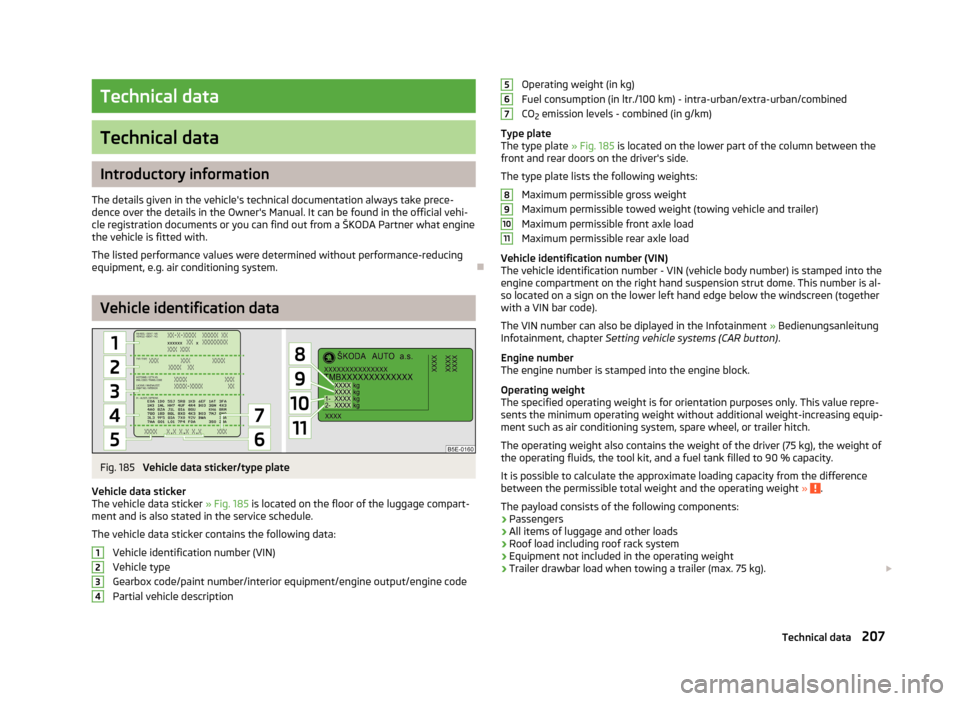
Fig. 185
Vehicle data sticker/type plate
Vehicle data sticker
The vehicle data sticker » Fig. 185 is located on the floor of the luggage compart-
ment and is also stated in the service schedule.
The vehicle data sticker contains the following data: Vehicle identification number (VIN)
Vehicle type
Gearbox code/paint number/interior equipment/engine output/engine code Partial vehicle description
1234Operating weight (in kg)
Fuel consumption (in ltr./100 km) - intra-urban/extra-urban/combined
CO 2 emission levels - combined (in g/km)
Type plate
The type plate » Fig. 185 is located on the lower part of the column between the
front and rear doors on the driver's side.
The type plate lists the following weights: Maximum permissible gross weight
Maximum permissible towed weight (towing vehicle and trailer)
Maximum permissible front axle load
Maximum permissible rear axle load
Vehicle identification number (VIN)
The vehicle identification number - VIN (vehicle body number) is stamped into the engine compartment on the right hand suspension strut dome. This number is al-
so located on a sign on the lower left hand edge below the windscreen (together
with a VIN bar code).
The VIN number can also be diplayed in the Infotainment » Bedienungsanleitung
Infotainment, chapter Setting vehicle systems (CAR button) .
Engine number
The engine number is stamped into the engine block.
Operating weight
The specified operating weight is for orientation purposes only. This value repre- sents the minimum operating weight without additional weight-increasing equip- ment such as air conditioning system, spare wheel, or trailer hitch.
The operating weight also contains the weight of the driver (75 kg), the weight of
the operating fluids, the tool kit, and a fuel tank filled to 90 % capacity.
It is possible to calculate the approximate loading capacity from the difference
between the permissible total weight and the operating weight »
.
The payload consists of the following components: › Passengers
› All items of luggage and other loads
› Roof load including roof rack system
› Equipment not included in the operating weight
› Trailer drawbar load when towing a trailer (max. 75 kg).
567891011207Technical data
Page 218 of 222

ReplenishingCoolant175
Engine oil173
Windscreen washer fluid176
Roof luggage rack Attachment points
69
Roof rack system68
Roof load69
Running-in the first 1 500 km
100
Running in Brake pads
100
Engine100
Tyres100
S
Safe securing system
30
Safety138
Child safety154
Child safety seats154
Head restraints63
ISOFIX157
TOP TETHER158
Save electrical energy101
Seat Adjusting electrically
60
Manually adjusting60
Seat belt Warning light
14, 15
Seat belt height adjuster145
Seat belts Belt tensioners
145
Cleaning165
fastening and unfastening144
Height adjustment145
Seatbelts Inertia reels
145
Seatsfolding forward63
Head restraints63
Heating62
see automatic gearbox Manual shifting of gears on the multifunction steering wheel
131
Select driving mode124
Selector lever see selector lever positions
130
Selector lever positions130
Service display11
setting Auxiliary heating (auxiliary heating and ventila- tion)
90
Setting Manual air conditioning system
85
Steering wheel93
Setting the clock11
Shifting Diving economically
101
Gearshift lever99
Side airbag149
Sliding/tilting roof Closing
41
Opening and tilting41
Operating41
Snow chains186
Spare wheel184
Speedometer10
Speed symbol see Wheels
183
Stabilisation Control (ESC)112
START/STOP Function
121
Starting engine Jump-starting
195
Starting the engine92
START STOP Jump-starting
196
Steering force assistance93
Steering wheel93
Stopping off the engine92
Storage72
Storage compartments72
Sun screen53
Sun visors53
Switching lights on and off44
T
Tachometer see Speedometer
10
Taking care of the vehicle Material coverings
164
Natural leather164
Seat belts165
Taking care of your vehicle159
Automatic car wash system160
Chrome parts161
Cleaning the wheels163
Door lock cylinders163
Headlight lenses162
High-pressure cleaner161
Plastic parts162
Polishing the paintwork161
Preservation161
Rubber seals163
Washing160
Washing by hand160
Wash system160
TCS Function
113
Warning light16
Technical data207
Through-loading bag77
Through-loading channel77
Tiptronic131
Tool188
TOP TETHER158
216Index
Page 219 of 222

Towing196
Towing a trailer106
Towing device Description
106
Drawbar load106
Towing eye front
197
Rear197
Towing protection36
Traction control system (TCS)113
Traffic sign recognition25
Traffic signs see Traffic sign recognition
25
Trailer106
13-pin power socket110
driving with a trailer110
loading109
Safety eye110
Transport Boot
64
Roof rack system68
Transporting children safely154
Two-way radio systems134
Type plate207
Tyre control display Calibration
185
Tyre load-bearing capacity see Wheels
184
Tyre repair192
Tyres see Wheels
183
U
Underbody protection
163
Unlocking Remote control
32
Unlock the vehicle Keys
31
V
Vehicle battery Automatic load deactivation
180
charging179
Checking the electrolyte level179
Operation in winter179
replacing179
Safety instructions176
Vehicle care Alcantara
164
Artificial leather164
Cloths164
Vehicle Condition see Auto Check Control
12
Vehicle data sticker207
Vehicle dimensions208
Vehicle height208
vehicle identification number - VIN (vehicle body number)
207
Vehicle key28
Vehicle length208
Vehicle tool kit188
Vehicle width208
Vest Holder for reflex vest
74
Visors see Sun screen
53
see Sun visors53
W
Warning lights
12
Warning symbols see Warning lights
12
Warning triangle188
Washing159
Automatic car wash system160
by hand160
Chrome parts161
High-pressure cleaner161
Weights207
Wheel bolts Anti-theft wheel bolt
192
Caps185
Loosening and tightening191
Wheel rims181
Wheels Bolts
186
changing189
Full trim185
General information181
Load index184
Low-profile tyres184
new tyres183
replacing wheels182
Snow chains186
Spare wheel184
Speed symbol183
Store wheels182
Tyre inflation pressure182
Tyre life182
Winter tyres186
Window Interior mirror
57
Window convenience operation40
Windows De-icing
162
See Electrical power windows38
Windscreen heating
52
see Radio reception162
Windscreen washer fluid Checking
176
Replenishing176
Warning light19
Winter176
Windscreen washer system176
Windscreen wipers54
217Index