2012 SKODA OCTAVIA change wheel
[x] Cancel search: change wheelPage 188 of 222

While pressing the button, the warning light lights up. At the same time the
system memory is erased and the new calibration is started, which is confirmed
with an audible signal and then the warning light goes out.
If the warning light does not go out after the calibration, this indicates a sys-
tem fault. Seek help from a ŠKODA specialist garage.
The rolling circumference of the tyre can change if: › the tyre inflation pressure is too low;
› the structure of the tyre is damaged;
› the vehicle is loaded on one side;
› the wheels of an axle are loaded heavily (e.g. when towing a trailer or when
driving uphill or downhill);
› snow chains are mounted;
› the spare wheel is mounted;
› one wheel per axle was changed.WARNING■
When the warning light illuminates, immediately reduce the speed and
avoid sudden steering and brake manoeuvres. Stop the vehicle as soon as
possible and inspect the tyres and their inflation pressure.■
Under certain circumstances (e.g. sporty style of driving, wintry or unpaved
roads) the warning light can be delayed or does not light up at all.
Wheel bolts
First read and observe the introductory information and safety warn-ings
on page 181.
Wheels and wheel bolts are matched to each other in terms of design. Each time
you fit other wheels, e.g. light alloy wheels or wheels with winter tyres, you must
also use the matching wheel bolts of the correct length and shape of spherical cap. This is essential to ensure that the wheels are tightly fitted and that the
brake system operates properly.
Winter tyres
First read and observe the introductory information and safety warn-
ings
on page 181.
The handling of your vehicle will be significantly improved when driving on wintry roads if you fit winter tyres. Summer tyres on ice, snee and at temperatures be-
low 7 °C have less grip. This is especially true of low-profile tyres or high-speed
tyres .
To achieve the best possible handling properties, winter tyres must be fitted on
all 4 wheels, the minimum tread depth must be 4 mm and tyres must be no older than 4 years.
Winter tyres of a lower speed category can be used provided that the permissible
maximum speed of these tyres is not exceeded even if the possible maximum
speed of the vehicle is higher.
The winter tyres speed limit is set in the menu » operating instructions for Info-
tainment , chapter Setting vehicle systems (CAR button) .
For the sake of the environment
Fit the summer tyres on again in good time as they provide better handling prop-
erties, a shorter braking distance, less tyre noise, and reduced tyre wear on roadswhich are free of snow and ice as well as at temperatures above 7 °C. The fuelconsumption is also lower.
Snow chains
First read and observe the introductory information and safety warn-
ings
on page 181.
When driving on wintry roads, snow chains improve not only traction, but also the
braking performance.
Snow chains must only be mounted on the front wheels.
For technical reasons, it is only permissible to fit snow chains with the following wheel/tyre combinations.
Wheel sizeDepth (D)Tyre size6J x 15 a)43 mm195/65 R156J x 16 b)48 mm205/55 R166J x 17b)48 mm205/50 R17a)
Only fit snow chains with links and locks not larger than 13 mm.
b)
Only fit snow chains with links and locks not larger than 12 mm.
Remove the full wheel trims before installing the snow chains.
186General Maintenance
Page 191 of 222
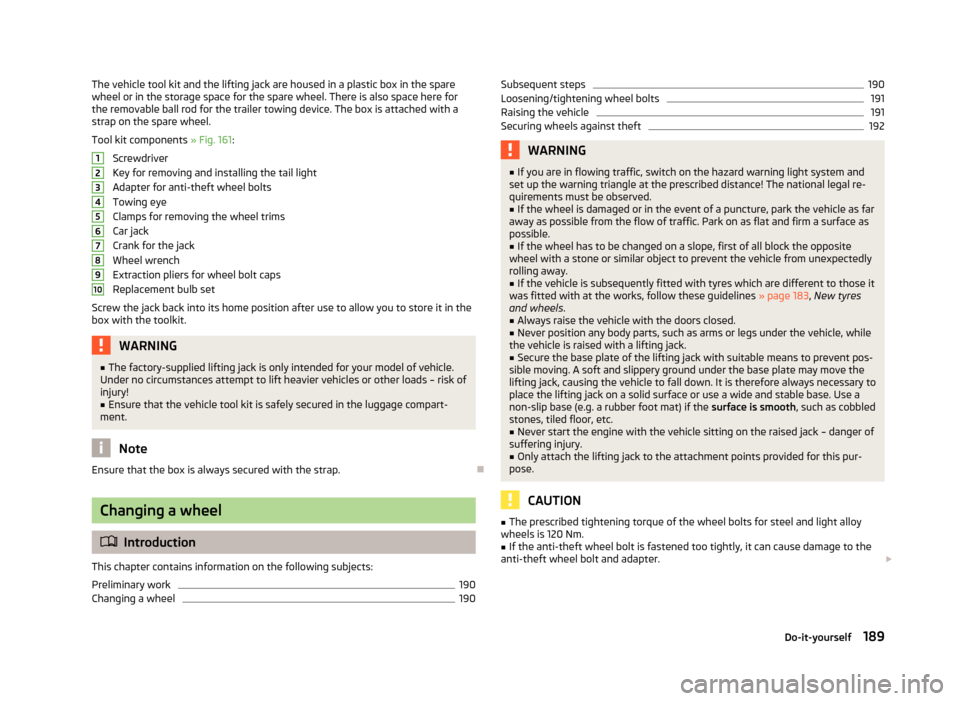
The vehicle tool kit and the lifting jack are housed in a plastic box in the sparewheel or in the storage space for the spare wheel. There is also space here for
the removable ball rod for the trailer towing device. The box is attached with a
strap on the spare wheel.
Tool kit components » Fig. 161:
Screwdriver
Key for removing and installing the tail light
Adapter for anti-theft wheel bolts
Towing eye
Clamps for removing the wheel trims
Car jack
Crank for the jack
Wheel wrench
Extraction pliers for wheel bolt caps
Replacement bulb set
Screw the jack back into its home position after use to allow you to store it in the
box with the toolkit.WARNING■ The factory-supplied lifting jack is only intended for your model of vehicle.
Under no circumstances attempt to lift heavier vehicles or other loads – risk of
injury!■
Ensure that the vehicle tool kit is safely secured in the luggage compart-
ment.
Note
Ensure that the box is always secured with the strap.
Changing a wheel
Introduction
This chapter contains information on the following subjects:
Preliminary work
190
Changing a wheel
19012345678910Subsequent steps190Loosening/tightening wheel bolts191
Raising the vehicle
191
Securing wheels against theft
192WARNING■ If you are in flowing traffic, switch on the hazard warning light system and
set up the warning triangle at the prescribed distance! The national legal re-
quirements must be observed.■
If the wheel is damaged or in the event of a puncture, park the vehicle as far
away as possible from the flow of traffic. Park on as flat and firm a surface as
possible.
■
If the wheel has to be changed on a slope, first of all block the opposite
wheel with a stone or similar object to prevent the vehicle from unexpectedly
rolling away.
■
If the vehicle is subsequently fitted with tyres which are different to those it
was fitted with at the works, follow these guidelines » page 183, New tyres
and wheels .
■
Always raise the vehicle with the doors closed.
■
Never position any body parts, such as arms or legs under the vehicle, while
the vehicle is raised with a lifting jack.
■
Secure the base plate of the lifting jack with suitable means to prevent pos-
sible moving. A soft and slippery ground under the base plate may move the
lifting jack, causing the vehicle to fall down. It is therefore always necessary to
place the lifting jack on a solid surface or use a wide and stable base. Use a
non-slip base (e.g. a rubber foot mat) if the surface is smooth, such as cobbled
stones, tiled floor, etc.
■
Never start the engine with the vehicle sitting on the raised jack – danger of
suffering injury.
■
Only attach the lifting jack to the attachment points provided for this pur-
pose.
CAUTION
■ The prescribed tightening torque of the wheel bolts for steel and light alloy
wheels is 120 Nm.■
If the anti-theft wheel bolt is fastened too tightly, it can cause damage to the
anti-theft wheel bolt and adapter.
189Do-it-yourself
Page 192 of 222

Note■The anti-theft wheel bolt set and adapter can be purchased from a ŠKODA Part-
ner.■
The national legal requirements must be observed when changing a wheel.
Preliminary work
First read and observe the introductory information and safety warn-ings
on page 189.
The following steps must be carried out before actually changing the wheel:
›
Park the vehicle as far away as possible from the flow of traffic. The place you choose should be level.
›
Let all of the occupants get out. While changing a tyre, the occupants of the
vehicle should not stand on the road (instead they should remain behind a crash
barrier).
›
Switch off the engine and move the gearshift lever into Neutral or move the se-
lector lever on the automatic gearbox into position P.
›
Firmly apply the handbrake.
›
If a trailer is connected, remove it.
›
Remove the vehicle tool kit » page 188 and the spare wheel » page 184 from
the luggage compartment.
Changing a wheel
First read and observe the introductory information and safety warn-
ings
on page 189.
Always change a wheel on a level surface as far as possible.
›
Remove the full wheel trim » page 185 or caps » page 185 .
›
First of all slacken the anti-theft wheel bolt and then the other wheel
bolts » page 191 .
›
Jack up the vehicle until the wheel that needs changing is clear of the
ground » page 191 .
›
Unscrew the wheel bolts and place them on a clean surface (cloth, paper, etc.).
›
Remove the wheel.
›
Attach the spare wheel and slightly screw on the wheel bolts.
›
Lower the vehicle.
›Alternately tighten the wheel bolts opposite each other using the wheel
wrench (crosswise) and then tighten the anti-theft wheel bolt » page 191.›
Replace the wheel trim or the caps.
Note
■
All bolts must be clean and must turn easily.■Under no circumstances grease or oil the wheel bolts!■
When fitting unidirectional tyres, ensure that the direction of rotation is cor-
rect » page 181 .
Subsequent steps
First read and observe the introductory information and safety warn-
ings
on page 189.
The following steps must also be performed after changing the wheel.
›
Stow and attach the replaced wheel in the spare wheel well using a special screw » page 184 .
›
Stow the vehicle tool kit in the space provided.
›
Check the tyre pressure on the installed spare wheel as soon as possible.
›
Have the tightening torque of the wheel bolts checked with a torque wrench
as soon as possible.
›
Change the damaged wheel or consult a ŠKODA specialist garage about repair
possibilities.
Note
■ If it is determined that the wheel bolts are corroded and difficult to turn when
changing the wheel, the bolts must be replaced before checking the tightening
torque.■
Drive cautiously and only at a moderate speed until the tightening torque has
been checked.
190Do-it-yourself
Page 204 of 222

Fuse assignment in engine compartmentNo.Power consumerF1Control unit for ESCF2Control unit for ESC, ABSF3Engine control unitF4Engine control unit, relay for electric auxiliary heatingF5Engine componentsF6Brake sensor, engine componentsF7Coolant pump, engine componentsF8Lambda probeF9Ignition, control unit for glow plug system, engine componentsF10Control unit for fuel pump, ignitionF11Electrical auxiliary heating systemF12Electrical auxiliary heating systemF13Control unit for automatic gearboxF14Windscreen heater - leftF15HornF16IgnitionF17Control unit for ABS, ESC, engine control unitF18Data bus control unitF19Windscreen wipersF20AlarmF21ABSF22Engine control unitF23StarterF24Electrical auxiliary heating systemF31Not assignedF32Not assignedF33Not assignedF34Windscreen heater - rightF35Not assignedF36Not assignedNo.Power consumerF37Control unit for auxiliary heatingF38Not assigned
Bulbs
Introduction
This chapter contains information on the following subjects:
Headlights
203
Changing the bulb for the low beam
203
Replacing the bulb for main beam and separate daytime running lights
204
Changing the bulb for daytime running lights and parking light
204
Changing light bulbs for fog lights
204
Changing the bulb for the licence plate light
205
Tail lamp assembly
205
Replacing the bulbs in the tail lamp assembly
206
Some manual skills are required to change a bulb. For this reason, if uncertain, we recommend that bulbs are replaced by a ŠKODA specialist garage or other experthelp is sought.
› Switch off the ignition and all of the lights before replacing a bulb.
› Faulty bulbs must only be replaced with the same type of bulbs. The designa-
tion is located on the light socket or the glass bulb.
› A stowage compartment for replacement bulbs is located in a plastic box in the
spare wheel or underneath the floor covering in the luggage compartment.
WARNING■ Accidents can be caused if the road in front of the vehicle is not sufficiently
illuminated and the vehicle cannot or can only be seen with difficulty by other
road users.■
Always read and observe the warnings before completing any work in the
engine compartment » page 169.
202Do-it-yourself
Page 215 of 222

Central locking system29
Changes165
Changing Engine oil
173
Wheels189
Charge level indicator of the vehicle battery
11
Charge level indicator vehicle battery
11
Charging a vehicle battery179
Checking Battery electrolyte level
179
Brake fluid175
Coolant level174
Engine oil172
Oil level172
Windscreen washer fluid176
Children and safety154
Child safety Side airbag
156
Child safety lock29
Child safety seat Use of child safety seats
156
Child seat Classification
156
ISOFIX157
on the front passenger seat155
TOP TETHER158
Use of child seats157
Chrome parts refer to Taking care of your vehicle
161
Cigarette lighter70
Cleaning159
Alcantara164
Artificial leather164
Cloths164
Headlight lenses162
Material coverings164
Natural leather164
Plastic parts162
Wheels163
Climatronic86
Clock11
Clothes hooks79
Cockpit Ashtray
70
Cigarette lighter70
General view7
Light51
Sockets71
Storage compartments72
Compartments72
Computer see Multifunction display
22
Coolant Checking
174
Replenishing175
Coolant temperature gauge display
10
Correct seated position139
Counter for distance driven11
Cruise control system (CCS)119
D
Daylight driving light
44
De-icing the windscreen and rear window52
Deactivating an airbag
151
Deactivating an airbag151
Delayed locking of the boot lid see Boot lid
38
Diesel refer to Fuel
169
Diesel fuel Operation in winter
169
Diesel particulate filter18
Digital clock11
Dipstick172
Display Service interval
11
Distance driven11
Door Child safety lock
29
Door locking Emergency
36
Doors Emergency locking
36
Driving Abroad
104
Driving through water on the street104
Emissions207
Fuel consumption207
Driving mode see Select driving mode
124
E
Economical and environmentally friendly driving
101
EDL114
Electrical power windows Button in the driver's door
38, 39
Button in the rear doors40
Central locking system40
Operational faults41
Electronic differential lock (EDL)114
Electronic immobiliser93
Emergency Automatic gearbox
133
Changing a wheel189
Door locking36
Hazard warning light system49
Jump-starting195
KESSY - start engine97
Locking the driver's door36
Towing the vehicle196
Tyre repair192
Unlocking the driver's door36
Unlocking the luggage compartment lid38
Emissions207
213Index