2012 SKODA OCTAVIA rims
[x] Cancel search: rimsPage 187 of 222

Full wheel trimFirst read and observe the introductory information and safety warn-
ings
on page 181.
Pulling off
›
Hook the clamp found in the vehicle tool kit into the reinforced edge of the wheel trim.
›
Push the wheel wrench through the clamp, support on the tyre and pull off the
wheel trim.
Install
›
Press the wheel trim onto the wheel rim at the valve opening provided.
›
Then press the trim into the wheel rim until its entire circumference locks cor- rectly in place.
CAUTION
■ Use the pressure of your hand, do not knock the full wheel trim! Avoid heavy
knocks when the trim is not yet inserted in the wheel rim. This could cause dam-
age to the guide and centring elements of the trim.■
Ensure that the anti-theft wheel bolt has been installed correctly » page 192,
Securing wheels against theft .
■
If wheel trims are retrofitted it must be ensured that an adequate flow of air is
assured to cool the brake system.
Wheel bolts
Fig. 158
Remove the cap
First read and observe the introductory information and safety warn- ings on page 181.
Pulling off›Push the plastic clip sufficiently far onto the cap until the inner catches of the
clip are positioned at the collar of the cap » Fig. 158.›
Remove the cap.
Install
›
Push the caps onto the wheel bolts up to the stop.
The wheel bolt caps are housed in a plastic box in the spare wheel or in the stor-
age space for the spare wheel.
Tyre control display
Fig. 159
Button for setting the tyre infla-
tion pressure control value
First read and observe the introductory information and safety warn-
ings on page 181.
Calibration
After changing the tyre inflation pressure » page 182, in section Introduction ,
after changing one or several wheels, the position of a wheel on the vehicle or
when the warning light lights up while driving, a calibration of the system must
be carried out as follows:
›
Inflate all of the tyres to the specified inflation pressure » page 182.
›
Switch on the ignition.
›
Start the system calibration.
On vehicles with Infortainment » operating instructions for Infotainment , chap-
ter Setting vehicle systems (CAR button) .
On vehicles with the radio preinstallation .
›
Press and hold the button
» Fig. 159 for longer than 2 seconds.
185Wheels
Page 188 of 222

While pressing the button, the warning light lights up. At the same time the
system memory is erased and the new calibration is started, which is confirmed
with an audible signal and then the warning light goes out.
If the warning light does not go out after the calibration, this indicates a sys-
tem fault. Seek help from a ŠKODA specialist garage.
The rolling circumference of the tyre can change if: › the tyre inflation pressure is too low;
› the structure of the tyre is damaged;
› the vehicle is loaded on one side;
› the wheels of an axle are loaded heavily (e.g. when towing a trailer or when
driving uphill or downhill);
› snow chains are mounted;
› the spare wheel is mounted;
› one wheel per axle was changed.WARNING■
When the warning light illuminates, immediately reduce the speed and
avoid sudden steering and brake manoeuvres. Stop the vehicle as soon as
possible and inspect the tyres and their inflation pressure.■
Under certain circumstances (e.g. sporty style of driving, wintry or unpaved
roads) the warning light can be delayed or does not light up at all.
Wheel bolts
First read and observe the introductory information and safety warn-ings
on page 181.
Wheels and wheel bolts are matched to each other in terms of design. Each time
you fit other wheels, e.g. light alloy wheels or wheels with winter tyres, you must
also use the matching wheel bolts of the correct length and shape of spherical cap. This is essential to ensure that the wheels are tightly fitted and that the
brake system operates properly.
Winter tyres
First read and observe the introductory information and safety warn-
ings
on page 181.
The handling of your vehicle will be significantly improved when driving on wintry roads if you fit winter tyres. Summer tyres on ice, snee and at temperatures be-
low 7 °C have less grip. This is especially true of low-profile tyres or high-speed
tyres .
To achieve the best possible handling properties, winter tyres must be fitted on
all 4 wheels, the minimum tread depth must be 4 mm and tyres must be no older than 4 years.
Winter tyres of a lower speed category can be used provided that the permissible
maximum speed of these tyres is not exceeded even if the possible maximum
speed of the vehicle is higher.
The winter tyres speed limit is set in the menu » operating instructions for Info-
tainment , chapter Setting vehicle systems (CAR button) .
For the sake of the environment
Fit the summer tyres on again in good time as they provide better handling prop-
erties, a shorter braking distance, less tyre noise, and reduced tyre wear on roadswhich are free of snow and ice as well as at temperatures above 7 °C. The fuelconsumption is also lower.
Snow chains
First read and observe the introductory information and safety warn-
ings
on page 181.
When driving on wintry roads, snow chains improve not only traction, but also the
braking performance.
Snow chains must only be mounted on the front wheels.
For technical reasons, it is only permissible to fit snow chains with the following wheel/tyre combinations.
Wheel sizeDepth (D)Tyre size6J x 15 a)43 mm195/65 R156J x 16 b)48 mm205/55 R166J x 17b)48 mm205/50 R17a)
Only fit snow chains with links and locks not larger than 13 mm.
b)
Only fit snow chains with links and locks not larger than 12 mm.
Remove the full wheel trims before installing the snow chains.
186General Maintenance
Page 191 of 222
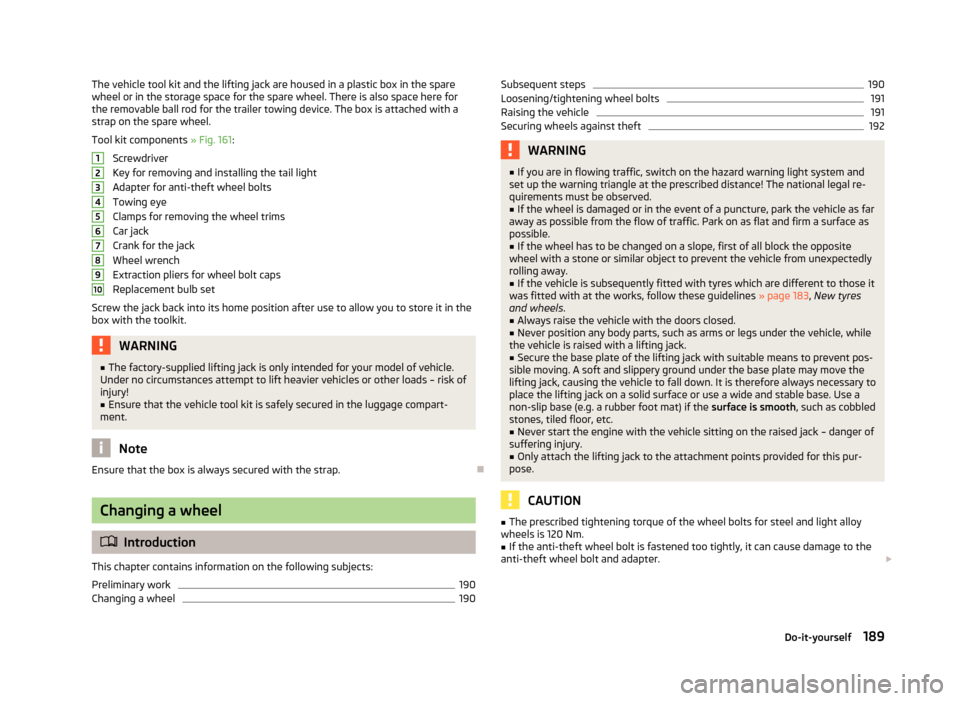
The vehicle tool kit and the lifting jack are housed in a plastic box in the sparewheel or in the storage space for the spare wheel. There is also space here for
the removable ball rod for the trailer towing device. The box is attached with a
strap on the spare wheel.
Tool kit components » Fig. 161:
Screwdriver
Key for removing and installing the tail light
Adapter for anti-theft wheel bolts
Towing eye
Clamps for removing the wheel trims
Car jack
Crank for the jack
Wheel wrench
Extraction pliers for wheel bolt caps
Replacement bulb set
Screw the jack back into its home position after use to allow you to store it in the
box with the toolkit.WARNING■ The factory-supplied lifting jack is only intended for your model of vehicle.
Under no circumstances attempt to lift heavier vehicles or other loads – risk of
injury!■
Ensure that the vehicle tool kit is safely secured in the luggage compart-
ment.
Note
Ensure that the box is always secured with the strap.
Changing a wheel
Introduction
This chapter contains information on the following subjects:
Preliminary work
190
Changing a wheel
19012345678910Subsequent steps190Loosening/tightening wheel bolts191
Raising the vehicle
191
Securing wheels against theft
192WARNING■ If you are in flowing traffic, switch on the hazard warning light system and
set up the warning triangle at the prescribed distance! The national legal re-
quirements must be observed.■
If the wheel is damaged or in the event of a puncture, park the vehicle as far
away as possible from the flow of traffic. Park on as flat and firm a surface as
possible.
■
If the wheel has to be changed on a slope, first of all block the opposite
wheel with a stone or similar object to prevent the vehicle from unexpectedly
rolling away.
■
If the vehicle is subsequently fitted with tyres which are different to those it
was fitted with at the works, follow these guidelines » page 183, New tyres
and wheels .
■
Always raise the vehicle with the doors closed.
■
Never position any body parts, such as arms or legs under the vehicle, while
the vehicle is raised with a lifting jack.
■
Secure the base plate of the lifting jack with suitable means to prevent pos-
sible moving. A soft and slippery ground under the base plate may move the
lifting jack, causing the vehicle to fall down. It is therefore always necessary to
place the lifting jack on a solid surface or use a wide and stable base. Use a
non-slip base (e.g. a rubber foot mat) if the surface is smooth, such as cobbled
stones, tiled floor, etc.
■
Never start the engine with the vehicle sitting on the raised jack – danger of
suffering injury.
■
Only attach the lifting jack to the attachment points provided for this pur-
pose.
CAUTION
■ The prescribed tightening torque of the wheel bolts for steel and light alloy
wheels is 120 Nm.■
If the anti-theft wheel bolt is fastened too tightly, it can cause damage to the
anti-theft wheel bolt and adapter.
189Do-it-yourself
Page 206 of 222

Replacing the bulb for main beam and separate daytime
running lightsFig. 176
Halogen headlight: Replacing
the bulb for main beam and sep-
arate daytime running lights
First read and observe the introductory information and safety warn-
ings on page 202.
›
Remove the rubber cover
2
» Fig. 174 on page 203.
›
Turn the bulb holder
A
» Fig. 176 anti-clockwise up to the stop and remove.
›
Replace the bulb, insert the bulb holder with the new bulb and turn in a clock-
wise direction to the stop.
›
Insert the rubber cover.
Changing the bulb for daytime running lights and parking light
Fig. 177
Headlights with Xenon light:
Changing the bulb for daytime
running lights and parking light
First read and observe the introductory information and safety warn-
ings on page 202.
›
Remove the rubber cover
4
» Fig. 174 on page 203.
›
Turn the bulb holder
B
» Fig. 177 anti-clockwise up to the stop and remove.
›Replace the bulb, insert the bulb holder with the new bulb and turn in a
clock-
wise direction to the stop.›
Insert the rubber cover.
Changing light bulbs for fog lights
Fig. 178
Front bumper: Remove the protective grille/fog light
Fig. 179
Replacing the light bulb
First read and observe the introductory information and safety warn-
ings on page 202.
Removing the protective grille
›
Release the protective grille in the area of the arrow » Fig. 178 -
using the
clamp for removing the wheel trims » page 188, Vehicle tool kit .
›
Remove the protective grille in the direction of the arrow
1
» Fig. 178 .
Changing light bulbs for fog lights
›
Use the screwdriver from the tool kit to unscrew the fog lamp » Fig. 178 -
.
›
Unlock the fuse in the direction of the arrow
2
with the screwdriver.
›
Remove the headlight in the direction of the arrow
3
.
204Do-it-yourself
Page 207 of 222

›Remove the connector.›Turn the bulb holder A
» Fig. 179 in an anti-clockwise direction up to the stop
and remove.›
Insert the bulb holder with the new buln into the headlight and turn in a clock-
wise direction as far as the stop.
›
Fit the connector.
›
Replace the fog lamp by inserting it in the opposite direction of the arrow
3
» Fig. 178 and tighten.
›
Insert the protective grille and carefully press it in.
The protective grille must engage firmly.
Changing the bulb for the licence plate light
Fig. 180
Remove the number plate light/replace the bulb
First read and observe the introductory information and safety warn- ings
on page 202.
›
Open the luggage compartment lid.
›
Insert a slotted screwdriver at the location indicated by the arrow » Fig. 180 -
,
press it in lightly, and unlatch the springs.
›
Remove the lamp.
›
Pull the faulty bulb out of the holder in the direction of the arrow » Fig. 180 -
.
›
Insert a new bulb into the holder.
›
Replace the lamp and lightly press it until the spring latches.
Tail lamp assemblyFig. 181
Remove cover/light
Fig. 182
Installing the lamp connector/lamp
First read and observe the introductory information and safety warn-
ings
on page 202.
Removing
›
Open the luggage compartment lid.
›
Insert the clamp for removing the wheel trims
into the hole at the position
indicated by the arrow » page 188, Vehicle tool kit - » Fig. 181 .
›
Remove the cover in the direction of the arrow » Fig. 181 -
.
›
Use the screwdriver from the tool kit » Fig. 181 -
to unscrew the lamp.
›
Grip the tail lamp assembly and carefully remove it by pulling vertically to the di-
rection of travel with loosening movements.
›
Press together the interlocks on the connector in the direction of the arrow
1
» Fig. 182 -
.
205Fuses and light bulbs
Page 219 of 222

Towing196
Towing a trailer106
Towing device Description
106
Drawbar load106
Towing eye front
197
Rear197
Towing protection36
Traction control system (TCS)113
Traffic sign recognition25
Traffic signs see Traffic sign recognition
25
Trailer106
13-pin power socket110
driving with a trailer110
loading109
Safety eye110
Transport Boot
64
Roof rack system68
Transporting children safely154
Two-way radio systems134
Type plate207
Tyre control display Calibration
185
Tyre load-bearing capacity see Wheels
184
Tyre repair192
Tyres see Wheels
183
U
Underbody protection
163
Unlocking Remote control
32
Unlock the vehicle Keys
31
V
Vehicle battery Automatic load deactivation
180
charging179
Checking the electrolyte level179
Operation in winter179
replacing179
Safety instructions176
Vehicle care Alcantara
164
Artificial leather164
Cloths164
Vehicle Condition see Auto Check Control
12
Vehicle data sticker207
Vehicle dimensions208
Vehicle height208
vehicle identification number - VIN (vehicle body number)
207
Vehicle key28
Vehicle length208
Vehicle tool kit188
Vehicle width208
Vest Holder for reflex vest
74
Visors see Sun screen
53
see Sun visors53
W
Warning lights
12
Warning symbols see Warning lights
12
Warning triangle188
Washing159
Automatic car wash system160
by hand160
Chrome parts161
High-pressure cleaner161
Weights207
Wheel bolts Anti-theft wheel bolt
192
Caps185
Loosening and tightening191
Wheel rims181
Wheels Bolts
186
changing189
Full trim185
General information181
Load index184
Low-profile tyres184
new tyres183
replacing wheels182
Snow chains186
Spare wheel184
Speed symbol183
Store wheels182
Tyre inflation pressure182
Tyre life182
Winter tyres186
Window Interior mirror
57
Window convenience operation40
Windows De-icing
162
See Electrical power windows38
Windscreen heating
52
see Radio reception162
Windscreen washer fluid Checking
176
Replenishing176
Warning light19
Winter176
Windscreen washer system176
Windscreen wipers54
217Index