2012 SKODA CITIGO tow
[x] Cancel search: towPage 51 of 157
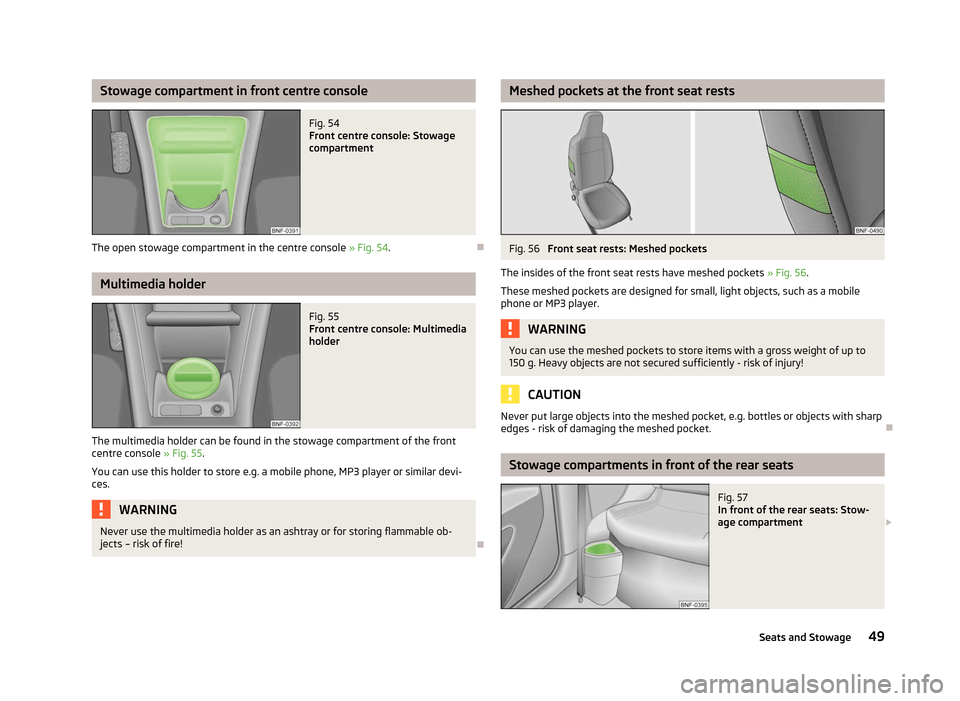
Stowage compartment in front centre console
Fig. 54
Front centre console: Stowage
compartment
The open stowage compartment in the centre console » Fig. 54. ÐMultimedia holder
Fig. 55
Front centre console: Multimedia
holder
The multimedia holder can be found in the stowage compartment of the front
centre console » Fig. 55.
You can use this holder to store e.g. a mobile phone, MP3 player or similar devi-
ces. WARNING
Never use the multimedia holder as an ashtray or for storing flammable ob-
jects – risk of fire! Ð Meshed pockets at the front seat rests
Fig. 56
Front seat rests: Meshed pockets
The insides of the front seat rests have meshed pockets » Fig. 56.
These meshed pockets are designed for small, light objects, such as a mobile
phone or MP3 player. WARNING
You can use the meshed pockets to store items with a gross weight of up to
150 g. Heavy objects are not secured sufficiently - risk of injury! CAUTION
Never put large objects into the meshed pocket, e.g. bottles or objects with sharp
edges - risk of damaging the meshed pocket. Ð Stowage compartments in front of the rear seats
Fig. 57
In front of the rear seats: Stow-
age compartment £
49
Seats and Stowage
Page 52 of 157
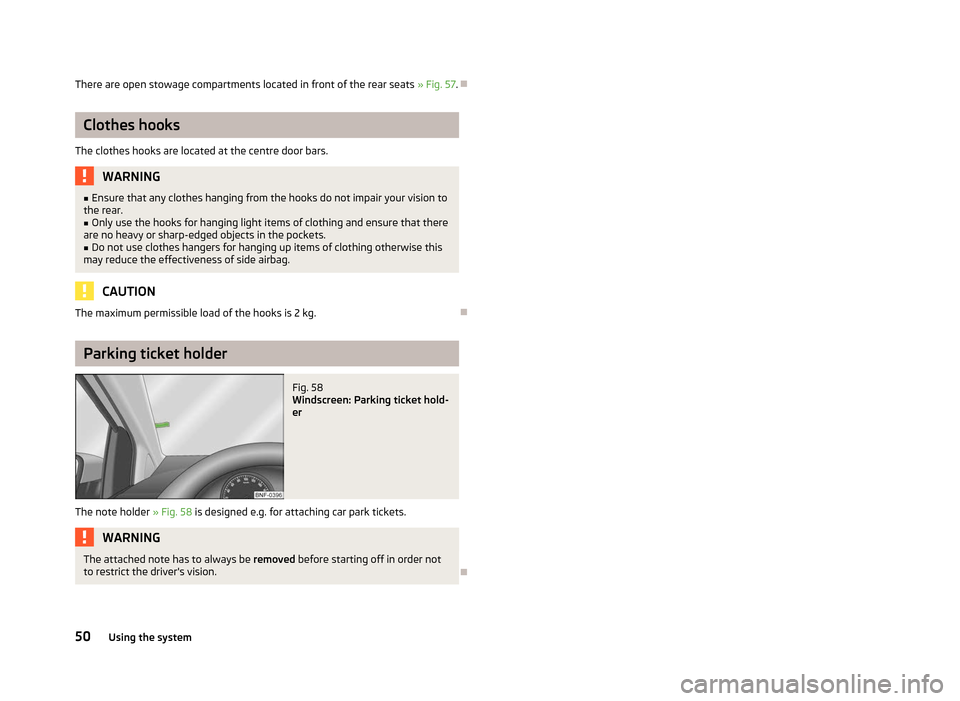
There are open stowage compartments located in front of the rear seats
» Fig. 57.ÐClothes hooks
The clothes hooks are located at the centre door bars. WARNING
■ Ensure that any clothes hanging from the hooks do not impair your vision to
the rear.
■ Only use the hooks for hanging light items of clothing and ensure that there
are no heavy or sharp-edged objects in the pockets.
■ Do not use clothes hangers for hanging up items of clothing otherwise this
may reduce the effectiveness of side airbag. CAUTION
The maximum permissible load of the hooks is 2 kg. ÐParking ticket holder
Fig. 58
Windscreen: Parking ticket hold-
er
The note holder » Fig. 58 is designed e.g. for attaching car park tickets.WARNING
The attached note has to always be removed before starting off in order not
to restrict the driver's vision. Ð50
Using the system
Page 54 of 157
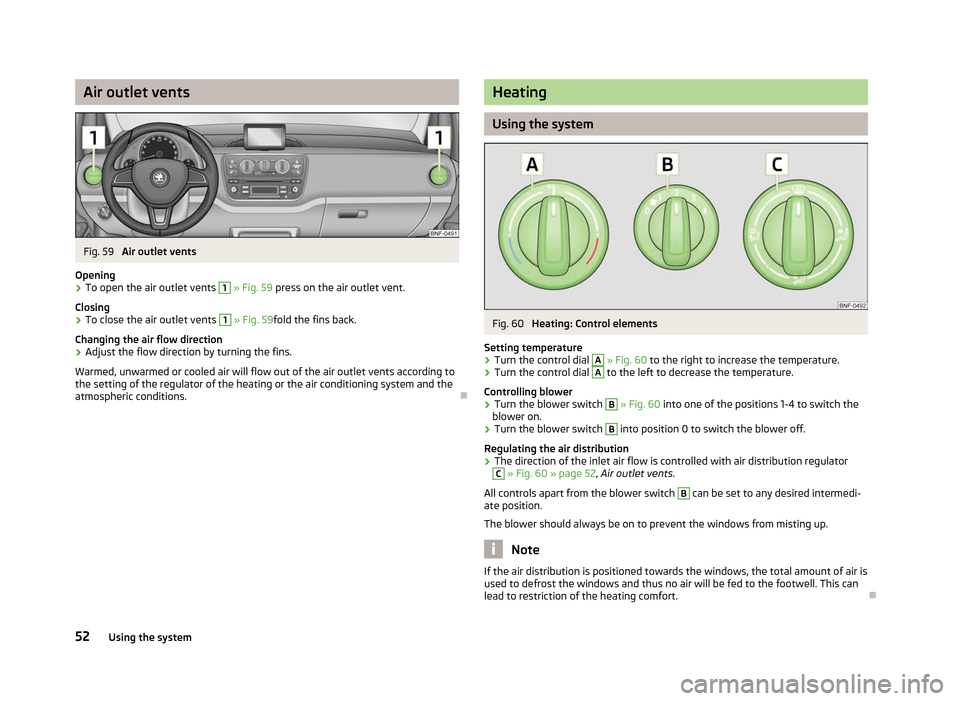
Air outlet vents
Fig. 59
Air outlet vents
Opening
› To open the air outlet vents 1
» Fig. 59 press on the air outlet vent.
Closing
› To close the air outlet vents 1
» Fig. 59
fold the fins back.
Changing the air flow direction
› Adjust the flow direction by turning the fins.
Warmed, unwarmed or cooled air will flow out of the air outlet vents according to
the setting of the regulator of the heating or the air conditioning system and the
atmospheric conditions. Ð Heating
Using the system
Fig. 60
Heating: Control elements
Setting temperature › Turn the control dial A
» Fig. 60 to the right to increase the temperature.
› Turn the control dial A
to the left to decrease the temperature.
Controlling blower
› Turn the blower switch B
» Fig. 60 into one of the positions 1-4 to switch the
blower on.
› Turn the blower switch B
into position 0 to switch the blower off.
Regulating the air distribution
› The direction of the inlet air flow is controlled with air distribution regulator C
» Fig. 60
» page 52, Air outlet vents.
All controls apart from the blower switch B
can be set to any desired intermedi-
ate position.
The blower should always be on to prevent the windows from misting up. Note
If the air distribution is positioned towards the windows, the total amount of air is
used to defrost the windows and thus no air will be fed to the footwell. This can
lead to restriction of the heating comfort. Ð
52 Using the system
Page 56 of 157
Using the system
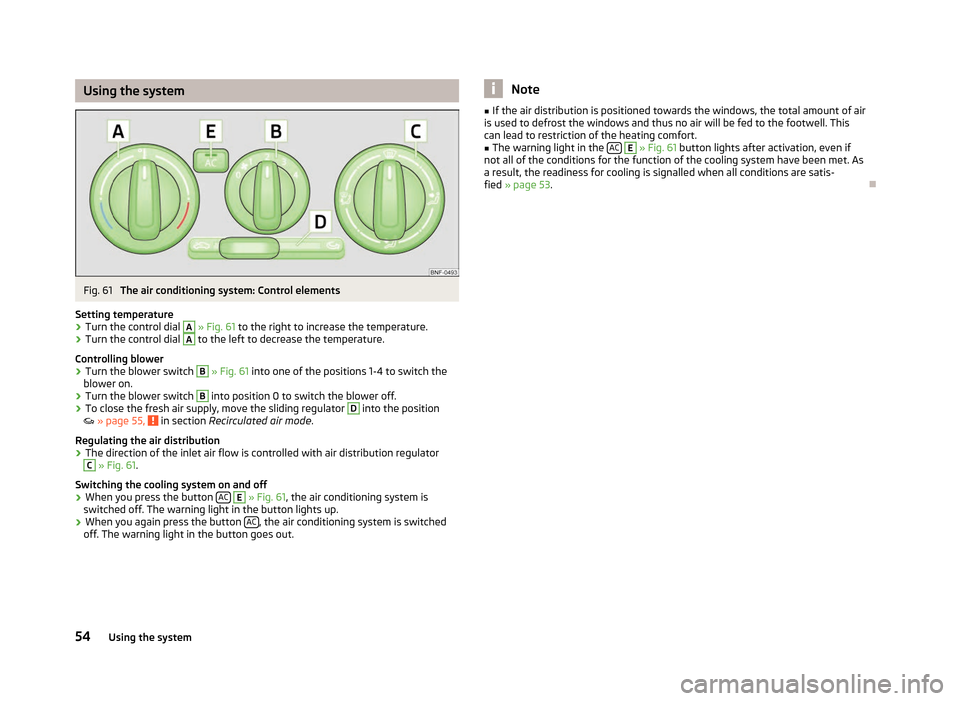
Fig. 61
The air conditioning system: Control elements
Setting temperature
› Turn the control dial A
» Fig. 61 to the right to increase the temperature.
› Turn the control dial A
to the left to decrease the temperature.
Controlling blower
› Turn the blower switch B
» Fig. 61 into one of the positions 1-4 to switch the
blower on.
› Turn the blower switch B
into position 0 to switch the blower off.
› To close the fresh air supply, move the sliding regulator D
into the position
»
page 55, in section
Recirculated air mode .
Regulating the air distribution
› The direction of the inlet air flow is controlled with air distribution regulator C
» Fig. 61.
Switching the cooling system on and off
› When you press the button
AC E
» Fig. 61
, the air conditioning system is
switched off. The warning light in the button lights up.
› When you again press the button
AC , the air conditioning system is switched
off. The warning light in the button goes out. Note
■ If the air distribution is positioned towards the windows, the total amount of air
is used to defrost the windows and thus no air will be fed to the footwell. This
can lead to restriction of the heating comfort. ■ The warning light in the AC E
» Fig. 61 button lights after activation, even if
not all of the conditions for the function of the cooling system have been met. As
a result, the readiness for cooling is signalled when all conditions are satis-
fied » page 53. Ð54
Using the system
Page 58 of 157

Starting-off and Driving
Starting and stopping the engine
ä
Introduction
This chapter contains information on the following subjects:
Adjusting the steering wheel position 57
Electromechanical power steering 57
Electronic immobiliser 57
Ignition lock 58
Starting engine 58
Switching the engine off 58
WARNING
■ Never adjust the steering wheel when the vehicle is moving only when the
vehicle is stationary!
■ Maintain a distance of 25 cm B
to the steering wheel
» Fig. 62 on page 57.
Not maintaining this minimum distance will mean that the airbag system will
not be able to properly protect you – hazard! ■ The lever for adjusting the steering wheel must be locked whilst driving so
that the position of the steering wheel cannot accidently change during the
journey – risk of accident! ■ If the steering wheel is adjusted further towards the head, the protection
provided by the driver airbag in the event of an accident is reduced. Check
that the steering wheel is aligned to the chest. ■ When driving, hold the steering wheel with both hands firmly on the outer
edge in the 9
o'clock and 3 o'clock position. Never hold the steering wheel in
the 12 o'clock position or in any other way (e.g. in the middle or inner edge of
the steering wheel). In such cases, you could injure the arms, hands and head
when the driver airbag is deployed. ■ When driving, the ignition key must always be in the position 2
» Fig. 63 on
page 58
(ignition switched on) without the engine running. This position is
indicated by the warning lights coming on. If this is not the case, it could result
in unexpected locking of the steering wheel – risk of accident! WARNING (Continued)
■ Only pull the ignition key from the ignition lock when the vehicle has come
to a complete stop (by applying the handbrake). Otherwise the steering wheel
could block – risk of accident!
■ When leaving the vehicle, the ignition must always be removed. This is par-
ticularly important if children are left in the vehicle. Otherwise the children
could, for example, start the engine – risk of accident or injury!
■ Never leave the engine running in unventilated or closed rooms. The ex-
haust gases of the engine contain besides the odorless and colourless carbon
monoxide a poisonous gas – hazard! Carbon monoxide can cause uncon-
sciousness and death. ■ Never leave the vehicle unattended with the engine running.
■ Never switch off the engine before the vehicle is stationary – risk of acci-
dent! CAUTION
■ The starter may only be operated (ignition key position 3
» page 58), if the
engine is not running. The starter or engine can be damaged if the starter is acti-
vated when the engine is running. ■ Let go of the ignition key as soon as the engine starts otherwise the starter
could be damaged. ■ Avoid high engine revolutions, full throttle and high engine loads as long as the
engine has not yet reached its operating temperature – risk of damaging the en-
gine!
■ Do not tow start the engine - danger of damaging the engine! On vehicles with
a catalytic converter, unburnt fuel may get into the catalytic converter where it
may ignite. This in turn may damage the catalytic converter. The battery from an-
other vehicle can be used as a jump-start aid » page 134, Jump-starting .
■ Do not switch the engine off immediately at the end of your journey after the
engine has been operated over a prolonged period at high loads but leave it to
run at an idling speed for about 1
minute. This prevents any possible accumulation
of heat when the engine is switched off. For the sake of the environment
Do not warm up the engine while the vehicle is stationary. If possible, start your
journey as soon as the engine has started. Through this the engine reaches its
operating temperature more rapidly and the pollutant emissions are lower. £
56 Using the system
Page 59 of 157

Note
■ The engine can only be started with a genuine ŠKODA key with the matching
code. ■ The engine running noises may louder at first be louder for a short time after
starting the cold engine. This is quite normal and is not an operating problem. ■ After switching off the ignition, the radiator fan can intermittently continue to
operate for approx. 10
minutes.
■ If the engine does not start up after a second attempt, the fuse for the fuel
pump may have a fault. Check the fuse and replace, if necessary » page 138,
Fuses on the underside of the dash panel or seek assistance from a ŠKODA
spe-
cialist garage.
■ We recommend locking the steering wheel whenever leaving the vehicle. This
acts as a deterrent against the attempted theft of your car. ÐAdjusting the steering wheel position
Fig. 62
Adjustable steering wheel: Lever below the steering wheel/safe dis-
tance to the steering wheel
First read and observe the introductory information and safety warn-
ings on page 56.
The height of the steering wheel can be adjusted.
› First of all adjust the driver's seat
» page 38.
› Pull the lever A
» Fig. 62 below the steering wheel down.
› Adjust the height of the steering wheel to the desired position.
› Push the lever upwards to the stop. Ð
ä Electromechanical power steering
First read and observe the introductory information and safety warn-
ings on page 56.
The power steering enables you to steer the vehicle with less physical force.
With the electromechanical power steering, the steering assist is automatically
adapted to the speed and to the steering angle.
It is still possible to fully steer the vehicle if the power steering fails or if the en-
gine is not running (vehicle being towed in). However, greater physical effort is
required to turn the steering wheel.
If there is a fault in the power steering, the warning light or lights up in the
instrument cluster » page 16. WARNING
Contact your ŠKODA specialist garage if the power steering is defective. Ð Electronic immobiliser
First read and observe the introductory information and safety warn-
ings on page 56.
An electronic chip is integrated in the head of the key. The immobiliser is deacti-
vated with the aid of this chip when the key is inserted in the ignition lock. The
electronic immobiliser is automatically activated when the ignition key is with-
drawn from the lock.
The engine will not start if a non-authorized ignition key is used. Ð
ä
ä
57
Starting-off and Driving
Page 61 of 157

WARNING (Continued)
■ If a front spoiler, full wheel trim, etc. is mounted retrospectively, it must be
ensured that the air supply to the front wheel brakes is not reduced. Other-
wise, the functionality of the brake system could be impaired – risk of acci-
dent!
■ Please note that the handbrake must be fully released. A handbrake which
is only partially released can result in the rear brakes overheating, which can
have a negative effect on the operation of the brake system – risk of accident!
■ Never leave children unattended in the vehicle. The children might, for ex-
ample, release the handbrake or take the vehicle out of gear. The vehicle
might then move off – risk of accident!
■ A lack of fuel can cause irregular engine running or cause the engine to shut
down. The brake assist systems would then be without function – risk of acci-
dent!
■ Adjust the speed and driving style to the current visibility, weather, road and
traffic conditions. The increased safety offered by the brake assist systems
must not tempt you to take greater risks than otherwise – risk of an accident! ■ The normal braking system is still fully functional if there is an ABS fault.
Visit a ŠKODA specialist garage immediately and adjust your style of driving
according to the damage to the ABS as you will not know how great the dam-
age is and the limitation it is placing on the braking efficiency. CAUTION
■ Observe the recommendations on the new brake pads » page 91.
■ Never let the brakes slip with light pressure on the pedal if braking is not neces-
sary. This causes the brakes to overheat and can also result in a longer braking
distance and excessive wear. ■ All four wheels must be fitted with the same tyres approved by the manufactur-
er to ensure the brake assist systems operate correctly. Note
■ If the brakes are applied in full and the control unit for the braking system con-
siders the situation to be dangerous for the following traffic, the brake light
flashes automatically. After the speed was reduced below around 10
km/h or the
vehicle was stopped, the brake light stops flashing and the hazard warning light
system switches on. The hazard warning light system is switched off automatical-
ly after accelerating or driving off again. ■ Before negotiating a steep downhill section, reduce the speed, shift down into
the next lower gear (manual gearbox) or select a lower drive position (automatic
gearbox). As a result, the braking effect of the engine will be used, reducing the
load on the brakes. Any additional braking should be completed intermittently,
not continuously. ■ Changes to the vehicle (e.g. to the engine, brakes, chassis or another combina-
tion of tyres and wheels) can influence the functionality of the brake assist sys-
tems »
page 125, Accessories, changes and replacement of parts .
■ If a fault occurs in the ABS system, the ESC, TCS and EDL also do not work. A
warning light » page 17 comes on if a fault occurs in the ABS system. Ð Information for braking
First read and observe the introductory information and safety warn-
ings on page 58.
Wear-and-tear
The wear of the brake pads is dependent on the operating conditions and driving
style. The brake pads wear more quickly if a lot of journeys are completed in
towns and over short distances or if a very sporty style of driving is adopted. If
operated under severe conditions, the thickness of the brake pads must be
checked by a ŠKODA specialist garage before the next service appointment.
Wet roads or road salt
The performance of the brakes can be delayed as the brake discs and brake pads
may be moist or have a coating of ice or layer of salt on them in winter. The
brakes are cleaned and dried by applying the brakes several times.
Corrosion
Corrosion on the brake discs and dirt on the bake pads occur if the vehicle has
been parked for a long period and if you do not make much use of the braking
system. If the brake system is not used much or if there is corrosion on the sur-
face, we recommend cleaning the brake discs by firmly applying the brakes from a
high speed. £
ä
59
Starting-off and Driving
Page 69 of 157

WARNING (Continued)
■ The City Safe Drive system can carry out unexpected braking interventions
in complex driving situations, e.g. when vehicles scrape past each other.
■ Taking the City Safe Drive system into account in one's own driving behav-
iour can lead to accidents and serious injuries. The
City Safe Drive system is
not a substitute for the driver's attention. ■ Always adapt your speed and safety distance to the vehicle ahead to the
visibility, weather, road and traffic conditions.
■ The laser beam from the laser sensor can cause serious eye injuries.
■ Never use optical devices, e.g. a range-finder camera or magnifying glass to
look into the laser sensor.
■ The laser beam can also be active when the City Safe Drive system is
switched off or is not available. The laser beam is not visible to the human
eye.
■ The City Safe Drive system cannot detect persons, animals, or crossing vehi-
cles or approaching vehicles in the same lane.
■ The City Safe Drive system cannot exceed physical and system-defined lim-
its. For instance, responses from the
City Save Drive system can happen late
or unexpectedly from the driver's perspective. Always stay attentive and take
control when required. CAUTION
If the vehicle starts to roll after the City Safe Drive system is triggered, use the
foot pedal to break. Note
■ When replacing the windscreen wiper blades, only use windscreen blades ap-
proved by ŠKODA. ■ Do not paint the laser sensor range on the windscreen. Do not cover it up with
stickers or similar. ■ Remove any snow with a hand-held brush and we recommend you remove any
ice with a solvent-free deicing spray. ■ Keep the laser sensor range free of dirt and ice at all times.
■ If the laser sensor range on the windscreen has scratches, cracks, etc, replace
the windscreen. Only use windscreens approved by
ŠKODA. Carrying out repairs
to the windscreen are not permissible. ■
A damaged windscreen in the area of the laser sensor can lead to a failure of
the City Safe Drive
system.
■ Repairing the laser sensor requires specialist expertise. We recommend an au-
thorised
ŠKODA Service partner. Ð Switching the City Safe Drive on and off
Fig. 71
Lower part of the centre con-
sole: Button for the City Safe
Drive system
First read and observe the introductory information and safety warn-
ings on page 66.
Switching on the City Safe Drive
The City Safe Drive
system is automatically switched on after turning on the igni-
tion.
Switching the City Safe Drive system on and off again
The City Safe Drive system is switched off by pressing the button » Fig. 71 in the
front centre console.
When the City Safe Drive system is switched off while the vehicle is travelling at a
speed between 5–30 km/h (3–19 mph), the warning light will light up in the
instrument cluster display.
You can switch on the City Safe Drive system again with the button » Fig. 71. The
warning light lights up for around 5 seconds in the instrument cluster dis-
play.
The City Safe Drive system must be switched off in the following cases.
› When the vehicle is being towed away.
› When the vehicle is driven though an automatic car wash.
› When the vehicle is on a rolling test bench.
› When the laser sensor is faulty.
› After force is applied to the laser sensor.
› When driving off-road (overhanging branches).
£
ä
67
Starting-off and Driving