2012 SKODA CITIGO tow
[x] Cancel search: towPage 40 of 157

Seats and Stowage
Front seats
ä
Introduction
This chapter contains information on the following subjects:
Adjusting the front seats 38
Front seat heating 39
The driver's seat should be adjusted in such a way that the pedals can be fully
pressed to the floor with slightly bent legs.
The seat backrest on the driver's seat should be adjusted in such a way that the
upper point of the steering wheel can be easily reached with slightly bent arms.
Correct adjustment of the seats is particularly important for:
› safely and quickly reaching the controls;
› a relaxed, fatigue-free body position;
› achieving the maximum protection offered by the seat belts and the airbag
system. WARNING
■ Only adjust the driver's seat when the vehicle is stationary – risk of accident!
■ Caution when adjusting the seat! You may suffer injuries or bruises as a re-
sult of adjusting the seat without paying proper attention.
■ The seat backrests must not be angled too far back when driving otherwise
this will affect proper operation of the seat belts and of the airbag system –
risk of injury!
■ Never carry more people than the number of seats in the vehicle.
■ Each occupant must correctly fasten the seat belt belonging to the seat.
Children must be fastened » page 87, Transporting children safely with a
suitable restraint system.
■ The front seats and rear head restraints must always be adjusted to match
the body size, in order to offer an optimal protection for you and your occu-
pants. WARNING (Continued)
■ Always keep your feet in the footwell when the car is being driven – never
place your feet on the instrument panel, out of the window or on the surfaces
of the seats. This is particularly important for the front seat passenger. You
will be exposed to increased risk of injury if it becomes necessary to apply the
brake or in the event of an accident. If an airbag is deployed, you may suffer
fatal injuries when adopting an incorrect seated position!
■ It is important for the driver and front passenger to maintain a distance of at
least 25 cm from the steering wheel or dash panel. Not maintaining this mini-
mum distance will mean that the airbag system will not be able to properly
protect you – hazard!
■ Ensure that there are no objects in the driver's footwell as they may get
caught behind the pedals when driving or applying the braking. You would
then no longer be able to operate the clutch, brake or accelerate.
■ Do not transport any objects on the front passenger seat except objects
(e.g. child safety seat) provided for this purpose – risk of accident! Note
After a certain time, play can develop within the adjustment mechanism of the
backrest angle. Ð Adjusting the front seats
Fig. 35
Control elements at the seat
First read and observe the introductory information and safety warn-
ings on page 38.
Adjusting a seat in a forward/back direction
› Pull the lever 1
» Fig. 35 up and push the seat into the desired position.
› Release the lever 1
and push the seat until the lock clicks into place.
£
ä
38 Using the system
Page 41 of 157

Adjusting height of seat
›
To lift the seat, pull or pump the lever 2
» Fig. 35 upwards.
› To lower the seat, push or pump the lever 2
downwards.
Adjusting the angle of the seat backrest
› Remove the load on the seat backrest (do not lean on it), pull the lever 3
» Fig. 35 or 4 1)
towards the rear and set the desired angle of the seat back-
rest with the back.
Folding the front seat forwards and moving it 1
)
› Pull the lever 3
» Fig. 35
or 4
and fold the seat backrest fully forwards. At the
same time, move the seat forwards.
Moving seats into the initial position 1
)
› Move the seat towards the rear until the lock is heard to engage.
› Then push the seat backrest back into the upright position until the unlocking
button clicks into place - check by pulling on the seat backrest. ÐFront seat heating
Fig. 36
Heated front seats
First read and observe the introductory information and safety warn-
ings on page 38.
The front seats can be heated electrically. In some seat versions, the seat back-
rest is heated as well.
The seat heating can only be switched on when the engine is running.
› Heating on the driver's and front passenger's seat can be switched on and
regulated by pressing the button or
» Fig. 36.
ä Pressing once switches the seat heating on at its maximum level.
With repeated pressing of the switch, the level of the seat heating is down-regu-
lated up to the switch-off. The level of the seat heating is indicated by the num-
ber of illuminated warning lights in the switch. WARNING
If, as an occupant, you have a subdued pain and/or temperature sensitivity,
e.g. through medication, paralysis or because of chronic illness (e.g. diabetes),
we recommend you do not use seat heating on the driver or front passenger
seat. This can lead to burns on the back, the posterior and the legs which are
difficult to heal. If the seat heating is used, we recommend to make regular
breaks in your journey when driving long distances, so that the body can recu-
perate from the stress of the journey. Please consult your doctor, who can
evaluate your specific condition. CAUTION
■ Do not kneel on the seats or otherwise apply pressure at specific points to
avoid damaging the heating elements for the seat heaters.
■ Do not use the seat heaters if the seats are not occupied by persons or if ob-
jects, such as a child seat, bag, etc., are fastened or stored on them. A fault of the
heating elements in the seat heating can occur.
■ Do not clean the seats using moisture » page 102, Fabric covers on electrically
heated seats. Note
If the on-board voltage drops, the seat heating is switched off automatically, in
order to provide sufficient electrical energy for the engine control »
page 118,
Automatic load deactivation . Ð1)
Applies to front seats with the Easy Entry system.
39
Seats and Stowage
Page 42 of 157
Head restraints
Fig. 37
Head restraints rear: adjusting/
removing
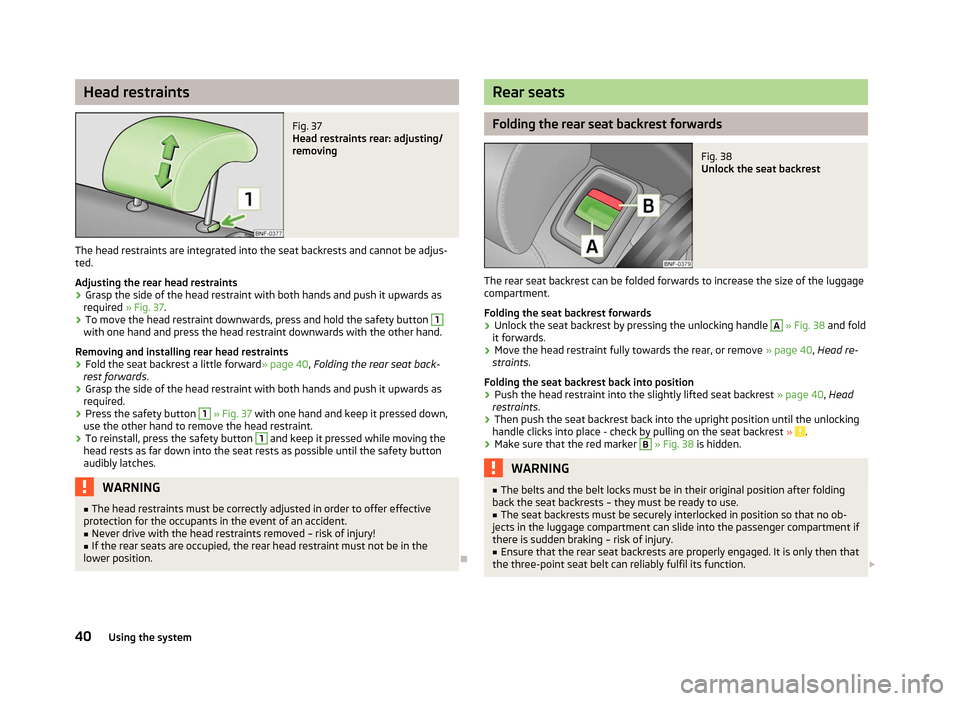
The head restraints are integrated into the seat backrests and cannot be adjus-
ted.
Adjusting the rear head restraints
› Grasp the side of the head restraint with both hands and push it upwards as
required » Fig. 37.
› To move the head restraint downwards, press and hold the safety button 1
with one hand and press the head restraint downwards with the other hand.
Removing and installing rear head restraints
› Fold the seat backrest a little forward
» page 40, Folding the rear seat back-
rest forwards.
› Grasp the side of the head restraint with both hands and push it upwards as
required.
› Press the safety button 1
» Fig. 37 with one hand and keep it pressed down,
use the other hand to remove the head restraint.
› To reinstall, press the safety button 1
and keep it pressed while moving the
head rests as far down into the seat rests as possible until the safety button
audibly latches. WARNING
■ The head restraints must be correctly adjusted in order to offer effective
protection for the occupants in the event of an accident.
■ Never drive with the head restraints removed – risk of injury!
■ If the rear seats are occupied, the rear head restraint must not be in the
lower position. Ð Rear seats
Folding the rear seat backrest forwards
Fig. 38
Unlock the seat backrest
The rear seat backrest can be folded forwards to increase the size of the luggage
compartment.
Folding the seat backrest forwards › Unlock the seat backrest by pressing the unlocking handle A
» Fig. 38 and fold
it forwards.
› Move the head restraint fully towards the rear, or remove
» page 40, Head re-
straints.
Folding the seat backrest back into position
› Push the head restraint into the slightly lifted seat backrest
» page 40, Head
restraints.
› Then push the seat backrest back into the upright position until the unlocking
handle clicks into place - check by pulling on the seat backrest » .
› Make sure that the red marker B
» Fig. 38 is hidden.
WARNING
■ The belts and the belt locks must be in their original position after folding
back the seat backrests – they must be ready to use.
■ The seat backrests must be securely interlocked in position so that no ob-
jects in the luggage compartment can slide into the passenger compartment if
there is sudden braking – risk of injury.
■ Ensure that the rear seat backrests are properly engaged. It is only then that
the three-point seat belt can reliably fulfil its function. £
40 Using the system
Page 43 of 157

CAUTION
Ensure that the seat belts are not damaged when operating the seat backrests.
Under no circumstances must the rear seat belts be jammed by the folded back
seat backrests. ÐLuggage compartment
ä
Introduction
This chapter contains information on the following subjects:
Lashing eyes 42
Bag hooks 42
Fixing nets 43
Luggage compartment cover 43
Please observe the following for the purpose of maintaining good handling char-
acteristics of your vehicle:
› Distribute loads as evenly as possible.
› Place heavy objects as far forward as possible.
› Attach the items of luggage to the lashing eyes or using the fixing
net » page 42 .
In the event of an accident, there is such a high kinetic energy which is produced
by small and light objects that they can cause severe injuries. The magnitude of
the kinetic energy is dependent on the speed at which the vehicle is travelling
and the weight of the object. The speed at which the vehicle is travelling is in this
case the more significant factor.
Example: In the event of a frontal collision at a speed of 50 km/h, an unsecured
object with a weight of 4.5 kg produces an energy, which corresponds to 20 times
its own weight. This means that it results in a weight of approx. 90 kg “ ”. You can
imagine the injuries that can occur, if this “object” flies through the interior com-
partment and hits an occupant. WARNING
■ Store the objects in the luggage compartment and attach them to the lash-
ing eyes.
■ Loose objects in the passenger compartment can be thrown forward during
a sudden manoeuvre or in case of an accident and can injure the occupants or
other oncoming traffic. This risk is still increased, if the objects which are fly-
ing around are hit by a deployed airbag. In this case, the objects which are
thrown back can injure the occupants – hazard.
■ Please note that the handling properties of the vehicle may be affected
when transporting heavy objects as the centre of gravity can be displaced –
risk of accident! The speed and style of driving must be adjusted accordingly. ■ If the items of luggage or objects are attached to the lashing eyes with un-
suitable or damaged lashing straps, injuries can occur in the event of braking
manoeuvres or accidents. To prevent items of luggage from being thrown for-
ward, always use suitable lashing straps which must be firmly attached to the
lashing eyes. ■ The items carried in the luggage compartment must be stored in such a way
that no objects are able to slip forward if any sudden driving or braking ma-
noeuvres are undertaken – risk of injury!
■ When transporting fastened objects which are sharp and dangerous in the
luggage compartment that has been enlarged by folding the rear seats for-
ward, ensure the safety of the passengers transported on the other rear
seats »
page 76, Correct seated position for the occupants on the rear seats .
■ If the rear seat next to the folded forward seat is occupied, ensure maxi-
mum safety, e.g. by placing the goods to be transported in such a way that the
seat is prevented from folding back in case of a rear collision.
■ Never drive with the luggage compartment lid fully opened or slightly ajar
otherwise exhaust gases may get into the interior of the vehicle – risk of poi-
soning! ■ Under no circumstances, should the permissible axle loads and permissible
gross weight of the vehicle be exceeded – risk of accident! ■ Never transport people in the luggage compartment! CAUTION
Please ensure that the heating elements for the rear window heater are not dam-
aged as a result of abrasive objects. Note
The tyre pressure must be adjusted to the load . Ð
41
Seats and Stowage
Page 45 of 157
Fixing nets
Fig. 41
Fixing nets/fastening details in the rear area of the luggage com-
partment Fig. 42
Fixing nets: Details of the fastening behind the rear seats
First read and observe the introductory information and safety warn-
ings on page 41.
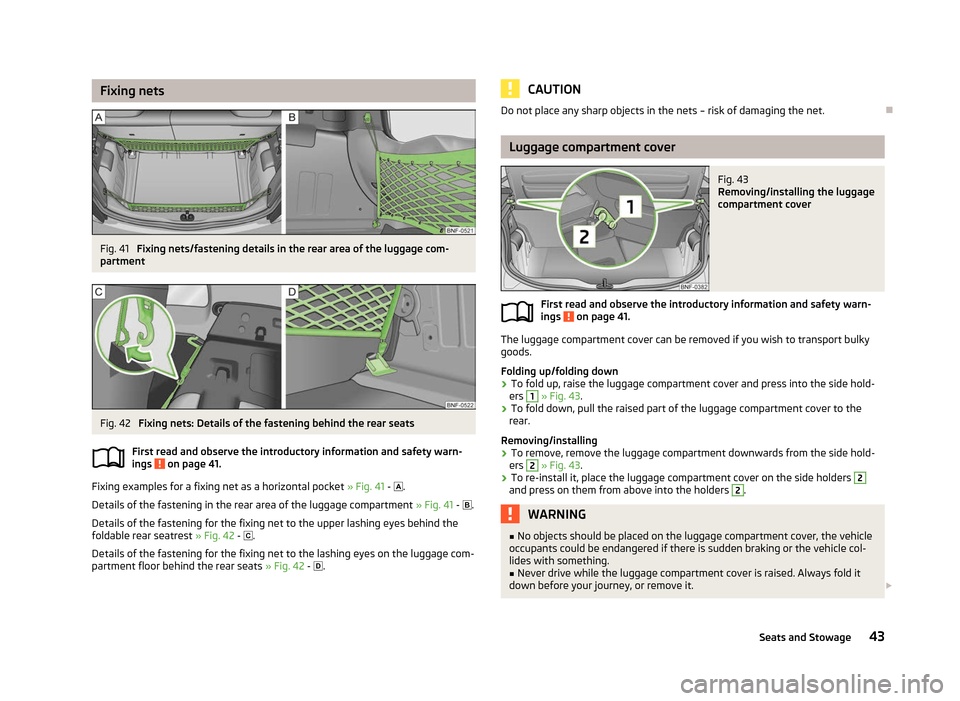
Fixing examples for a fixing net as a horizontal pocket
» Fig. 41 - .
Details of the fastening in the rear area of the luggage compartment » Fig. 41 - .
Details of the fastening for the fixing net to the upper lashing eyes behind the
foldable rear seatrest » Fig. 42 - .
Details of the fastening for the fixing net to the lashing eyes on the luggage com-
partment floor behind the rear seats » Fig. 42 - .
ä CAUTION
Do not place any sharp objects in the nets – risk of damaging the net. Ð Luggage compartment cover
Fig. 43
Removing/installing the luggage
compartment cover
First read and observe the introductory information and safety warn-
ings on page 41.
The luggage compartment cover can be removed if you wish to transport bulky
goods.
Folding up/folding down
›
To fold up, raise the luggage compartment cover and press into the side hold-
ers 1
» Fig. 43.
› To fold down, pull the raised part of the luggage compartment cover to the
rear.
Removing/installing
› To remove, remove the luggage compartment downwards from the side hold-
ers 2
» Fig. 43.
› To re-install it, place the luggage compartment cover on the side holders 2
and press on them from above into the holders 2
.
WARNING
■ No objects should be placed on the luggage compartment cover, the vehicle
occupants could be endangered if there is sudden braking or the vehicle col-
lides with something.
■ Never drive while the luggage compartment cover is raised. Always fold it
down before your journey, or remove it. £
ä
43
Seats and Stowage
Page 47 of 157
Roof load
First read and observe the introductory information and safety warn-
ings on page 44.
The maximum permissible roof load (including roof rack system) of
50 kg and the
maximum permissible total weight of the vehicle should not be exceeded.
The full permissible roof load cannot be used if a roof rack system with a lower
load carrying capacity is used. In this case, the roof rack system must only be loa-
ded up to the maximum weight limit specified in the fitting instructions. ÐCup holder
Fig. 45
Centre console: Cup holder at the front/rear
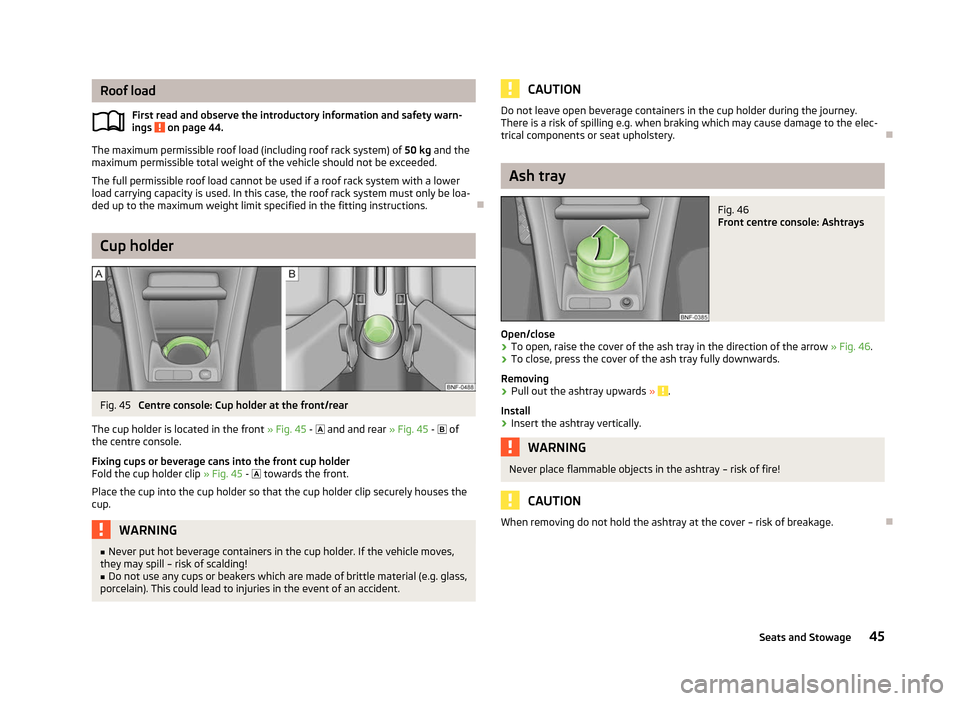
The cup holder is located in the front » Fig. 45 - and and rear » Fig. 45 - of
the centre console.
Fixing cups or beverage cans into the front cup holder
Fold the cup holder clip » Fig. 45 - towards the front.
Place the cup into the cup holder so that the cup holder clip securely houses the
cup. WARNING
■ Never put hot beverage containers in the cup holder. If the vehicle moves,
they may spill – risk of scalding! ■ Do not use any cups or beakers which are made of brittle material (e.g. glass,
porcelain). This could lead to injuries in the event of an accident.
ä CAUTION
Do not leave open beverage containers in the cup holder during the journey.
There is a risk of spilling e.g. when braking which may cause damage to the elec-
trical components or seat upholstery. Ð Ash tray
Fig. 46
Front centre console: Ashtrays
Open/close
› To open, raise the cover of the ash tray in the direction of the arrow
» Fig. 46.
› To close, press the cover of the ash tray fully downwards.
Removing
› Pull out the ashtray upwards
» .
Install
› Insert the ashtray vertically. WARNING
Never place flammable objects in the ashtray – risk of fire! CAUTION
When removing do not hold the ashtray at the cover – risk of breakage. Ð
45
Seats and Stowage
Page 49 of 157
Note
The 12-Volt power socket will only work when ignition is switched on. ÐStorage compartments
Overview
The vehicle has the following storage compartments: Storage compartment on the driver's side » page 47
Storage compartment on the front passenger side » page 47
Stowage compartment with cover on the passenger side » page 48
Bag holder » page 48
Photo holder » page 48
Stowage compartment in front centre console » page 49
Multimedia holder » page 49
Meshed pockets at the front seat rests » page 49
Stowage compartments in front of the rear seats » page 49WARNING
■ Do not place anything on the dash panel. These objects might slide or fall
down when driving and may distract you from concentrating on the traffic –
risk of accident!
■ When driving, ensure that no objects from the centre console or from other
storage compartments can get into the driver's footwell. You would then no
longer be able to apply the brakes, operate the clutch or accelerator – risk of
accident! Ð Storage compartment on the driver's side
Fig. 49
Dash panel: Storage compart-
ment on the driver's side
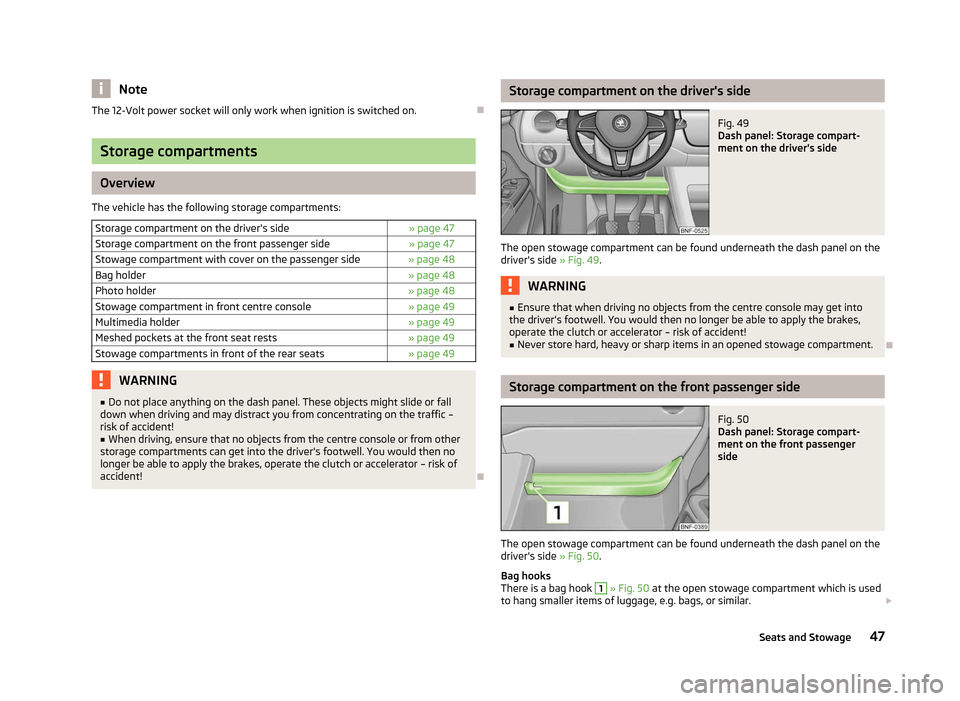
The open stowage compartment can be found underneath the dash panel on the
driver's side » Fig. 49. WARNING
■ Ensure that when driving no objects from the centre console may get into
the driver's footwell. You would then no longer be able to apply the brakes,
operate the clutch or accelerator – risk of accident!
■ Never store hard, heavy or sharp items in an opened stowage compartment. Ð Storage compartment on the front passenger side
Fig. 50
Dash panel: Storage compart-
ment on the front passenger
side
The open stowage compartment can be found underneath the dash panel on the
driver's side » Fig. 50.
Bag hooks
There is a bag hook 1
» Fig. 50 at the open stowage compartment which is used
to hang smaller items of luggage, e.g. bags, or similar. £
47
Seats and Stowage
Page 50 of 157
CAUTION
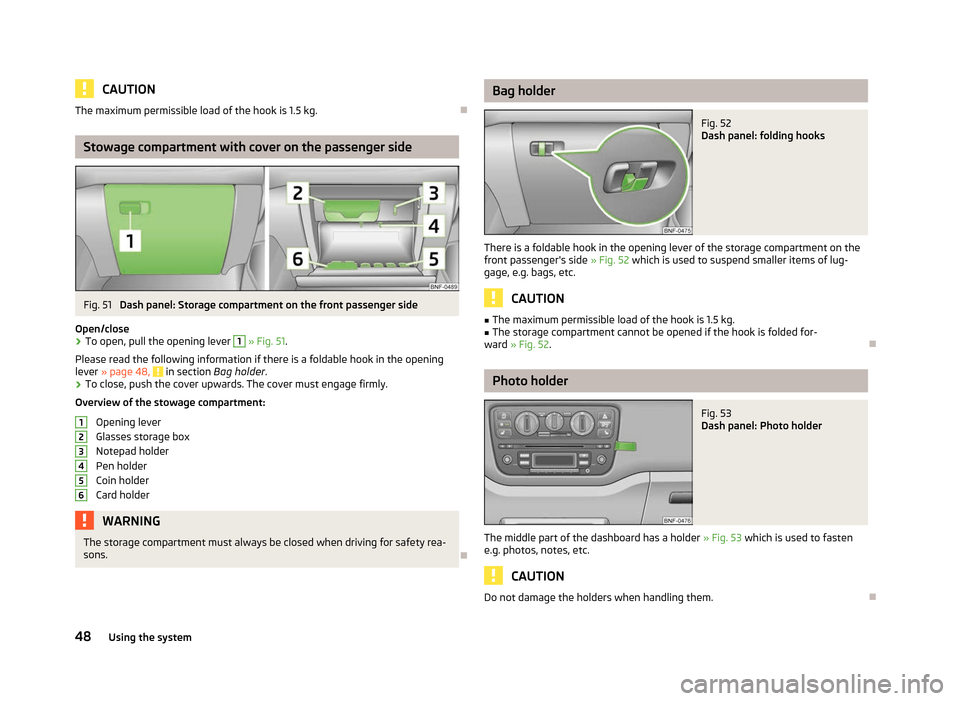
The maximum permissible load of the hook is 1.5 kg. ÐStowage compartment with cover on the passenger side
Fig. 51
Dash panel: Storage compartment on the front passenger side
Open/close › To open, pull the opening lever 1
» Fig. 51.
Please read the following information if there is a foldable hook in the opening
lever » page 48
, in section Bag holder
.
› To close, push the cover upwards. The cover must engage firmly.
Overview of the stowage compartment:
Opening lever
Glasses storage box
Notepad holder
Pen holder
Coin holder
Card holder WARNING
The storage compartment must always be closed when driving for safety rea-
sons. Ð1
2
3
4
5
6 Bag holder
Fig. 52
Dash panel: folding hooks
There is a foldable hook in the opening lever of the storage compartment on the
front passenger's side » Fig. 52
which is used to suspend smaller items of lug-
gage, e.g. bags, etc. CAUTION
■ The maximum permissible load of the hook is 1.5 kg.
■ The storage compartment cannot be opened if the hook is folded for-
ward » Fig. 52. Ð Photo holder
Fig. 53
Dash panel: Photo holder
The middle part of the dashboard has a holder » Fig. 53 which is used to fasten
e.g. photos, notes, etc. CAUTION
Do not damage the holders when handling them. Ð
48 Using the system