2012 SKODA CITIGO service
[x] Cancel search: servicePage 36 of 157

WARNING
■ Properly maintained windscreen wiper blades are essential for clear visibility
and safe driving » page 35.
■ Do not use the windscreen washer system at low temperatures, without
heating the windscreen beforehand. Otherwise the window cleaner could
freeze on the windscreen and restrict the view to the front. CAUTION
■ In cold temperatures and during the winter, check before the journey or before
switching on the ignition that the wiper blades are not frozen to the windscreen.
If the windscreen wipers are switched on when the blades are frozen to the
windscreen, this may damage both the blades and windscreen wiper motor!
■ If the ignition is switched off while the windscreen wipers are switched on, the
windscreen wipers will continue wiping in the same mode after the ignition is
turned back on. The windscreen wipers could freeze up in cold temperatures be-
tween the time the ignition was turned off and when it was turned back on again.
■ Carefully detach frozen wiper blades from the front or rear window.
■ Remove snow and ice from the windscreen wipers before driving.
■ If the windscreen wipers are handled carelessly, there is a risk of damage to the
windscreen.
■ Replace the windscreen wiper blades once or twice a year for safety reasons.
These can be purchased from a ŠKODA Service Partner.
■ The ignition must not be switched on if the front windscreen wiper arms are fol-
ded out. The wiper blades would move back into their rest position and while do-
ing so damage the paintwork of the bonnet. Note
■ Periodic wiping is dependent on the driving speed. The faster the driver is go-
ing, the more frequent the wiper action. ■ If there is an obstacle on the windscreen, the wiper will try to push away the
obstacle. If the wiper is blocked by an obstruction, the wiper will remain station-
ary. Remove the the obstacle and switch the wiper on again. ■ The capacity of the windscreen washer fluid reservoir is approximately 3 litres.
■ The wiper blades should be cleaned on a regular basis with a windscreen clean-
er to avoid any smears. The wiper blades should be cleaned with a sponge or
cloth if they are heavily soiled by insect residues, for example. Ð Activating the windscreen wipers and washers
Fig. 30
Activating the windscreen wipers/rear window wiper
First read and observe the introductory information and safety warn-
ings on page 33.
Flick wipe
›
If you only wish to wipe the windscreen
briefly, push the lever into the spring-
tensioned position 4
» Fig. 30.
Periodic wiping
› Position the lever upwards into position 1
» Fig. 30.
Slow wipe
› Position the lever upwards into position 2
» Fig. 30.
Fast wipe
› Position the lever upwards into position 3
» Fig. 30.
Automatic wipe/wash for windscreen
› Pull the lever towards the steering wheel into the spring-tensioned position 5
» Fig. 30, the wash system and the windscreen wipers will operate.
› Release the lever. The windscreen wash system stops and the wiper continues
for another 1-3 wiper strokes (depending on the period of spraying of the wind-
screen).
Wiping the rear window pane
› Push the lever away from the steering wheel into position 6
» Fig. 30 and the
windscreen wiper will operate every 6
seconds.
Automatic wipe/wash for the rear window
› Push the lever away from the steering wheel into the spring-tensioned position 7
» Fig. 30, the windscreen wiper and wash system will operate.
£
ä
34 Using the system
Page 37 of 157

›
Release the lever. The washer system stops and the wiper continues for anoth-
er 1-3 wiper strokes (depending on the duration of the spraying process). The
lever will stay in position after releasing it 6
.
Switching windscreen wipers off
› Move the lever back into the home position 0
» Fig. 30.
ÐReplacing the windscreen wiper blades
Fig. 31
Windscreen wiper blade
First read and observe the introductory information and safety warn-
ings on page 33.
Before replacing the windscreen wiper blade, put the windscreen wiper arms into
the service position.
Service position for changing wiper blades
›
Closing the bonnet.
› Switch the ignition off and on again.
› Press the windscreen wiper lever into position 4
» Fig. 30 on page 34, the
windscreen wiper arms will move into the service position.
Removing the wiper blade
› Raise the windscreen wiper arm from the rear window and slightly tilt the
windscreen wiper blade towards the wiper arm, arrow A
»
Fig. 31.
› Hold the windscreen wiper arm at the top end.
› Unlock the locking button 1
and remove the wiper blade in the direction of ar-
row B
.
Attaching the wiper blade
› Push the windscreen wiper blade until the stop and it locks in place.
› Check that the wiper blade is correctly attached.
› Fold the wiper arm back to the windscreen.
ä ›
Turn on the ignition and press the windscreen wiper lever into position 4
» Fig. 30 on page 34, the windscreen wiper arms move to the home position.
Ð Replacing the rear window wiper blade
Fig. 32
Rear window wiper blade
First read and observe the introductory information and safety warn-
ings on page 33.
Removing the wiper blade
›
Raise the windscreen wiper arm from the rear window and slightly tilt the
windscreen wiper blade towards the wiper arm, arrow A
»
Fig. 32.
› Hold the windscreen wiper arm at the top end.
› Unlock the locking button 1
and remove the wiper blade in the direction of ar-
row B
.
Attaching the wiper blade
› Push the windscreen wiper blade until the stop and it locks in place.
› Check that the wiper blade is correctly attached.
› Fold the wiper arm back to the windscreen. Ð Rear window
Interior mirror
Basic setting
› Pull the lever on the bottom edge of the mirror forward.
Dimming mirror
› Push the lever on the bottom edge of the mirror backwards. Ð
ä
35
Lights and visibility
Page 61 of 157

WARNING (Continued)
■ If a front spoiler, full wheel trim, etc. is mounted retrospectively, it must be
ensured that the air supply to the front wheel brakes is not reduced. Other-
wise, the functionality of the brake system could be impaired – risk of acci-
dent!
■ Please note that the handbrake must be fully released. A handbrake which
is only partially released can result in the rear brakes overheating, which can
have a negative effect on the operation of the brake system – risk of accident!
■ Never leave children unattended in the vehicle. The children might, for ex-
ample, release the handbrake or take the vehicle out of gear. The vehicle
might then move off – risk of accident!
■ A lack of fuel can cause irregular engine running or cause the engine to shut
down. The brake assist systems would then be without function – risk of acci-
dent!
■ Adjust the speed and driving style to the current visibility, weather, road and
traffic conditions. The increased safety offered by the brake assist systems
must not tempt you to take greater risks than otherwise – risk of an accident! ■ The normal braking system is still fully functional if there is an ABS fault.
Visit a ŠKODA specialist garage immediately and adjust your style of driving
according to the damage to the ABS as you will not know how great the dam-
age is and the limitation it is placing on the braking efficiency. CAUTION
■ Observe the recommendations on the new brake pads » page 91.
■ Never let the brakes slip with light pressure on the pedal if braking is not neces-
sary. This causes the brakes to overheat and can also result in a longer braking
distance and excessive wear. ■ All four wheels must be fitted with the same tyres approved by the manufactur-
er to ensure the brake assist systems operate correctly. Note
■ If the brakes are applied in full and the control unit for the braking system con-
siders the situation to be dangerous for the following traffic, the brake light
flashes automatically. After the speed was reduced below around 10
km/h or the
vehicle was stopped, the brake light stops flashing and the hazard warning light
system switches on. The hazard warning light system is switched off automatical-
ly after accelerating or driving off again. ■ Before negotiating a steep downhill section, reduce the speed, shift down into
the next lower gear (manual gearbox) or select a lower drive position (automatic
gearbox). As a result, the braking effect of the engine will be used, reducing the
load on the brakes. Any additional braking should be completed intermittently,
not continuously. ■ Changes to the vehicle (e.g. to the engine, brakes, chassis or another combina-
tion of tyres and wheels) can influence the functionality of the brake assist sys-
tems »
page 125, Accessories, changes and replacement of parts .
■ If a fault occurs in the ABS system, the ESC, TCS and EDL also do not work. A
warning light » page 17 comes on if a fault occurs in the ABS system. Ð Information for braking
First read and observe the introductory information and safety warn-
ings on page 58.
Wear-and-tear
The wear of the brake pads is dependent on the operating conditions and driving
style. The brake pads wear more quickly if a lot of journeys are completed in
towns and over short distances or if a very sporty style of driving is adopted. If
operated under severe conditions, the thickness of the brake pads must be
checked by a ŠKODA specialist garage before the next service appointment.
Wet roads or road salt
The performance of the brakes can be delayed as the brake discs and brake pads
may be moist or have a coating of ice or layer of salt on them in winter. The
brakes are cleaned and dried by applying the brakes several times.
Corrosion
Corrosion on the brake discs and dirt on the bake pads occur if the vehicle has
been parked for a long period and if you do not make much use of the braking
system. If the brake system is not used much or if there is corrosion on the sur-
face, we recommend cleaning the brake discs by firmly applying the brakes from a
high speed. £
ä
59
Starting-off and Driving
Page 69 of 157

WARNING (Continued)
■ The City Safe Drive system can carry out unexpected braking interventions
in complex driving situations, e.g. when vehicles scrape past each other.
■ Taking the City Safe Drive system into account in one's own driving behav-
iour can lead to accidents and serious injuries. The
City Safe Drive system is
not a substitute for the driver's attention. ■ Always adapt your speed and safety distance to the vehicle ahead to the
visibility, weather, road and traffic conditions.
■ The laser beam from the laser sensor can cause serious eye injuries.
■ Never use optical devices, e.g. a range-finder camera or magnifying glass to
look into the laser sensor.
■ The laser beam can also be active when the City Safe Drive system is
switched off or is not available. The laser beam is not visible to the human
eye.
■ The City Safe Drive system cannot detect persons, animals, or crossing vehi-
cles or approaching vehicles in the same lane.
■ The City Safe Drive system cannot exceed physical and system-defined lim-
its. For instance, responses from the
City Save Drive system can happen late
or unexpectedly from the driver's perspective. Always stay attentive and take
control when required. CAUTION
If the vehicle starts to roll after the City Safe Drive system is triggered, use the
foot pedal to break. Note
■ When replacing the windscreen wiper blades, only use windscreen blades ap-
proved by ŠKODA. ■ Do not paint the laser sensor range on the windscreen. Do not cover it up with
stickers or similar. ■ Remove any snow with a hand-held brush and we recommend you remove any
ice with a solvent-free deicing spray. ■ Keep the laser sensor range free of dirt and ice at all times.
■ If the laser sensor range on the windscreen has scratches, cracks, etc, replace
the windscreen. Only use windscreens approved by
ŠKODA. Carrying out repairs
to the windscreen are not permissible. ■
A damaged windscreen in the area of the laser sensor can lead to a failure of
the City Safe Drive
system.
■ Repairing the laser sensor requires specialist expertise. We recommend an au-
thorised
ŠKODA Service partner. Ð Switching the City Safe Drive on and off
Fig. 71
Lower part of the centre con-
sole: Button for the City Safe
Drive system
First read and observe the introductory information and safety warn-
ings on page 66.
Switching on the City Safe Drive
The City Safe Drive
system is automatically switched on after turning on the igni-
tion.
Switching the City Safe Drive system on and off again
The City Safe Drive system is switched off by pressing the button » Fig. 71 in the
front centre console.
When the City Safe Drive system is switched off while the vehicle is travelling at a
speed between 5–30 km/h (3–19 mph), the warning light will light up in the
instrument cluster display.
You can switch on the City Safe Drive system again with the button » Fig. 71. The
warning light lights up for around 5 seconds in the instrument cluster dis-
play.
The City Safe Drive system must be switched off in the following cases.
› When the vehicle is being towed away.
› When the vehicle is driven though an automatic car wash.
› When the vehicle is on a rolling test bench.
› When the laser sensor is faulty.
› After force is applied to the laser sensor.
› When driving off-road (overhanging branches).
£
ä
67
Starting-off and Driving
Page 74 of 157
Communication
Mobile phones and two-way radio systems
ŠKODA permits the operation of mobile phones and two-way radio systems with
a professionally installed external aerial and a maximum transmission power of
up to 10 watts.
Please refer to a ŠKODA Service Partner for information about the possibilities of
installing and operating mobile phones and two-way radio systems that have a
transmission power of more than 10
W.
Operating mobile phones or two-way radio systems may interfere with the func-
tionality of the electronic systems in your vehicle.
The reasons for this are as follows:
› no external aerial;
› external aerial incorrectly installed;
› transmission power greater than 10 watts. WARNING
■ Concentrate fully at all times on your driving! As the driver you are fully re-
sponsible for the operation of your vehicle. Use the telephone system only to
such an extent that you are in full control of your vehicle at any time.
■ The national regulations for using a mobile phone in a vehicle must be ob-
served. ■ If a mobile phone or a two-way radio system is operated in a vehicle without
an external aerial or an external aerial which has been installed incorrectly,
this can increase the strength of the electromagnetic field inside the vehicle.
■ Two-way radio systems, mobile phones or mounts must not be installed on
airbag covers or within the immediate deployment range of the airbags.
■ Never leave a mobile phone on a seat, on the dash panel or in another area,
from which it can be thrown during a sudden braking manoeuvre, an accident
or a collision – risk of injury.
■ In the event of air transport, the Bluetooth ®
function for the hands-free sys-
tem must be switched off by a specialist garage. Note
■ We recommend that the installation of mobile phones and two-way radio sys-
tems in a vehicle be carried out by a ŠKODA
Service Partner.
■ The range of the Bluetooth ®
connection to the hands-free system is restricted
to the vehicle interior. The range is dependent on local factors, e.g. obstacles be-
tween the devices and mutual interferences with other devices. If your mobile
phone is in a jacket pocket, for example, this can lead to difficulties when estab-
lishing a connection with the hands-free-system or transferring data. Ð Multifunction device Move & Fun
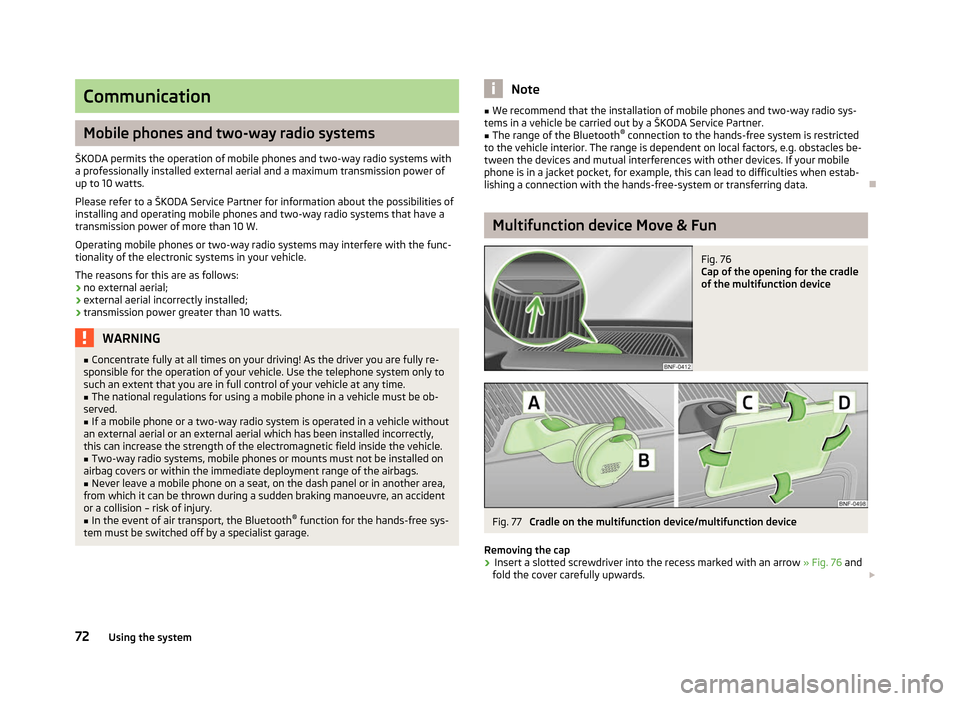
Fig. 76
Cap of the opening for the cradle
of the multifunction device Fig. 77
Cradle on the multifunction device/multifunction device
Removing the cap
› Insert a slotted screwdriver into the recess marked with an arrow
» Fig. 76 and
fold the cover carefully upwards. £
72 Using the system
Page 83 of 157

Belt tensioners are not activated in the event of minor frontal collisions, side and
rear-end collisions, in the case of a rollover and also not in accidents in which no
major forces are produced from the front.
WARNING
■ Any work on the belt tensioner system including removal and installation of
system components because of other repair work, must only be carried out by
a specialist garage.
■ The protective function of the system is only adequate for a single accident.
If the belt tensioners have been deployed, it is then necessary to replace the
entire system. Note
■ Smoke is generated when the belt tensioners are deployed. This is not an indi-
cation of a fire in the vehicle. ■ When disposing of the vehicle or parts of the belt tensioner system, it is impor-
tant to comply with national legal requirements. ŠKODA Service Partners are fa-
miliar with these regulations and will be able to provide you with detailed infor-
mation. Ð 81
Seat belts
Page 87 of 157

WARNING (Continued)
■ If children adopt an incorrect seated position when travelling, they may be
exposed to an increased risk of injury in the event of an accident. This can re-
sult in serious injuries » page 87, Child seat.
■ The airbag control unit operates with pressure sensors located in the front
doors. For this reason no adjustments must be carried out to the doors and
door panels (e.g. additional installation of loudspeakers). Resulting damages
can have a negative affect on the operation of the airbag system. All work on
the front doors and their panels must only be carried out by a
ŠKODA special-
ist garage.
■ In the event of a side collision, the side airbags will not function properly, if
the sensors cannot measure the increasing air pressure inside the doors, be-
cause the air can escape through large, non-sealed openings in the door pan-
el. ■Never drive with removed inner door panels.
■ Never drive, if parts of the inner door panel have been removed and the
remaining openings have not been properly sealed.
■ Never drive, if the loudspeakers in the doors have been removed, only if
the loudspeaker openings have been properly sealed.
■ Always make sure that the openings are covered or filled, if additional
loudspeakers or other equipment parts are installed in the inner door pan-
els. ■ Always have work completed by a ŠKODA
Service Partner or a competent
ŠKODA specialist garage.
■ Only hang light items of clothing on the hooks fitted in the vehicle. Never
leave any heavy or sharp-edged objects in the pockets of the items of cloth-
ing.
■ Ensure that there are no excessive forces, such as violent knocks, kicks etc.,
impact on the backrests of the seats otherwise the system may be damaged.
The side airbags would not be deployed in such a case!
■ Any seat or protective covers which you fit to the driver or front passenger
seats must only be of the type expressly authorized by
ŠKODA. In view of the
fact that the airbag inflates out of the backrest of the seat, use of non-ap-
proved seat or protective covers would considerably impair the protective
function of the side airbag.
■ Any damage to the original seat covers in the area of the side airbag module
must be repaired without delay by your
ŠKODA specialist garage.
■ The airbag modules in the front seats must not display any damage, cracks
or deep scratches. It is not permissible to use force in order to open the mod-
ules. Ð Switching off the airbags
Deactivating airbags
Deactivation of airbags is envisaged only for particular instances, such as if: › using a child seat on the front passenger seat, in which the child has its back to
the vehicle's direction of travel (in some countries this must be in the direction
of travel due to different legal regulations applying)
» page 87, Transporting
children safely ;
› not being able to maintain a distance of at least 25 cm between the middle of
the steering wheel and chest, despite the driver's seat being correctly adjusted;
› special attachments are required in the area of the steering wheel because of a
physical disability;
› other seats have been installed (e.g. orthopaedic seats without side airbags).
The front passenger airbag can be switched off with the key-operated
switch » page 86.
We recommend that you ask a
ŠKODA Service Partner to switch off any other air-
bags.
Monitoring the airbag system
The functionality of the airbag system is also monitored electronically when one
airbag has been switched off.
If the airbag was switched off using diagnostic equipment:
› The airbag warning light
lights up for 3 seconds each time the ignition is
switched on and then flashes after that for about 12 seconds.
If the airbag was switched off using the key switch on the side of the dash pan-
el:
› The airbag warning light
comes on for 3 seconds after the ignition has been
switched on;
› The deactivated airbag is indicated by the illumination of the warning light
in the middle of the dash panel » Fig. 86 on page 86 - . Note
■ The national regulations for switching off airbags must be observed.
■ A ŠKODA Service Partner will be able to inform you which airbags in your vehicle
can/must be deactivated. Ð
85
Airbag system
Page 91 of 157
Group
Weight of the child Approximate age
1 9-18 kg up to 4 years
2 15-25 kg up to 7 years
3 22-36 kg over 7 years Ð
Suitability of child seats
First read and observe the introductory information and safety warn-
ings on page 87.
Overview of the suitability of child seats according to the standard ECE-R
44
Seat Child seat
type
Front passenger seat U
Car seat U
+
T
Universal category – a child seat with the word UNIVERSAL, which is de-
signed for fastening on the seat with the seat belt.
ISOFIX
– a child seat which is designed for fastening on the seat with eyelets
for the ISOFIX system is provided » page 89, Child seats with the ISOFIX
system.
TOP TETHER – a child seat which is designed for fastening on the seat with
an eyelet for the TOP TETHER system is provided » page 90, Child seat with
the TOP TETHER system. Ð
ä U
+
T Child seats with the ISOFIX system
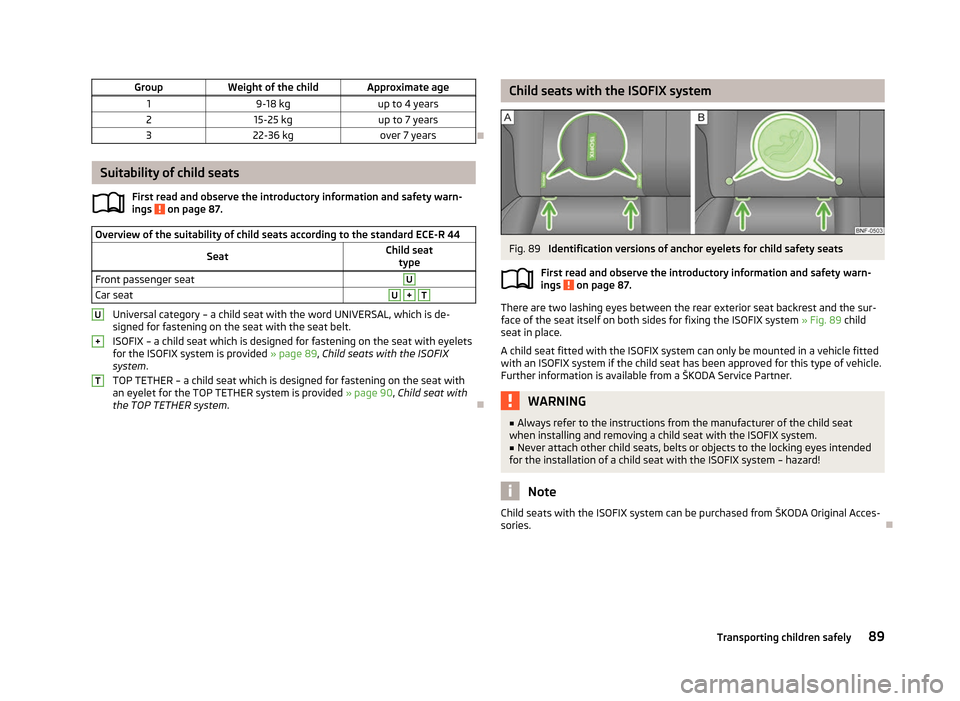
Fig. 89
Identification versions of anchor eyelets for child safety seats
First read and observe the introductory information and safety warn-
ings on page 87.
There are two lashing eyes between the rear exterior seat backrest and the sur-
face of the seat itself on both sides for fixing the ISOFIX system » Fig. 89 child
seat in place.
A child seat fitted with the ISOFIX system can only be mounted in a vehicle fitted
with an ISOFIX system if the child seat has been approved for this type of vehicle.
Further information is available from a ŠKODA Service Partner. WARNING
■ Always refer to the instructions from the manufacturer of the child seat
when installing and removing a child seat with the
ISOFIX system.
■ Never attach other child seats, belts or objects to the locking eyes intended
for the installation of a child seat with the
ISOFIX system – hazard! Note
Child seats with the ISOFIX system can be purchased from ŠKODA Original Acces-
sories. Ð
ä
89
Transporting children safely