2012 Seat Alhambra warning
[x] Cancel search: warningPage 317 of 388
315
Wheels and tyres
Changing a wheel
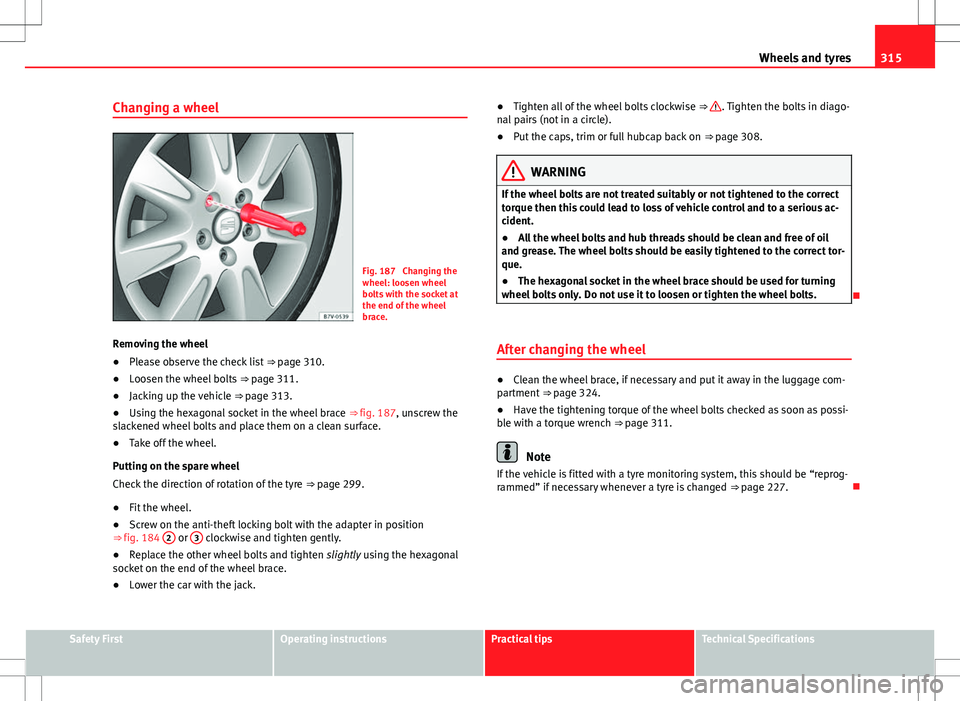
Fig. 187 Changing the
wheel: loosen wheel
bolts with the socket at
the end of the wheel
brace.
Removing the wheel
● Please observe the check list ⇒ page 310.
● Loosen the wheel bolts ⇒ page 311.
● Jacking up the vehicle ⇒ page 313.
● Using the hexagonal socket in the wheel brace ⇒ fig. 187, unscrew the
slackened wheel bolts and place them on a clean surface.
● Take off the wheel.
Putting on the spare wheel
Check the direction of rotation of the tyre ⇒ page 299.
● Fit the wheel.
● Screw on the anti-theft locking bolt with the adapter in position
⇒ fig. 184 2
or 3 clockwise and tighten gently.
● Replace the other wheel bolts and tighten slightly using the hexagonal
socket on the end of the wheel brace.
● Lower the car with the jack. ●
Tighten all of the wheel bolts clockwise ⇒
. Tighten the bolts in diago-
nal pairs (not in a circle).
● Put the caps, trim or full hubcap back on ⇒ page 308.
WARNING
If the wheel bolts are not treated suitably or not tightened to the correct
torque then this could lead to loss of vehicle control and to a serious ac-
cident.
● All the wheel bolts and hub threads should be clean and free of oil
and grease. The wheel bolts should be easily tightened to the correct tor-
que.
● The hexagonal socket in the wheel brace should be used for turning
wheel bolts only. Do not use it to loosen or tighten the wheel bolts.
After changing the wheel
● Clean the wheel brace, if necessary and put it away in the luggage com-
partment ⇒ page 324.
● Have the tightening torque of the wheel bolts checked as soon as possi-
ble with a torque wrench ⇒ page 311.
Note
If the vehicle is fitted with a tyre monitoring system, this should be “reprog-
rammed” if necessary whenever a tyre is changed ⇒ page 227.
Safety FirstOperating instructionsPractical tipsTechnical Specifications
Page 318 of 388

316If and when
If and when
In case of emergency
Introduction
Additional information and warnings:
● Braking, stopping and parking ⇒ page 185
● Emergency locking and unlocking ⇒ page 318
● Vehicle tools ⇒ page 324
WARNING
A faulty vehicle in traffic represents a risk of accident for the driver and
for other road users.
● Stop the vehicle safely as soon as possible. Park the vehicle a safe
distance from surrounding traffic to lock all the doors in case of an emer-
gency. Turn on the hazard warning lights to warn other road users.
● Never leave children or disabled people alone in the vehicle if the
doors are to be locked. In case of an emergency, passengers will be trap-
ped inside the vehicle. Individuals locked in the vehicle can be exposed
to very high or very low temperatures.
Protecting yourself and securing the vehicle
Fig. 188 In the centre of
the instrument panel:
Switch for hazard warn-
ing lights.
Always fulfil legal requirements for securing a broken down vehicle. In a
number of countries it is now obligatory, for example, to turn on the hazard
warning lights and use a reflective safety vest ⇒ page 318.
When being towed with the hazard warning lights on, a change in direction
or traffic lane can be indicated as usual using the turn indicator lever. The
hazard lights will be interrupted temporarily.
Checklist
For your own safety and that of other passengers, the following points
should be observed in the order given ⇒
:
Park the vehicle a safe distance from traffic and on suitable ground
⇒
.
Turn on the hazard warning lights with the button ⇒
fig. 188.
Connect the electronic parking brake ⇒ page 185.
1.
2.
3.
Page 319 of 388

317
If and when
Move the selector lever to its intermediate position or to P ⇒ page 176.
Stop the engine and remove the key from the ignition ⇒ page 172.
Have all occupants leave the vehicle and move to safety, for example
behind a guard rail.
When leaving the vehicle, take all keys with you.
Place an emergency warning triangle to indicate the position of your ve-
hicle to other road users.
Allow the engine to cool and check if a specialist is required.
Examples of when to use the hazard warning lights:
● If the vehicles ahead suddenly slow down or reach the end of a traffic
jam, to warn the vehicles behind.
● In case of an emergency.
● If the vehicle breaks down.
● When being towed.
Always comply with the applicable laws regarding the use of hazard warn-
ing lights.
If the hazard warning lights are not working, you must use an alternative
method of drawing attention to your vehicle. This method must comply with
traffic legislation.
WARNING
Failure to follow the checklist prepared for your own safety could lead to
accidents and severe injuries.
● Always complete the operations given in the checklist and observe
the general rules of safety.
4.
5.
6.
7.
8.
9.WARNING
The components of the exhaust system reach very high temperatures.
This could cause a fire and considerable damage.
● Always park your vehicle so that no part of the exhaust system can
come in contact with flammable materials (such as dried grass or fuel).
Note
● The vehicle battery will discharge and run down if the hazard warning
lights remain on for too much time (even with the ignition turned off).
● For some vehicles, the brake lights will blink when braking suddenly at
speeds of approximately 80 km/h to warn vehicles behind. If braking con-
tinues, then the hazard warning lights will automatically be turned on at the
speed of less than approximately 10 km an hour. The brake lights remain lit.
Upon accelerating, the hazard warning lights will be automatically turned
off.
Safety FirstOperating instructionsPractical tipsTechnical Specifications
Page 320 of 388

318If and when
First aid kit, warning triangle, reflective vests and fire
extinguishers*
Fig. 189 On the boot lid:
Warning triangle bracket.
Reflective vests
Some vehicles will have a driver's door compartment to store a reflective
vest ⇒ page 53.
Warning triangle
With the tailgate open, rotate the lock ⇒ fig. 189 90°. Lower the bracket and
remove the warning triangle.
First-aid kit
There is a first aid kit ⇒ page 142 in the rear left-hand side storage com-
partment of the luggage compartment.
The first aid kit must comply with legal requirements. Check the expiry date
of the contents of the first aid kit.
Fire extinguisher
There is a Fire extinguisher underneath the passenger seat. The fire extinguisher must conform to legal requirements, be ready for use
and be checked regularly. Check the certification seal on the extinguisher.
WARNING
Loose objects in the passenger compartment can be violently thrown in
case of a sudden manoeuvre or braking and especially in accidents caus-
ing serious injury.
● Secure fire extinguishers, first aid kit, reflective vests and warning
triangle securely to their respective supports.
Emergency locking and unlocking Introduction
The doors, tailgate and panoramic sliding roof can be locked manually and
partially opened, for example if the key or the central locking is damaged.
Additional information and warnings:
● Vehicle key set ⇒ page 71
● Central locking and locking system ⇒ page 74
● Doors ⇒ page 80
● Tailgate ⇒ page 84
● Panorama sliding sunroof ⇒ page 92
● In case of emergency ⇒ page 316
Page 321 of 388

319
If and when
WARNING
Opening and closing doors carelessly can cause serious injury.
● If the vehicle is locked from outside, the doors and windows cannot
be opened from the inside.
● Never leave children or disabled people alone in the car. They could
be trapped in the car in an emergency and will not be able to get them-
selves to safety.
● Depending on the time of the year, temperatures inside a locked and
closed vehicle can be extremely high or extremely low resulting in seri-
ous injuries and illness or even death, particularly for young children.
WARNING
Getting in the way of the doors and the panoramic sliding roof is danger-
ous and can lead to serious injury.
● Open and close the doors and the panoramic sliding roof only when
nobody is in the way.
CAUTION
When opening and closing in an emergency, carefully disassemble compo-
nents and then reassemble them carefully to avoid damage to the vehicle. Manually locking and unlocking the driver's door
Fig. 190 Driver's door
handle: Hidden lock cyl-
inder.
In general, when the driver's door is locked all other doors are locked. Un-
locking manually only opens the driver's door. Please note the instructions
for the anti-theft alarm ⇒ page 74.
● Unfold the key shaft ⇒ page 71.
● Insert the key shaft into the opening in the cover on the driver's door
handle from below ⇒ fig. 190 (arrow) then remove the cover upwards.
● Insert the key shaft into the lock cylinder to unlock or lock the vehicle.
Unlocking notes:
● The anti-theft alarm will remain active when vehicles are unlocked. How-
ever, the alarm will not yet be triggered ⇒ page 74.
● If the driver's door is opened, the alarm will be triggered.
● Switch the ignition on. When the ignition is switched on, the electronic
immobiliser recognises a valid vehicle key and deactivates the anti-theft
alarm system.
Safety FirstOperating instructionsPractical tipsTechnical Specifications
Page 325 of 388

323
If and when
Manually unlocking the gear selection lever
Fig. 197 Remove the lin-
ing from the area of the
gear indication.
Fig. 198 Manual release
of gear selector lever.
If the vehicle power supply should ever fail (discharged battery, etc.) and
the vehicle has to be pushed or towed, the selector lever must first be
moved to position N using the manual release mechanism. The emergency release mechanism is located underneath the gearbox cover
panel to the right-hand side. To release the gear selector lever mechanism,
a suitable tool is required, for example a screwdriver.
Preparations
●
Apply the parking brake. If the parking brake cannot be activated in the
vehicle must be secured otherwise so that it cannot move.
● Switch the ignition off.
To remove the gearbox cover panel
● Pull the cover up around the dust guard on the gear selector lever
⇒ fig. 197.
● Take the cover off by passing it over the gear selector lever ⇒
.
Manual release of selector lever
● Press the release lever ⇒ fig. 198 in the direction of the arrow and hold
it in this position.
● Press the lock button ⇒ fig. 197 1
on the gear selector lever knob and
place the gear selector lever in the N position.
WARNING
Never move the gear selector lever from the position P while the electron-
ic parking brake is deactivated. Otherwise, the vehicle may accidentally
move off on hills or steep slopes causing serious accidents.
CAUTION
If the vehicle is moved on its wheels with the engine stopped and the selec-
tor lever in position N for a prolonged period of time and at high speed, for
example for towing, then the automatic gearbox will be damaged.
Safety FirstOperating instructionsPractical tipsTechnical Specifications
Page 326 of 388

324If and when
Tools*
Introduction
When securing the vehicle in case of a breakdown, please note the legal re-
quirements for each country.
Additional information and warnings:
● Working in the engine compartment ⇒ page 279
● Change wheel ⇒ page 309
● In case of emergency ⇒ page 316
WARNING
Loose objects in the passenger compartment can be violently fired
through the compartment in case of a sudden manoeuvre or braking and
especially in accidents causing serious injury.
● Make sure that the vehicle tools are stored safely in the luggage com-
partment.
WARNING
Unsuitable or damaged on-board tools can cause injury or accidents.
● Never work with inappropriate or damaged tools.
Location
Fig. 199 In the luggage
compartment, viewed
from inside the vehicle:
On-board tools are loca-
ted in a cavity close to
the lock carrier.
Depending on the model, the vehicle tools may be kept in the luggage com-
partment, in a cavity close to the lock carrier ⇒ fig. 199. Loosen the safety
straps and remove the on-board tools. For vehicles factory-fitted with winter
tyres, you will find additional tools in a toolbox located in the luggage com-
partment.
Note
After use, return the jack to its initial position using the handle in order to
securely store it in the vehicle.
Page 328 of 388

326If and when
Fuses
Introduction
Due to the constant update of vehicles, fuse assignments depending on
equipment and the use of the same fuse for various electrical components,
at the time of printing this manual it is not possible to provide an up-to-date
summary of the electrical components fuse positions. For detailed informa-
tion about the fuse positions, please consult a Technical Service.
In general, a fuse can be assigned to various electrical components. Like-
wise, an electrical component can be protected by several fuses.
Only replace fuses when the cause of the problem has been solved. If a
newly inserted fuse blows after a short time, you must have the electrical
system checked by a qualified dealership as soon as possible.
Additional information and warnings:
● Working in the engine compartment ⇒ page 279
WARNING
The high voltages in the electrical system can give serious electrical
shocks, causing burns and even death!
● Never touch the electrical wiring of the ignition system.
● Take care not to cause short circuits in the electrical system.
WARNING
Using unsuitable fuses, repairing fuses or bridging a current circuit with-
out fuses can cause a fire and serious injury.
● Never use a fuse with a higher value. Only replace fuses with a fuse of
the same amperage (same colour and markings) and size.
● Never repair a fuse.
● Never replace a fuse by a metal strip, staple or similar.
CAUTION
● To avoid damage to the vehicles electric system, before replacing a fuse
turn off the ignition, the lights and all electrical elements and remove the
keys from the ignition.
● If you replace a fuse with higher-rating fuse, you could cause damage to
another part of the electrical system.
● Protect the fuse boxes when open to avoid the entry of dust or humidity.
Dirt and humidity inside fuse boxes can cause damage to the electrical sys-
tem.
Note
● One single consumer could have more than one fuse.
● Several consumers could run over one single fuse.