2012 RENAULT WIND ignition
[x] Cancel search: ignitionPage 8 of 185
keys ...................................................... (up to the end of the DU)
children ................................................. (up to the end of the DU)
child safety ............................................ (up to the end of the DU)
locking the doors .................................. (up to the end of the DU)
1.2
ENG_UD14790_1
Clé / Télécommande à radiofréquence : Généralités (E33 - X33 - Renault)
ENG_NU_865-6_E33_Renault_1
Jaune NoirNoir texte
Key/radio frequency remote control: general information, use, deadlocking
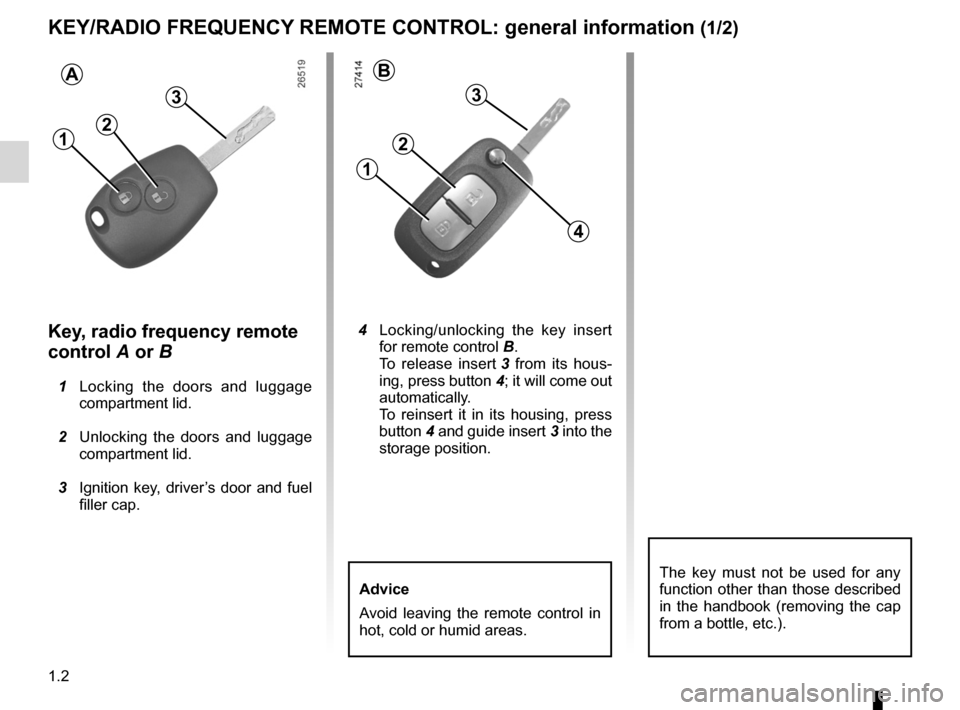
KEY/RADIO FREQUENCY REMOTE CONTROL: general information (1/2)
4 Locking/unlocking the key insert
for remote control B.
To release insert 3 from its hous -
ing, press button 4; it will come out
automatically.
To reinsert it in its housing, press
button 4 and guide insert 3 into the
storage position.
The key must not be used for any
function other than those described
in the handbook (removing the cap
from a bottle, etc.).
Key, radio frequency remote
control A or B
1 Locking the doors and luggage
compartment lid.
2 Unlocking the doors and luggage
compartment lid.
3 Ignition key, driver’s door and fuel
filler cap.
Advice
Avoid leaving the remote control in
hot, cold or humid areas.
B
1
2
3
4
A
3
12
Page 12 of 185

warning buzzer ...................................................... (current page)
doors ..................................................... (up to the end of the DU)
locking the doors .................................. (up to the end of the DU)
opening the doors ................................. (up to the end of the DU)
closing the doors .................................. (up to the end of the DU)
children ................................................. (up to the end of the DU)
doors/tailgate ........................................ (up to the end of the DU)
1.6
ENG_UD24353_3
Ouverture et fermeture des portes (E33 - X33 - Renault)
ENG_NU_865-6_E33_Renault_1
Jaune NoirNoir texte
Doors
Opening from the inside
Pull handle 1.
Closing from the inside
Depending on the vehicle, pull handle 2
or 3.
Driver’s responsibility
If you decide to keep the
doors locked when you are
driving, remember that it
may be more difficult for those as -
sisting you to gain access to the
passenger compartment in the
event of an emergency.
Opening manually from the
outside
Using the key, unlock left-hand door
lock 4. Place your hand under handle 5.
Lift the handle and then pull the door
towards you.
Lights-on warning buzzer
If you have left the lights on after switch-
ing off the ignition, a warning buzzer will
sound when the driver’s door is opened
(to prevent the battery from going flat,
etc.).
4
5
D r i v e r ’s r e s p o n s i b i l i t y
when parking or stopping
the vehicle
Never leave an animal,
child or adult who is not self-suffi -
cient alone on your vehicle, even for
a short time.
They may pose a risk to themselves
or to others by starting the engine,
activating equipment such as the
electric windows or by locking the
doors.
Also, in hot and/or sunny weather,
please remember that the tempera-
ture inside the passenger compart-
ment increases very quickly.
RISK OF DEATH OR SERIOUS
INJURY.
OpENING AND CLOSING THE DOORS (1/2)
As a safety precaution,
the doors should only be
opened or closed when the
vehicle is stationary.
1
2
3
Page 14 of 185

1.8
ENG_UD11151_1
Verrouillage / Déverrouillage des portes (E33 - X33 - Renault)
ENG_NU_865-6_E33_Renault_1
Jaune NoirNoir texte
SElectric central locking(depending on vehicle)
The door and luggage compartment
can be locked and unlocked simultane -
ously.
Lock or unlock by pressing button 1.
The doors cannot be locked/unlocked
with a door open.
If a door is open or not properly closed,
the doors lock and then quickly unlock.
Doors and tailgate status
indicator light
With the ignition on, the indicator
light integrated in button 1 informs
you of the status of the doors and
luggage compartment lid:
– the indicator light is on when the
doors/tailgate are locked;
– when the doors are unlocked (or not
properly closed) the indicator light is
off.
With the ignition switched off, when you
lock the doors using the remote control,
the indicator light stays on for about a
minute, then goes out.
LOCKING/UNLOCKING THE DOORS (1/2)
Driver’s responsibility
Never leave your vehicle
with the key or remote con-
trol inside.
If you decide to keep the doors
locked when you are driving, re -
member that it may be more diffi -
cult for those assisting you to gain
access to the passenger compart -
ment in the event of an emergency.
1
Page 15 of 185
JauneNoirNoir texte
1.9
ENG_UD11151_1
Verrouillage / Déverrouillage des portes (E33 - X33 - Renault)
ENG_NU_865-6_E33_Renault_1
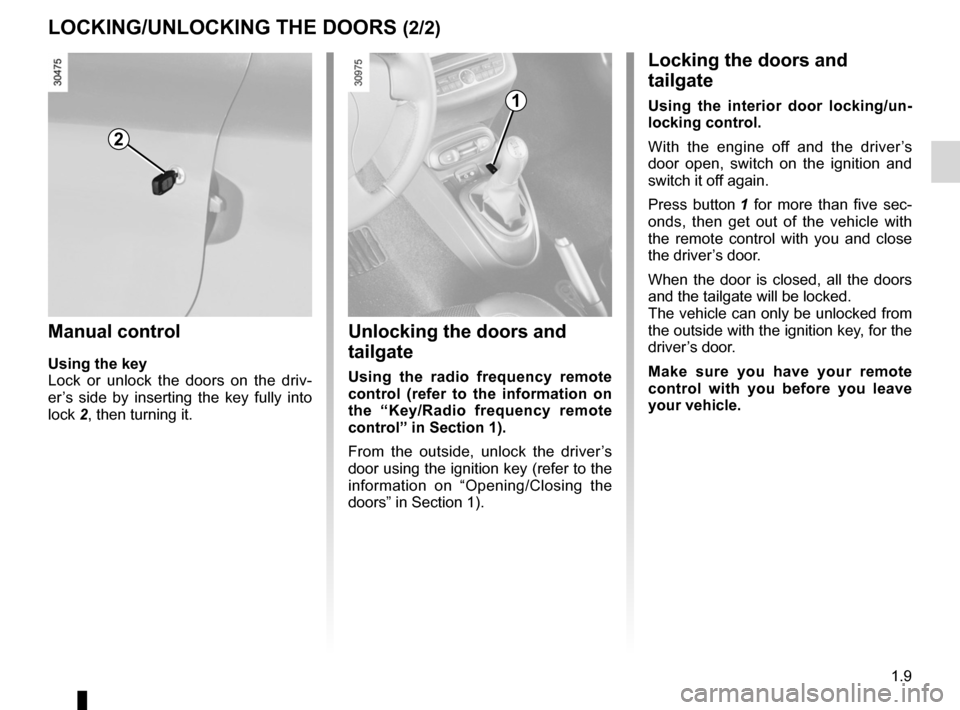
LOCKING/UNLOCKING THE DOORS (2/2)
Unlocking the doors and
tailgate
Using the radio frequency remote
control (refer to the information on
the “Key/Radio frequency remote
control” in Section 1).
From the outside, unlock the driver’s
door using the ignition key (refer to the
information on “Opening/Closing the
doors” in Section 1).
Manual control
Using the key
Lock or unlock the doors on the driv -
er’s side by inserting the key fully into
lock 2, then turning it.
2
Locking the doors and
tailgate
Using the interior door locking/un -
locking control.
With the engine off and the driver ’s
door open, switch on the ignition and
switch it off again.
Press button 1 for more than five sec -
onds, then get out of the vehicle with
the remote control with you and close
the driver’s door.
When the door is closed, all the doors
and the tailgate will be locked.
The vehicle can only be unlocked from
the outside with the ignition key, for the
driver’s door.
Make sure you have your remote
control with you before you leave
your vehicle.1
Page 16 of 185

RENAULT ANTI-INTRUDER DEVICE (RAID) (up to the end of the DU)
central door locking .............................. (up to the end of the DU)
doors ..................................................... (up to the end of the DU)
locking the doors .................................. (up to the end of the DU)
doors/tailgate ........................................ (up to the end of the DU)
1.10
ENG_UD11152_1
Condamnation automatique des ouvrants en roulage (E33 - X33 - Renault)
ENG_NU_865-6_E33_Renault_1
Automatic locking when driving
AUTOMATIC LOCKING WHEN DRIVING
You must first decide if you want to
activate this function.
To activate
With the ignition on, press central door
locking button 1 for about five seconds,
until a double beep is heard.
To deactivate
With the ignition on, press central door
locking button 1 for about five seconds,
until a double beep is heard.
Driver’s responsibility
If you decide to keep the
doors locked when you are
driving, remember that it
may be more difficult for those as -
sisting you to gain access to the
passenger compartment in the
event of an emergency.
The door can be unlocked:
– by opening a door when stationary.
Note: if a door is opened, it will auto-
matically be locked again when the
vehicle reaches a speed of approxi -
mately 4 mph (7 km/h);
– by pressing door unlocking button 1.
Operating faults
If you find an operating fault (no au -
tomatic locking, the indicator light for
button 1 does not light up when trying
to lock the doors and luggage com -
partment lid, etc.), firstly check that the
doors and luggage compartment lid are
properly closed. If they are properly
closed, contact an approved dealer.
Operating principle
When the vehicle is started, the system
automatically locks the doors as
soon as a speed of 4 mph (7 km/h) is
reached.
The button’s indicator light 1 comes on.
1
Page 17 of 185

front seat adjustment ............................(up to the end of the DU)
front seats adjustment ...................................... (up to the end of the DU)
front seats with manual controls ........................................ (current page)
1.11
ENG_UD11155_1
Sièges avant à commandes manuelles (E33 - X33 - Renault)
ENG_NU_865-6_E33_Renault_1
Siège avant
To move the seat forwards or
back
Lift handle 1 to release. Release the
handle once the seat is in the correct
position and ensure that the seat is
locked.
To raise or lower the seat
base
Depending on the vehicle, lift handle 2.
Release the handle once the seat is in
the correct position and ensure that the
seat is locked.
For safety reasons, carry
out any adjustments when
the vehicle is not being
driven.
We would advise you not to recline
the seatbacks too far to ensure that
the effectiveness of the seat belts is
not reduced.
Make sure that the seatbacks are
correctly locked in place.
Nothing should be placed on the
floor (area in front of driver) as such
objects may slide under the pedal
during braking manoeuvres, thus
obstructing its use.
1
2
Heated seats(depending on the vehicle)
With the ignition on , press switch 3 .
The integrated indicator comes on.
The system, which has a thermostat,
decides whether or not the heating is
needed.
To tilt the seatback
Use lever 4 to tilt the seatback to the
desired position.
FRONT SEATS
4
3
Page 21 of 185

seat belts .............................................. (up to the end of the DU)
additional methods of restraint ............. (up to the end of the DU)
seat belt pretensioners ......................... (up to the end of the DU)
air bag ................................................... (up to the end of the DU)
air bag ................................................... (up to the end of the DU)
methods of restraint in addition to the front seat belts
(up to the end of the DU)
additional methods of restraint to the front seat belts ......................(up to the end of the DU)
methods of restraint in addition to the seat belts
(up to the end of the DU)
pretensioners ......................................................... (current page)
1.15
ENG_UD20473_2
Dispositifs complémentaires aux ceintures avant (E33 - X33 - Renault)
ENG_NU_865-6_E33_Renault_1
Additional methods of restraint:
to the front seat belts
METHODS OF RESTRAINT IN ADDITION TO THE FRONT SEAT BELTS (1/3)
Depending on the vehicle, they are
composed of:
– seat belt pretensioners;
– chest-level load limiters;
– air bags for driver and front pas -
senger.
These systems are designed to act in-
dependently or together when the ve -
hicle is subjected to a frontal impact.
Depending on the severity of the
impact, the system can trigger:
– seat belt locking;
– the seat belt inertia reel pretensioner
(which engages to correct seat belt
slack);
– the front air bags.
Load limiterAbove a certain severity of impact, this
mechanism is used to limit the force of
the belt against the body so that it is at
an acceptable level.
pretensioners
The pretensioners hold the seat belt
against the body, holding the occupant
more securely against the seat, thus in-
creasing the seat belt’s efficiency.
With the ignition on, if the vehicle is
subject to a significant frontal impact
the system may, depending on the se-
verity of the impact, trigger inertia reel
pretensioner 1 on the front seats.
– Have the entire restraint
system checked following
an accident.
– No operation whatso -
ever is permitted on any part of
the system (pretensioners, air
bags, computers, wiring) and the
system components must not
be reused on any other vehicle,
even if identical.
– To avoid incorrect triggering of
the system which may cause
injury, only qualified personnel
from an approved dealer may
work on the pretensioner and air
bag system.
– The electric trigger system may
only be tested by a specially
trained technician using special
equipment.
– When the vehicle is scrapped,
contact an approved dealer for
disposal of the pretensioner and
air bag gas generators.
1
Page 22 of 185

1.16
ENG_UD20473_2
Dispositifs complémentaires aux ceintures avant (E33 - X33 - Renault)
ENG_NU_865-6_E33_Renault_1
Jaune NoirNoir texte
METHODS OF RESTRAINT IN ADDITION TO THE FRONT SEAT BELTS (2/3)
Operation
This system is only operational when
the ignition is switched on.
In a severe frontal impact, the air bags
inflate rapidly, cushioning the impact
of the driver’s head and chest against
the steering wheel and of the front pas-
senger against the dashboard. The air
bags then deflate immediately so that
the passengers are not in any way hin-
dered when leaving the vehicle.
A
Air bags for driver and front
passenger
Fitted to the driver and passenger side.
Depending on the vehicle, the pres -
ence of this equipment is indicated by
the word “air bag” on the steering wheel
and dashboard (air bag zone A ) and
a symbol on the lower section of the
windscreen.
Each air bag system consists of:
– an air bag and gas generator fitted
on the steering wheel for the driver
and in the dashboard for the front
passenger;
– a shared computer, which includes
the impact detector and the moni -
tor controlling the electrical trigger
system for each of the gas genera -
tors;
– a single indicator light
å on the
instrument panel;
– remote sensors.
The air bag system uses
pyrotechnic principles. This
explains why, when the air
bag inflates, it will gener -
ate heat, produce smoke (this does
not mean that a fire is about to start)
and make a noise upon detonation.
In a situation where an air bag is
required, it will inflate immediately
and this may cause some minor, su-
perficial grazing to the skin or other
problems.