2012 RENAULT LAGUNA COUPE rims
[x] Cancel search: rimsPage 94 of 221

2.16
ENG_UD19886_6
Conseils antipollution, économie de carburant, conduite (X45 - H45 -\
X85 - B85 - C85 - S85 - X91 - X83 - X61 - F61 - K61 - K85 - X95 - B95 -\
D95 - J95 - R95 - L38 - X61
ENG_NU_939-3_D91_Renault_2
Jaune NoirNoir texte
aDVICe: antipollution, fuel economy and driving (2/3)
– Avoid sudden acceleration.
– Brake as little as possible. If you an-
ticipate an obstacle or bend in ad -
vance, you may then simply release
the accelerator pedal.
– Do not try to maintain the same
speed up a hill, accelerate no more
than you would on the level. Keep
your foot in the same position on the
accelerator pedal.
– Double declutching and accelerating
before switching off are unnecessary
in modern vehicles.
– Bad weather, flooded roads:
Do not drive through floods
if the water is above the
lower edge of the wheel
rims.
Driving– Drive carefully for the first few miles
until the engine reaches its normal
operating temperature, rather than
let it warm up while the vehicle is sta-
tionary.
– Speed is expensive.
– Sporty driving uses a lot of fuel: drive
with a light right foot.
– Do not overrev the engine in the in-
termediate gears.
Always use the highest gear possi -
ble without labouring the engine.
On versions with an automatic gear-
box, it is preferable to keep the gear
lever in position D.
exhaust gas monitoring
system
The exhaust gas monitoring system will
detect any operating faults in the vehi-
cle’s antipollution system.
If this system malfunctions, toxic sub -
stances may be released into the at -
mosphere or damage may occur.
ÄThis warning light on the in -
strument panel will indicate if
there are any faults in the system:
This lights up when the ignition is
switched on and goes out when the
engine is started.
– If it lights up continuously, consult an
approved Dealer as soon as possi -
ble;
– if it flashes, reduce the engine speed
until the light stops flashing. Contact
your approved dealer as soon as
possible.
obstructions to the driver
On the driver ’s side, only
use mats adapted to the ve-
hicle that attach to the pre-
installed parts, and regularly check
their mounting. Do not place several
mats on top of each other.
Risk of pedals jamming
Page 170 of 221
tool kit ................................................... (up to the end of the DU)
jack ....................................................... (up to the end of the DU)
puncture ................................................ (up to the end of the DU)
wheelbrace ........................................... (up to the end of the DU)
hubcap tool ........................................... (up to the end of the DU)
towing hitch ........................................... (up to the end of the DU)
wheelbrace ........................................... (up to the end of the DU)
5.8
ENG_UD29836_5
Outils (X91 - D91 - Renault)
ENG_NU_939-3_D91_Renault_5
Tools (Jack-Wheelbrace, etc.)
t OOLS
The tools for changing a wheel are lo-
cated in the luggage compartment
under the carpets. When storing the
tools, ensure the jack is correctly
clipped in, with base plate B towards
the bottom.
The tools included in the tool kit depend
on the vehicle.
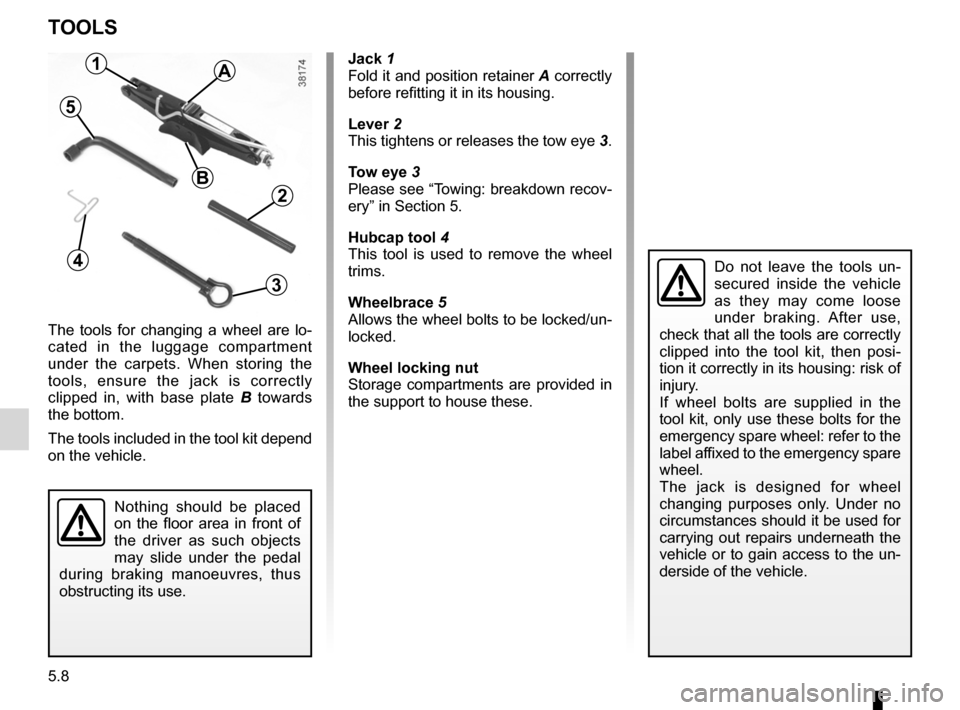
Jack 1
Fold it and position retainer A correctly
before refitting it in its housing.
Lever 2
This tightens or releases the tow eye 3.
t ow eye 3
Please see “Towing: breakdown recov-
ery” in Section 5.
Hubcap tool 4
This tool is used to remove the wheel
trims.
Wheelbrace 5
Allows the wheel bolts to be locked/un-
locked.
Wheel locking nut
Storage compartments are provided in
the support to house these.
Do not leave the tools un -
secured inside the vehicle
as they may come loose
under braking. After use,
check that all the tools are correctly
clipped into the tool kit, then posi -
tion it correctly in its housing: risk of
injury.
If wheel bolts are supplied in the
tool kit, only use these bolts for the
emergency spare wheel: refer to the
label affixed to the emergency spare
wheel.
The jack is designed for wheel
changing purposes only. Under no
circumstances should it be used for
carrying out repairs underneath the
vehicle or to gain access to the un-
derside of the vehicle.
Nothing should be placed
on the floor area in front of
the driver as such objects
may slide under the pedal
during braking manoeuvres, thus
obstructing its use.
1A
B
2
3
4
5
Page 173 of 221
tyres ...................................................... (up to the end of the DU)
wheels (safety) ..................................... (up to the end of the DU)
5.11
ENG_UD22249_4
Pneumatiques (X91 - B91 - K91 - Renault)
ENG_NU_939-3_D91_Renault_5
Tyres (tyre and wheel safety, use in winter)
tYreS
Maintaining the tyres
The tyres must be in good condition
and the tread form must have sufficient
depth; tyres approved by our Technical
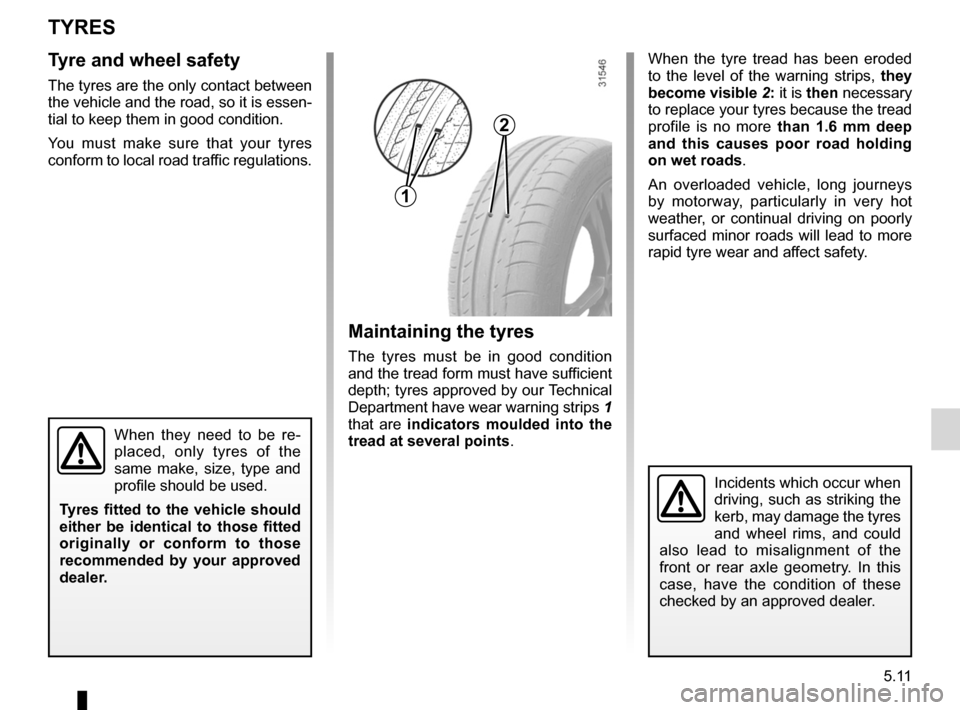
Department have wear warning strips 1
that are indicators moulded into the
tread at several points.
t yre and wheel safety
The tyres are the only contact between
the vehicle and the road, so it is essen-
tial to keep them in good condition.
You must make sure that your tyres
conform to local road traffic regulations. When the tyre tread has been eroded
to the level of the warning strips,
they
become visible 2: it is then necessary
to replace your tyres because the tread
profile is no more than 1.6 mm deep
and this causes poor road holding
on wet roads .
An overloaded vehicle, long journeys
by motorway, particularly in very hot
weather, or continual driving on poorly
surfaced minor roads will lead to more
rapid tyre wear and affect safety.
When they need to be re -
placed, only tyres of the
same make, size, type and
profile should be used.
t yres fitted to the vehicle should
either be identical to those fitted
originally or conform to those
recommended by your approved
dealer.
Incidents which occur when
driving, such as striking the
kerb, may damage the tyres
and wheel rims, and could
also lead to misalignment of the
front or rear axle geometry. In this
case, have the condition of these
checked by an approved dealer.
1
2