2012 RENAULT LAGUNA COUPE battery
[x] Cancel search: batteryPage 96 of 221

2.18
ENG_UD25716_1
Environnement (sans marque) (X44 - X45 - X77 - X81 - X85 - X90 - X91 \
- X83 - X61 - TEST - X95 - J9")
environment .......................................... (up to the end of the DU)
2.18
ENG_UD25716_1
Environnement (sans marque) (X44 - X45 - X77 - X81 - X85 - X90 - X91 \
- X83 - X61 - TEST - X95 - J95 - R95 - F90 Ph2 - X33 - X47 - X43 - X38 - H79 - X62 - X32 -\
X09 -
ENG_NU_939-3_D91_Renault_2
Environment
eNVIRoNMeNt
emissions
Your vehicle has been designed to
emit fewer greenhouse gases (CO2)
while in use, and therefore to consume
less fuel (eg. 140 g/km, equivalent to
5.3 l/100 km for a diesel vehicle).
Our vehicles are also equipped with a
particle filter system including a cata -
lytic converter, an oxygen sensor and
an active carbon filter (the latter pre -
vents vapour from the fuel tank being
released into the open air).
For certain diesel vehicles, this system
also has a particle filter to reduce the
volume of soot particles emitted.
Please make your own
contribution towards
protecting the environment
too
– Worn parts replaced in the course of
routine vehicle maintenance (vehi -
cle battery, oil filter, air filter, batter -
ies, etc.) and oil containers (empty or
filled with used oil) must be disposed
of through specialist organisations. –
At the end of the vehicle’s service
life, it should be sent to approved
centres to ensure that it is recycled.
– In all cases, comply with local legis -
lation.
Recycling
Your vehicle is 85% recyclable and
95% recoverable.
To achieve these objectives, many of
the vehicle components have been de-
signed to enable them to be recycled.
The materials and structures have
been carefully designed to allow these
components to be easily removed and
reprocessed by specialist companies.
In order to preserve raw material re -
sources, this vehicle incorporates nu -
merous parts made from recycled plas-
tics or renewable materials (vegetable
or animal-derived materials such as
cotton or wool).
Your vehicle has been designed with
respect for the
environment in mind for
its entire service life: during production,
use and at the end of its life.
This commitment is illustrated by the of
the manufacturer eco² signature.Manufacture
Your vehicle has been manufactured at
a factory which complies with a policy
to reduce the environmental impact
on the surrounding areas (reduction of
water and energy consumption, visual
and noise pollution, atmospheric emis-
sions and waste water; sorting and re-
using waste).
Page 130 of 221
3.12
ENG_UD22219_4
Lève-vitres électriques (X91 - D91 - Renault)
ENG_NU_939-3_D91_Renault_3
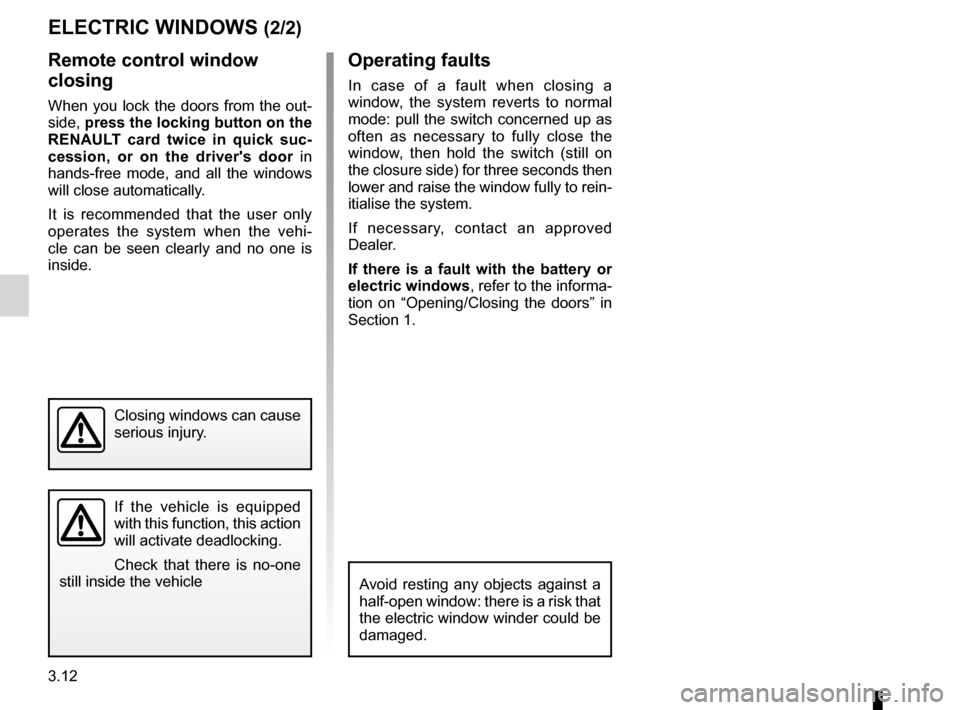
Remote control window
closing
When you lock the doors from the out-
side, press the locking button on the
RENA ulT card twice in quick suc -
cession, or on the driver's door in
hands-free mode, and all the windows
will close automatically.
It is recommended that the user only
operates the system when the vehi -
cle can be seen clearly and no one is
inside.
ElEcTRIc WINDoWS (2/2)
operating faults
In case of a fault when closing a
window, the system reverts to normal
mode: pull the switch concerned up as
often as necessary to fully close the
window, then hold the switch (still on
the closure side) for three seconds then
lower and raise the window fully to rein-
itialise the system.
If necessary, contact an approved
Dealer.
If there is a fault with the battery or
electric windows , refer to the informa-
tion on “Opening/Closing the doors” in
Section 1.
Closing windows can cause
serious injury.
If the vehicle is equipped
with this function, this action
will activate deadlocking.
Check that there is no-one
still inside the vehicle
Avoid resting any objects against a
half-open window: there is a risk that
the electric window winder could be
damaged.
Page 145 of 221

4.1
ENG_UD29930_4
Sommaire 4 (X91 - D91 - Renault)
ENG_NU_939-3_D91_Renault_4
Section 4: Maintenance
Bonnet . . . . . . . . . . . . . . . . . . . . . . . . . . . . . . . . . . . . . . . . . . . . . . . . . . . . . . . . . . . . . . . . . . . . . . . . 4.2
Engine oil level: . . . . . . . . . . . . . . . . . . . . . . . . . . . . . . . . . . . . . . . . . . . . . . . . . . . . . . . . . . . . . . . . . 4.4
general information . . . . . . . . . . . . . . . . . . . . . . . . . . . . . . . . . . . . . . . . . . . . . . . . . . . . . . . . 4.4
Engine oil level: topping up, filling . . . . . . . . . . . . . . . . . . . . . . . . . . . . . . . . . . . . . . . . . . . . . . . . . . . 4.6
Engine oil change . . . . . . . . . . . . . . . . . . . . . . . . . . . . . . . . . . . . . . . . . . . . . . . . . . . . . . . . . . . . . . . 4.7
Levels: . . . . . . . . . . . . . . . . . . . . . . . . . . . . . . . . . . . . . . . . . . . . . . . . . . . . . . . . . . . . . . . . . . . . . . . . 4.8
engine coolant . . . . . . . . . . . . . . . . . . . . . . . . . . . . . . . . . . . . . . . . . . . . . . . . . . . . . . . . . . . . 4.8
brake fluid . . . . . . . . . . . . . . . . . . . . . . . . . . . . . . . . . . . . . . . . . . . . . . . . . . . . . . . . . . . . . . . . 4.9
windscreen/headlight washer reservoir . . . . . . . . . . . . . . . . . . . . . . . . . . . . . . . . . . . . . . . . . 4.10
Filters . . . . . . . . . . . . . . . . . . . . . . . . . . . . . . . . . . . . . . . . . . . . . . . . . . . . . . . . . . . . . . . . . . . . . . . . . 4.10
Tyre pressure. . . . . . . . . . . . . . . . . . . . . . . . . . . . . . . . . . . . . . . . . . . . . . . . . . . . . . . . . . . . . . . . . . . 4.11
Battery . . . . . . . . . . . . . . . . . . . . . . . . . . . . . . . . . . . . . . . . . . . . . . . . . . . . . . . . . . . . . . . . . . . . . . . . 4.12
Bodywork maintenance . . . . . . . . . . . . . . . . . . . . . . . . . . . . . . . . . . . . . . . . . . . . . . . . . . . . . . . . . . . 4.14
Interior trim maintenance . . . . . . . . . . . . . . . . . . . . . . . . . . . . . . . . . . . . . . . . . . . . . . . . . . . . . . . . . . 4.16
Page 156 of 221

battery................................................... (up to the end of the DU)
4.12
ENG_UD29102_2
Batterie (X91 - D91 - Renault)
ENG_NU_939-3_D91_Renault_4
Jaune NoirNoir texte
Battery
BAtteR y (1/2)
The engine may be hot
during operations in close
proximity. In addition, the
engine cooling fan may
start at any moment.
Risk of injury.
Depending on the vehicle, the battery is
in the engine compartment or in the lug-
gage compartment.
It is always maintenance-free.
Depending on the vehicle, a system
continuously checks the battery charge
status. If the level drops, the message
“ Battery low start engine ” is displayed
on the instrument panel. In this case,
start the engine. Then the message
“ Battery charging ” appears on the in -
strument panel.
The charge status of your battery can
decrease especially if you use your ve-
hicle:
– for short journeys;
– for driving in town;
– when the temperature drops;
– when the radio is used for extended
periods with the engine switched off
etc.
Handle the battery with care
as it contains sulphuric acid
which must not come into
contact with the eyes or
skin. If it does, wash the affected
area with plenty of cold water. If
necessary, consult a doctor.
Ensure that naked flames, red hot
objects and sparks do not come into
contact with the battery as there is a
risk of explosion.
The battery is a specific
type , please ensure it is
replaced with the same
type. Consult an approved
dealer.
A
123
456
Label A
Observe the indications on the battery:
– 1 naked flames and smoking are for-
bidden;
– 2 eye protection required;
– 3 keep away from children;
– 4 explosive materials;
– 5 please consult the driver’s hand -
book;
– 6 corrosive substances.
Page 157 of 221

JauneNoirNoir texte
4.13
ENG_UD29102_2
Batterie (X91 - D91 - Renault)
ENG_NU_939-3_D91_Renault_4
Replacing the battery
As this operation is complex, we advise
you to contact an approved Dealer.
Vehicle fitted with the Stop and Start
function
After changing or disconnecting the bat-
tery, the message “ New battery?” ap-
pears on the instrument panel. Select
“Yes” or “No” with a short press on one
of the buttons 7 or 8, then confirm with
a long press on one of the two buttons.
BA tteR y (2/2)
The battery is a specific
type , please ensure it is
replaced with the same
type. Consult an approved
dealer.
Deactivate the Stop and
Start function for any opera -
tion performed in the engine
compartment.
7
8
Page 163 of 221
5.1
ENG_UD29931_4
Sommaire 5 (X91 - D91 - Renault)
ENG_NU_939-3_D91_Renault_5
Section 5: Practical advice
Puncture . . . . . . . . . . . . . . . . . . . . . . . . . . . . . . . . . . . . . . . . . . . . . . . . . . . . . . . . . . . . . . . . . . . . . . 5.2
Emergency spare wheel . . . . . . . . . . . . . . . . . . . . . . . . . . . . . . . . . . . . . . . . . . . . . . . . . . . . . . . . . . 5.2
Tyre inflation kit . . . . . . . . . . . . . . . . . . . . . . . . . . . . . . . . . . . . . . . . . . . . . . . . . . . . . . . . . . . . . . . . . 5.3
Tools (Jack-Wheelbrace, etc.) . . . . . . . . . . . . . . . . . . . . . . . . . . . . . . . . . . . . . . . . . . . . . . . . . . . . . . 5.8
Changing a wheel . . . . . . . . . . . . . . . . . . . . . . . . . . . . . . . . . . . . . . . . . . . . . . . . . . . . . . . . . . . . . . . 5.9
Tyres (tyre and wheel safety, use in winter) . . . . . . . . . . . . . . . . . . . . . . . . . . . . . . . . . . . . . . . . . . . 5.11
Rear lights and side lights (changing bulbs) . . . . . . . . . . . . . . . . . . . . . . . . . . . . . . . . . . . . . . . . . . . 5.15
Interior lights (changing bulbs) . . . . . . . . . . . . . . . . . . . . . . . . . . . . . . . . . . . . . . . . . . . . . . . . . . . . . 5.17
Fuses . . . . . . . . . . . . . . . . . . . . . . . . . . . . . . . . . . . . . . . . . . . . . . . . . . . . . . . . . . . . . . . . . . . . . . . . . 5.19
Battery . . . . . . . . . . . . . . . . . . . . . . . . . . . . . . . . . . . . . . . . . . . . . . . . . . . . . . . . . . . . . . . . . . . . . . . . 5.21
RENAULT card: battery . . . . . . . . . . . . . . . . . . . . . . . . . . . . . . . . . . . . . . . . . . . . . . . . . . . . . . . . . . . 5.23
Accessories . . . . . . . . . . . . . . . . . . . . . . . . . . . . . . . . . . . . . . . . . . . . . . . . . . . . . . . . . . . . . . . . . . . . 5.24
Wipers (replacing blades) . . . . . . . . . . . . . . . . . . . . . . . . . . . . . . . . . . . . . . . . . . . . . . . . . . . . . . . . . 5.25
Towing . . . . . . . . . . . . . . . . . . . . . . . . . . . . . . . . . . . . . . . . . . . . . . . . . . . . . . . . . . . . . . . . . . . . . . . . 5.26
Operating faults . . . . . . . . . . . . . . . . . . . . . . . . . . . . . . . . . . . . . . . . . . . . . . . . . . . . . . . . . . . . . . . . . 5.28
Page 183 of 221

batterytroubleshooting ............................... (up to the end of the DU)
5.21
ENG_UD29103_2
Batterie : dépannage (X91 - D91 - Renault)
ENG_NU_939-3_D91_Renault_5
connecting a battery charger
t he battery charger must be com -
patible with a battery with nominal
voltage of 12 volts.
Follow the instructions given by the
manufacturer of the battery charger
you are using.
t o avoid all risk of sparks:
Do not place metal objects on the bat-
tery as this could create a short circuit
between the terminals.
Battery
Never disconnect it.
Battery
BA tter Y: breakdown recovery (1/2)
Handle the battery with care
as it contains sulphuric acid,
which must not come into
contact with eyes or skin. If
it does, wash the affected area with
plenty of cold water.
Ensure that naked flames, red hot
objects and sparks do not come into
contact with the battery as there is a
risk of explosion.
The engine may be hot when car -
rying out operations in close prox -
imity. In addition, the engine cooling
fan can come on at any moment.
Risk of injury.
Starting the vehicle using the
battery from another vehicle
If you have to use the battery from an-
other vehicle to start, obtain suitable
jump leads (with a large cross section)
from an approved dealer or, if you al -
ready have jump leads, ensure that
they are in perfect condition.
the two batteries must have an iden-
tical nominal voltage of 12 volts. The
battery supplying the current should
have a capacity (amp-hours, Ah) which
is at least the same as that of the dis-
charged battery.
Special procedures may be
required to charge some
batteries. Contact an ap -
proved Dealer.
Avoid all risk of sparks which may
cause an immediate explosion, and
charge the battery in a well-venti -
lated area.
Risk of serious injury.
Deactivate the Stop and
Start function for any opera -
tion performed in the engine
compartment.
Page 184 of 221

5.22
ENG_UD29103_2
Batterie : dépannage (X91 - D91 - Renault)
ENG_NU_939-3_D91_Renault_5
Battery in the engine compartment
Connect the positive cable A to the
support 1 on the (+) terminal, then to
the (+) terminal 2 of the battery sup -
plying the current.
Connect the negative cable B to the (–)
terminal 3 of the battery supplying the
current and then to the (–) terminal 4 of
the discharged battery.
BA tter Y: breakdown recovery (2/2)
Battery in the luggage compartment
(V6 engines)
Use the terminals in the engine com -
partment.
Turn screw 6 one quarter of a turn to
the right, then pull cover 7 upwards to
access the 8 (+) terminal. Connect the
positive cable A to the support 8 on
the (+) terminal, then to the (+) termi-
nal 3 of the battery supplying the cur -
rent.
Connect the negative cable B to the (–)
terminal 4 of the battery supplying the
current and then to the (–) terminal 5.
Starting the vehicle using the
battery from another vehicle
(continued)
Ensure that there is no risk of contact
between the two vehicles (risk of short
circuiting when the positive terminals
are connected) and that the discharged
battery is properly connected. Switch
off your vehicle ignition.
Start the engine of the vehicle supply -
ing the current and run it at an interme-
diate engine speed.
8
5
6
7
Start the engine, and as soon as it starts running, disconnect cables A and B in
reverse order (4 - 3 - 2 - 1 or 5 - 3 - 2 - 8).
Check that there is no con-
tact between leads A and B
and that the positive lead A
is not touching any metal
parts on the vehicle supplying the
current.
Risk of injury or damage to the ve-
hicle.
Leads A and B must only be con-
nected to the terminals indicated.
1
A
B
1
4
23