2012 RENAULT KANGOO ZERO EMISSION brake
[x] Cancel search: brakePage 95 of 213

handbrake.............................................................. (current page)
2.4
ENG_UD26205_3
Commande de vitesse (X61 électrique - Renault)
ENG_NU_911-4_F61e_Renault_2
Handbrake
t o release:
Pull the lever 5 up slightly, press
button 6 and then lower the lever to the
floor.
t o apply:
Pull upwards, check that the vehicle is
properly immobilised.
Handbrake
gEar cOntrOl (2/2)/HanDbrakE
Parking the vehicle
When the vehicle is stopped, move the
lever to position P while keeping your
foot on the brake pedal: the gearbox is
in neutral and the drive wheels are me-
chanically locked by the driveshaft.
apply the handbrake.
In the event an impact to
the underside of the vehicle
(e.g.: striking a post, raised
kerb or other street furni -
ture), this may result in damage to
the vehicle (e.g.: twisted axle), the
electrical circuit or the traction bat -
tery.
Do not touch the circuit elements or
any fluids or liquids.
To prevent any risk of accident,
have your vehicle checked by an
authorised dealer.
r isk of serious injury or electric
shock and risk to life.
When setting off, if the lever is locked
in position P even though you are
pressing the brake pedal, the lever can
be released manually. To do this, unclip
the base of the lever and simultane -
ously press at location 4 and the un -
locking button 6 on the lever.
When stationary and de -
pending on the slope and/or
vehicle load, it may be nec-
essary to pull up the hand -
brake at least two extra notches and
engage position P.
Make sure that the hand -
brake is properly released
when driving (red indicator
light off), otherwise over -
heating, or even damage, may
occur.
6
4
5
Page 99 of 213

traction battery ....................................................... (current page)
energy consumption .............................................. (current page)
charge meter ......................................................... (current page)
energy range ................................................................ (current page)
energy consumption .................................................... (current page)
energy charge meter (function) .................................... (current page)
energy recovery ........................................................... (current page)
energy recovery ..................................................... (current page)
2.8
ENG_UD23007_2
Economètre (X61 électrique - Renault)
ENG_NU_911-4_F61e_Renault_2
Charge meter
cHargE MEtEr
The traction battery supplies the elec -
trical energy required for the motor to
move the vehicle.
When you lift your foot off the accelera -
tor pedal, the motor generates electri -
cal current during deceleration, and this
energy is used to recharge the traction
battery.
“Energy recovery” usage
zone A
Indicates that the vehicle is generating
energy and recharging the battery. Energy recovery features
The motor generates a more significant
engine brake than a conventional vehi-
cle.
After a maximum charge for the traction
battery and during the first few miles
when driving the vehicle, the engine
brake is temporarily reduced. Please
adapt your driving style accordingly.
“neutral” position
B
Indicates nil consumption.
“recommended
consumption” usage zone C
Indicates “economical” energy con -
sumption
“consumption not
recommended” usage zone D
Indicates significant energy consump -
tion.
a
b
c
D
acD
Page 101 of 213

ABS ...................................................... (up to the end of the DU)
driving ................................................... (up to the end of the DU)
anti-lock braking system: ABS ..............(up to the end of the DU)
emergency brake assist ........................(up to the end of the DU)
emergency braking ............................... (up to the end of the DU)
2.10
ENG_UD23727_2
Dispositifs de correction de conduite (X61 - F61 - Renault)
ENG_NU_911-4_F61e_Renault_2
Jaune NoirNoir texte
Driving correction devices
abS (anti-lock braking
System)
Under heavy braking, the ABS prevents
the wheels from locking, allowing the
stopping distance to be managed and
keeping control of the vehicle.
Under these circumstances, the vehi -
cle can be steered to avoid an obstacle
whilst braking. In addition, this system
can increase stopping distances, par -
ticularly on roads with low surface grip
(wet ground, etc.).
You will feel a pulsation through the
brake pedal each time the system is
activated. The ABS does not in any way
improve the vehicle’s physical perform-
ance relating to the road surface and
roadholding. It is still essential to follow
the rules of good driving practice (such
as driving at a safe distance from the
vehicle in front). Operating faults:
–
If the x warning light on the in-
strument panel comes on while driv-
ing, braking is still operational .
– If the
x and D warning
lights on the instrument panel come
on while driving, this indicates a
fault in the braking system.
In such cases, the ABS and emergency
brake assist are also deactivated and,
depending on the vehicle, the mes -
sages “check ABS” and “check brak -
ing system” appear on the instrument
panel.
Consult an approved dealer.
DriVing cOrrEctiOn DEVicES (1/2)
Depending on the vehicle, this is com-
posed of:
– abS (anti-lock braking system);
– emergency brake assist with, de -
pending on the vehicle, braking
anticipation;
In an emergency, apply firm and
continuous pressure to the brake
pedal. There is no need to pump
it repeatedly. The ABS will modu -
late the force applied in the braking
system.
These functions are an ad-
ditional aid in the event of
critical driving conditions,
enabling the vehicle behav -
iour to be adapted to suit the driving
conditions.
However, the functions do not take
the place of the driver. they do
not increase the vehicle’s limits
and should not encourage you
to drive more quickly. Therefore,
they can under no circumstances
replace the vigilance or responsibil -
ity of the driver when manoeuvring
the vehicle (the driver must always
be ready for sudden incidents which
may occur when driving).
Yo u r b r a k i n g s y s t e m s
are partially operational.
However, it is dangerous
to brake suddenly and
it is essential to stop immediately,
as soon as traffic conditions allow.
Contact an approved dealer.
Page 102 of 213

JauneNoirNoir texte
2.11
ENG_UD23727_2
Dispositifs de correction de conduite (X61 - F61 - Renault)
ENG_NU_911-4_F61e_Renault_2
Emergency brake assist
This is an additional system to ABS
which helps reduce vehicle stopping
distances.
Operating principle
The system detects an emergency
braking situation. In this case, the brak-
ing assistance immediately develops
maximum power and may trigger ABS
regulation.
ABS braking is maintained as long as
the brake pedal is not released.
DriVing cOrrEctiOn DEVicES (2/2)
Hazard warning lights switching on
Depending on the vehicle, these may
light up in the event of sudden decel -
eration.
Operating faultsWhen the system detects an operating
fault the message “braking fault” ap -
pears on the instrument panel along
with the
© warning light.
Consult an approved dealer.
Page 106 of 213

driving ................................................... (up to the end of the DU)
cruise control ........................................ (up to the end of the DU)
2.15
ENG_UD29323_3
Régulateur-limiteur de vitesses : fonction régulateur (X61 - F61 - Renault)
ENG_NU_911-4_F61e_Renault_2
The cruise control function helps you to
maintain your driving speed at a speed
that you choose, called the cruising
speed.
This cruising speed may be set at any
speed above 18 mph (30 km/h).
Cruise control
cruiSE cOntrOl, SPEED liMitEr: cruise control function (1/4)
2453
The cruise control function
is in no way linked to the
braking system.
This function is an addi -
tional driving aid. However,
the function does not take
the place of the driver.
Therefore, it can under no circum -
stances replace the driver’s respon-
sibility to respect speed limits and to
be vigilant (the driver must always
be ready to brake).
Cruise control must not be used in
heavy traffic, on undulating or slip -
pery roads (black ice, aquaplan -
ing, gravel) and during bad weather
(fog, rain, side winds etc.).
There is a risk of accidents.
controls 1 Main “On/Off” switch.
2 Cruising speed activation, storage
and increase switch (+).
3 Decreasing cruising speed (-).
4 Switch the function to standby
(with cruising speed saved) (O).
5 Activation with recall of saved
cruising speed (R).
1
Page 109 of 213

2.18
ENG_UD29323_3
Régulateur-limiteur de vitesses : fonction régulateur (X61 - F61 - Renault)
ENG_NU_911-4_F61e_Renault_2
Switching off the function
The cruise control function is deacti -
vated if you press switch 1: in this case
a speed is no longer stored.
The green
and indicator lights
on the instrument panel go out, con -
firming that the function is deactivated.
recalling the cruising speed
If a speed has been stored, it can be re-
called by pressing button 5 (R), on con-
dition that you are driving faster than
approximately 20 mph (30 km/h) and
that you are sure that the driving condi -
tions are suitable (traffic, road surface
condition, weather conditions, etc.).
nb : if the speed previously stored is
much higher than the current speed,
the vehicle will accelerate more rapidly
to reach this threshold.
When the cruise control function is
put on standby, pressing switch 2
(+) reactivates the cruise control
function without taking into account
the stored speed: it is the speed at
which the vehicle is moving that is
taken into account.
Putting the function on
standby
The function is set to standby if you:
– the brake pedal;
– move to neutral position;
– switch 4 (O).
In all three cases, the cruising speed is
stored.
Standby is confirmed when the green
warning light goes out and the
“stored” message appears on the in -
strument panel.
cruiSE cOntrOl, SPEED liMitEr: cruise control function (4/4)
Putting the cruise control
on standby or switching it
off does not cause a rapid
reduction in speed: you
must brake by depressing the brake
pedal.
2453
1
Page 135 of 213
transporting objectsin the luggage compartment ........... (up to the end of the DU)
tailgate .................................................. (up to the end of the DU)
3.24
ENG_UD21474_3
Transports d’objets dans le coffre (X61 - F61 - K61 - Renault)
ENG_NU_911-4_F61e_Renault_3
Transporting objects in the boot
Always position the heavi -
est items directly on the
floor.
Use the lashing points on
the floor of the luggage compart -
ment, if these are fitted to the vehi-
cle.
The luggage should be loaded in
such a way that no items will be
thrown forward and strike the occu-
pants if the driver has to brake sud-
denly.
Fasten the rear seat belts, even if
the seats are not occupied.
trAnsPortinG oBjeCts in tHe luGGAGe CoMPArtMent
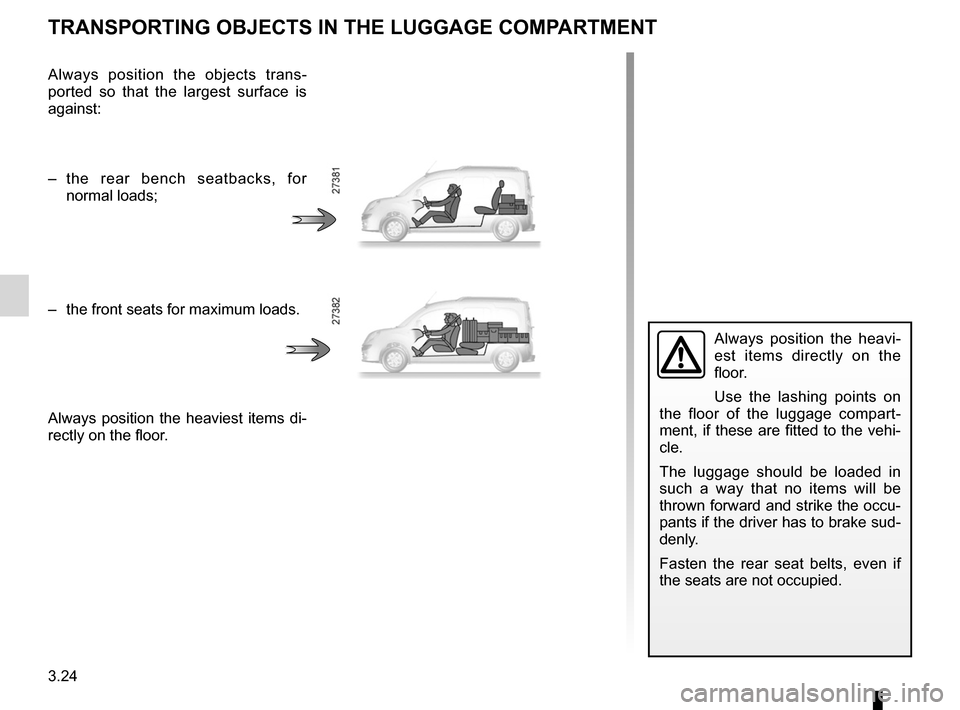
Always position the objects trans -
ported so that the largest surface is
against:
– the rear bench seatbacks, for
normal loads;
– the front seats for maximum loads.
Always position the heaviest items di-
rectly on the floor.
Page 136 of 213

towingtowing equipment ............................ (up to the end of the DU)
towing equipment fitting ............................................... (up to the end of the DU)
3.25
ENG_UD29274_3
Remorquage : attelage (X61 - F61 - K61 - Renault)
ENG_NU_911-4_F61e_Renault_3
A = 776.5 mm.
Towbar
Permissible nose weight, maxi -
mum permissible towing weight,
braked and unbraked : refer to
Section 6 “Weights”.
Refer to the manufacturer’s instruc-
tions for information on how to fit
and operate the towing equipment.
Please keep these instructions with
the rest of the vehicle documenta -
tion.
t oWBAr
A
If the towbar ball obscures the regis-
tration plate or the rear fog lights, it
should be removed when not in use.
In all cases, comply with local leg -
islation.