2012 RENAULT ESPACE lock
[x] Cancel search: lockPage 184 of 267
bonnet.................................................................... (current page)
levels ..................................................................... (current page)
4.2
ENG_UD24344_2
Capot moteur (X81 - J81 - Renault)
ENG_NU_932-3_X81ph3_Renault_4
Jaune NoirNoir texte
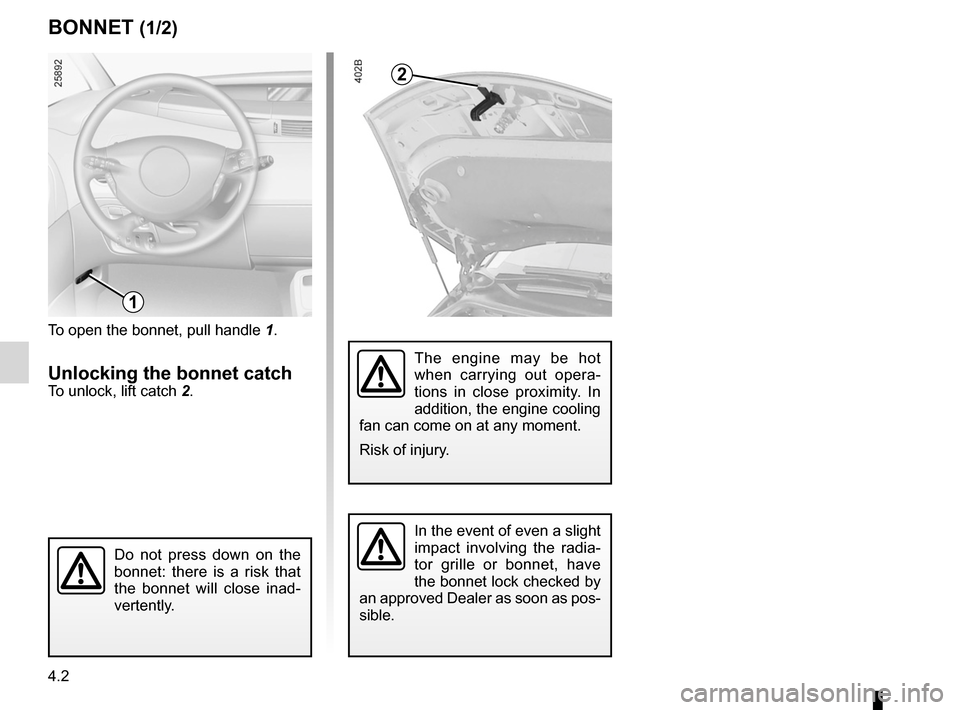
To open the bonnet, pull handle 1.
Unlocking the bonnet catchTo unlock, lift catch 2.
Bonnet
Bonnet (1/2)
1
2
The engine may be hot
when carrying out opera-
tions in close proximity. In
addition, the engine cooling
fan can come on at any moment.
Risk of injury.
In the event of even a slight
impact involving the radia -
tor grille or bonnet, have
the bonnet lock checked by
an approved Dealer as soon as pos-
sible.
Do not press down on the
bonnet: there is a risk that
the bonnet will close inad -
vertently.
Page 185 of 267

JauneNoirNoir texte
4.3
ENG_UD24344_2
Capot moteur (X81 - J81 - Renault)
ENG_NU_932-3_X81ph3_Renault_4
Closing the bonnet
Before closing the bonnet, check to
make sure that nothing has been left
in the engine compartment. To close
the bonnet again, hold the bonnet in
the middle and lower it to 30 cm above
the closed position, then release it. It
will latch automatically under its own
weight.
Bonnet (2/2)
Before opening the bonnet,
remember to return the
windscreen wiper stalk to
park position (refer to the in-
formation on the “Windscreen wash/
wipe” in Section 1).
Ensure that the bonnet is
properly locked.
Check that nothing is pre -
venting the catch from lock-
ing (gravel, cloth, etc.).
opening the bonnetLift the bonnet; you will need to guide it
as it is held by a strut.
After carrying out any work
in the engine compart -
ment, check that nothing
has been left behind (cloth,
tools, etc.).
These may damage the engine or
cause a fire.
Page 198 of 267

maintenance:interior trim ...................................... (up to the end of the DU)
interior trim maintenance ................................... (up to the end of the DU)
cleaning: inside the vehicle ............................ (up to the end of the DU)
4.16
ENG_UD22866_8
Entretien des garnitures intérieures (X35 - X45 - X65 - J77 - X81 - \
J81 - X85 - X91 - B91 - K91 - D91 - X83 - X61 - X77 ph2 - X95 - B95 - D9\
5 - E95 - K95 - J95 - R95 -
ENG_NU_932-3_X81ph3_Renault_4
Jaune NoirNoir texte
Interior trim maintenance
Glass instrument panel(e.g. instrument panel, clock, exterior
temperature display, radio display, etc.)
Use a soft cloth (or cotton wool).
If this does not clean it properly, use a
soft cloth (or cotton wool) slightly mois-
tened with soapy water and then wipe
clean with a soft damp cloth or cotton
wool.
Finally, carefully dry off with a soft dry
cloth.
Cleaning products containing alco -
hol must not be used under any cir-
cumstances.
Seat belts
These must be kept clean.
Use products selected by our Technical
Department (Approved outlets) or
warm, soapy water and a sponge and
wipe with a dry cloth.
Detergents or dyes must not be used
under any circumstances.
InteRIoR tRIM MAIntenAnCe (1/2)
textiles (seats, door trim, etc)
Vacuum-clean the textiles regularly.
Liquid stain
Use soapy water.
Dab lightly (never rub) with a soft cloth,
rinse and remove the excess.
Solid or pasty stain
Carefully remove the excess solid or
pasty material immediately with a
spatula (working from the edges to the
centre to avoid spreading the stain).
Clean as for a liquid stain.
Special instructions for sweets or
chewing gum
Put an ice cube on the stain to solidify
it, then proceed as for a solid stain.
A well-maintained vehicle will last
longer. It is therefore recommended to
maintain the interior of the vehicle regu-
larly.
A stain should always be dealt with
swiftly.
Whatever type of stain is on the trim,
use
cold (or warm) soapy water with
natural soap.
Detergents (washing-up liquid, pow -
dered products, alcohol-based prod-
ucts) should not be used.
Use a soft cloth.
Rinse and soak up the excess.
For further recommendations for
maintaining the interior, and/or for
any unsatisfactory results, please
see an authorised dealer.
Page 202 of 267

practical advice ..................................... (up to the end of the DU)
puncture ................................................ (up to the end of the DU)
emergency spare wheel ....................... (up to the end of the DU)
wheels (safety) ..................................... (up to the end of the DU)
5.2
ENG_UD24346_2
Roue de secours (X81 - J81 - Renault)
ENG_NU_932-3_X81ph3_Renault_5
Jaune NoirNoir texte
Puncture
Emergency spare wheel
Puncture/eMerGencY SPAre WHeeL (1/2)
In the event of a puncture,
depending on the vehicle,
you will have:
An emergency spare wheel or tyre in -
flation kit (refer to the information on the
following pages).
If you have an emergency spare wheel,
you need to use tool A comprising
ratchet spanner 2 and end-piece 1.
nB: using other tools could damage the
mechanism)
These components are stored in the
tool kit in the luggage compartment
(refer to the information on the “Took
kit” in Section 5). Ensure that the end piece 1 is securely
attached to the ratchet spanner
2.
The ratchet spanner has one direction
for tightening and another for loosen -
ing. Reverse the direction of the oper -
ation when moving from loosening to
tightening and vice versa.
emergency spare wheel B
It is located under the vehicle.
– In the luggage compartment, lift
cover 3;
– remove the blanking cover;
– use tool A and turn it until the wheel
retaining cable unwinds and the
wheel drops to the ground; –
stand the wheel up outside the vehi-
cle;
– press on lock 4 and turn it a quarter
of a turn
– run the retaining cable across the
wheel rim and release the wheel;
– depending on the vehicle, take out
the shim from inside the wheel rim.
n ote: depending on the vehicle, the
shim on the top of the emergency spare
wheel should only be repositioned with
this emergency spare wheel; it should
not be used with the punctured wheel.
12
3
B
4
A
4
Page 203 of 267

JauneNoirNoir texte
5.3
ENG_UD24346_2
Roue de secours (X81 - J81 - Renault)
ENG_NU_932-3_X81ph3_Renault_5
Puncture/eMerGencY SPAre WHeeL (2/2)
t o refit the emergency spare
wheel
Proceed in the reverse order.
– stand the punctured wheel up, with
valve 5 towards you;
– run the cable across and reposition
lock 4;
– lie the wheel down, with valve 5
facing the ground;
– in the luggage compartment, use the
tool to completely to rewind the re -
taining cable. Advice
Check the pressure of the emergency
spare wheel regularly.
note:
The bolts for the aluminium wheel may
be used to secure the steel emergency
spare wheel.
using the emergency spare
wheel
The “tyre pressure monitor” function
does not monitor the emergency spare
wheel (the wheel replaced by the emer-
gency spare wheel disappears from the
instrument panel and/or the information
display). Refer to the information on the
“Tyre pressure monitor” in Section 2.
Special note
Using an emergency spare wheel may
disrupt certain functions (automatic
gearbox, etc.).
If the emergency spare
wheel has been stored
for several years, have it
checked by your Dealer to
ensure that it is safe to use.
4
5
Vehicles fitted with an
emergency spare wheel
which is different to the
four other wheels:
– Never fit more than one emer -
gency spare wheel to the same
vehicle.
– Replace the emergency spare
wheel as soon as possible with
a wheel identical to the original
one.
– When this is fitted to the vehicle,
which must only be a temporary
measure, the driving speed must
not exceed the speed indicated
on the label on the wheel.
– Fitting an emergency spare
wheel may alter the way the ve -
hicle usually runs. Avoid sudden
acceleration or deceleration and
reduce your speed when corner-
ing.
– If you need to use snow chains,
fit the emergency spare wheel to
the rear axle and check the tyre
pressure.
Page 227 of 267

JauneNoirNoir texte
5.27
ENG_UD24349_2
Fusibles (X81 - J81 - Renault)
ENG_NU_932-3_X81ph3_Renault_5
FuSeS (continued)
Allocation of fuses (DePenDInG On tHe eQuIPMent LeVeL)
numbers Allocation numbersAllocation numbersAllocation
ALIM
UCHElectrical management
unit/Engine immobiliserÉHazard warning lights/
IndicatorsëPassenger compartment
accessory socket
ÁNot usednAnti-lock Braking System
(ABS)FRear fog light
ÞInstrument panel/Remote
headlight adjustmentÌHorn
ðHeated door mirrors
ÅAir bags/Pretensioners
t
Air conditioning/Parking
proximity sensor/Reversing
light
hElectric windows/Electric
door mirrors
NDoor locking/unlocking
ZInterior lightingGFront fog lights/Instrument
panel
ßStop lights/Cruise control
ÏCommunication system/
Radio/Electric seats
ÆCigar lighter
CRear screen demisting/
Steering column lock
LLeft-hand dipped beam
headlight
YLeft-hand side light/Internal
control lightingfRear wiper/Main beam
headlightsTRight-hand dipped beam
headlight
VRight-hand side lights
Page 230 of 267

5.30
ENG_UD20429_1
Batterie : dépannage (X81 - J81 - Renault)
ENG_NU_932-3_X81ph3_Renault_5
Jaune NoirNoir texte
BAtter Y: troubleshooting (continued)
connecting a battery charger
t he battery charger must be com -
patible with a battery with a nominal
voltage of 12 volts.
It is essential to disconnect both bat -
tery leads from the terminals (engine
stopped) starting with the negative
terminal.
Do not disconnect the battery when the
engine is running. Follow the instruc-
tions given by the manufacturer of
the battery charger you are using.
Only a fully charged and well-main -
tained battery will have a long and
useful life and enable you to start the
vehicle’s engine normally.
The battery must be kept clean and dry.
Have the battery’s charge status
checked regularly:
– Especially if you use your vehicle for
short journeys or for frequent driving
in town. –
When the exterior temperature drops
(in winter), the charge decreases.
In winter, only use electrical equip -
ment which is really necessary.
– Finally, you should understand that
the charge decreases naturally as a
result of certain permanent electrical
consumers such as the clock, after-
sales accessories, etc.
When a large number of accessories
are fitted to the vehicle, have them con-
nected to the + after ignition feed. In
this case, it is advisable to have your
vehicle fitted with a battery which has
an increased nominal capacity. Contact
an approved dealer. If your vehicle is to be left stationary
for a relatively long time, disconnect
the battery or have it recharged regu
-
larly, particularly during cold weather.
The equipment with a memory, radio
etc. will then have to be reprogrammed.
The battery must be stored in a cool dry
place, protected from frost.
Special procedures may be
required to charge some
batteries. Contact your ap -
proved dealer.
Avoid all risk of sparks which may
cause an immediate explosion, and
charge the battery in a well-venti -
lated area. Risk of serious injury.
Page 232 of 267

wiper blades .......................................................... (current page)
practical advice ...................................................... (current page)
wipers blades .............................................................. (current page)
5.32
ENG_UD20430_1
Balais d’essuie-vitre (X81 - J81 - Renault)
ENG_NU_932-3_X81ph3_Renault_5
Wipers (replacing blades)
WInDScreen WIPer BLADeS
replacing windscreen wiper
blades 1
– Lift wiper arm 2;
– move blade 1 into a horizontal posi-
tion;
– slide blade 1 until catch 3 on the
wiper arm is released.
refitting
To refit the wiper blade, proceed in the
reverse order to removal. Make sure
that the blade is correctly locked in po-
sition.
Windscreen washer jets
These can be adjusted using a tool
such as a flat-blade screwdriver.
rear screen wiper blade 4
– Lift wiper arm 5 as far as it will go;
– pivot blade 4 until it is removed from
its hinge.
refitting
To refit the wiper blade, clip the blade
onto its hinge. Make sure that the blade
is correctly locked in position.
– In frosty weather, make
sure that the wiper blades
are not stuck by ice (risk of
motor overheating).
– Check the condition of the wiper
blades. Replace the wiper blades
as soon as they begin to lose ef-
ficiency (approximately once a
year).
1
23
4
5