2012 RENAULT ESPACE tow
[x] Cancel search: towPage 91 of 267
JauneNoirNoir texte
2.9
ENG_UD20366_1
Frein de parking assisté (X81 - J81 - Renault)
ENG_NU_932-3_X81ph3_Renault_2
ASSISTED PARKING BRAKE (continued)
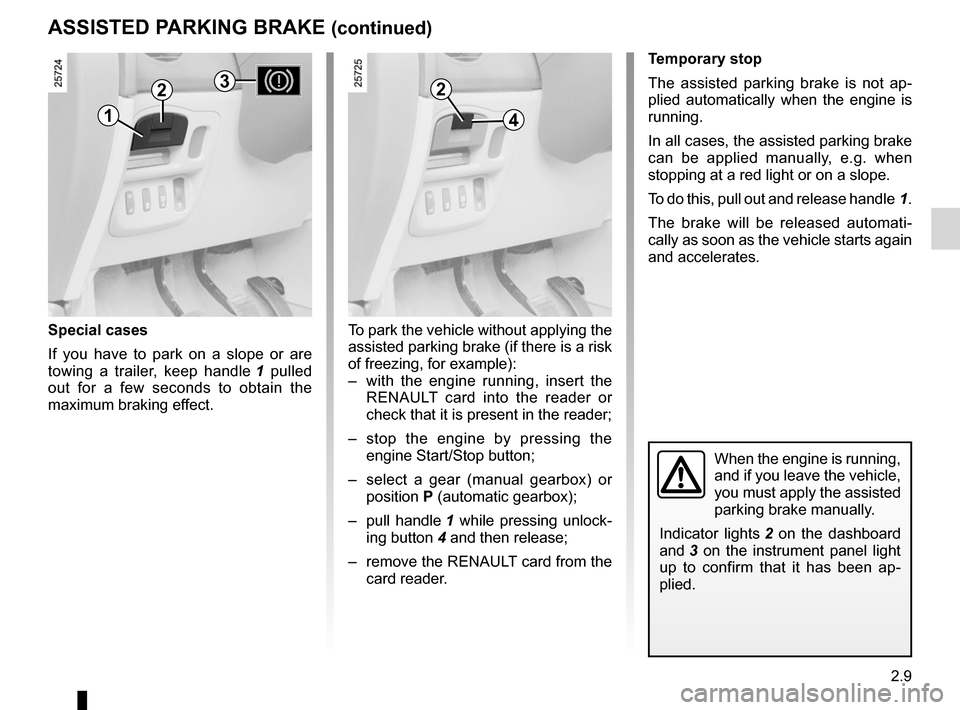
Special cases
If you have to park on a slope or are
towing a trailer, keep handle 1 pulled
out for a few seconds to obtain the
maximum braking effect.
Temporary stop
The assisted parking brake is not ap -
plied automatically when the engine is
running.
In all cases, the assisted parking brake
can be applied manually, e.g. when
stopping at a red light or on a slope.
To do this, pull out and release handle 1.
The brake will be released automati -
cally as soon as the vehicle starts again
and accelerates.
When the engine is running,
and if you leave the vehicle,
you must apply the assisted
parking brake manually.
Indicator lights 2 on the dashboard
and 3 on the instrument panel light
up to confirm that it has been ap -
plied.
To park the vehicle without applying the
assisted parking brake (if there is a risk
of freezing, for example):
– with the engine running, insert the
RENAULT card into the reader or
check that it is present in the reader;
– stop the engine by pressing the
engine Start/Stop button;
– select a gear (manual gearbox) or
position P (automatic gearbox);
– pull handle 1 while pressing unlock-
ing button 4 and then release;
– remove the RENAULT card from the
card reader.
2
41
23
Page 96 of 267
ENG_NU_932-3_X81ph3_Renault_2
ADvIcE: antipollution, fuel economy and driving (continued)
Advice on")
2.14
ENG_UD20368_1
Conseils antipollution, économies de carburant, conduite (X81 - J81 \
- Renault)ENG_NU_932-3_X81ph3_Renault_2
ADvIcE: antipollution, fuel economy and driving (continued)
Advice on use
– Electricity is fuel: switch off all electri-
cal components when you no longer
need them. However (safety first),
keep your lights on when the visibil -
ity is poor (“see and be seen”).
– Use the air vents. Driving with the
windows open at 60 mph (100 km/h)
will increase fuel consumption by
4%.
– Do not leave an empty roof rack
fitted to the vehicle. –
In vehicles fitted with air condi -
tioning , it is normal to observe an
increase in fuel consumption (es -
pecially in city conditions) when
it is used. For vehicles fitted with
manual air conditioning, switch off
the system when it is not required.
In order to minimise consumption
and help to protect the environ -
ment: it is recommended to drive
with the air vents on and the win -
dows closed. If the vehicle has been
parked in the sun, open the doors
for a few moments to let the hot air
escape before starting the engine.
– Never fill the fuel tank right to the
brim to avoid overflow.
– It is better to fit a trailer for bulky ob-
jects.
– When towing a caravan, fit a wind
deflector and adjust it carefully. –
Avoid using the vehicle for door -
to-door calls (short journeys with
long waits in between) because the
engine never reaches its normal op-
erating temperature.
Tyres
– Under-inflated tyres increase fuel
consumption.
– The use of non-recommended tyres
can increase fuel consumption.
Page 97 of 267

2.15
ENG_UD25716_1
Environnement (sans marque) (X44 - X45 - X77 - X81 - X85 - X90 - X91 \
- X83 - X61 - TEST - X95 - J9")
environment .......................................... (up to the end of the DU)
2.15
ENG_UD25716_1
Environnement (sans marque) (X44 - X45 - X77 - X81 - X85 - X90 - X91 \
- X83 - X61 - TEST - X95 - J95 - R95 - F90 Ph2 - X33 - X47 - X43 - X38 - H79 - X62 - X32 -\
X09 -
ENG_NU_932-3_X81ph3_Renault_2
Environment
ENvIRONMENT
Emissions
Your vehicle has been designed to emit
fewer greenhouse gases (CO2) while in
use, and therefore to consume less fuel
(eg. 140 g/km, equivalent to 5.3 l/100
km for a diesel vehicle).
Our vehicles are also equipped with a
particle filter system including a cata -
lytic converter, an oxygen sensor and
an active carbon filter (the latter pre -
vents vapour from the fuel tank being
released into the open air).
For certain diesel vehicles, this system
also has a particle filter to reduce the
volume of soot particles emitted.
Please make your own
contribution towards
protecting the environment
too
– Worn parts replaced in the course of
routine vehicle maintenance (vehi -
cle battery, oil filter, air filter, batter -
ies, etc.) and oil containers (empty or
filled with used oil) must be disposed
of through specialist organisations. –
At the end of the vehicle’s service
life, it should be sent to approved
centres to ensure that it is recycled.
– In all cases, comply with local legis -
lation.
Recycling
Your vehicle is 85% recyclable and
95% recoverable.
To achieve these objectives, many of
the vehicle components have been de-
signed to enable them to be recycled.
The materials and structures have
been carefully designed to allow these
components to be easily removed and
reprocessed by specialist companies.
In order to preserve raw material re -
sources, this vehicle incorporates nu -
merous parts made from recycled plas-
tics or renewable materials (vegetable
or animal-derived materials such as
cotton or wool).
Your vehicle has been designed with
respect for the
environment in mind for
its entire service life: during production,
use and at the end of its life.
This commitment is illustrated by the
Renault eco² signature.Manufacture
Your vehicle has been manufactured at
an factory which uses a progress policy
to reduce the environmental impact on
the surrounding area and nature (re -
duction of water and energy consump-
tion, visual and noise pollution, atmos-
pheric emissions and waste water,
sorting and reusing waste).
Page 122 of 267

2.40
ENG_UD24090_2
Boîte automatique (X81 - J81 - Renault)
ENG_NU_932-3_X81ph3_Renault_2
AUTOMATIc GEARBOX (continued)
When setting off, if the lever is locked
in position P even though you are de -
pressing the brake pedal and pressing
unlocking button 2, the lever can be re-
leased manually.
To do this, unclip the upper section of
the gaiter 3.Push unlocking button 2 and button 4
under the gaiter at the same time to
move the lever from position P.
4
2
3
Operating faults
– When driving , if the message
“ Check auto gearbox ” appears on
the instrument panel, this indicates
there is a fault.
Contact your approved Dealer as
soon as possible.
– When driving, if the message “Auto
gearbox overheating” appears on the
instrument panel, stop the vehicle to
allow the gearbox to cool down.
Contact your approved Dealer as
soon as possible.
– If a vehicle with an automatic
gearbox breaks down, refer to the
information on “Towing” in Section 5.
Page 142 of 267

3.20
ENG_UD20382_1
Air conditionné automatique (X81 - J81 - Renault)
ENG_NU_932-3_X81ph3_Renault_3
Jaune NoirNoir texte
AUTOMATIC CLIMATE CONTROL (continued)
Adjusting automatic mode
Adjusting the distribution of air
in the passenger compartment,
button 6.
In automatic mode, the system man -
ages the distribution of air in the pas -
senger compartment (indicator light A
lit), but you may alter the selections
made by the system. Exit automatic mode by pressing
button
6 (indicator light A goes out).
However, in this case, only the air dis-
tribution will no longer be controlled au-
tomatically by the system.
There are four choices for air distribu -
tion that are determined by pressing
button 6 repeatedly.
JAir exits through the front
vents.
OAir exits through the front and
rear vents.
PThe air exits from all the vents
and the vents next to the occu-
pants feet.
QThe air is directed towards the
occupants feet and towards
the windscreen.
This is the recommended mode
of use: the automatic climate con -
trol system guarantees comfort
(except in the event of extreme con-
ditions) in the passenger compart -
ment and good visibility while opti -
mising consumption.
Return to automatic mode as
soon as possible.
A
6
Page 147 of 267

air conditioning ...................................................... (current page)
heating system ...................................................... (current page)
air conditioning ...................................................... (current page)
temperature regulation .......................................... (current page)
ventilation .............................................................. (current page)
heating and air conditioning system ...................... (current page)
3.25
ENG_UD11274_2
Air conditionné : informations et conseils d’utilisation (X81 - R\
enault)
ENG_NU_932-3_X81ph3_Renault_3
AIR CONDITIONING: information and advice on use
Fuel consumption
You will normally notice an increase
in fuel consumption (especially
when driving in town) when the air
conditioning is operating.
For vehicles fitted with manual air
conditioning, switch off the system
when it is not required.
Advice for reducing consumption
and therefore helping to preserve
the environment:
Drive with the air vents open and
the windows closed.
If the vehicle has been parked in
the sun, open the doors for a few
moments to let the hot air escape
before starting the engine.
Maintenance
Refer to the Maintenance Service
Booklet for your vehicle for the in -
spection frequency.Vehicles fitted with an auxiliary
heater
Some vehicles are fitted with an
auxiliary heater which heats the pas-
senger compartment more quickly.
This device operates only when
the engine is running and in cold
weather.
When the device is functioning you
can normally see a small amount of
smoke on the right-hand side of the
vehicle coming from the heater’s ex-
haust system.Operating faults
As a general rule, contact your ap-
proved dealer in the event of an op-
erating fault.
– Reduction in de-icing, demist -
ing or air conditioning per -
formance. This may be caused
by the passenger compartment
filter cartridge becoming clogged.
– No cold air is being produced.
Check that the controls are set
correctly and that the fuses are
sound. Otherwise, switch off the
system.
Do not open the refriger -
ant fluid circuit. The fluid
may damage eyes or skin.
Notes
Presence of water under the ve -
hicle. After prolonged use of the air
conditioning system, it is normal for
water to be present under the vehi-
cle. This is caused by condensation.
Do not add anything to the
vehicle’s ventilation circuit
(for example, to remove
bad odours).
There is a risk of damage or of
fire.
Page 164 of 267

rear seats............................................................... (current page)
3.42
ENG_UD20393_1
Sièges arrière : appuis-tête (X81 - J81 - Renault)
ENG_NU_932-3_X81ph3_Renault_3
Rear seats
REAR SEATS: headrests
To refit the headrest
Insert the rods into the sleeves, with the
notches at bottom to the front, and lower
the headrest to the desired height.
Rear headrest storage
position
Press tab 1 on the headrest guide and
lower the headrest completely.
The fully lowered headrest position
is a storage position: it should not be
in this position when a passenger is
seated.
To adjust the height
Slide the headrest slowly while pulling it
towards the front of the vehicle.
The headrest does not lower fully.
To remove the headrest
Press tab 1 on the headrest guide
and lift the headrest. If the headrest is
trapped against the roof of the vehicle,
tilt the seatback.The headrest is a safety
component, check that it
is fitted and in the correct
position. The distance be -
tween your head and the headrest
should be as small as possible. The
top of your head should be in line
with the top of the headrest.
1
Page 165 of 267

child headrest ....................................... (up to the end of the DU)
child safety ............................................ (up to the end of the DU)
children ................................................. (up to the end of the DU)
3.43
ENG_UD20394_1
Appuis-tête convertible enfant (X81 - J81 - Renault)
ENG_NU_932-3_X81ph3_Renault_3
CHILD’S CONVERTIBLE HEADREST
Depending on the vehicle, the child
headrests are fitted to the rear side
seats (for a normal chassis) or the side
seats in the second row of rear seats
(for a long chassis). To adjust the height
Pull the headrest towards you and si
-
multaneously slide it to the recom -
mended height (see Figure A).
The headrest is a safety
component, check that it is
fitted and in the correct po-
sition.
The headrest is approved
only for the vehicle on which
it is originally fitted.
It must not be fitted to an-
other vehicle under any circum -
stances.
To remove the headrest
Press tabs 1 and raise the headrest to
remove it.
To refit the headrest
Insert the headrest rods into the holes,
with the notches to the front, and lower
the headrest to the desired height.
1
A