2012 RENAULT CLIO SPORT TOURER engine
[x] Cancel search: enginePage 204 of 264
bulbschanging ......................................... (up to the end of the DU)
changing a bulb .................................... (up to the end of the DU)
lights: dipped beam headlights .................. (up to the end of the DU)
lights: direction indicators .......................... (up to the end of the DU)
lights: side lights ........................................ (up to the end of the DU)
lights: main beam headlights ...................................... (current page)
bulbs changing ......................................... (up to the end of the DU)
lights front ................................................. (up to the end of the DU)
indicators .............................................. (up to the end of the DU)
lights changing bulbs ................................ (up to the end of the DU)
5.16
ENG_UD14672_3
Projecteurs avant avec lampes halogènes : remplacement des lampes (X\
85 - B85 - C85 - S85 - K85 - Renault)
ENG_NU_853-8_BCSK85_Renault_5
Jaune NoirNoir texte
It is essential to use anti-U.V. 55W
bulbs so as not to damage the plastic
on the headlights.
Do not touch the bulb glass. Hold it
by its base.
Mark the bulb’s position before removal
to ensure correct positioning when re -
placing.
When the bulb has been changed,
make sure you refit the cover correctly.
However, because parts need to be
removed, you are advised to have
your bulbs replaced by an approved
dealer.
Vehicle without additional
cornering lights
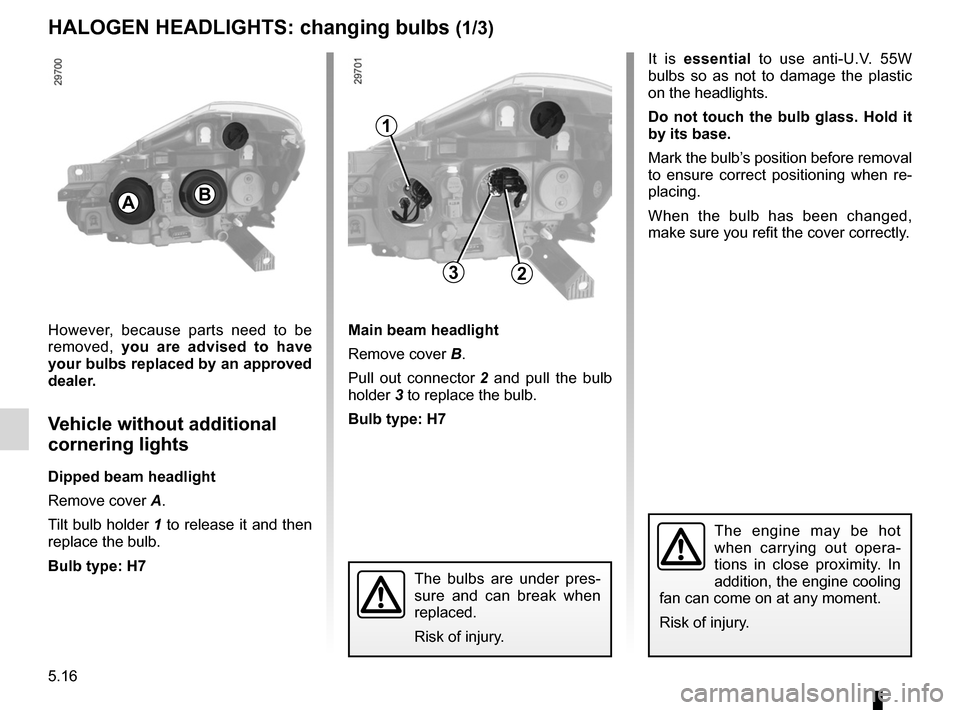
Dipped beam headlight
Remove cover A.
Tilt bulb holder 1 to release it and then
replace the bulb.
Bulb type: H7
Headlights (changing bulbs)
The bulbs are under pres -
sure and can break when
replaced.
Risk of injury.
HALOGEN HEADLIGHTS: changing bulbs (1/3)
The engine may be hot
when carrying out opera-
tions in close proximity. In
addition, the engine cooling
fan can come on at any moment.
Risk of injury.
A
Main beam headlight
Remove cover B.
Pull out connector 2 and pull the bulb
holder 3 to replace the bulb.
Bulb type: H7
B
1
23
Page 205 of 264

ENG_NU_853-8_BCSK85_Renault_5
It is essential to")
JauneNoirNoir texte
5.17
ENG_UD14672_3
Projecteurs avant avec lampes halogènes : remplacement des lampes (X\
85 - B85 - C85 - S85 - K85 - Renault)
ENG_NU_853-8_BCSK85_Renault_5
It is essential to use anti-U.V. 55W
bulbs so as not to damage the plastic
on the headlights.
Do not touch the bulb glass. Hold it
by its base.
Mark the bulb’s position before removal
to ensure correct positioning when re -
placing.
When the bulb has been changed,
make sure you refit the cover correctly.
The bulbs are under pres -
sure and can break when
replaced.
Risk of injury.
HALOGEN HEADLIGHTS: changing bulbs (2/3)
The engine may be hot
when carrying out opera-
tions in close proximity. In
addition, the engine cooling
fan can come on at any moment.
Risk of injury.
However, because parts need to be
removed, you are advised to have
your bulbs replaced by an approved
dealer.
Vehicle with additional
cornering lights
Dipped beam headlight
Remove cover C.
Tilt bulb holder 4 to release it and then
replace the bulb.
Bulb type: H7
Main beam headlight
Remove cover D.
Pull out connector 5.
Unclip the spring and take out the bulb.
Bulb type: H7
CD
4
5
Page 206 of 264

ENG_NU_853-8_BCSK85_Renault_5
Additional cornering light
Due to their")
5.18
ENG_UD14672_3
Projecteurs avant avec lampes halogènes : remplacement des lampes (X\
85 - B85 - C85 - S85 - K85 - Renault)
ENG_NU_853-8_BCSK85_Renault_5
Additional cornering light
Due to their reduced accessibility
(sometimes requiring the removal of
bodywork or mechanical components),
we advise you to have your bulbs 7 re-
placed by an approved Dealer.
Bulb type: H7.
Front side light
Remove cover E, then pull bulb holder 6
to access the bulb.
Bulb type: W5W.
Direction indicator lights
Turn bulb holder F a quarter of a turn
and take out the bulb.
Bulb type: orange PY21 W.
Once the bulb has been replaced,
check that it is properly secured.
The bulbs are under pres -
sure and can break when
replaced.
Risk of injury.
HALOGEN HEADLIGHTS: changing bulbs (3/3)
The engine may be hot
when carrying out opera-
tions in close proximity. In
addition, the engine cooling
fan can come on at any moment.
Risk of injury.
To comply with local legislation, or
as a precaution, you can obtain an
emergency kit containing a set of
spare bulbs and fuses from an ap -
proved dealer.
E
6
F
7
Page 215 of 264
JauneNoirNoir texte
5.27
ENG_UD24921_5
Fusibles (X85 - B85 - C85 - S85 - K85 - Renault)
ENG_NU_853-8_BCSK85_Renault_5
Some accessories are protected by
fuses located in the engine compart -
ment.
However, due to their reduced acces -
sibility, we advise you to have your
fuses replaced by an approved
Dealer .
FUSES (2/2)
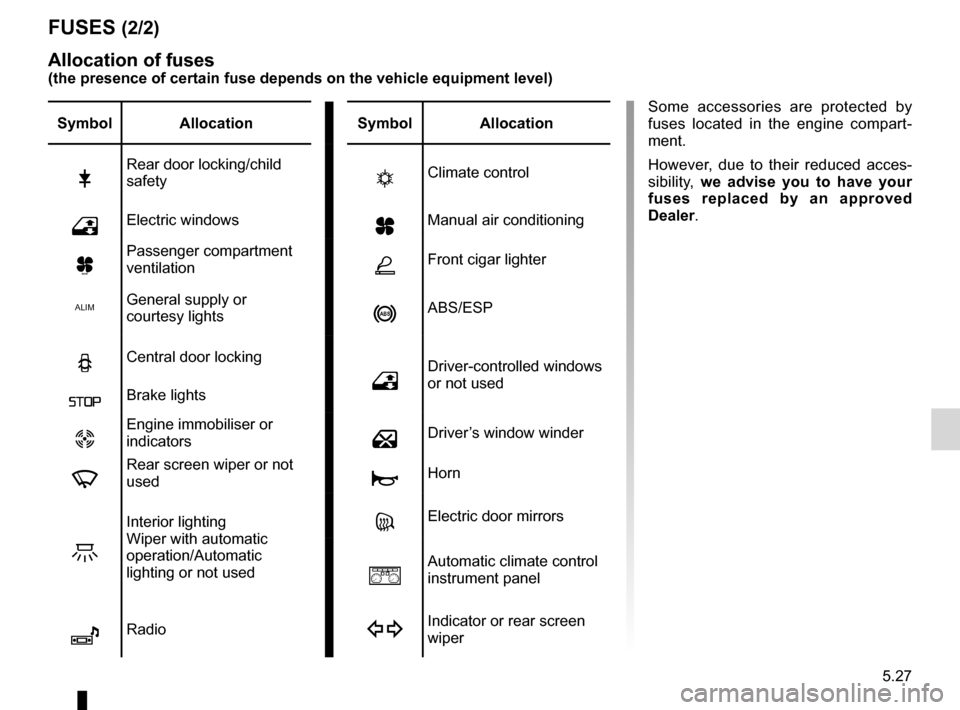
Allocation of fuses
(the presence of certain fuse depends on the vehicle equipment level)
Symbol Allocation SymbolAllocation
2Rear door locking/child
safetytClimate control
hElectric windowsyManual air conditioning
ÚPassenger compartment
ventilationÆFront cigar lighter
ALIMGeneral supply or
courtesy lightsnABS/ESP
NCentral door locking
hDriver-controlled windows
or not used
ßBrake lights
ÙEngine immobiliser or
indicatorsæDriver’s window winder
fRear screen wiper or not
usedÌHorn
Z
Interior lighting
Wiper with automatic
operation/Automatic
lighting or not usedgElectric door mirrors
aAutomatic climate control
instrument panel
îRadioIndicator or rear screen
wiper
Page 216 of 264
5.28
ENG_UD12592_2
Batterie : dépannage (X85 - B85 - C85 - S85 - K85 - Renault)
ENG_NU_853-8_BCSK85_Renault_5
Jaune NoirNoir texte
To avoid all risk of sparks:
– ensure that any consumers are
switched off before disconnecting or
reconnecting the battery;
– when charging, stop the charger
before connecting or disconnecting
the battery;
– to avoid creating a short circuit be -
tween the terminals, do not place
metal objects on the battery;
– always wait at least one minute after
the engine has been switched off
before disconnecting a battery;
– make sure that you reconnect the
battery terminals after refitting.
Battery
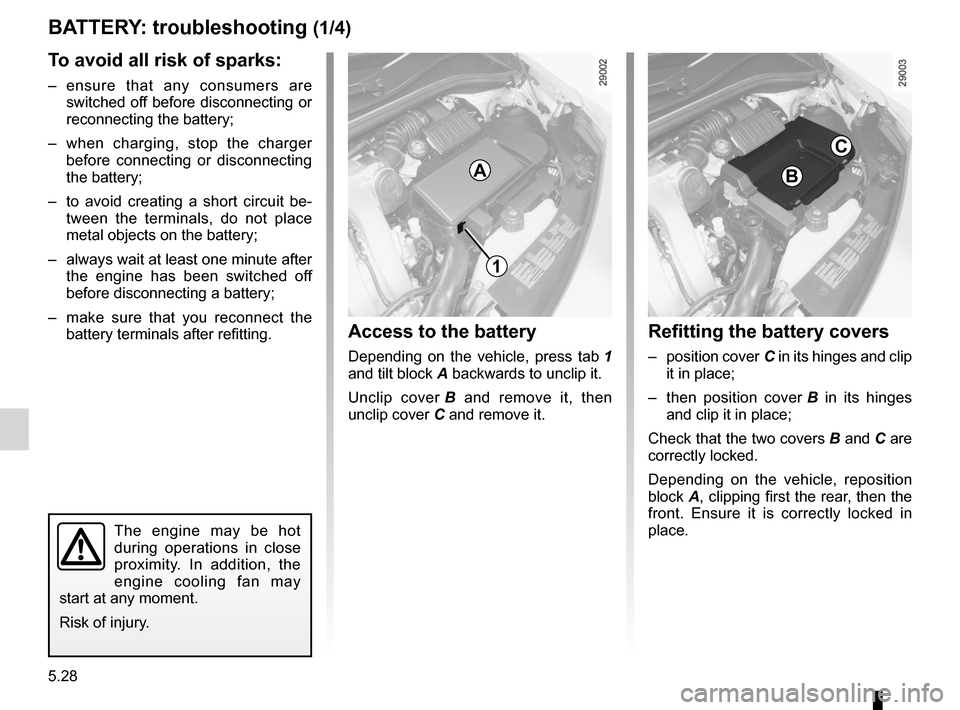
Refitting the battery covers
– position cover C in its hinges and clip
it in place;
– then position cover B in its hinges
and clip it in place;
Check that the two covers B and C are
correctly locked.
Depending on the vehicle, reposition
block A, clipping first the rear, then the
front. Ensure it is correctly locked in
place.
Access to the battery
Depending on the vehicle, press tab 1
and tilt block A backwards to unclip it.
Unclip cover B and remove it, then
unclip cover C and remove it.
BATTERY: troubleshooting (1/4)
AB
C
1
The engine may be hot
during operations in close
proximity. In addition, the
engine cooling fan may
start at any moment.
Risk of injury.
Page 217 of 264
JauneNoirNoir texte
5.29
ENG_UD12592_2
Batterie : dépannage (X85 - B85 - C85 - S85 - K85 - Renault)
ENG_NU_853-8_BCSK85_Renault_5
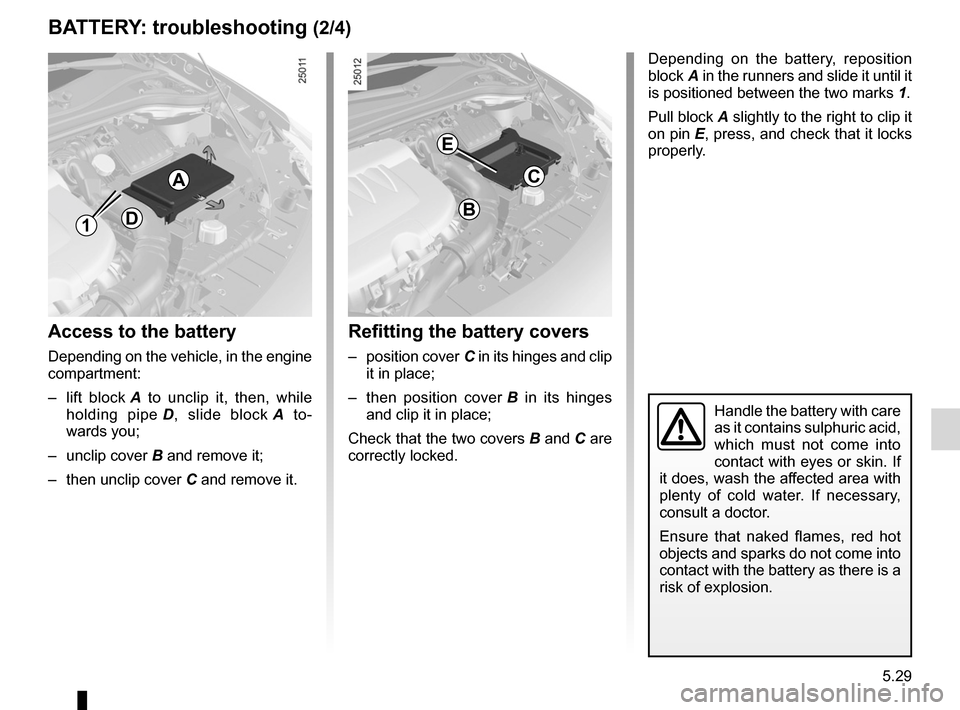
Depending on the battery, reposition
block A in the runners and slide it until it
is positioned between the two marks 1.
Pull block A slightly to the right to clip it
on pin E, press, and check that it locks
properly.
Refitting the battery covers
– position cover C in its hinges and clip
it in place;
– then position cover B in its hinges
and clip it in place;
Check that the two covers B and C are
correctly locked.
Access to the battery
Depending on the vehicle, in the engine
compartment:
– lift block A to unclip it, then, while
holding pipe D , slide block A to -
wards you;
– unclip cover B and remove it;
– then unclip cover C and remove it.
BATTERY: troubleshooting (2/4)
D
A
B
C
E
1
Handle the battery with care
as it contains sulphuric acid,
which must not come into
contact with eyes or skin. If
it does, wash the affected area with
plenty of cold water. If necessary,
consult a doctor.
Ensure that naked flames, red hot
objects and sparks do not come into
contact with the battery as there is a
risk of explosion.
Page 218 of 264
5.30
ENG_UD12592_2
Batterie : dépannage (X85 - B85 - C85 - S85 - K85 - Renault)
ENG_NU_853-8_BCSK85_Renault_5
Jaune NoirNoir texte
BATTERY: troubleshooting (3/4)
Special procedures may be
required to charge some
batteries. Contact your ap-
proved Dealer.
Avoid all risk of sparks which may
cause an immediate explosion and
charge the battery in a well-venti -
lated area. Risk of serious injury.
If your vehicle is to be left stationary for
a relatively long time, disconnect the
battery or have it recharged regularly,
particularly during cold weather. It will
then be necessary, with the engine run-
ning, to move the steering wheel slowly,
from lock to lock and to reprogram the
electronic equipment with a memory
feature, radio, etc. The battery should
be stored in a cool and dry location pro-
tected from frost.
Note: if you have disconnected or re -
charged a battery, move the steering
wheel slowly from lock to lock to reset
the system.
Have the battery’s charge status
checked regularly:
–
especially if you use your vehicle for
short journeys or for frequent driving
in town;
– when the exterior temperature drops
(in winter), the charge decreases .
In winter, only use the electrical
equipment that is really necessary;
– finally, you should understand that
the charge decreases naturally as a
result of certain permanent electrical
consumers such as the clock, after-
sales accessories, etc.
When many accessories are fitted to
the vehicle, have them connected to
the + after ignition feed. In this case, it
is advisable to have your vehicle fitted
with a battery which has an increased
nominal capacity. Contact an approved
Dealer.Connecting a battery charger
The battery charger must be com -
patible with a battery with nominal
voltage of 12 volts.
Switch the engine off and then discon -
nect both battery leads starting with
the negative terminal.
Do not disconnect the battery when the
engine is running. Follow the instruc-
tions given by the manufacturer for
the battery charger you are using.
Only a fully charged and well-main -
tained battery will have a long and
useful life and enable you to start the
vehicle’s engine normally.
The battery must be kept clean and dry.
Page 219 of 264
JauneNoirNoir texte
5.31
ENG_UD12592_2
Batterie : dépannage (X85 - B85 - C85 - S85 - K85 - Renault)
ENG_NU_853-8_BCSK85_Renault_5
Start the engine as you would normally.
As soon as it is running, disconnect
leads A and B in the reverse order (5-
4-3-2).Attach the positive lead A on support 1
to terminal 2 (+) of the discharged bat-
tery, then to terminal 3 (+) of the bat -
tery supplying the current.
Attach negative lead B to terminal 4
(–) of the battery supplying the current,
then to terminal 5 (–) of the discharged
battery.
Starting the vehicle using the
battery from another vehicle
Proceed as follows when starting your
vehicle from another vehicle’s battery:
Obtain suitable jump leads (large) from
an approved Dealer or, if you already
have jump leads, ensure that they are
in perfect condition.
The two batteries must have an iden-
tical nominal voltage of 12 volts. The
battery supplying the current should
have a capacity (amp-hours, Ah) which
is at least the same as that of the dis-
charged battery.
Ensure that there is no risk of contact
between the two vehicles (risk of short
circuiting when the positive terminals
are connected) and that the discharged
battery is properly connected. Switch
off your vehicle ignition.
Start the engine of the vehicle supply -
ing the current and run it at an interme-
diate engine speed.
BATTERY: troubleshooting (4/4)
A
4
B
3
25
1
1
Leads A and B must only be con -
nected to the terminals indicated.
Check that there is no con-
tact between leads A and B
and that the positive lead A
is not touching any metal
parts on the vehicle supplying the
current.
Risk of injury and/or damage to the
vehicle.