2012 PEUGEOT RCZ warning
[x] Cancel search: warningPage 107 of 336
5/
SAFETY
BRAKING ASSISTA NCE SYSTEMS
Group of supplementary systems which help you to obtain optimum
braking in complete safety in emergency situations:
- anti-lock braking system (ABS),
- electronic brake force distribution (EBFD),
- emergency braking assistance (EBA).
ANTI-LOCK BRAKING SYSTEM AND
ELECTRONIC BRAKE FORCE DISTRIBUTION
Linked systems which improve the stability and manoeuvrability of your
vehicle when braking, in particular on poor or slippery surfaces.
Activation
The anti-lock braking system comes into operation automatically when
there is a risk of wheel lock.
Normal operation of the ABS may make itself felt by slight vibration of
the brake pedal.
When braking in an emergency, press very fi rmly without releasing
the pressure.
Operating fault
If this warning lamp comes on, accompanied by an audible
signal and a message in the screen, it indicates a malfunction
of the anti-lock braking system which could result in loss of
control of the vehicle when braking. If this warning lamp comes on, together with the STOP
and
ABS
warning lamps, accompanied by an audible signal and
a message in the screen, it indicates a malfunction of the
electronic brake force distribution which could result in loss of control of
the vehicle when braking.
You must stop as soon as it is safe to do so.
In either case, contact a PEUGEOT dealer or a qualifi ed workshop.
When replacing wheels (tyres and rims), ensure that they conform
to the manufacturer's recommendations.
When braking in an emergency, press fi rmly without releasing the
pressure.
EMERGENCY BRAKING ASSISTANCE
System which, in an emergency, enables you to obtain the optimum
braking pressure more quickly, thus reducing the stopping distance.
Activation
It is triggered by the speed at which the brake pedal is pressed.
The effect of this is a reduction in the resistance of the pedal and an
increase in braking effi ciency.
Page 108 of 336

106
TRAJECTORY CONTROL SYSTEMS
ANTI-SLIP REGULATION (ASR) AND
ELECTRONIC STABILITY CONTROL (ESC)
The anti-slip regulation (also known as traction control) optimises
traction to prevent skidding of the wheels, by acting on the brakes of the
driving wheels and on the engine.
The electronic stability control acts on the brake of one or more wheels
and on the engine to keep the vehicle on the trajectory required by the
driver, within the limits of the laws of physics.
Activation
These systems are activated automatically each time the vehicle is
started.
They come into operation in the event of a grip or trajectory problem.
This is indicated by fl ashing of this warning lamp in the
instrument panel.
SNOW DRIVING ASSISTANCE
(INTELLIGENT TRACTION CONTROL)
Your vehicle has a system to help driving on snow: Intelligent Traction
Control.
This automatic system continuously checks for situations of diffi cult
surface adhesion that could make it diffi cult to move off or make
progress on deep fresh snow or compacted snow.
In these situations, Intelligent Traction Control
limits the amount of
wheel slip to provide the best traction and trajectory control.
In extremely severe conditions (deep snow, mud…), it can be useful to
temporarily deactivate the dynamic stability control and wheel anti-
slip
systems to allow a degree of wheel spin and so recover grip.
It is recommended that the system be reactivated as soon as possible.
Snow tyres are strongly recommended on surfaces offering low levels
of adhesion.
Page 109 of 336

5/
SAFETY
Deactivation
In exceptional conditions (starting a vehicle which is bogged down,
stuck in snow, on soft ground, ...), it may be advisable to deactivate
the ASR and ESP systems, so that the wheels can move freely and
regain grip.
)
Press the button located in the centre of the dashboard.
Illumination of the indicator lamp in the button indicates that these
systems are deactivated.
This action also deactivates the automatic operation of the hazard
warning lamps.
Reactivation
These systems are reactivated automatically each time the ignition is
switched back on.
)
Press the button again to reactivate them manually.
This action also reactivates the automatic operation of the hazard
warning lamps.
Operating fault
These systems offer exceptional safety in normal driving, but this
should not encourage the driver to take extra risks or drive at high
speed.
The correct operation of these systems depends on observation of
the manufacturer's recommendations on :
- wheels (tyres and rims),
- braking components,
- electronic components,
- assembly and repair procedures.
After an impact, have these systems checked by a PEUGEOT
dealer or a qualifi ed workshop.
The illumination of this warning lamp and the indicator lamp in
the button, accompanied by an audible signal and a message
in the screen, this indicates a malfunction of these systems.
Have it checked by a PEUGEOT dealer or a qualifi ed workshop dealer.
Page 110 of 336
108
ACTIVE BONNET
Operating fault
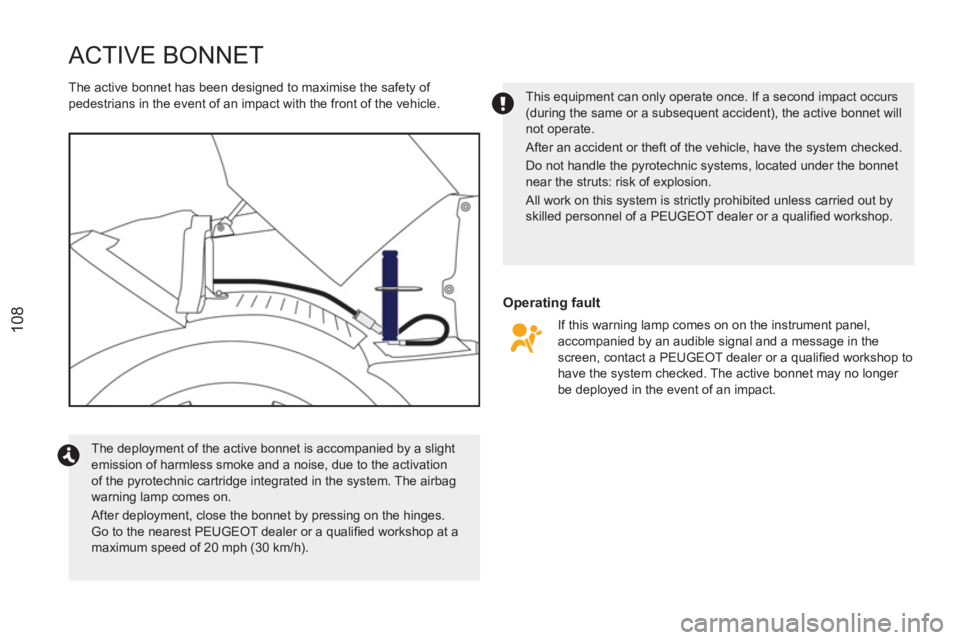
The active bonnet has been designed to maximise the safety of
pedestrians in the event of an impact with the front of the vehicle.
The deployment of the active bonnet is accompanied by a slight
emission of harmless smoke and a noise, due to the activation
of the pyrotechnic cartridge integrated in the system. The airbag
warning lamp comes on.
After deployment, close the bonnet by pressing on the hinges.
Go to the nearest PEUGEOT dealer or a qualifi ed workshop at a
maximum speed of 20 mph (30 km/h). This equipment can only operate once. If a second impact occurs
(during the same or a subsequent accident), the active bonnet will
not operate.
After an accident or theft of the vehicle, have the system checked.
Do not handle the pyrotechnic systems, located under the bonnet
near the struts: risk of explosion.
All work on this system is strictly prohibited unless carried out by
skilled personnel of a PEUGEOT dealer or a qualifi ed workshop.
If this warning lamp comes on on the instrument panel,
accompanied by an audible signal and a message in the
screen, contact a PEUGEOT dealer or a qualifi ed workshop to
have the system checked. The active bonnet may no longer
be deployed in the event of an impact.
Page 113 of 336
5/
SAFETY
SEAT BELTS
FRONT SEAT BELTS
Fastening
)
Pull the strap, then insert the tongue in the buckle.
)
Check that the seat belt is fastened correctly by pulling the strap.
Unfastening
)
Press the red button on the buckle.
)
Guide the seat belt as it reels in.
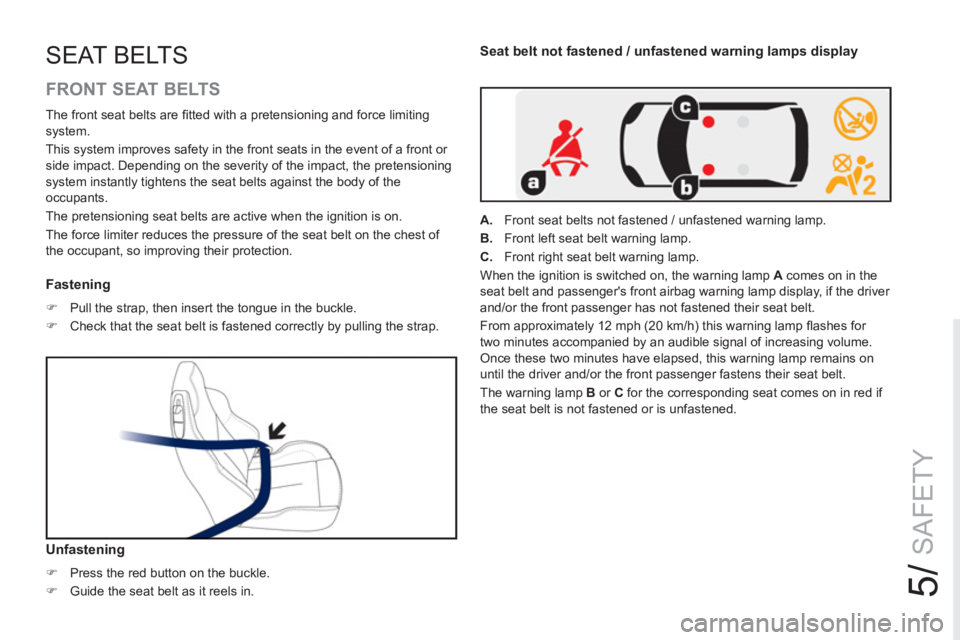
Seat belt not fastened / unfastened warning lamps display
A.
Front seat belts not fastened / unfastened warning lamp.
B.
Front left seat belt warning lamp.
C.
Front right seat belt warning lamp.
When the ignition is switched on, the warning lamp A
comes on in the
seat belt and passenger's front airbag warning lamp display, if the driver
and/or the front passenger has not fastened their seat belt.
From approximately 12 mph (20 km/h) this warning lamp fl ashes for
two minutes accompanied by an audible signal of increasing volume.
Once these two minutes have elapsed, this warning lamp remains on
until the driver and/or the front passenger fastens their seat belt.
The warning lamp B
or C
for the corresponding seat comes on in red if
the seat belt is not fastened or is unfastened.
The front seat belts are fi tted with a pretensioning and force limiting
system.
This system improves safety in the front seats in the event of a front or
side impact. Depending on the severity of the impact, the pretensioning
system instantly tightens the seat belts against the body of the
occupants.
The pretensioning seat belts are active when the ignition is on.
The force limiter reduces the pressure of the seat belt on the chest of
the occupant, so improving their protection.
Page 114 of 336

11 2
REAR SEAT BELTS
The rear seats are each fi tted with a three-point inertia reel seat belt
with force limiter.
Fastening
1.
Pull the strap and insert the tongue F
in the black buckle F
, in the
centre of the bench seat.
2.
Insert the tongue G
in the outer red buckle G
.
3.
Check that each buckle is fastened correctly by pulling the strap.
Unfastening
1.
Press the red button on the buckle G
, then the black button on the
buckle F
.
2.
Guide the strap as it reels in and bring the tongue G
, then the
tongue F
to the corresponding securing point on the backrest.
Seat belt unfastened warning lamps display
A.
Rear seat belts unfastened warning lamp.
D.
Rear right seat belt warning lamp.
E.
Rear left seat belt warning lamp.
The warning lamp A
comes on, either on in the seat belt and
passenger's front airbag warning lamps display, when one or more rear
passengers unfasten their seat belt.
From approximately 12 mph (20 km/h), this warning lamp fl ashes for
two minutes accompanied by an audible signal of increasing volume.
Once these two minutes have elapsed, this warning lamp remains on
until the one or more rear passengers fasten their seat belt.
When the ignition is switched on, with the engine running or the vehicle
moving at a speed below approximately 12 mph (20 km/h),
the corresponding warning lamps D
and E
come on in red for
approximately 30 seconds, if the seat belt is not fastened.
When the vehicle is moving at a speed of more than approximately
12 mph (20 km/h), the corresponding warning lamp D
or E
comes on in
red, accompanied by an audible signal and a message in the screen,
if a rear passenger has unfastened their seat belt.
Unfastening is detected on both buckles of the seat belt. The
corresponding warning lamp comes on when at least one of the
two buckles is unfastened.
Page 115 of 336
5/
SAFETY
The driver must ensure that passengers use the seat belts
correctly and that they are all restrained securely before
setting off.
Wherever you are seated in the vehicle, always fasten your seat
belt, even for short journeys.
Do not interchange the seat belt buckles as they will not fulfi l their
role fully.
The seat belts are fi tted with an inertia reel permitting automatic
adjustment of the length of the strap to your size. The seat belt is
stowed automatically when not in use.
Before and after use, ensure that the seat belt is reeled in
correctly.
The lower part of the strap must be positioned as low as possible
on the pelvis.
The upper part must be positioned in the hollow of the shoulder.
The inertia reels are fi tted with an automatic locking device which
comes into operation in the event of a collision, emergency
braking or if the vehicle rolls over. You can release the device by
pulling fi rmly on the strap and releasing it so that it reels in slightly.
In order to be effective, a seat belt must:
- be tightened as close to the body as possible,
- be pulled in front of you with a smooth movement, checking
that it does not twist,
- be used to restrain only one person,
- not bear any trace of cuts or fraying,
- not be converted or modifi ed to avoid affecting its
performance. In accordance with current safety regulations, for all repairs on your
vehicle, go to a qualifi ed workshop with the skills and equipment
needed, which a PEUGEOT dealer is able to provide.
Have your seat belts checked regularly by a PEUGEOT dealer or a
qualifi ed workshop, particularly if the straps show signs of damage.
Clean the seat belt straps with soapy water or a textile cleaning
product, sold by PEUGEOT dealers.
After folding or moving a seat or rear bench seat, ensure that the
seat belt is positioned and reeled in correctly.
Recommendations for children
Use a suitable child seat if the passenger is less than 12 years old or
shorter than one and a half metres.
Never use the same seat belt to secure more than one person.
Never allow a child to travel on your lap.
In the event of an impact
Depending on the nature and seriousness of the impact
, the
pretensioning device may be deployed before and independently
of the airbags. Deployment of the pretensioners is accompanied
by a slight discharge of harmless smoke and a noise, due to the
activation of the pyrotechnic cartridge incorporated in the system.
In all cases, the airbag warning lamp comes on.
Following an impact, have the seat belts system checked, and if
necessary replaced, by a PEUGEOT dealer or a qualifi ed workshop.
Page 117 of 336

5/
SAFETY
FRONT AIRBAGS
System which protects the driver and front passenger in the event of
a serious front impact in order to limit the risk of injury to the head and
thorax.
The driver's airbag is fi tted in the centre of the steering wheel; the front
passenger's airbag is fi tted in the dashboard above the glove box.
Deployment
The airbags are deployed, except the passenger's front airbag if it is
deactivated, in the event of a serious front impact to all or part of the
front impact zone A
, in the longitudinal centreline of the vehicle on a
horizontal plane and directed from the front to the rear of the vehicle.
The front airbag infl ates between the thorax and head of the front
occupant of the vehicle and the steering wheel, driver's side, and the
dashboard, passenger's side to cushion their forward movement.
Deactivation
Only the passenger's front airbag can be deactivated:
)
with the ignition off
, insert the key in the passenger airbag
deactivation switch,
)
turn it to the "OFF"
position,
)
then, remove the key keeping the switch in the new position.
To assure the safety of your child, the passenger's front airbag
must be deactivated when you install a "rear facing" child seat on
the front passenger seat.
Otherwise, the child would risk being seriously injured or killed if
the airbag were deployed. This warning lamp comes on in the passenger's front airbag
warning lamps display when the ignition is on and until the
airbag is reactivated.