2012 PEUGEOT 4007 wheel
[x] Cancel search: wheelPage 110 of 236
6
SAFETY
AIRBAGS
The airbags do not operate
when the ignition is switched
off.
This equipment will only operate
once. If a second impact occurs
(during the same or a subse-
quent accident), the airbag will
not operate.
Front airbags
System which protects the head and
chest of the driver and front passenger
in the event of a front impact.
The driver's airbag is fi tted in the centre
of the steering wheel; the front passen-
ger's airbag is fi tted in the dashboard
above the glove box.
Deployment
The airbags are deployed simultane-
ously, unless the passenger's front
airbag is deactivated, in the event of
a serious front impact applied to all or
part of the front impact zone A
, in the
longitudinal centreline of the vehicle on
a horizontal plane and directed from the
front to the rear of the vehicle.
The front airbag infl ates between the
front occupant of the vehicle and the
dashboard to cushion their forward
movement.
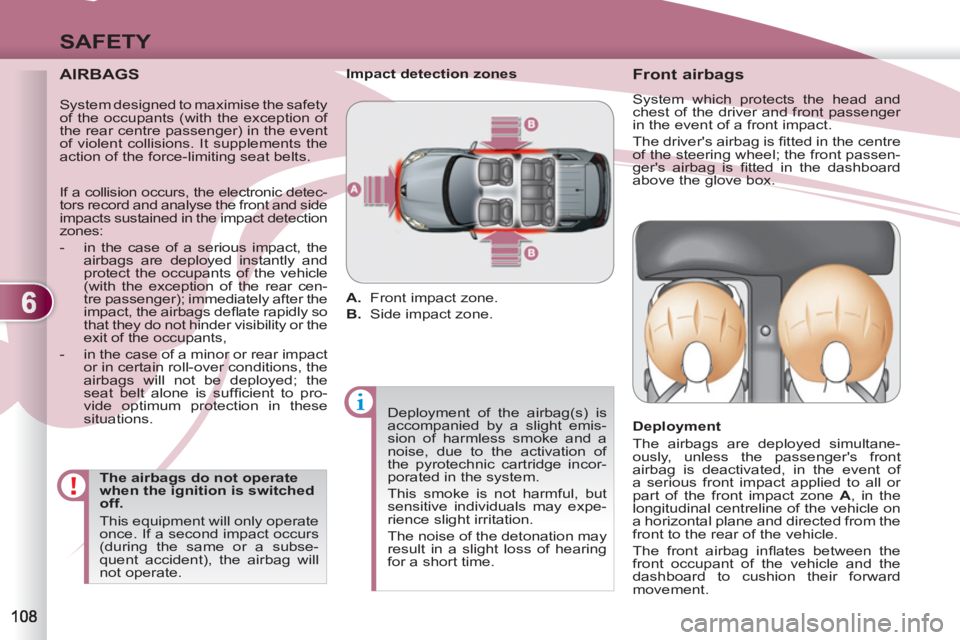
Impact detection zones
A.
Front impact zone.
B.
Side impact zone.
Deployment of the airbag(s) is
accompanied by a slight emis-
sion of harmless smoke and a
noise, due to the activation of
the pyrotechnic cartridge incor-
porated in the system.
This smoke is not harmful, but
sensitive individuals may expe-
rience slight irritation.
The noise of the detonation may
result in a slight loss of hearing
for a short time.
System designed to maximise the safety
of the occupants (with the exception of
the rear centre passenger) in the event
of violent collisions. It supplements the
action of the force-limiting seat belts.
If a collision occurs, the electronic detec-
tors record and analyse the front and side
impacts sustained in the impact detection
zones:
- in the case of a serious impact, the
airbags are deployed instantly and
protect the occupants of the vehicle
(with the exception of the rear cen-
tre passenger); immediately after the
impact, the airbags defl ate rapidly so
that they do not hinder visibility or the
exit of the occupants,
- in the case of a minor or rear impact
or in certain roll-over conditions, the
airbags will not be deployed; the
seat belt alone is suffi cient to pro-
vide optimum protection in these
situations.
Page 113 of 236
6
SAFETY
For the airbags to be fully
effective, observe the
following safety rules:
Sit in a normal upright position.
Wear a correctly adjusted seat belt.
Do not leave anything between
the occupants and the airbags
(a child, pet, object...). This could
hamper the operation of the air-
bags or injure the occupants.
Lateral airbags
Use only approved covers on the seats, compatible with the deployment the
lateral airbags. For information on the range of seat covers suitable for your
vehicle, you can contact a PEUGEOT dealer (see "Practical information - §
Accessories").
Do not fi x or attach anything to the seat backs (clothing...). This could cause
injury to the chest or arms if the lateral airbag is deployed.
Do not sit with the upper part of the body any nearer to the door than necessary. After an accident or if the vehicle has
been stolen or broken into, have the
airbag systems checked.
All work on the airbag system must
be carried out by a PEUGEOT dealer
or a qualifi ed workshop.
Even if all of the precautions men-
tioned are observed, a risk of injury
or of minor burns to the head, chest
or arms when an airbag is deployed
cannot be ruled out. The bag in-
fl ates almost instantly (within a few
milliseconds) then defl ates within
the same time discharging the hot
gas via openings provided for this
purpose.
Front airbags
Do not drive holding the steering wheel by its spokes or resting your hands on
the centre part of the wheel.
Passengers must not place their feet on the dashboard.
If possible, do not smoke as deployment of the airbags can cause burns or the
risk of injury from a cigarette or pipe.
Never remove or pierce the steering wheel or hit it violently.
Curtain airbags
Do not fi x or attach anything to the roof. This could cause injury to the head if
the curtain airbag is deployed.
If fi tted on your vehicle, do not remove the grab handles installed on the roof,
they play a part in securing the curtain airbags.
Page 114 of 236
7
DRIVING
When the vehicle is being
driven, the display of this
message indicates that the
parking brake is still on or has
not been properly released.
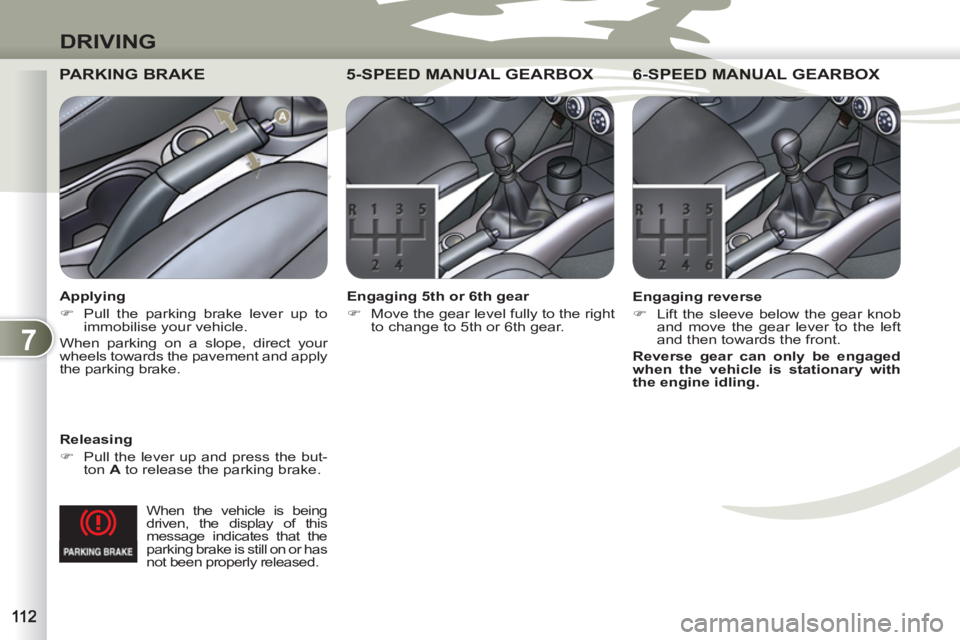
PARKING BRAKE
Releasing
)
Pull the lever up and press the but-
ton A
to release the parking brake.
NUAL GEARBOX
5-SPEED MANUAL GEARBOX
Engaging 5 th or 6 th gear
)
Move the gear level fully to the right
to change to 5 th or 6 th gear.
Applying
)
Pull the parking brake lever up to
immobilise your vehicle.
When parking on a slope, direct your
wheels towards the pavement and apply
the parking brake.
6-SPEED MANUAL GEARBOX6-SPEED MANUA
Engaging reverse
)
Lift the sleeve below the gear knob
and move the gear lever to the left
and then towards the front.
Reverse gear can only be engaged
when the vehicle is stationary with
the engine idling.
Page 119 of 236

7
DRIVING
"Normal" automatic mode
Select position D
.
"D"
appears in the instrument panel
screen.
The gearbox then operates in automatic
mode, without any action on the part of
the driver.
To optimise driving comfort and obtain
the most suitable gear, avoid sharp vari-
ations in the pressure on the accelerator
pedal.
"Temporary" manual mode
In automatic mode, you can take con-
trol temporarily at any time using the
steering mounted controls.
The use of these controls permits man-
ual selection of the gears in situations
which require a faster change down than
that offered in automatic mode (arrival at
a roundabout, exit from a car park with a
steep gradient, overtaking...).
The gearbox engages the gear re-
quested if the engine speed permits it.
The gear engaged appears.
To return to the automatic mode, press
the back of the "+/OFF"
control for at
least 2 seconds.
"Sport" automatic mode
From automatic mode, you can engage
"Sport" mode.
With the vehicle moving or stationary,
push the thumb wheel A
forward.
"SPORT"
appears in the instrument
panel screen.
Switching off "Sport" automatic
mode
You can return to "Normal" automatic
mode at any time:
Push the thumbwheel A
rearward once.
Stopping the vehicle
Before switching off the engine, you
must engage position P
or N
to place
the gearbox in neutral.
You must apply the parking brake to im-
mobilise the vehicle.
The gear lever must be in position P
to
remove the ignition key.
Hill start assist
To assist you when starting on a gradi-
ent, your vehicle is fi tted with a system
which immobilises it briefl y (approximate-
ly 2 seconds), the time required to move
your foot from the brake pedal to the
accelerator pedal. This function is only
active when the vehicle has been com-
pletely immobilised with your foot on the
brake pedal and on certain gradients.
Do not get out of the vehicle during
the hill start assist temporary immo-
bilisation phase.
To immobilise the vehicle on a gradient
for a longer period, you must use the
parking brake, not the accelerator.
When starting on a gradient, accelerate
gradually while releasing the parking
brake.
Page 121 of 236

7
DRIVING
FOUR WHEEL DRIVE SYSTEMFOUR WH
WITH ELECTRONIC CONTROL WITH E
4WD AUTO (position 1)
The vehicle operates with four wheel
drive and provides optimum traction re-
gardless of the level of grip.
This is the vehicle's normal and regular
operating mode, the distribution of the
torque between the front and rear axles
is controlled automatically.
The distribution favours the front wheels,
the transfer of torque to the rear wheels
is managed electronically by the control
unit in relation to the level of grip, so
providing optimum road holding.
Three transmission modes are avail-
able and can be selected manually by
the driver in accordance with his re-
quirements.
You can change transmission mode
when stationary or while driving at a
speed below 60 mph (100 km/h)
.
The transmission mode can be selected
by turning the control A
.
Display in the instrument panel
The transmission mode is displayed
in the form of an intermittent display in
the instrument panel screen when the
transmission mode is selected.
Selecting the transmission
mode
The selection of this mode is
recommended when the level of
grip permits.
2WD (position 3)
The vehicle operates with front two
wheel drive.
This mode corresponds to use on a tar-
macked road on which the driver con-
siders that there is no risk of loss of grip
(dry road).
4WD LOCK (position 2)
The vehicle operates with four wheel
drive in this mode also.
It is recommended when grip is particularly
poor or diffi cult (sand, mud, slopes, ...). System which permits the selection of
a transmission mode in relation to the
driving conditions.
Page 122 of 236

7
DRIVING
Operating faults
If the selected transmission mode display
fl ashes, the vehicle switches automati-
cally to front "2WD"
transmission mode.
It is then no longer possible to select the
transmission mode using the control A
. Do not subject the vehicle to ex-
cessive conditions while driving.
As the engine torque is applied
to all four wheels, the condition
of the tyres has a considerable
impact on the performance of
the vehicle.
Ensure that all four tyres are in
good condition.
Avoid driving the vehicle in
sandy or muddy areas or in
other areas in which the wheels
could spin.
Spinning the wheels places the
transmission components under
pressure and could cause a seri-
ous malfunction.
Do not drive the vehicle through
deep water.
Avoid driving over excessively
uneven terrain (risk of scraping
under the body or of grounding
on crossing a bridge).
Have your vehicle towed on a
fl atbed.
The vehicle must not be towed
with the front or rear wheels on
the ground even if it is in front
"2WD" (2 wheel drive) mode.
If the message "SLOW DOWN" is dis-
played on the instrument panel, let the
transmission cool down then wait for the
display to clear before setting off again.
If "4WD" and "LOCK" are displayed
alternately and if "MAINTENANCE
REQUIRED" is displayed in the instru-
ment panel, the system has failed and
the safety system has been activated.
Contact a PEUGEOT dealer or a quali-
fi ed workshop without delay.
Page 123 of 236
7
DRIVING
Programming
)
Press button 1
.
)
Set the programmed speed by ac-
celerating to the required speed,
then press button 2 "COAST SET"
.
CRUISE CONTROL CRUISE C
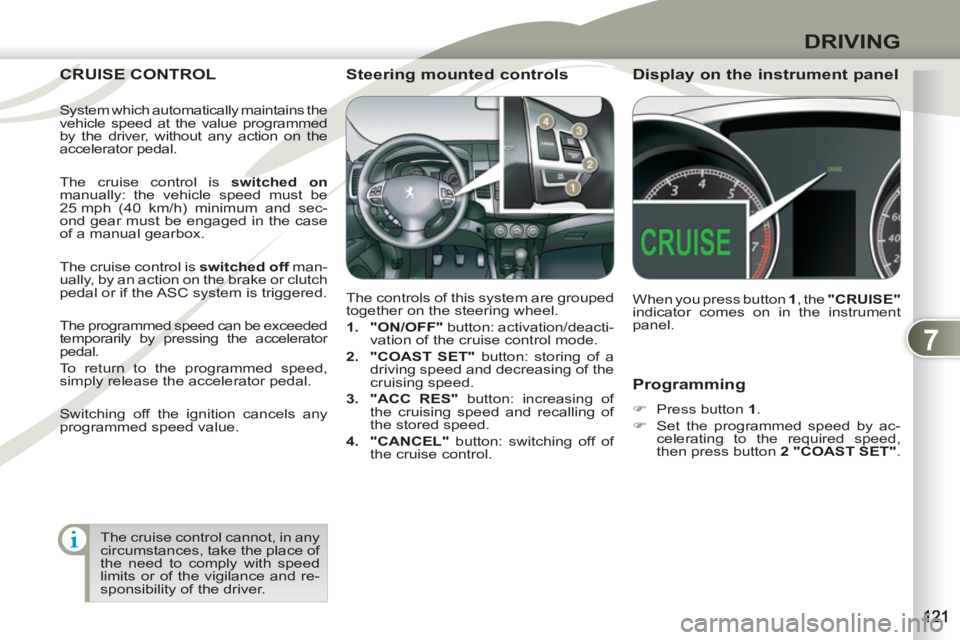
The controls of this system are grouped
together on the steering wheel.
1.
"ON/OFF"
button: activation/deacti-
vation of the cruise control mode.
2.
"COAST SET"
button: storing of a
driving speed and decreasing of the
cruising speed.
3.
"ACC RES"
button: increasing of
the cruising speed and recalling of
the stored speed.
4.
"CANCEL"
button: switching off of
the cruise control.
When you press button 1
, the "CRUISE"
indicator comes on in the instrument
panel.
Steering mounted controls
Display on the instrument panel
The cruise control cannot, in any
circumstances, take the place of
the need to comply with speed
limits or of the vigilance and re-
sponsibility of the driver.
System which automatically maintains the
vehicle speed at the value programmed
by the driver, without any action on the
accelerator pedal.
The cruise control is switched on
manually: the vehicle speed must be
25 mph (40 km/h) minimum and sec-
ond gear must be engaged in the case
of a manual gearbox.
The cruise control is switched off
man-
ually, by an action on the brake or clutch
pedal or if the ASC system is triggered.
The programmed speed can be exceeded
temporarily by pressing the accelerator
pedal.
To return to the programmed speed,
simply release the accelerator pedal.
Switching off the ignition cancels any
programmed speed value.
Page 134 of 236
9
PRACTICAL INFORMATION
CHANANGING A WHEEL
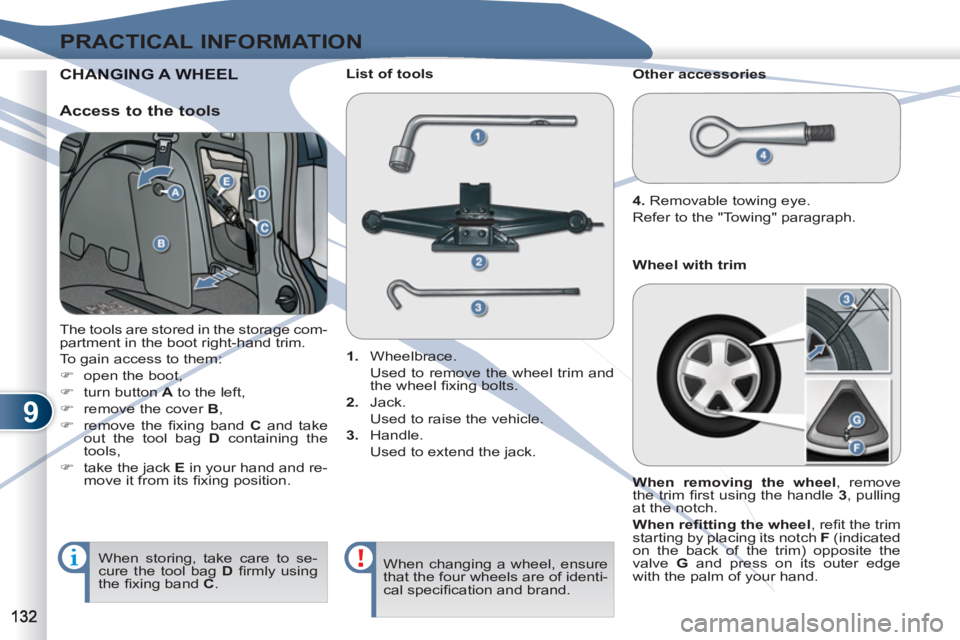
The tools are stored in the storage com-
partment in the boot right-hand trim.
To gain access to them:
)
open the boot,
)
turn button A
to the left,
)
remove the cover B
,
)
remove the fi xing band C
and take
out the tool bag D
containing the
tools,
)
take the jack E
in your hand and re-
move it from its fi xing position.
1.
Wheelbrace.
Used to remove the wheel trim and
the wheel fi xing bolts.
2.
Jack.
Used to raise the vehicle.
3.
Handle.
Used to extend the jack.
List of tools
Other accessories
4.
Removable towing eye.
Refer to the "Towing" paragraph.
Access to the tools
When changing a wheel, ensure
that the four wheels are of identi-
cal specifi cation and brand. When storing, take care to se-
cure the tool bag D
fi rmly using
the fi xing band C
.
When removing the wheel
, remove
the trim fi rst using the handle 3
, pulling
at the notch.
When refi tting the wheel
, refi t the trim
starting by placing its notch F
(indicated
on the back of the trim) opposite the
valve G
and press on its outer edge
with the palm of your hand.
Wheel with trim