2012 NISSAN NOTE tyres
[x] Cancel search: tyresPage 206 of 235
may be used. However, some provinces and states
prohibit their use. Check local, state and provincial
laws before installing studded tyres. Skid and trac-
tion capabilities of studded snow tyres, on wet or
dry surfaces, may be poorer than that of non-stud-
ded snow tyres.
SNOW CHAINS
Use of snow chains may be prohibited in some ar-
eas. Check the local laws before installing snow
chains. When installing snow chains, make sure they
are of proper size for the tyres on your vehicle and
are installed according to the chain manufacturer’s
suggestions. Use chain tensioners when recom-
mended by the snow chain manufacturer to ensure
a tight fit. Loose end links of the snow chain must be
secured or removed to prevent the possibility of
whipping action damage to the fenders or undercar-
riage.
In addition, drive at a reduced speed. Otherwise,
your vehicle can be damaged and/or vehicle han-
dling and performance may be adversely affected.
Snow chains must be installed only on the front
wheels and not on the rear wheels.
CAUTION
Do not drive with snow chains on paved roads
which are clear of snow. Driving with chains in
such conditions can cause damage to the vari-
ous mechanisms of the vehicle due to some
overstress.
•Never install snow chains on a small size spare
tyre.
•Never install snow chains on a temporary-use
spare tyre.
•Do not drive with snow chains on paved roads
which are clear of snow. Driving with chains in
such conditions can cause damage to the
various mechanisms of the vehicle due to
some overstress.
TYRE ROTATION
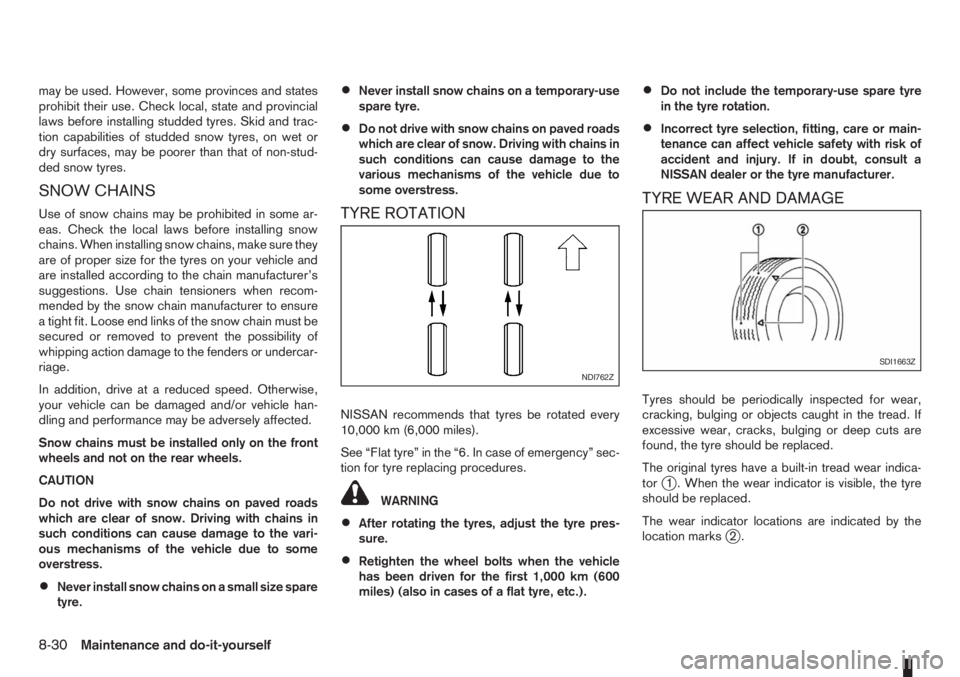
NISSAN recommends that tyres be rotated every
10,000 km (6,000 miles).
See “Flat tyre” in the “6. In case of emergency” sec-
tion for tyre replacing procedures.
WARNING
•After rotating the tyres, adjust the tyre pres-
sure.
•Retighten the wheel bolts when the vehicle
has been driven for the first 1,000 km (600
miles) (also in cases of a flat tyre, etc.).
•Do not include the temporary-use spare tyre
in the tyre rotation.
•Incorrect tyre selection, fitting, care or main-
tenance can affect vehicle safety with risk of
accident and injury. If in doubt, consult a
NISSAN dealer or the tyre manufacturer.
TYRE WEAR AND DAMAGE
Tyres should be periodically inspected for wear,
cracking, bulging or objects caught in the tread. If
excessive wear, cracks, bulging or deep cuts are
found, the tyre should be replaced.
The original tyres have a built-in tread wear indica-
tor
j1 . When the wear indicator is visible, the tyre
should be replaced.
The wear indicator locations are indicated by the
location marks
j2.
NDI762ZSDI1663Z
8-30Maintenance and do-it-yourself
Page 207 of 235
TYRE AGE
Remember tyre age. Never use a tyre over six years
old, regardless of whether they have been used or
not.
Tyres degrade with age as well as the use they are
subjected to. Have the tyres checked and balanced
frequently by a NISSAN dealer or qualified work-
shop. Report all accidents where the tyre is knocked
even if it is minor.
CHANGING TYRES AND WHEELS
WARNING
Do not install a deformed wheel or tyre even if it
has been repaired. Such wheels or tyres could
have structural damage and could fail without
warning.
When replacing a tyre, use the same size, speed
rating and load carrying capacity as originally
equipped. Recommended types and sizes are men-
tioned in “Wheels and tyres” in the “9. Technical
information” section.
The use of tyres other than those recommended or
the mixed use of tyres of different brands, construc-
tion (bias, bias-belted or radial), or tread patterns
can adversely affect the ride, braking, handling,
ground clearance, body-to-tyre clearance, snow
chain clearance, speedometer calibration, headlight
aim and bumper height.
WARNING
Some of these effects may lead to accidents and
could result in serious personal injury.
If the wheels are changed for any reason, always
replace with wheels which have the same offset
dimension. Wheels of a different offset could cause
early tyre wear, possibly degraded vehicle handling
characteristics and/or interference with the brake
discs/drums. Such interference can lead to
decreased braking efficiency and/or early brake
pad/shoe wear.
WHEEL BALANCE
Unbalanced wheels may affect vehicle handling and
tyre life. Even with regular use, wheels can get out
of balance. Therefore, they should be balanced as
required.
Wheel balance service should be performed with
the wheels off the vehicle. Spin balancing the front
wheels on the vehicle could lead to transmission
damage.
SPARE TYRE
The temporary-use spare wheel/tyre can be identi-
fied by the temporary-use spare tyre label which
contrasts to the standard road wheels. If in doubt,
contact a NISSAN dealer, qualified workshop or
see “Spare tyre” in the “6. In case of emergency”
section.
CARE OF WHEELS
For details, see “Care of wheels” in the “7. Appear-
ance and care” section.
Maintenance and do-it-yourself8-31
Page 209 of 235

9Technical informationTechnical information
Capacities and recommended fuel/lubricants ........... 9-2
Fuel recommendation ......................................... 9-4
Recommended SAE viscosity number ................. 9-4
Air conditioning system refrigerant and
lubricant recommendations (where fitted) ............ 9-4
Engine ..................................................................... 9-5
Wheels and tyres ..................................................... 9-5
Dimensions .............................................................. 9-6
When travelling or transferring your registration to
another country........................................................ 9-6Vehicle identification ................................................ 9-6
Vehicle identification plate ................................... 9-6
Vehicle identification number (VIN) (chassis
number).............................................................. 9-6
Engine serial number .......................................... 9-7
Tyre placard ....................................................... 9-7
Air conditioner specification label (where
fitted).................................................................. 9-7
NATS immobilizer radio approval number ................. 9-8
Approval numbers.................................................... 9-8
Page 213 of 235
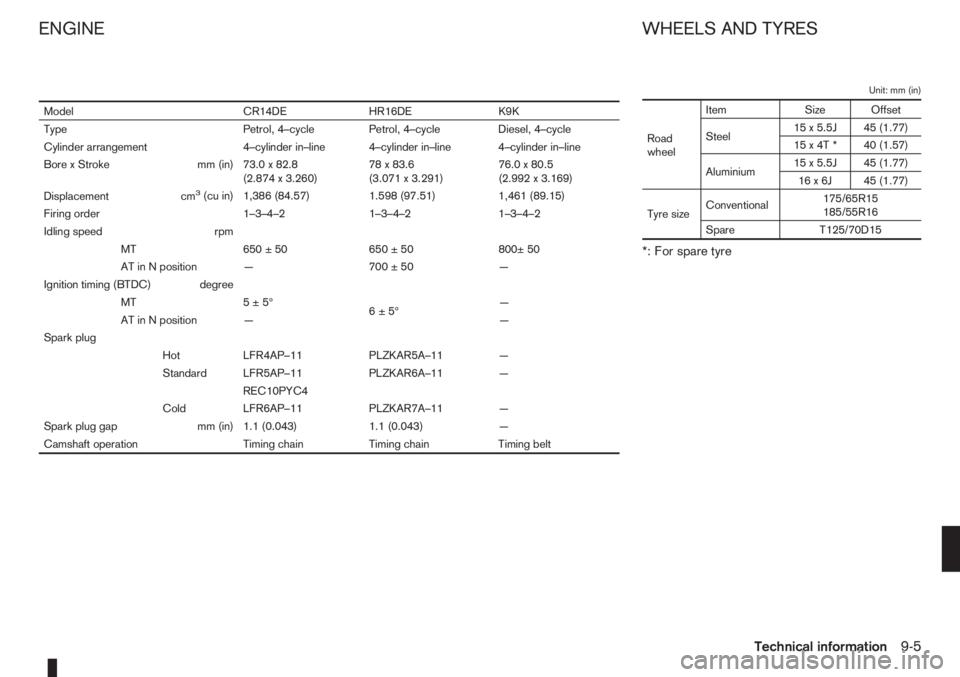
Unit: mm (in)
Road
wheelItem Size Offset
Steel15 x 5.5J 45 (1.77)
15 x 4T * 40 (1.57)
Aluminium15 x 5.5J 45 (1.77)
16 x 6J 45 (1.77)
Tyre sizeConventional175/65R15
185/55R16
Spare T125/70D15
*: For spare tyre
Model CR14DE HR16DE K9K
Type Petrol, 4–cycle Petrol, 4–cycle Diesel, 4–cycle
Cylinder arrangement 4–cylinder in–line 4–cylinder in–line 4–cylinder in–line
Bore x Stroke mm (in) 73.0 x 82.8
(2.874 x 3.260)78 x 83.6
(3.071 x 3.291)76.0 x 80.5
(2.992 x 3.169)
Displacement cm
3(cu in) 1,386 (84.57) 1.598 (97.51) 1,461 (89.15)
Firing order 1–3–4–2 1–3–4–2 1–3–4–2
Idling speed rpm
MT 650 ± 50 650 ± 50 800± 50
AT in N position — 700 ± 50 —
Ignition timing (BTDC) degree
MT 5±5°
6±5°—
AT in N position — —
Spark plug
Hot LFR4AP–11 PLZKAR5A–11 —
Standard LFR5AP–11 PLZKAR6A–11 —
REC10PYC4
Cold LFR6AP–11 PLZKAR7A–11 —
Spark plug gap mm (in) 1.1 (0.043) 1.1 (0.043) —
Camshaft operation Timing chain Timing chain Timing belt
ENGINE WHEELS AND TYRES
Technical information9-5
Page 222 of 235

– Trailer brakes ................................................................ 5-25
C
Capacities and recommended fuel/lubricants ......................... 9-2
– Fuel recommendation ...................................................... 9-4
Car phone or CB radio ........................................................ 4-39
Care when driving ................................................................. 5-5
Changing
– Changing engine coolant ................................................. 8-6
– Changing engine oil ......................................................... 8-9
– Changing engine oil filter ............................................... 8-11
– Changing tyres and wheels ........................................... 8-31
Checking
– Checking brake pedal ................................................... 8-13
– Checking engine coolant level ......................................... 8-6
– Checking engine oil level ................................................. 8-9
– Checking handbrake ..................................................... 8-13
Child restraint anchorage (top tether) .................................. 1-23
Child restraints .................................................................... 1-16
– Installation on front passenger seat ................................ 1-19
– Installation on rear seats ................................................ 1-20
Child safety ........................................................................... 1-7
Cleaning
– Alloy wheels .................................................................... 7-3
– Chrome parts .................................................................. 7-3
– Exterior ............................................................................ 7-2
– Glass ....................................................................... 7-3, 7-4
– Interior ............................................................................ 7-3
– Plastic parts .................................................................... 7-4
– Removing spots ............................................................... 7-2
– Underbody ...................................................................... 7-3
Clock (digital) ........................................................................ 2-5
Clutch fluid .......................................................................... 8-13
Cold weather driving ........................................................... 5-31Coolant
– Changing engine coolant ................................................. 8-6
– Checking engine coolant level ......................................... 8-6
– Engine coolant ............................................................... 5-31
– Engine cooling system ..................................................... 8-6
Corrosion protection .................................................... 5-32, 7-4
– Environmental factors ...................................................... 7-4
Cruise control system .......................................................... 5-18
Cruise control system operations ......................................... 5-19
D
Defogger switch
– Outside mirror defogger ................................................ 2-15
– Rear window defogger .................................................. 2-15
Diesel particulate filter ........................................................... 5-5
Dimensions ........................................................................... 9-6
Door
– Back door lock ................................................................ 3-8
– Child safety rear door lock ............................................... 3-8
– Door locks ....................................................................... 3-6
– Emergency situation – Super Lock system ....................... 3-6
– Locking/unlocking with emergency key or key (vehicle dead
battery situation) .............................................................. 3-7
– Power door lock switch ................................................... 3-7
– Super Lock system .......................................................... 3-6
Drive belts ........................................................................... 8-18
Driving
– Care when driving ........................................................... 5-5
– Cold weather driving ..................................................... 5-31
– Driving on wet road ......................................................... 5-5
– Driving the vehicle ......................................................... 5-11
– Driving under winter conditions ........................................ 5-5
– Driving with automatic transmission ............................... 5-12
– Driving with manual transmission ................................... 5-11
– Precautions when starting and driving .............................. 5-3
10-2Index
Page 227 of 235

Starting
– Before starting the engine ................................................ 5-2
– Jump-starting .......................................................... 6-9, 8-16
– Precautions when starting and driving .............................. 5-3
– Push-starting ................................................................. 6-11
– Starting the engine ........................................................ 5-10
Steering
– Power steering system .................................................. 5-27
– Steering lock ............................................................ 5-7, 5-8
– Steering wheel adjustment ............................................. 3-12
– Steering wheel switches for hands-free telephone
control ........................................................................... 4-38
– Steering-wheel switches for audio control ...................... 4-38
– Telephone button ................................................. 4-34, 4-38
– Wheel i switch ................................................................. 2-3
Storage ............................................................................... 2-21
– “Flexi-board” system ...................................................... 2-24
– Centre console box ....................................................... 2-22
– Convenience hooks ....................................................... 2-23
– Cup holder .................................................................... 2-22
– Glove box ...................................................................... 2-21
– Rear foldable tables ....................................................... 2-23
– Seat pockets ................................................................. 2-23
– Under seat storage tray ................................................. 2-23
Supplemental Restraint System (air bag system)
– Air bag system .............................................................. 1-10
– Air bag warning labels ................................................... 1-13
– Air bag warning light ...................................................... 1-13
– Front passenger air bag indicator light ........................... 1-14
Switch
– Defogger switch ............................................................ 2-15
– Fog light switch ............................................................. 2-17
– Headlight and turn signal switch .................................... 2-16
– Wiper and washer switch .............................................. 2-13T
Temporary-use spare tyre ...................................................... 6-2
Three-point type seat belts .................................................... 1-7
Three-way catalyst (Petrol engine models) ............................. 5-4
Tilting steering wheel ........................................................... 3-12
Top tether strap for child restraint ........................................ 1-23
Towing
– Recommended towing .................................................. 6-13
– Tow bar Installation ....................................................... 5-25
– Tow truck towing ........................................................... 6-12
– Towing eye .................................................................... 6-13
– Towing hook/eye ........................................................... 6-14
– Towing precautions ....................................................... 6-12
– Trailer towing ................................................................ 5-24
Trailer
– Trailer brakes ................................................................ 5-25
– Trailer detection ............................................................. 5-25
– Trailer towing ................................................................ 5-24
Transmission
– Automatic transmission (ignition knob) ...................... 5-6, 5-8
– Automatic transmission fluid (ATF) ................................. 8-13
– Driving with automatic transmission ............................... 5-12
– Driving with manual transmission ................................... 5-11
– Manual transmission (ignition knob) ................................. 5-8
– Manual transmission (ignition switch) ............................... 5-6
Travelling or transferring your registration to another country .. 9-6
Turbocharger system (Diesel engine models) ......................... 5-4
Turn signal switch ............................................................... 2-17
Tyre
– Changing tyres and wheels ........................................... 8-31
– Flat tyre ........................................................................... 6-3
– Repairing flat tyre ............................................................ 6-7
– Spare tyre ..................................................................... 8-31
– Temporary-use spare tyre ................................................ 6-2
– Types of tyres ................................................................ 8-29
Index10-7
Page 228 of 235

– Tyre age ........................................................................ 8-31
– Tyre equipment .............................................................. 5-31
– Tyre inflation pressure ................................................... 8-29
– Tyre placard .................................................................... 9-7
– Tyre pressure (Trailer) ................................................... 5-25
– Tyre rotation .................................................................. 8-30
– Tyre wear and damage .................................................. 8-30
– Wheels and tyres ................................................... 8-29, 9-5
U
Ultrasonic sensor
– Parking sensor .............................................................. 5-22
USB Memory operation ....................................................... 4-29
V
Vehicle identification
– Vehicle identification number (VIN) (chassis number) ....... 9-6
– Vehicle identification plate ................................................ 9-6
Vehicle security ............................................................ 3-9, 5-26
Vents .................................................................................... 4-2
W
Warning/indicator lights and audible reminders ...................... 2-7
– Audible reminders ......................................................... 2-12
– Checking bulbs ............................................................... 2-7
– Indicator lights ............................................................... 2-11
– Warning lights ................................................................. 2-7
Washer nozzle ..................................................................... 8-20
Washing ............................................................................... 7-2
Waxing .................................................................................. 7-2Wheel
– Blocking the wheels ........................................................ 6-3
– Care of wheels ................................................................ 7-3
– Changing tyres and wheels ........................................... 8-31
– Getting the tools and spare wheel .................................... 6-4
– Installing the wheel .......................................................... 6-6
– Removing the wheel ........................................................ 6-4
– Removing the wheel cover ............................................... 6-4
– Stowing the wheel and tools ............................................ 6-6
– Wheel balance .............................................................. 8-31
– Wheels and tyres ................................................... 8-29, 9-5
Windows
– Power window — Driver’s side (Reinitialisation
procedure) .................................................................... 8-16
– Power windows ............................................................. 2-25
Winter (Special winter equipment) ....................................... 5-32
Wiper
– Front window wiper replacement ................................... 8-20
– Rain sensor ................................................................... 2-14
– Rear window wiper and washer switch .......................... 2-14
– Window washer/headlight cleaner fluid .......................... 8-14
– Windscreen wiper and washer switch ............................ 2-13
– Wiper blades replacement ............................................. 8-19
10-8Index
Page 230 of 235
Manufacturing phase
NISSAN plants based in the UK and Spain already
achieve a recycling rate of over 90% and are look-
ing for further improvements. The UK plant installed
8 windmills to cut carbon dioxide emissions at power
plants by more than 3,000 tonnes per year. Since
the end of March 2007, NMISA (Spain) uses a solar
panel water heating system to save energy. This will
generate 33% of the energy consumed in the baths
during the painting of your vehicle.
Production and distribution phase
Using resources efficiently to reduce the amount of
waste generated during the production and distribu-
tion stage. NISSAN promotes activities based on
Reducing, Reusing, and Recycling materials when-
ever possible. The NISSAN GREEN PROGRAM
2010 (NGP2010) is our midterm environmental ac-
tion plan defining our goals for achieving a 100%
recycling rate for operations in Japan and globally.
Use and service phase
NISSAN dealers are our window to you, our cus-
tomer. In order to meet your expectations they pro-
vide not only high quality services but are also envi-
ronmentally responsible. NISSAN promotes activi-
ties to recycle the waste generated as a result of
service centre activities.
Disposal phase
Recycle your end of life vehicle or its components.
When your NISSAN reaches the end of its life, and
is no longer suitable for daily use, it still has value.You can help prevent waste affecting the environ-
ment by bringing your NISSAN to be recycled at our
collection networks in your area. Our collection net-
works guarantee no cost for the treatment of your
ELV. For further information on how and where to
dispose of your ELV refer to your local NISSAN
dealer or consult: www.nissan.eu.
PROTECT THE ENVIRONMENT
WHEN DRIVING
Your driving behaviour has significant impact on fuel
economy and the environment. Follow the tips be-
low for better fuel-efficiency, better driving habits,
and to be environmentally friendly by reducing emis-
sions:
Defensive driving
Anticipating traffic conditions and acting accordingly
reduces fuel consumption, helping to protect of our
natural environment. Take your foot off the accelera-
tor while approaching traffic lights and avoid last
minute braking when the light turns red.
Avoid speeding, harsh acceleration, and strong
braking. The gain in time does not offset pollution of
the environment. Try to maintain speed when driving
uphill to reduce fuel consumption and pollution.
Maintain speed or allow the vehicle to go slower
where traffic allows.
Close windows when driving
Driving with a window open at 100 km/h (62 MPH)
increases fuel consumption by up to 4%. Driving
with the windows closed allows for better fuel
economy.
Optimise the use of air conditioning
The air conditioning system has a positive effect on
driving and vehicle safety through comfort cooling
and dehumidifying, drivers are more alert and have
better visibility when window demisting/defogging
becomes necessary. However, use of the air condi-
tioning system will increase fuel consumption sub-
stantially in an urban environment. Optimise the use
of air conditioning by using the vents as much as
possible.
Use the parking brake on slopes
Use the parking brake when holding your vehicle on
a slope. Avoid using the clutch (manual transmis-
sion) or the accelerator (automatic transmission) to
hold your vehicle as this leads to unnecessary fuel
consumption and wear.
Maintain a safe distance
Anticipate traffic conditions for a smoother drive and
to assure comfort and safety during your trip. Drive
and maintain a safe distance from other vehicles
while in traffic. This will help reduce fuel consump-
tion as you will not be constantly tapping your
brakes.
Check your tyre pressure
Low tyre pressure increases fuel consumption as
well as the use of non-recommended tyres. Correct
tyre pressure will maximise the grip of your vehicle
and optimise fuel consumption.