2012 NISSAN NOTE petrol
[x] Cancel search: petrolPage 172 of 235

In order to maintain the appearance of your vehicle,
it is important to take proper care of it.
Whenever possible, park your vehicle inside a ga-
rage or in a covered area to minimise the chances
of damaging the paint surface of your vehicle.
When it is necessary to park outside, park in a shady
area or protect the vehicle with a body cover.Be
careful not to scratch the paint surface when put-
ting on or removing the body cover.
WASHING
In the following instances, wash your vehicle as soon
as possible to protect the paint surface:
•After a rainfall, to prevent possible damage from
acid rain.
•After driving on coastal roads.
•When contaminants such as soot, bird drop-
pings, tree sap, metal particles or insects get on
the paint surface.
•When dust or mud builds up on the paint sur-
face.
1. Wash the vehicle surface with a wet sponge and
plenty of water.
2. Clean the vehicle surface gently and thoroughly
using a mild soap or a special vehicle wash sham-
poo mixed with clean, lukewarm (never hot) wa-
ter.CAUTION
•Do not wash the vehicle with strong house-
hold soap, strong chemical detergents, petrol
or solvents.
•Do not wash the vehicle in direct sunlight or
while the vehicle body is hot, as the paint sur-
face may become water-spotted.
•Avoid using tight-napped or rough cloths,
such as washing mitts. Care must be taken
when removing caked-on dirt or other foreign
substances so the paint surface is not
scratched or damaged.
3. Rinse the vehicle thoroughly with plenty of clean
water.
4. Use a damp chamois to dry the paint surface to
avoid leaving water spots.
When washing the vehicle, take care of the follow-
ing:
•Inside flanges, joints and folds on the doors, back
door and bonnet are particularly vulnerable to
the effects of road salt. Therefore, these areas
must be cleaned regularly.
•Be sure that the drain holes in the lower edge of
the doors are not clogged.
•Spray water to the underbody and in the wheel
wells to loosen the dirt and/or wash away road
salt.
•If using a high pressure washer always follow
the recommendations on the equipment (pres-
sure and spraying distance).
•If there are damaged areas on the vehicle (e.g.
painted bumpers or headlamp assembly), it is
not recommended to direct the high pressure jet
on to them. Carefully wash these areas by hand.
•Avoid the entry of water into the locks.
REMOVING SPOTS
Remove tar and oil spots, industrial dust, insects,
and tree sap as quickly as possible from the paint
surface to avoid lasting damage or staining. Special
cleaning products are available at a NISSAN dealer
or any automotive accessory store.
WAXING
Regular waxing protects the paint surface and helps
to retain a new vehicle appearance.
After waxing, polishing is recommended to remove
built-up residue.
A NISSAN dealer or qualified workshop can assist
you in choosing the appropriate waxing products.
CAUTION
•Wash your vehicle thoroughly and completely
before applying wax to the paint surface.
•Always follow the manufacturer’s instructions
supplied with the wax.
CLEANING EXTERIOR
7-2Appearance and care
Page 176 of 235

8Maintenance and do-it-yourselfMaintenance and do-it-yourself
Maintenance requirements ....................................... 8-2
Scheduled maintenance...................................... 8-2
General maintenance .......................................... 8-2
Where to go for service ...................................... 8-2
General maintenance ............................................... 8-2
Explanation of general maintenance items ........... 8-2
Maintenance precautions ......................................... 8-4
Engine compartment ................................................ 8-5
Engine cooling system ............................................. 8-6
Checking engine coolant level............................. 8-6
Changing engine coolant .................................... 8-6
Engine oil................................................................. 8-8
Checking engine oil level .................................... 8-9
Changing engine oil ............................................ 8-9
Changing engine oil filter .................................... 8-11
Protect the environment ...................................... 8-12
Fuel filter (Diesel engine models) ............................. 8-12
Bleeding the fuel system ..................................... 8-12
Automatic transmission fluid (ATF) ........................... 8-13
Brakes ..................................................................... 8-13
Checking brake pedal......................................... 8-13
Checking handbrake........................................... 8-13
Brake and clutch fluid .............................................. 8-13
Window washer fluid/headlight cleaner fluid
(where fitted) ........................................................... 8-14
Battery..................................................................... 8-15
Vehicle battery .................................................... 8-15
Reinitialisation procedure after battery
reconnection....................................................... 8-16
Jump-starting ...................................................... 8-16Integrated Keyfob/Intelligent Key battery
replacement........................................................ 8-17
Drive belts ............................................................... 8-18
Spark plugs (Petrol engine models).......................... 8-18
Air cleaner filter........................................................ 8-19
Viscous paper type ............................................. 8-19
Dry paper type (where fitted) .............................. 8-19
Wiper blades ........................................................... 8-19
Cleaning ............................................................. 8-19
Front window wiper replacement ........................ 8-20
Back door window wiper replacement ................ 8-20
Windscreen washer nozzle ................................. 8-20
Fuses ...................................................................... 8-21
Passenger compartment ..................................... 8-21
Engine compartment ........................................... 8-22
Lights ...................................................................... 8-23
Headlights .......................................................... 8-23
Exterior lights ...................................................... 8-24
Interior lights....................................................... 8-24
Light locations .................................................... 8-25
Wheels and tyres ..................................................... 8-29
Tyre inflation pressure......................................... 8-29
Types of tyres ..................................................... 8-29
Snow chains....................................................... 8-30
Tyre rotation ....................................................... 8-30
Tyre wear and damage ....................................... 8-30
Tyre age ............................................................. 8-31
Changing tyres and wheels ................................. 8-31
Wheel balance.................................................... 8-31
Spare tyre .......................................................... 8-31
Page 179 of 235

Lights*:
Clean the headlights on a regular basis. Make sure
that the headlights, stop lights, tail lights, turn signal
lights, and other lights are all operating properly and
installed securely. Also check headlight aim.
Tyres*:
Check the pressure with a gauge periodically when
at a service station (including the spare) and adjust
to the specified pressure if necessary. Check care-
fully for damage, cuts or excessive wear.
Tyre rotation*:
Tyres should be rotated at least every 10,000 km
(6,000 miles). However, the timing for tyre rotation
may vary according to your driving habits and road
surface conditions.
Wheel alignment and balance:
If the vehicle pull to either side while driving on a
straight and level road, or if you detect uneven or
abnormal tyre wear, there may be a need for wheel
alignment. If the steering wheel or seat vibrates at
normal highway speeds, wheel balancing may be
needed.
Wheel bolts:
When checking the tyres, make sure no wheel bolts
are missing, and check for any loose wheel bolts.
Tighten if necessary.Windscreen:
Clean the windscreen on a regular basis. Check the
windscreen at least every six months for cracks or
other damage. Have a damaged windscreen re-
paired by a qualified repair facility.
Wiper blades*:
Check for cracks or wear if they do not wipe prop-
erly.
Under the bonnet and vehicle
The maintenance items listed here should be
checked periodically, e.g. each time you check the
engine oil or refuel.
Battery*:
Check if the green indicator on the top of the main-
tenance free battery is visible. If it is not visible,
replace the battery as soon as possible.
Vehicles operated in high temperatures or under
severe conditions, check the fluid level frequently.
Brake and clutch fluid level*:
Make sure that the brake and clutch fluid level is
between the MAX and MIN lines on the reservoir.
Engine coolant level*:
Check the coolant level when the engine is cold.
Engine drive belts*:
Make sure that the drive belts are not frayed, worn,
cracked or oily.Engine oil level*:
Check the level after parking the vehicle on a level
surface and turning off the engine.
Fluid leaks:
Check under the vehicle for fuel, oil, water or other
fluid leaks after the vehicle has been parked for a
while. Water dripping from the air conditioner after
use is normal. If you should notice any leaks or if
petrol fumes are evident, check for the cause and
have it corrected immediately.
Window washer fluid*:
Check that there is adequate fluid in the tank.
Inside the vehicle
The maintenance items listed here should be
checked on a regular basis, such as when perform-
ing periodic maintenance, cleaning the vehicle, etc.
Accelerator pedal:
Check the pedal for smooth operation and make
sure that the pedal does not catch or require uneven
effort. Keep the floor mats away from the pedal.
Brake pedal*:
Check the pedal for smooth operation. If the brake
pedal suddenly goes down further than normal, the
pedal feels spongy or the vehicle seems to take
longer to stop, contact a NISSAN dealer or qualified
workshop immediately. Keep the floor mat away
from the pedal.
Maintenance and do-it-yourself8-3
Page 181 of 235
•If you must run the engine in an enclosed
space such as a garage, be sure there is
proper ventilation for exhaust gases.
•Never get under the vehicle while it is sup-
ported only by a jack. If it is necessary to work
under the vehicle, support it with safety
stands.
•Keep smoking materials, flame and sparks
away from fuel and battery.
•Never connect or disconnect either the bat-
tery or any transistorised component connec-
tor while the ignition switch is in the ON posi-
tion.
•Never leave the engine or transmission re-
lated component harness connector discon-
nected while the ignition switch is in the ON
position.
•On petrol engine models with the multiport
fuel injection (MFI) system, the fuel filter or
fuel lines should be serviced by a NISSAN
dealer or qualified workshop because the fuel
lines are under high pressure even when the
engine is off.
•Always wear eye protection whenever you
work on your vehicle.
•Failure to follow these or other common sense
guidelines may lead to serious injury or ve-
hicle damage.
NISSAN GREEN PROGRAM
Improperly disposed engine oil and/or other
vehicle fluids can pollute the environment. Al-
ways conform to local regulations for disposal
of vehicle fluid.
This section gives instructions regarding only those
items which are relatively easy for an owner to per-
form.
You should be aware that incomplete or improper
servicing may result in operating difficulties or ex-
cessive emissions, and could affect your warranty
coverage.If in doubt about any servicing, have it
done by your NISSAN dealer or qualified work-
shop.For an overview of the engine compartment, see
“Engine compartment” in the “0. Illustrated table
of contents” section.
ENGINE COMPARTMENT
Maintenance and do-it-yourself8-5
Page 194 of 235

2. Insert a flat blade screwdriver or a suitable tool
into the slit of the corner and twist it to open the
lid.
3. Replace the battery with a new one.
For models equipped with Integrated keyfob, use
the following battery type:
CR2016
For models equipped with Intelligent Key, use
the following battery type:
CR2032
•Do not touch the internal circuit and electric ter-
minals as doing so could cause a malfunction.
•Make sure that the + side faces the bottom of the
case, as illustrated.
4. Install the lid in the reverse order of removal.
5. Operate the buttons to check its operation.
Contact a NISSAN dealer or qualified workshop
if you need assistance for battery replacement.
WARNING
Be sure the ignition switch is in the “OFF” or
LOCK position. Otherwise the cooling fan or the
engine may start to operate suddenly.
1. Visually inspect each belt for signs of unusual
wear, cuts, fraying or looseness. If the belt is in
poor condition or loose, have it replaced or ad-
justed by a NISSAN dealer or qualified work-
shop.
2. Have the belts checked regularly for condition
and tension in accordance with the maintenance
schedule as shown in the separately provided
Warranty Information and Maintenance booklet.WARNING
Be sure the engine and ignition switch are off
and that the handbrake is engaged securely.
CAUTION
•Be sure to use the correct socket to remove
the spark plugs. An incorrect socket can
cause damage to the spark plugs.
•Always replace spark plugs with recom-
mended or equivalent ones.
Replace spark plugs according to the maintenance
schedule. For details, see the separately provided
Warranty Information & Maintenance Booklet.
If replacement is required, see a NISSAN dealer or
qualified workshop for servicing.
DRIVE BELTS SPARK PLUGS (Petrol engine
models)
8-18Maintenance and do-it-yourself
Page 212 of 235
FUEL RECOMMENDATION
Petrol engine
Unleaded petrol with an octane rating of at least 95
(RON) must be used.
CAUTION
Do not use leaded petrol. Using leaded petrol will
damage the catalytic converter.
Diesel engine
EN590Diesel fuel of at least 51 cetane must be
used.
If two types of diesel fuel are available, use summer
or winter fuel properly according to the following
temperature conditions.
•Above –7°C (20°F)...Summer type diesel fuel.
•Below–7°C(20°F)...Wintertypedieselfuel.
If you are in any doubt, please consult a NISSAN
dealer or qualified workshop.
CAUTION
•Do not use home heating oil, petrol or other
alternate fuels in the diesel engine, this can
cause engine damage.
•Do not add petrol or other alternate fuels to
diesel fuel.
•Do not use summer fuel at temperatures be-
low −7°C (20°F). Cold temperatures will cause
wax to form in the fuel and may prevent the
engine from running smoothly.
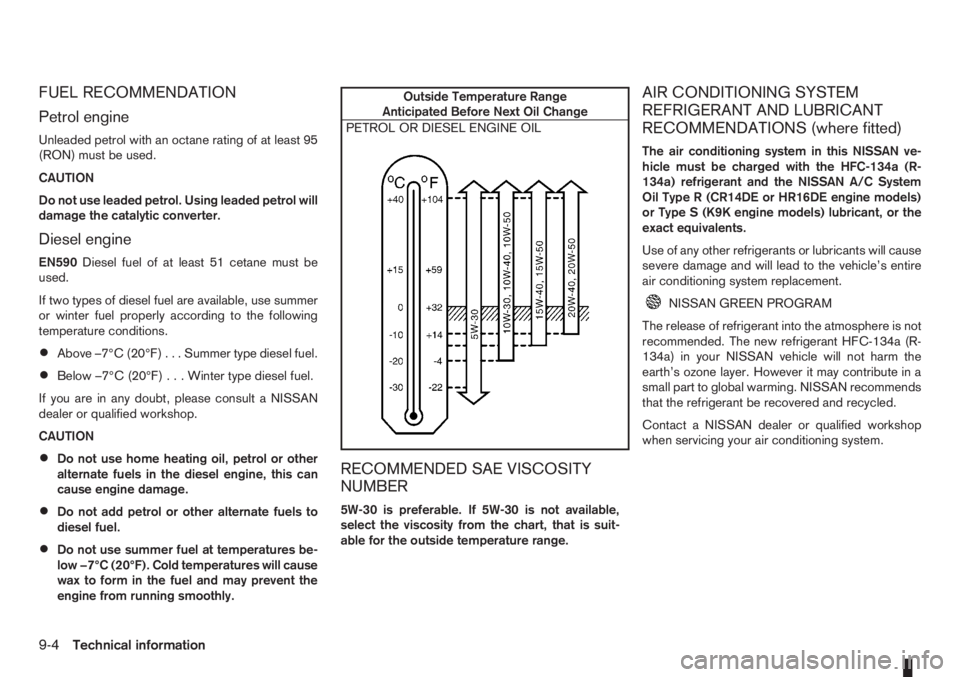
Outside Temperature Range
Anticipated Before Next Oil Change
PETROL OR DIESEL ENGINE OIL
m
RECOMMENDED SAE VISCOSITY
NUMBER
5W-30 is preferable. If 5W-30 is not available,
select the viscosity from the chart, that is suit-
able for the outside temperature range.
AIR CONDITIONING SYSTEM
REFRIGERANT AND LUBRICANT
RECOMMENDATIONS (where fitted)
The air conditioning system in this NISSAN ve-
hicle must be charged with the HFC-134a (R-
134a) refrigerant and the NISSAN A/C System
Oil Type R (CR14DE or HR16DE engine models)
or Type S (K9K engine models) lubricant, or the
exact equivalents.
Use of any other refrigerants or lubricants will cause
severe damage and will lead to the vehicle’s entire
air conditioning system replacement.
NISSAN GREEN PROGRAM
The release of refrigerant into the atmosphere is not
recommended. The new refrigerant HFC-134a (R-
134a) in your NISSAN vehicle will not harm the
earth’s ozone layer. However it may contribute in a
small part to global warming. NISSAN recommends
that the refrigerant be recovered and recycled.
Contact a NISSAN dealer or qualified workshop
when servicing your air conditioning system.
9-4Technical information
Page 213 of 235
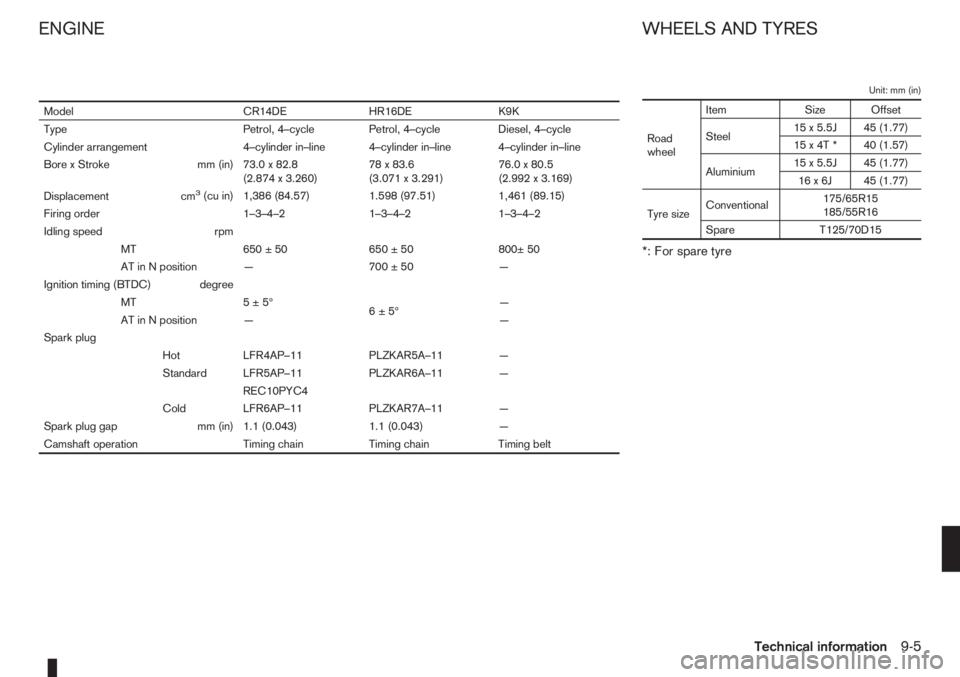
Unit: mm (in)
Road
wheelItem Size Offset
Steel15 x 5.5J 45 (1.77)
15 x 4T * 40 (1.57)
Aluminium15 x 5.5J 45 (1.77)
16 x 6J 45 (1.77)
Tyre sizeConventional175/65R15
185/55R16
Spare T125/70D15
*: For spare tyre
Model CR14DE HR16DE K9K
Type Petrol, 4–cycle Petrol, 4–cycle Diesel, 4–cycle
Cylinder arrangement 4–cylinder in–line 4–cylinder in–line 4–cylinder in–line
Bore x Stroke mm (in) 73.0 x 82.8
(2.874 x 3.260)78 x 83.6
(3.071 x 3.291)76.0 x 80.5
(2.992 x 3.169)
Displacement cm
3(cu in) 1,386 (84.57) 1.598 (97.51) 1,461 (89.15)
Firing order 1–3–4–2 1–3–4–2 1–3–4–2
Idling speed rpm
MT 650 ± 50 650 ± 50 800± 50
AT in N position — 700 ± 50 —
Ignition timing (BTDC) degree
MT 5±5°
6±5°—
AT in N position — —
Spark plug
Hot LFR4AP–11 PLZKAR5A–11 —
Standard LFR5AP–11 PLZKAR6A–11 —
REC10PYC4
Cold LFR6AP–11 PLZKAR7A–11 —
Spark plug gap mm (in) 1.1 (0.043) 1.1 (0.043) —
Camshaft operation Timing chain Timing chain Timing belt
ENGINE WHEELS AND TYRES
Technical information9-5
Page 226 of 235

Precautions
– Audio operation precautions .......................................... 4-10
– Brake precautions ......................................................... 5-27
– Child restraint usage ..................................................... 1-16
– Maintenance precautions ................................................. 8-4
– Operating precautions (trailer) ....................................... 5-24
– Precautions on cruise control system ............................. 5-19
– Towing precautions ....................................................... 6-12
– When starting and driving ................................................ 5-3
Pregnant women ................................................................... 1-7
Protect
– Protect the environment ................................................. 8-12
– Protect your vehicle from corrosion .................................. 7-5
Push-starting ....................................................................... 6-11
R
Radio
– AM-FM radio with CD player and navigation .................. 4-34
– FM AM radio with CD player ......................................... 4-23
– LW-MW-FM radio with CD player ................................. 4-16
– NATS immobilizer radio approval number ......................... 9-8
Rear parcel shelf ................................................................. 3-14
– Installation ..................................................................... 3-14
– Removal ........................................................................ 3-14
Rear seat .............................................................................. 1-2
Rear window defogger ........................................................ 2-15
Recommended SAE viscosity number ................................... 9-4
Remote
– Steering wheel i switch .................................................... 2-3
Remote control system (integrated keyfob) ............................ 3-3
Repairing flat tyre .................................................................. 6-7
Running-in schedule .............................................................. 5-2S
Safety
– Active head restraints ...................................................... 1-5
– Child safety ..................................................................... 1-7
– Child safety rear door lock ............................................... 3-8
– ISOFIX system .............................................................. 1-22
– Safety chains (Trailer) .................................................... 5-25
– Top tether strap for child restraint .................................. 1-23
Seat
– Active head restraints ...................................................... 1-5
– Front seats – Adjustment ................................................. 1-2
– Head restraints ................................................................ 1-4
– Rear seat ......................................................................... 1-2
– Seat heating .................................................................. 2-19
– Seats .............................................................................. 1-2
Seat belt
– Child safety ..................................................................... 1-7
– Injured persons ............................................................... 1-7
– Pre-tensioner seat belt system ......................................... 1-9
– Precautions on seat belt usage ........................................ 1-6
– Pregnant women ............................................................. 1-7
– Seat belt maintenance ..................................................... 1-9
– Seat belt warning lights ................................................... 1-5
– Seat belts ................................................................. 1-5, 7-4
– Three-point type seat belts ............................................... 1-7
Security system ..................................................................... 3-9
– NISSAN Anti-Theft System (NATS) ................................. 3-9
Servicing air conditioner ........................................................ 4-7
Snow chains ....................................................................... 8-30
Spare tyre ............................................................................. 6-2
Spark plugs (Petrol engine models) ..................................... 8-18
Speed limiter ....................................................................... 5-15
Speed limiter operations ...................................................... 5-16
– Vehicles with diesel engine ............................................ 5-17
– Vehicles with petrol engine ............................................ 5-16
10-6Index