Page 222 of 610
Features and controls
3-125
3
CAUTION
!�The rear-view camera uses a wide-angle lens. As a
result, images and distances shown on the screen are
not exact.�Actual distance may be different from distance indi-
cated by the lines on the screen, depending on the
loading condition of the vehicle and road surface
condition.
The reference lines for distance and vehicle width
are based on a level, flat road surface. In the follow-
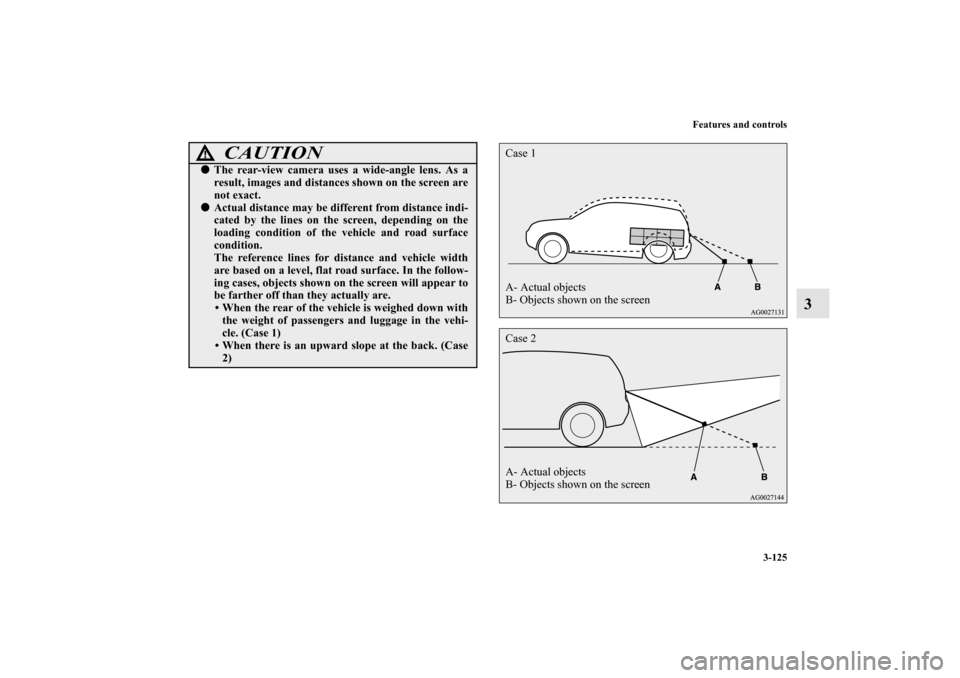
ing cases, objects shown on the screen will appear to
be farther off than they actually are.
• When the rear of the vehicle is weighed down with
the weight of passengers and luggage in the vehi-
cle. (Case 1)
• When there is an upward slope at the back. (Case
2)
A- Actual objects
B- Objects shown on the screen Case 1Case 2
A- Actual objects
B- Objects shown on the screen
BK0140300US.book 125 ページ 2011年6月28日 火曜日 午後5時18分
Page 223 of 610
3-126 Features and controls
3
NOTE�Mirror image is displayed on the screen.
�Monitor brightness is adjusted automatically by sensors.
�It is possible to change the display language of the screen.
For details, please refer to the separated owner’s manual
for “Mitsubishi Multi-Communication System” or
“Change language or turn off the inside rearview mirror
screen: To change the language of warning text (3)” on
page 3-126.
�Under certain circumstances, it may become difficult to
see an image on the screen, even when the system is func-
tioning correctly.
• In a dark area, such as at night.
• When water drops or condensation are on the lens.
• When sun light or headlights shine directly into the lens. Change language or turn off the inside rearview
mirror screen
N00568900024
It is possible to turn off the screen of the inside rearview mirror
and change the language of the warning messages on the
screen.
CAUTION
!�The reference lines for distance and vehicle width
are intended to indicate the distance to a flat object
such as a level, flat road surface. They may not indi-
cate correct distance depending on the shape of an
obstacle.
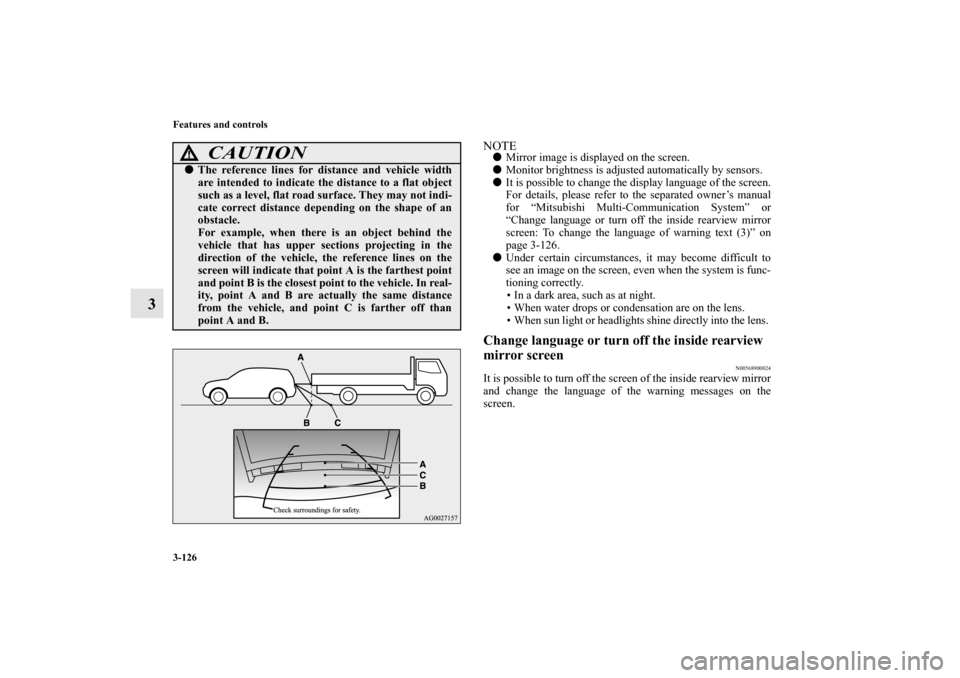
For example, when there is an object behind the
vehicle that has upper sections projecting in the
direction of the vehicle, the reference lines on the
screen will indicate that point A is the farthest point
and point B is the closest point to the vehicle. In real-
ity, point A and B are actually the same distance
from the vehicle, and point C is farther off than
point A and B.
BK0140300US.book 126 ページ 2011年6月28日 火曜日 午後5時18分
Page 533 of 610
7-24 Vehicle care and maintenance
7
�Intended outboard sidewall:
• The sidewall that contains a whitewall, bears white let-
tering or bears manufacturer, brand, and/or model name
molding that is higher or deeper than the same molding
on the other sidewall of the tire, or
• The outward facing sidewall of an asymmetrical tire that
has a particular side that must always face outward
when mounted on a vehicle.
�Passenger car tire: a tire intended for use on passenger
cars, multipurpose passenger vehicles, and trucks, that
have a gross vehicle weight rating (GVWR) of 10,000
pounds or less.
�Light truck (LT) tire: a tire designated by its manufacturer
as primarily intended for use on lightweight trucks or mul-
tipurpose passenger vehicles.
�Tread: portion of a tire that comes into contact with the
road.
�Tread rib: a tread section running circumferentially
around a tire.
�Tread separation: pulling away of the tread from the tire
carcass.
�Carcass: the tire structure, except tread and sidewall rub-
ber which, when inflated, bears the load.
�Sidewall: portion of a tire between the tread and bead.
�Section width: the linear distance between the exteriors of
the sidewalls of an inflated tire, excluding elevations due
to labeling, decoration, or protective bands.
�Bead: the part of the tire that is made of steel wires,
wrapped or reinforced by ply cords and that is shaped to
fit the rim.
�Ply: a layer of rubber-coated parallel cords.
�Cord: the strands forming the plies in the tire.�Rim: a metal support for a tire or a tire and tube assembly
upon which the tire beads are seated.
�Rim diameter: nominal diameter of the bead seat.
�Groove: the space between two adjacent tread ribs.
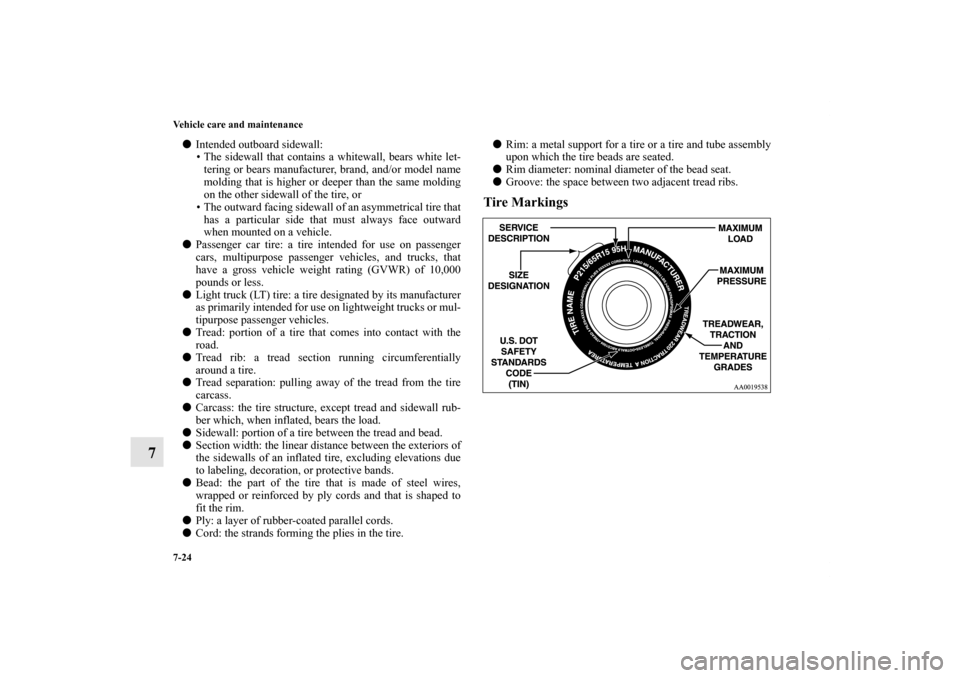
Tire Markings
BK0140300US.book 24 ページ 2011年6月28日 火曜日 午後5時18分
Page 534 of 610
Vehicle care and maintenance
7-25
7
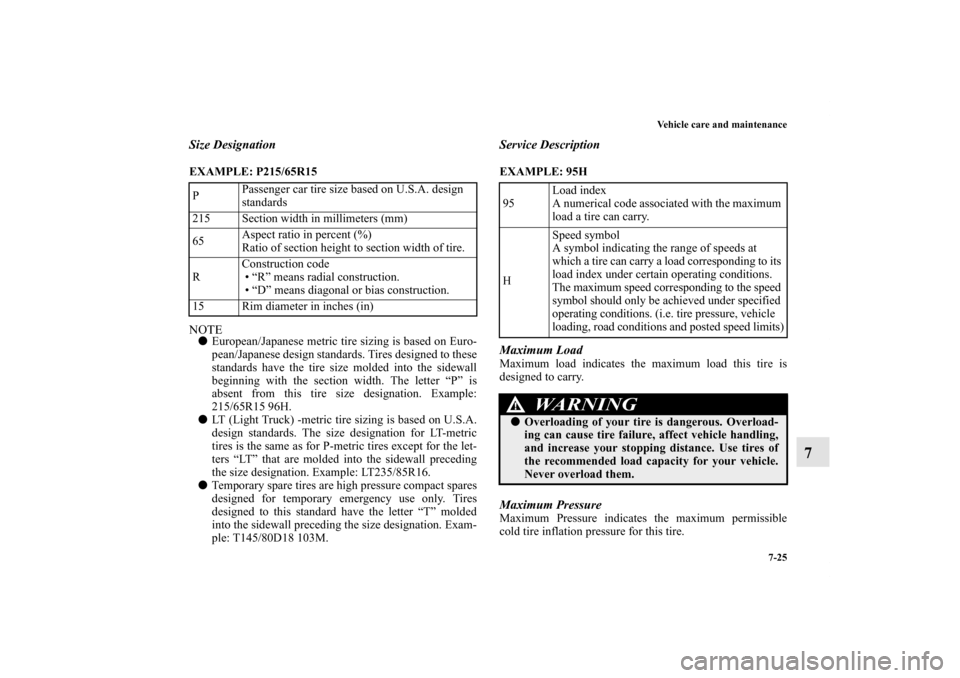
Size DesignationEXAMPLE: P215/65R15
NOTE�European/Japanese metric tire sizing is based on Euro-
pean/Japanese design standards. Tires designed to these
standards have the tire size molded into the sidewall
beginning with the section width. The letter “P” is
absent from this tire size designation. Example:
215/65R15 96H.
�LT (Light Truck) -metric tire sizing is based on U.S.A.
design standards. The size designation for LT-metric
tires is the same as for P-metric tires except for the let-
ters “LT” that are molded into the sidewall preceding
the size designation. Example: LT235/85R16.
�Temporary spare tires are high pressure compact spares
designed for temporary emergency use only. Tires
designed to this standard have the letter “T” molded
into the sidewall preceding the size designation. Exam-
ple: T145/80D18 103M.
Service DescriptionEXAMPLE: 95H
Maximum LoadMaximum load indicates the maximum load this tire is
designed to carry.Maximum PressureMaximum Pressure indicates the maximum permissible
cold tire inflation pressure for this tire. PPassenger car tire size based on U.S.A. design
standards
215 Section width in millimeters (mm)
65Aspect ratio in percent (%)
Ratio of section height to section width of tire.
RConstruction code
• “R” means radial construction.
• “D” means diagonal or bias construction.
15 Rim diameter in inches (in)95Load index
A numerical code associated with the maximum
load a tire can carry.
HSpeed symbol
A symbol indicating the range of speeds at
which a tire can carry a load corresponding to its
load index under certain operating conditions.
The maximum speed corresponding to the speed
symbol should only be achieved under specified
operating conditions. (i.e. tire pressure, vehicle
loading, road conditions and posted speed limits)
WA R N I N G
!�Overloading of your tire is dangerous. Overload-
ing can cause tire failure, affect vehicle handling,
and increase your stopping distance. Use tires of
the recommended load capacity for your vehicle.
Never overload them.
BK0140300US.book 25 ページ 2011年6月28日 火曜日 午後5時18分
Page 596 of 610
Specifications
9-5
9
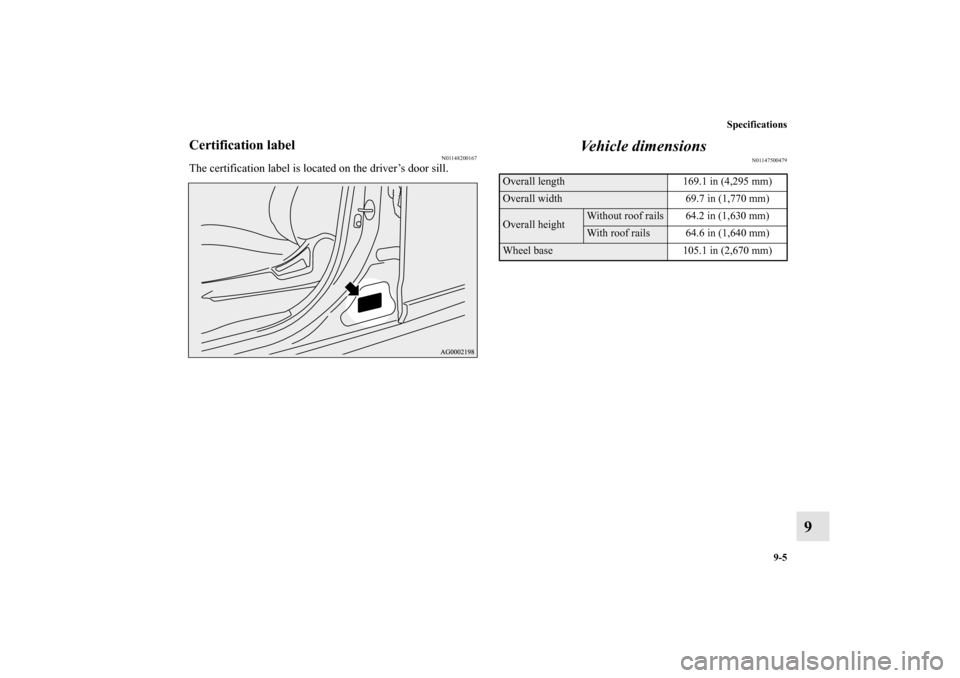
Certification label
N01148200167
The certification label is located on the driver’s door sill.
Vehicle dimensions
N01147500479
Overall length 169.1 in (4,295 mm)Overall width 69.7 in (1,770 mm)Overall height
Without roof rails 64.2 in (1,630 mm)With roof rails 64.6 in (1,640 mm)
Wheel base 105.1 in (2,670 mm)
BK0140300US.book 5 ページ 2011年6月28日 火曜日 午後5時18分