Page 287 of 378

4. When the bar graph in the engine coolant tem-
perature warning display in the multi-infor-
mation display drops, stop the engine.
Type 1
Type 2
Type 1
Type 2 5. Check
the coolant level in the reserve tank (B).
FULL
LOW
WARNING
l If
there is none, make sure that the en-
gine has cooled down before removing
the radiator cap (C), because hot steam
or boiling water otherwise will gush from
the filler port and may scald you. 6. Fill
the reserve tank with coolant as needed.
(Refer to the “Maintenance” section.) CAUTION
l
Do
not add coolant while the engine is
hot. Suddenly adding cold coolant could
damage the engine. Wait for the engine to
cool down, then add coolant a little at a
time.
7. Examine
the radiator hoses for coolant leak- age and the drive belt for looseness or damage.
If there is anything wrong with the cooling
system or drive belt, we recommend you to
have it checked and repaired. Tools, jack and tyre repair kit
E00800901278
Storage
The
tools, jack and tyre repair kit are stowed in the
luggage compartment.
The storage location of the tools, jack and tyre re-
pair kit should be remembered in case of an emer-
gency.
Vehicles with spare wheel 1- Tools
2-
Jack For emergencies
6-05 6
OGWE12E1
Page 316 of 378

NOTE
l Use
of additives is not recommended since
they may reduce the effectiveness of addi-
tives already included in the engine oil. It
may result in failure of the mechanical assem-
bly. Engine coolant
E01000501736
To check the coolant level
A
transparent coolant reserve tank (A) is located in
the engine compartment.
The coolant level in this tank should be kept be-
tween the “LOW” and “FULL” marks when meas-
ured while the engine is cold.
FULL
LOW To add coolant
The
cooling system is a closed system and normal-
ly the loss of coolant should be very slight. A no-
ticeable drop in the coolant level could indicate leak-
age. If this occurs, we recommend you to have the
system checked as soon as possible.
If the level should drop below the “LOW” level on
the reserve tank, open the lid and add coolant.
Also, if the reserve tank is completely empty, re-
move the radiator cap (B) and add coolant until the
level reaches the filler neck. WARNING
l Do
not open the radiator cap (B) while
the engine is hot. The coolant system is un-
der pressure and any hot coolant escap-
ing could cause severe burns.
Anti-freeze
The
engine coolant contains an ethylene glycol anti-
corrosion agent. Some parts of the engine are cast
aluminium alloy, and periodic changing of the en-
gine coolant is necessary to prevent corrosion of
these parts.
Use “DIA QUEEN SUPER LONG LIFE COOL-
ANT PREMIUM” or equivalent*.
*: similar high quality ethylene glycol based non-
silicate, non-amine, non-nitrate and non-borate cool-
ant with long life hybrid organic acid technology
MITSUBISHI Genuine Coolant has excellent pro-
tection against corrosion and rust formation of all
metals including aluminium and can avoid block-
ages in the radiator, heater, cylinder head, engine
block, etc.
Because of the necessity of this anti-corrosion
agent, the coolant must not be replaced with plain
water even in summer. The required concentration
of anti-freeze differs depending on the expected am-
bient temperature.
Above - 35 °C: 50 % concentration of anti-freeze
Below - 35 °C: 60 % concentration of anti-freeze Maintenance
8-06
8
OGWE12E1
Page 317 of 378
CAUTION
l
Do not use alcohol or methanol anti-
freeze or any engine coolants mixed with
alcohol or methanol anti-freeze. The use
of an improper anti-freeze can cause cor-
rosion of the aluminium components.
l Do not use water to adjust the concentra-
tion of coolant.
l Concentrations exceeding 60 % will re-
sult in a reduction of both the anti-freeze
and cooling performance thus adversely
affecting the engine.
l Do not top up with water only.
Water by itself reduces the rust-protec-
tive and anti-freeze qualities of the cool-
ant and has a lower boiling point. It can
also cause damage to the cooling system if
it should freeze. Do not use tapwater, as it
can cause corrosion and rust formation.
During cold weather
If
the temperatures in your area drop below freez-
ing, there is the danger that the coolant in the en-
gine or radiator could freeze and cause severe dam-
age to the engine and/or radiator. Add a sufficient
amount of anti-freeze to the coolant to prevent it
from freezing.
The concentration should be checked before the
start of cold weather and anti-freeze added to the
system if necessary. Washer fluid
E01000700832
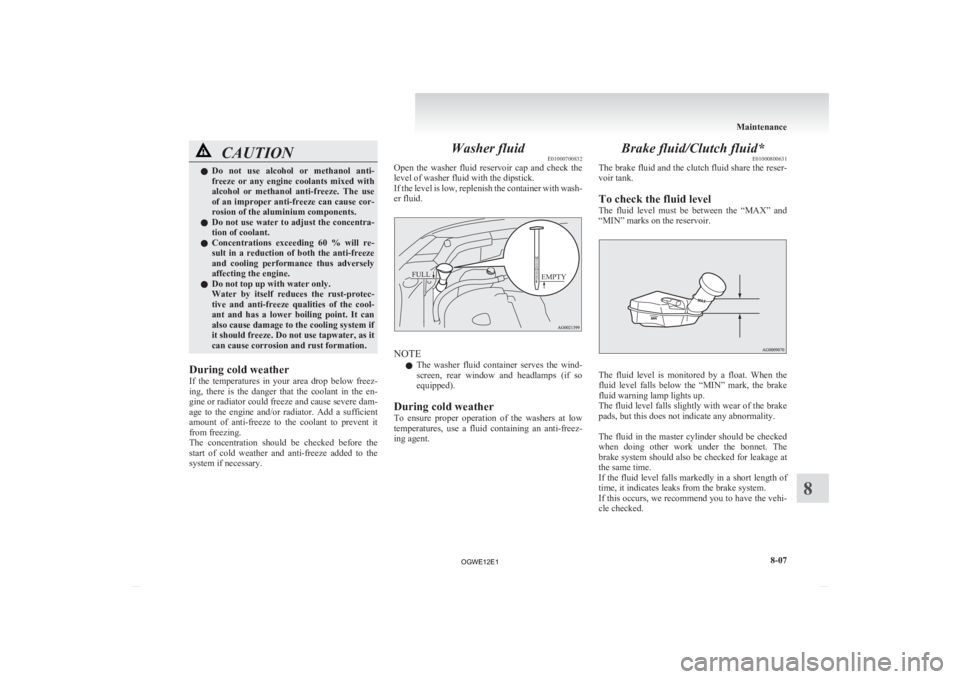
Open
the washer fluid reservoir cap and check the
level of washer fluid with the dipstick.
If the level is low, replenish the container with wash-
er fluid.
EMPTY
FULL NOTE
l The
washer fluid container serves the wind-
screen, rear window and headlamps (if so
equipped).
During cold weather
To ensure proper operation of the washers at low
temperatures, use a fluid containing an anti-freez-
ing agent. Brake fluid/Clutch fluid*
E01000800631
The
brake fluid and the clutch fluid share the reser-
voir tank.
To check the fluid level
The fluid level must be between the “MAX” and
“MIN” marks on the reservoir. The fluid level is monitored by a float. When the
fluid
level falls below the “MIN” mark, the brake
fluid warning lamp lights up.
The fluid level falls slightly with wear of the brake
pads, but this does not indicate any abnormality.
The fluid in the master cylinder should be checked
when doing other work under the bonnet. The
brake system should also be checked for leakage at
the same time.
If the fluid level falls markedly in a short length of
time, it indicates leaks from the brake system.
If this occurs, we recommend you to have the vehi-
cle checked. Maintenance
8-07 8
OGWE12E1