2012 MERCEDES-BENZ SPRINTER battery
[x] Cancel search: batteryPage 178 of 292
Disconnecting the battery
G
Warning
There is a risk of a short circuit if the positive
terminal of the
connected battery comes into
contact with any part of the vehicle. This could
cause the flammable gas mix to ignite. You
and others could be seriously injured.
R Do not place any metal objects or tools on
the batteries.
R When disconnecting the batteries, always
disconnect the negative terminal clamp
before the positive terminal clamp.
R When connecting the batteries, always
connect the positive terminal clamp before
the negative terminal clamp.
R Do not disconnect or connect the batteries
when the engine is running.
! Switch off the engine and remove the key
from the ignition lock before you loosen or
disconnect the terminal clamps. You may
otherwise destroy electronic components
such as the alternator.
Always disconnect the starter battery in the
battery case in the driver's footwell first.
! Always disconnect the battery in
the order described below. Never swap the
terminal clamps. You may otherwise
damage the vehicle electronics.
X Switch off all electrical consumers.
Disconnecting the starter battery
The starter battery is located in the battery
case in the driver's footwell. Removing/installing the floor covering in
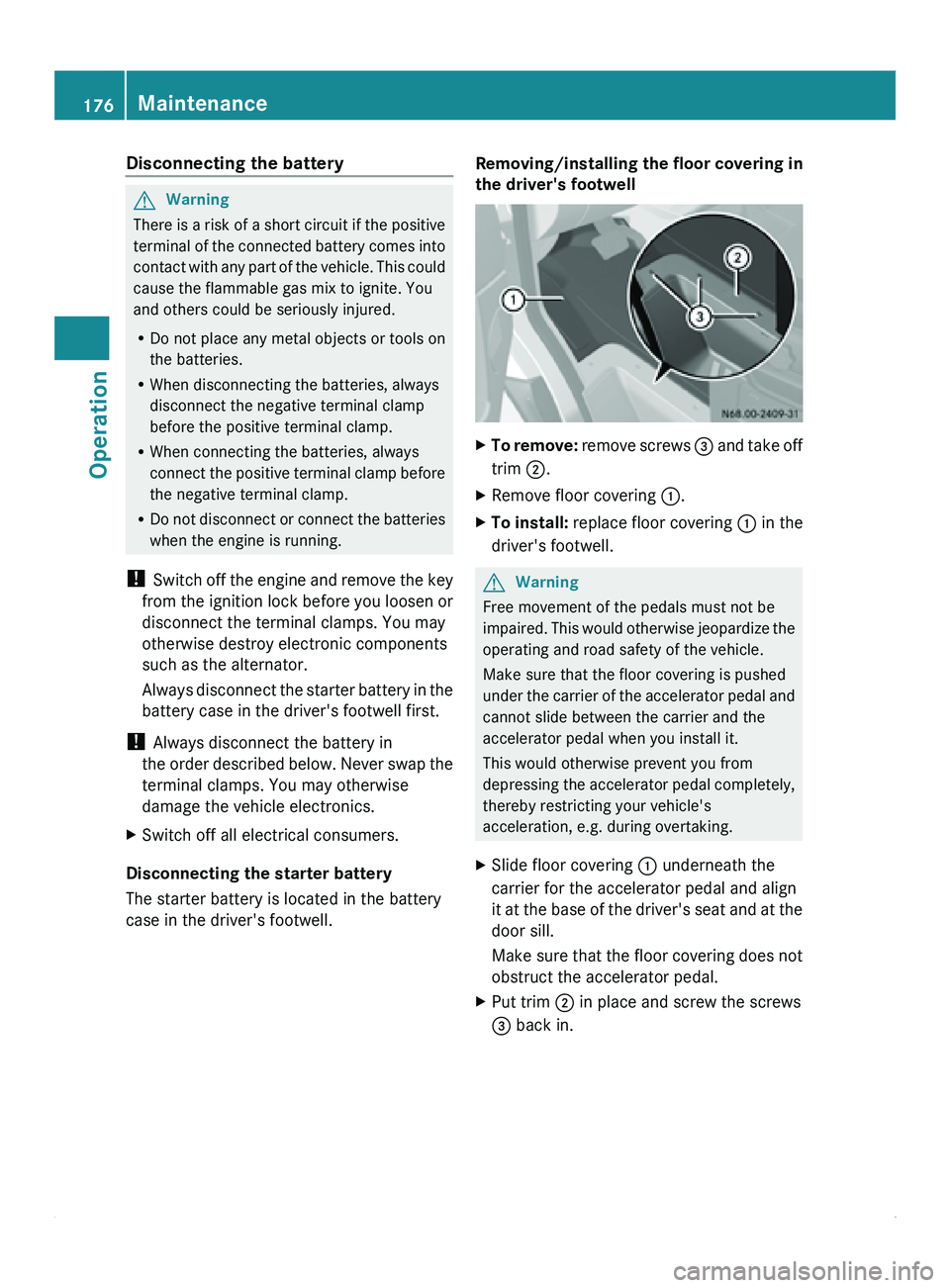
the driver's footwell X
To remove: remove screws 008A
and take off
trim 0047.
X Remove floor covering 0046.
X To install: replace floor covering
0046 in the
driver's footwell. G
Warning
Free movement of the pedals must not be
impaired. This would
otherwise jeopardize the
operating and road safety of the vehicle.
Make sure that the floor covering is pushed
under the carrier of the accelerator pedal and
cannot slide between the carrier and the
accelerator pedal when you install it.
This would otherwise prevent you from
depressing the accelerator pedal completely,
thereby restricting your vehicle's
acceleration, e.g. during overtaking.
X Slide floor covering 0046 underneath the
carrier for the accelerator pedal and align
it at the
base of the driver's seat and at the
door sill.
Make sure that the floor covering does not
obstruct the accelerator pedal.
X Put trim 0047 in place and screw the screws
008A back in.176
Maintenance
Operation
Page 179 of 292

Removing the battery cover in the driver's
footwell
X
Remove screws 0047 and slide cover 0046 in
the direction of the arrow.
The screws must protrude beyond the
recesses.
X Remove cover 0046 upwards. Starter battery in the driver's footwell
X
First loosen and remove the negative
terminal clamp so that it is no longer in
contact with the terminal.
X Remove the cover from the positive
terminal.
X Loosen the positive terminal clamp and fold
it up to the side together with the pre-fuse
box. Disconnecting the additional battery
Additional battery in the engine compartment
X
Remove the key from the ignition lock.
X Open the hood (Y page 168).
X First loosen and remove the negative
terminal clamp so that it is no longer in
contact with the terminal.
X Remove the cover from the positive
terminal.
X Loosen and remove the positive terminal
clamp.
Removing the battery Starter battery
X
Disconnect the battery ( Y page 176).
X Pull breather hose with connector
bracket 0047 from connection 0046 on the
degassing cover. Maintenance
177Operation Z
Page 180 of 292

X
Loosen the bolts holding retainer 008A, which
prevents the battery from moving around. X
Pull retainer 008A upwards and slide the
battery out of
its anchorage in the direction
of travel.
X Fold the bar upwards and remove the
battery from the battery case.
Additional battery in the engine
compartment
X Disconnect the battery ( Y page 177).
X Loosen the bolts holding the retainer that
prevents the battery from moving around.
X Remove the battery holder and take out the
battery.
Charging the battery G
Warning
Only charge the battery in a well-ventilated
area. As the battery is being charged, gases
can escape and generate minor explosions,
which can injure
you and others or may cause damage to the paintwork or acid corrosion on
the vehicle.
There is a risk of acid burns during the
charging process due to the gases which
escape from the battery. Do not, therefore,
lean over the battery while it is being
recharged.
X Recharge the removed battery. Observe
the notes in the operating instructions for
your battery charger.
X Follow the above steps in the reverse order
to install the battery again.
! Only charge the installed battery with a
battery charger that has been tested and
approved by the distributor named on the
inside front cover. This device allows the
battery to be
charged when it is installed in
the vehicle. The vehicle's electronics
system may otherwise be damaged.
i It is also possible to charge the starter
battery using the jump-starting connection
point in the engine compartment
(Y page 247).
Reconnecting the battery !
Always connect the battery in the order
described below. Never
mix up the terminal
clamp disconnection/connection order
and never mix up the terminal clamps. You
may otherwise damage the vehicle
electronics.
X Switch off all electrical consumers.
X Connect the positive terminal clamp.
X Attach the cover to the positive terminal.
X Connect the negative terminal clamp.
i After the battery has been reconnected,
you must reset the side windows
(Y page 61). 178
Maintenance
Operation
Page 181 of 292

Battery care
!
Please always observe the following
notes:
R dirty battery clamps
and battery surfaces
cause leak currents, which lead to the
batteries discharging. Always keep the
battery terminals and battery surfaces
clean and dry. Grease the battery
terminals, particularly the terminal
undersides, with a light coating of acid-
resistant grease.
R cleaning agents containing fuel corrode
the battery housing. Only clean the
battery housing with commercially
available cleaning agents.
R only clean the batteries when the caps
are screwed on. Dirt may otherwise enter
the battery cells and damage the battery.
R the breathers in the caps and the cell
ventilation tubes must be open.
Otherwise, gas cannot escape. Unscrew
blocked breathers and clean them with a
suitable tool such as a piece of wire. If
you do not unscrew the caps for cleaning,
there is a risk of short circuit.
R regularly check the battery terminals and
the fastening of the negative cable to the
chassis to ensure that they are firmly
seated.
R if batteries are not being used, you
should charge them once a month. Maintenance
179
Operation Z
Page 190 of 292

Problem Possible causes/consequences and
0050 Solutions009E 0031 003D 0065
The yellow ESP
®
, ABS
and ASR/BAS warning
lamps, and the red
brake system warning
lamp light up while the
engine is running. G
Warning!
EBD has been deactivated due to undervoltage.
It is possible that the battery is not being charged.
The rear wheels
could lock sooner than expected when you apply
the brakes.
X On vehicles with steering wheel buttons, also observe the
messages in the display ( Y page 197).
X Stop the vehicle as soon as possible, paying attention to road
and traffic conditions.
X Do not drive on.
X Consult a qualified specialist workshop. 0065
The red brake
system indicator
lamp is lit while
the engine is
running. A
warning tone
also sounds. G
Warning!
There is insufficient brake fluid in the supply reservoir.
X On vehicles with steering wheel buttons, also observe the
messages in the display ( Y page 197).
X Stop the vehicle as soon as possible, paying attention to road
and traffic conditions.
X Check the brake fluid level in the supply reservoir
(
Y page 170).
X If the brake fluid is below the MIN mark: do not drive on!
X Do not add brake fluid. This does not solve the problem.
X Consult a qualified specialist workshop. 0065
When towing a
trailer: The red
brake system
warning lamp is
lit while the
engine is
running.
A warning tone
also sounds. G
Warning!
The brake force booster in the trailer is faulty.
The driving and braking characteristics of your vehicle could
change. There is
a risk of the trailer overbraking and of you losing
control over the truck/trailer combination.
X On vehicles with steering wheel buttons, also observe the
messages in the display ( Y page 197).
X Stop the vehicle as soon as possible, paying attention to road
and traffic conditions.
X Do not drive on.
X Consult a qualified specialist workshop.188
Troubleshooting
Practical advice
Page 191 of 292

Problem Possible causes/consequences and
0050 Solutions003D
The yellow ASR/
BAS indicator
lamp is lit while
the engine is
running. G
Warning!
ASR has been deactivated due to a malfunction.
The engine power output may be reduced.
X Drive on with care.
X Consult a qualified specialist workshop as soon as possible. 003D
The yellow ASR/
BAS indicator
lamp is lit while
the engine is
running. G
Warning!
BAS has been deactivated due to a malfunction.
The brake system continues to function normally, but without
electronic support.
X Drive on with care.
X Consult a qualified specialist workshop as soon as possible. 003D
The yellow ASR/
BAS indicator
lamp is lit while
the engine is
running. G
Warning!
ASR and BAS have been deactivated due to undervoltage.
It is possible that the battery is not being charged.
The brake system
is still available with the normal braking effect.
X Drive on with care.
X Visit a qualified specialist workshop immediately. 0031
The yellow ABS
indicator lamp is
lit while the
engine is
running. G
Warning!
ABS has been deactivated due to a malfunction. ESP ®
, ASR and
BAS, as well as cruise control, have also been deactivated as a
result.
The brake system continues to function normally, but without
electronic support. The wheels could therefore lock, e.g. if the
brakes are applied with maximum force.
X On vehicles with steering wheel buttons, also observe the
messages in the display ( Y page 197).
X Drive on with care.
X Visit a qualified specialist workshop immediately. 0031
The yellow ABS
indicator lamp is
lit while the
engine is
running. G
Warning!
ABS is temporarily unavailable. Self diagnosis may not have been
completed yet.
The brake system
is still available with the normal braking effect.
X Drive on for a short distance at a speed of more than
13 mph(20 km/h).
ABS is available again if the message goes out. Troubleshooting
189
Practical advice Z
Page 192 of 292
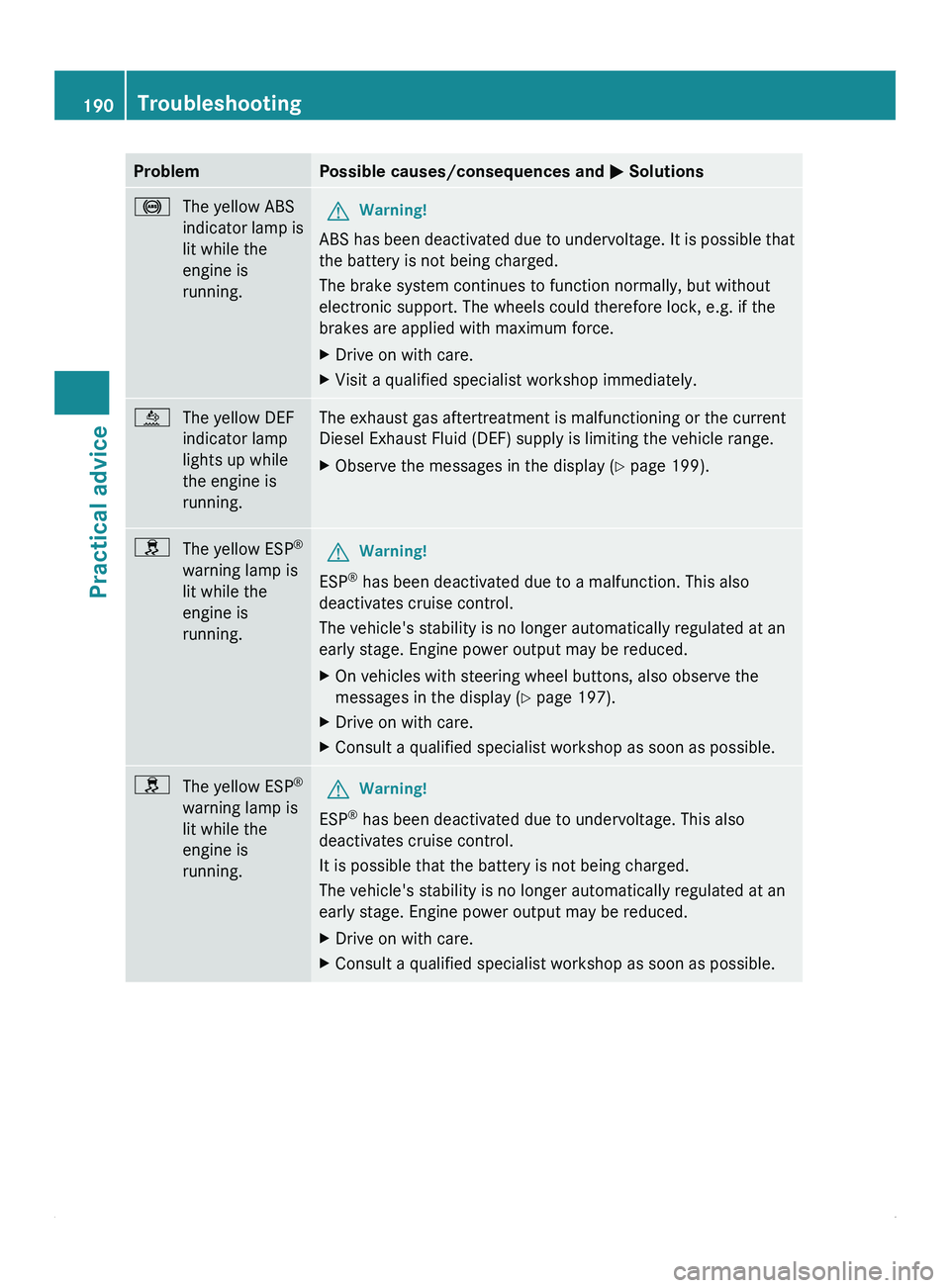
Problem Possible causes/consequences and
0050 Solutions0031
The yellow ABS
indicator lamp is
lit while the
engine is
running. G
Warning!
ABS has been deactivated due to undervoltage. It is possible that
the battery is not being charged.
The brake system continues to function normally, but without
electronic support. The wheels could therefore lock, e.g. if the
brakes are applied with maximum force.
X Drive on with care.
X Visit a qualified specialist workshop immediately. 00E4
The yellow DEF
indicator lamp
lights up while
the engine is
running. The exhaust gas aftertreatment is malfunctioning or the current
Diesel Exhaust Fluid (DEF) supply is limiting the vehicle range.
X
Observe the messages in the display ( Y page 199).009E
The yellow ESP ®
warning lamp is
lit while the
engine is
running. G
Warning!
ESP ®
has been deactivated due to a malfunction. This also
deactivates cruise control.
The vehicle's stability is no longer automatically regulated at an
early stage. Engine power output may be reduced.
X On vehicles with steering wheel buttons, also observe the
messages in the display ( Y page 197).
X Drive on with care.
X Consult a qualified specialist workshop as soon as possible. 009E
The yellow ESP ®
warning lamp is
lit while the
engine is
running. G
Warning!
ESP ®
has been deactivated due to undervoltage. This also
deactivates cruise control.
It is possible that the battery is not being charged.
The vehicle's stability is no longer automatically regulated at an
early stage. Engine power output may be reduced.
X Drive on with care.
X Consult a qualified specialist workshop as soon as possible.190
TroubleshootingPractical advice
Page 193 of 292

Problem Possible causes/consequences and
0050 Solutions008A
The red SRS
indicator lamp
does not go out
approximately
four seconds
after switching
on the ignition,
or lights up
again. G
Warning!
The restraint systems have malfunctioned. The air bags or belt
tensioners could be triggered unintentionally or might not be
triggered at all in the event of an accident.
X Drive on with care.
X Visit a qualified specialist workshop immediately. 003F
The red battery
charge indicator
lamp lights up
while the engine
is running. G
Warning!
The battery is not being charged. Possible causes are a defective
alternator or a torn poly-V-belt.
X Stop the vehicle as soon as possible, paying attention to road
and traffic conditions.
X Check the poly-V-belt.
If it is torn: do not drive on. Consult the nearest qualified
specialist workshop.
If it is not damaged: have the vehicle checked at a qualified
specialist workshop. 003F
The red battery
charge indicator
lamp lights up
while the engine
is running. G
Warning!
The battery is faulty.
X Stop the vehicle as soon as possible, paying attention to road
and traffic conditions.
X Do not continue driving under any circumstances.
X Contact a breakdown service, e.g. an authorized Sprinter
Dealer. 0026
The yellow brake
pad wear
indicator lamp
lights up after
the engine is
started or while
the vehicle is in
motion. G
Warning!
The brake pads/linings have reached their wear limit.
X Have the brake pads/linings replaced as soon as possible at a
qualified specialist workshop. Troubleshooting
191Practical advice Z