2012 MERCEDES-BENZ S-Class winter
[x] Cancel search: winterPage 511 of 536

All-weather tires and winter tiresIndexSpeed ratingH M+S29Up to 130 mph (210 km/h)V M+S29Up to 149 mph (240 km/h)
i
Not all tires that have the M+S
identification offer the driving
characteristics of winter tires. Winter tires
have, in addition to the M+S identification,
the i snow flake symbol on the tire
sidewall. Tires with this identification fulfill
the requirements of the Rubber
Manufacturers Association (RMA) and the
Rubber Association of Canada (RAC)
regarding the tire traction on snow and
have been especially developed for driving
on snow.
An electronic speed limiter prevents your
vehicle from exceeding the following speeds:
R 130 mph (210 km/h):
- All vehicles (except AMG vehicles)
R 155 mph (250 km/h):
- S 63 AMG
- S 65 AMG
R 186 mph (300 km/h):
- S 63 AMG (Performance Package)
- S 63 AMG with increased top speed
- S 65 AMG with increased top speed
The speed rating of tires mounted at the
factory may be higher than the maximum
speed that the electronic speed limiter
permits.
Make sure that your tires have the required
speed rating as specified in the "Tires"
section ( Y page 514), e.g. if you buy new
tires.
Further information about reading tire data
can be obtained from any qualified specialist
workshop, e.g. an authorized Mercedes-Benz
Center.
Load index
i Tire data is vehicle-specific and may
deviate from the data in the example.
In addition to the load bearing index, load
index : may be imprinted after the letters
that identify speed index B (Y page 507) on
the sidewall of the tire.
R If no specification is given: no text (as in the
example above), represents a standard
load (SL) tire
R XL or Extra Load: represents a reinforced
tire
R Light load: represents a light load tire
R C, D, E: represents a load range that
depends on the maximum load that the tire
can carry at a certain pressure
DOT, Tire Identification Number (TIN)
U.S. tire regulations prescribe that every
manufacturer of new tires or retreader has to
imprint a TIN in or on the sidewall of each tire
produced.
29 Or M+S i for winter tires.Tire labeling509Wheels and tiresZ
Page 517 of 536
For further information on the recommended
tire inflation pressure and on tire pressures
for specific driving conditions, see
( Y page 493).
i Notes on the vehicle equipment – always
equip the vehicle:
R with tires of the same size on a given axle
(left/right)
R with the same type of tires at a given time
(summer tires, winter tires, MOExtended
tires)
i On the following pages, you can find
information on approved wheel rims and
tire sizes for equipping your vehicle with
winter tires. Winter tires are not available
ex factory as standard equipment or
optional extras.
If you want to equip your vehicle with
approved winter tires, it may be necessary
to obtain wheel rims in the corresponding
size, as the size of the approved winter tires
may differ from the standard tires. This is
dependent on the model and the
equipment installed at the factory.
The tires and wheel rims, as well as further
information, can be obtained at a qualified
specialist workshop, e.g. at an authorized
Mercedes-Benz Center.
i Overview of abbreviations used in the
following tire tables:
R BA: both axles
R FA: front axle
R RA: rear axle
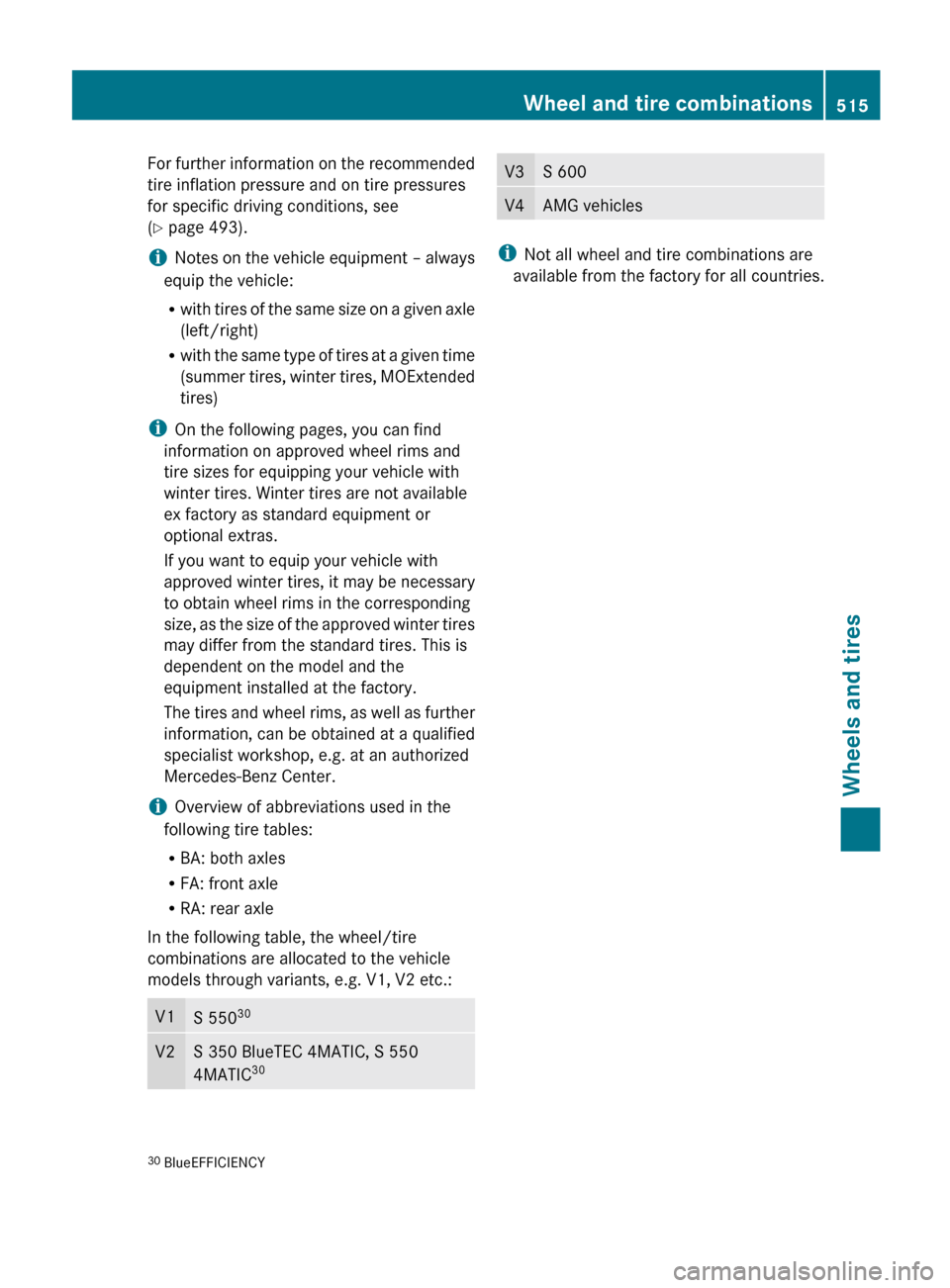
In the following table, the wheel/tire
combinations are allocated to the vehicle
models through variants, e.g. V1, V2 etc.:V1S 550 30V2S 350 BlueTEC 4MATIC, S 550
4MATIC 30V3S 600V4AMG vehicles
i
Not all wheel and tire combinations are
available from the factory for all countries.
30 BlueEFFICIENCYWheel and tire combinations515Wheels and tiresZ
Page 519 of 536

All-weather tiresAlloy wheelsV1V2V3V4BA255/40 R19 100 V XL M+S8.5 J x 19 H2
Wheel offset: 1.69 in (43 mm)###—FA
RA255/40 R19 100 V XL M+S
275/40 R19 101 V M+S 328.5 J x 19 H2
Wheel offset: 1.69 in (43 mm)
9.5 J x 19 H2
Wheel offset: 1.69 in (43 mm)#—#—Winter tiresAlloy wheelsV1V2V3V4BA255/45 R18 99 V
M+S i 338.5 J x 18 H2
Wheel offset: 1.69 in (43 mm)###—BA255/40 R19 100 V XL
M+S i 338.5 J x 19 H2
Wheel offset: 1.69 in (43 mm)####FA
RA255/40 R19 100 V XL
M+S i
275/40 R19 105 V XL
M+S i 328.5 J x 19 H2
Wheel offset: 1.69 in (43 mm)
9.5 J x 19 H2
Wheel offset: 1.69 in (43 mm)———#"Minispare" emergency spare wheel 32TiresWheelsV1V2V3V4T 155/70 R19 113 M
Tire pressure: 420 kPa (4.2 bar/
61 psi)4.5 B x 19 H2
Wheel offset: 1.38 in (35 mm)####
i The specified tire pressure is printed in yellow on the emergency/collapsible spare wheel.
32
Use of snow chains is not permitted. Observe the notes in the "Snow chains" section.
33 Only fine-link snow chains are permitted.Wheel and tire combinations517Wheels and tiresZ
Page 528 of 536

RIPA
R TBA
For MTBE, the concentration should not
exceed 15%.
The concentration of methanol in gasoline
including other additives must not exceed 3%.
Using mixtures of methanol and ethanol is not
permitted. Gasohol, a mixture of 10% ethanol
and 90% unleaded gasoline, can be used.
All of these mix fuels must fulfill the fuel
requirements, e.g.:
R knock resistance
R boiling point
R vapor pressure
Diesel engines – important safety notes
! Only use commercially available ULTRA-
LOW SULFUR DIESEL FUEL (ULSD, 15 ppm
MAXIMUM SULFUR) that meets the
ASTM D975 standard. Failure to use
ULTRA-LOW SULFUR DIESEL FUEL (ULSD)
can severely damage the vehicle's exhaust
gas aftertreatment system.
! Do not fill the tank with gasoline. Do not
blend diesel fuel with gasoline or kerosene.
Otherwise, the fuel system and the engine
could be damaged.
To prevent malfunctions, diesel fuel with
improved flow characteristics is available in
the winter months. Check with your gas
station.
Information on the fuel grade can usually be
found on the gas pump. If the information
cannot be found on the gas pump, ask the gas
station personnel. For further information,
consult an authorized Mercedes-Benz Center
or go to the Internet site
http://www.mbusa.com (USA only).
Diesel engines – fuels containing
biodiesel (FAME [fatty acid methyl ester])
Mercedes-Benz USA approves the use of B5
(ULSD with a maximum of up to five percent
by volume biodiesel) for all diesel engineswith common rail direct injection (CDI) and
BlueTEC.
Pure biodiesel and diesel fuels that have a
higher percentage of biodiesel, e.g. B20, can
damage the fuel system and the engine and
are therefore not approved.
For further information, please ask the gas
station personnel. The label on the gas pump
must indicate clearly that the B5 biodiesel
blend fulfills the ULSD standard. If the label
is not clear, do not refuel the vehicle.
Do not refuel your vehicle with fuels unless
they have been approved by Mercedes-Benz.
Additives in gasoline
One of the main problems of poor fuel quality
is the forming of deposits that are caused
during the gasoline combustion process.
Mercedes-Benz recommends that you use
fuel brands that have the additives.
If you use fuels without these additives for an
extended period of time, there may be a
buildup of carbon deposits, especially on the
inlet valves and in the combustion chamber.
This could lead to engine problems, e.g.:
R longer engine warm-up phase
R uneven idle
R engine noise
R misfiring
R loss of power
Carbon deposits may form if the availability
of gasoline with relevant additives is
insufficient (in certain regions). In this case,
Mercedes-Benz recommends the use of
additives that have been approved for
Mercedes-Benz vehicles.
Consult an authorized Mercedes-Benz Center
or go to the Internet site
http://www.mbusa.com (USA only) for a list
of approved products. Observe the
instructions for use on the product label.
Do not mix other fuel additives with fuel. This
causes unnecessary costs and could damage
the engine.
526Service products and capacitiesTechnical data
Page 529 of 536

! Do not refuel with low-grade fuel and do
not use fuel additives that are not tested
and approved for Mercedes-Benz vehicles.
Damage to or malfunctions of the fuel
system may otherwise occur.
DEF
Important safety notes
i For BlueTEC vehicles only.
DEF is a non-flammable, non-toxic, colorless,
odorless and water-soluble fluid.
! Rinse surfaces that have come into
contact with DEF immediately with water or
remove DEF using a damp cloth and cold
water. If the DEF has already crystallized,
use a sponge and cold water to clean it. DEF
residues crystallize after time and
contaminate the affected surfaces.
High outside temperatures
If DEF heats up to over 122 ‡ (50 †) for
extended periods, e.g. as a result of direct
sunlight on the DEF reservoir, DEF can
decompose. Ammonia vapors develop as a
result.
GWARNING
When opening the filler cap of the DEF tank
ammonia gas vapors may escape. Refill DEF
in a well ventilated area only. Ammonia gas
vapors have a pungent odor and are
particularly irritating for your skin, mucous
membranes, and eyes. Inhaling ammonia gas
vapors will cause burning eyes, nose, and
throat, as well as coughing and watering eyes.
Low outside temperatures
DEF freezes at a temperature of
approximately 12 ‡ (–11 †). The vehicle is
equipped with a DEF preheating system when
it leaves the factory. Winter operation is
therefore also guaranteed at temperatures
below 12 ‡ (–11 †).
Additives
! Only use DEF in accordance with ISO
22241. Do not use additives with DEF and
do not dilute DEF with water. This may
destroy the BlueTEC exhaust gas
aftertreatment system.
Purity
Assuring the purity of DEF is particularly
important with respect to avoiding
malfunctions in the exhaust gas
aftertreatment system.
If DEF is pumped out of the DEF tank, e.g.
during repair work, it must not be returned to
the tank. The purity of the fluid can no longer
be guaranteed.
! Impurities in DEF (e.g. due to other
service products, cleaning agents or dust)
lead to:
R increased emission values
R damage to the catalytic converter
R engine damage
R malfunctions in the BlueTEC exhaust gas
aftertreatment system
Engine oil
Please bear the following in mind
The engine oils are matched to the
performance of Mercedes-Benz engines and
service intervals. You should therefore only
use engine oils and oil filters that are
approved for vehicles with maintenance
systems.
For a list of approved engine oils and oil filters,
consult an authorized Mercedes-Benz Center
or go to the Internet site
http://www.mbusa.com (USA only).
! Never use engine oil or an oil filter of a
specification other than is necessary to
fulfill the prescribed service intervals. Do
not change the engine oil or oil filter in
order to achieve longer replacement
Service products and capacities527Technical dataZ
Page 532 of 536

ignite and burn. You could be seriously
burned.
Use MB SummerFit windshield washer
concentrate at temperatures above freezing:XMix 1 part MB SummerFit with 100 parts
water.
Use MB WinterFit windshield washer
concentrate at temperatures below freezing:
XAt temperatures down to 14 ‡(Ò 10 †): mix
1 part MB WinterFit with 2 parts water.XAt temperatures down to Ò 4 ‡( Ò 20 †): mix
1 part MB WinterFit with 1 part water.XAt temperatures down to
Ò 20.2 ‡(Ò 29 †): mix 2 parts MB WinterFit
with 1 part water.
! Only SummerFit and WinterFit can be
mixed. Otherwise, the jets could become
blocked.
Vehicle data
For the specified vehicle data, please note
that:
R The heights specified may vary due to:
- tires
- load
- condition of the suspension
- optional equipment
All modelsVehicle length206.7 in (5250 mm)Vehicle width
including exterior
mirrors83.5 in (2120 mm)Vehicle height58.2 in (1479 mm)Wheelbase124.6 in (3165 mm)Front track63.0 in (1600 mm)Rear track63.2 in (1606 mm)All modelsTurning circle40.0 ft (12.20 m)Maximum roof loadMaximum 220 lb (100 kg)Maximum trunk
loadMaximum 220 lb (100 kg)S 550 4MATIC BlueEFFICIENCYShort wheelbaseVehicle length200.8 in (5100 mm)Wheelbase119.5 in (3035 mm)Turning circle38.7 ft (11.80 m)Long wheelbaseVehicle length206.7 in (5250 mm)Wheelbase124.6 in (3165 mm)Turning circle40.0 ft (12.20 m)S 63 AMG
S 65 AMGVehicle length206.8 in (5252 mm)Vehicle height58.7 in (1490 mm)Turning circle40.1 ft (12.22 m)530Vehicle dataTechnical data