2012 MERCEDES-BENZ S-Class Tire
[x] Cancel search: TirePage 26 of 536

Tiredness assistantsee ATTENTION ASSIST
Tire pressure
Calling up (on-board computer) .....497
Checking manually ........................497
Display message ............................ 415
Maximum ....................................... 496
Notes ............................................. 495
Recommended ............................... 493
Tire pressure monitoring system
Function/notes ............................. 497
Restarting ...................................... 499
Warning lamp ................................. 429
Tires
Aspect ratio (definition) .................512
Average weight of the vehicle
occupants (definition) ....................511
Bar (definition) ............................... 510
Characteristics .............................. 510
Checking ........................................ 491
Definition of terms .........................510
Direction of rotation ......................514
Display message ............................ 415
Distribution of the vehicle
occupants (definition) ....................513
DOT, Tire Identification Number
(TIN) ............................................... 509
DOT (Department of
Transportation) (definition) ............510
GAWR (Gross Axle Weight Rating)
(definition) ..................................... 511
GVW (Gross Vehicle Weight)
(definition) ..................................... 511
GVWR (Gross Vehicle Weight
Rating) (definition) .........................511
Important safety notes ..................490
Increased vehicle weight due to
optional equipment (definition) ......511
Kilopascal (kPa) (definition) ...........512
Labeling (overview) ........................506
Load bearing index (definition) ......513
Load index ..................................... 509
Load index (definition) ...................512
Maximum loaded vehicle weight
(definition) ..................................... 511
Maximum load on a tire
(definition) ..................................... 512Maximum permissible tire
pressure (definition) ....................... 512
Maximum tire load .........................504
Maximum tire load (definition) .......512
Optional equipment weight
(definition) ..................................... 512
PSI (pounds per square inch)
(definition) ..................................... 512
Replacing ....................................... 513
Service life ..................................... 491
Sidewall (definition) .......................512
Speed rating (definition) ................511
Storing ........................................... 514
Structure and characteristics
(definition) ..................................... 510
Temperature .................................. 506
TIN (Tire Identification Number)
(definition) ..................................... 513
Tire bead (definition) ......................512
Tire pressure (definition) ................512
Tire pressures (recommended) ......511
Tire size (data) ............................... 514
Tire size designation, load-bearing
capacity, speed rating .................... 507
Tire tread ....................................... 491
Tire tread (definition) .....................512
Total load limit (definition) .............513
Traction ......................................... 505
Traction (definition) .......................513
Tread wear ..................................... 505
Uniform Tire Quality Grading
Standards ...................................... 505
Uniform Tire Quality Grading
Standards (definition) ....................511
Unladen weight (definition) ............512
Wear indicator (definition) .............513
Wheel rim (definition) ....................511
see Flat tire
Tonal properties
see Sound settings
Top Tether ............................................ 65
Towing Important safety guidelines ...........483
Installing the towing eye ................483
Removing the towing eye ...............484
With the rear axle raised ................484
Towing away
With both axles on the ground .......48424Index
Page 28 of 536

Vehicle levelActive Body Control (ABC) .............345
AIRMATIC ...................................... 343
Display message ............................ 410
Vehicle level (display message) ....... 409
Vehicle tool kit .................................. 472
Video see Video DVD
Video AUX
Setting the picture .........................240
Video DVD
Automatic picture shutoff ..............240
DVD menu ..................................... 244
Fast forward/rewind ...................... 242
Function restrictions ......................241
Interactive content ........................245
Notes on discs ............................... 240
Operation ....................................... 240
Operation using the on-board
computer ....................................... 379
Pause function ............................... 243
Playing conditions .......................... 241
Rear Seat Entertainment System ...254
Safety notes .................................. 240
Selecting ........................................ 242
Selecting a film/title ...................... 243
Selecting a scene/chapter ............243
Setting the audio format ................245
Setting the language ......................245
Setting the picture .........................240
Showing/hiding the control menu . 241
Showing/hiding the menu .............242
Stop function ................................. 243
Subtitles ........................................ 245
Switching to ................................... 241
VIN ...................................................... 521
Voice Control System Settings ......................................... 145
Volume, adjusting
COMAND ....................................... 134
Headphones .................................. 142
Navigation messages .....................134
Using the remote control (Rear
Seat Entertainment System) ..........140W
Waiting call ........................................ 201
Warning and indicator lamps ABS ................................................ 423
Brakes ........................................... 422
Check Engine ................................. 427
Cruise control ................................ 331
Distance warning ........................... 428
DISTRONIC PLUS ........................... 428
ESP ®
.............................................. 424
ESP ®
OFF ....................................... 425
Fuel tank ........................................ 428
LIM (DISTRONIC PLUS) ..................335
Overview .......................................... 36
PASSENGER AIRBAG OFF
indicator lamp .................................. 50
Reserve fuel ................................... 428
Seat belt ........................................ 420
SRS ................................................ 426
Tire pressure monitor ....................429
Warranty ............................................ 521
Washer fluid Display message ............................ 418
see Windshield washer system
Weather Band
Searching for a channel .................214
Switching on .................................. 214
Wheel bolt tightening torque ........... 477
Wheel chock ...................................... 474
Wheels Changing a wheel .......................... 473
Checking ........................................ 491
Cleaning ......................................... 465
Important safety notes ..................490
Interchanging/changing ................513
Mounting a wheel .......................... 476
Removing a wheel ..........................476
Storing ........................................... 514
Tightening torque ........................... 477
Wheel size/tire size .......................514
Window curtain air bag
Display message ............................ 398
Operation ......................................... 49
Windows
Cleaning ......................................... 466
see Side windows 26Index
Page 29 of 536

WindshieldDefrosting ...................................... 296
Infrared reflective .......................... 454
Windshield washer system .............. 461
Notes ............................................. 529
Windshield wipers
Problem (malfunction) ...................286
Replacing the wiper blades ............285
Switching on/off ........................... 285
Winter driving
Important safety notes ..................492
Slippery road surfaces ...................330
Snow chains .................................. 493
Winter operation
Radiator cover ............................... 457
Winter tires
M+S tires ....................................... 492
Wiper blades
Cleaning ......................................... 466
Important safety notes ..................285
Wooden trim (cleaning
instructions) ...................................... 468Index27
Page 31 of 536

Information for customers in
California
Under California law you may be entitled to a
replacement of your vehicle or a refund of the
purchase price or lease price, if after a
reasonable number of repair attempts
Mercedes-Benz USA, LLC and/or its
authorized repair or service facilities fail to fix
one or more substantial defects or
malfunctions in the vehicle that are covered
by its express warranty. During the period of
18 months from original delivery of the
vehicle or the accumulation of 18 000 miles
(approximately 29 000 km) on the odometer
of the vehicle, whichever occurs first, a
reasonable number of repair attempts is
presumed for a retail buyer or lessee if one or
more of the following occurs:(1)the same substantial defect or
malfunction results in a condition that is
likely to cause death or serious bodily
injury if the vehicle is driven, that defect
or malfunction has been subject to repair
two or more times, and you have directly
notified Mercedes-Benz USA, LLC in
writing of the need for its repair.(2)the same substantial defect or
malfunction of a less serious nature than
category (1) has been subject to repair
four or more times and you have directly
notified Mercedes-Benz in writing of the
need for its repair.(3)the vehicle is out of service by reason of
repair of the same or different substantial
defects or malfunctions for a cumulative
total of more than 30 calendar days.
Please send your written notice to:
Mercedes-Benz USA, LLC
Customer Assistance Center
One Mercedes Drive
Montvale, NJ 07645-0350
Maintenance
The Service and Warranty Booklet describes
all the necessary maintenance work which
should be done at regular intervals.
Always have the Service and Warranty
Booklet with you when you bring the vehicle
to an authorized Mercedes-Benz Center. The
service advisor will record every service for
you in the Service and Warranty Booklet.
Roadside Assistance
The Mercedes-Benz Roadside Assistance
Program offers technical help in the event of
a breakdown. Calls to the toll-free Roadside
Assistance Hotline are answered by our
agents 24 hours a day, 365 days a year.
1-800-FOR-MERCedes(1-800-367-6372)
(USA)
1-800-387-0100 (Canada)
For additional information, refer to the
Mercedes-Benz Roadside Assistance
Program brochure (USA) or the "Roadside
Assistance" section in the Service and
Warranty booklet (Canada). You will find both
in your vehicle literature portfolio.
Change of address or change of
ownership
In the event of a change of address, please
send us the "Change of Address Notice"
found in the Service and Warranty
Information Booklet, or simply call the
Mercedes-Benz Customer Assistance Center
(in the USA) at the hotline number
1-800-FOR-MERCedes(1-800-367-6372) or
Customer Service Center (in Canada) at
1-800-387-0100. This will assist us in
contacting you in a timely manner should the
need arise.
If you sell your Mercedes, please leave the
entire literature in the vehicle so that it is
available to the next owner.
Introduction29
Page 32 of 536

If you bought this vehicle used, be sure to
send in the "Notice of Purchase of Used Car"
found in the Service and Warranty
Information Booklet, or call the Mercedes-
Benz Customer Assistance Center (in the
USA) at
1-800-FOR-MERCedes(1-800-367-6372) or
Customer Service (in Canada) at
1-800-387-0100.
Vehicle operation outside the USA
and Canada
If you plan to operate your vehicle in foreign
countries, please be aware that:
R service facilities or replacement parts may
not be readily available.
R unleaded fuel for vehicles with a catalytic
converter may not be available. Leaded fuel
may cause damage to the catalytic
converter.
R the fuel may have a considerably lower
octane rating. Unsuitable fuel can cause
engine damage.
Some Mercedes-Benz models are available
for delivery in Europe through our European
Delivery Program. For details, consult an
authorized Mercedes-Benz Center or write to
one of the following addresses.
In the USA
Mercedes-Benz USA, LLC
European Delivery Department
One Mercedes Drive
Montvale, NJ 07645-0350
In Canada
Mercedes-Benz Canada, Inc.
European Delivery Department
98 Vanderhoof Avenue
Toronto, Ontario M4G 4C9
Operating safety
Safety notes
GWARNING
Work improperly carried out on electronic
components and associated software could
cause them to cease functioning. Because the
vehicle's electronic components are
interconnected, any modifications made may
produce an undesired effect on other
systems. Electronic malfunctions could
seriously impair the operating safety of your
vehicle.
Contact an authorized Mercedes-Benz Center
for repairs or modifications to electronic
components.
Other improper work or modifications on the
vehicle could also have a negative impact on
the operating safety of the vehicle.
Some safety systems only function when the
engine is running. You should therefore never
turn off the engine while driving.
GWARNING
Heavy blows against the vehicle underbody or
tires/wheels may cause serious damage and
impair the operating safety of your vehicle.
Such blows can be caused, for example, by
running over an obstacle, road debris or a
pothole.
If you feel a sudden significant vibration or
ride disturbance, or you suspect that damage
to your vehicle has occurred:
R turn on your hazard warning flashers.
R slow down carefully.
R drive with caution to an area which is a safe
distance from the road.
Inspect the vehicle underbody and tires/
wheels for possible damage. If the vehicle
appears unsafe, have it towed to the nearest
authorized Mercedes-Benz Center or other
qualified maintenance or repair facility for
further inspection or repairs.
30Introduction
Page 38 of 536
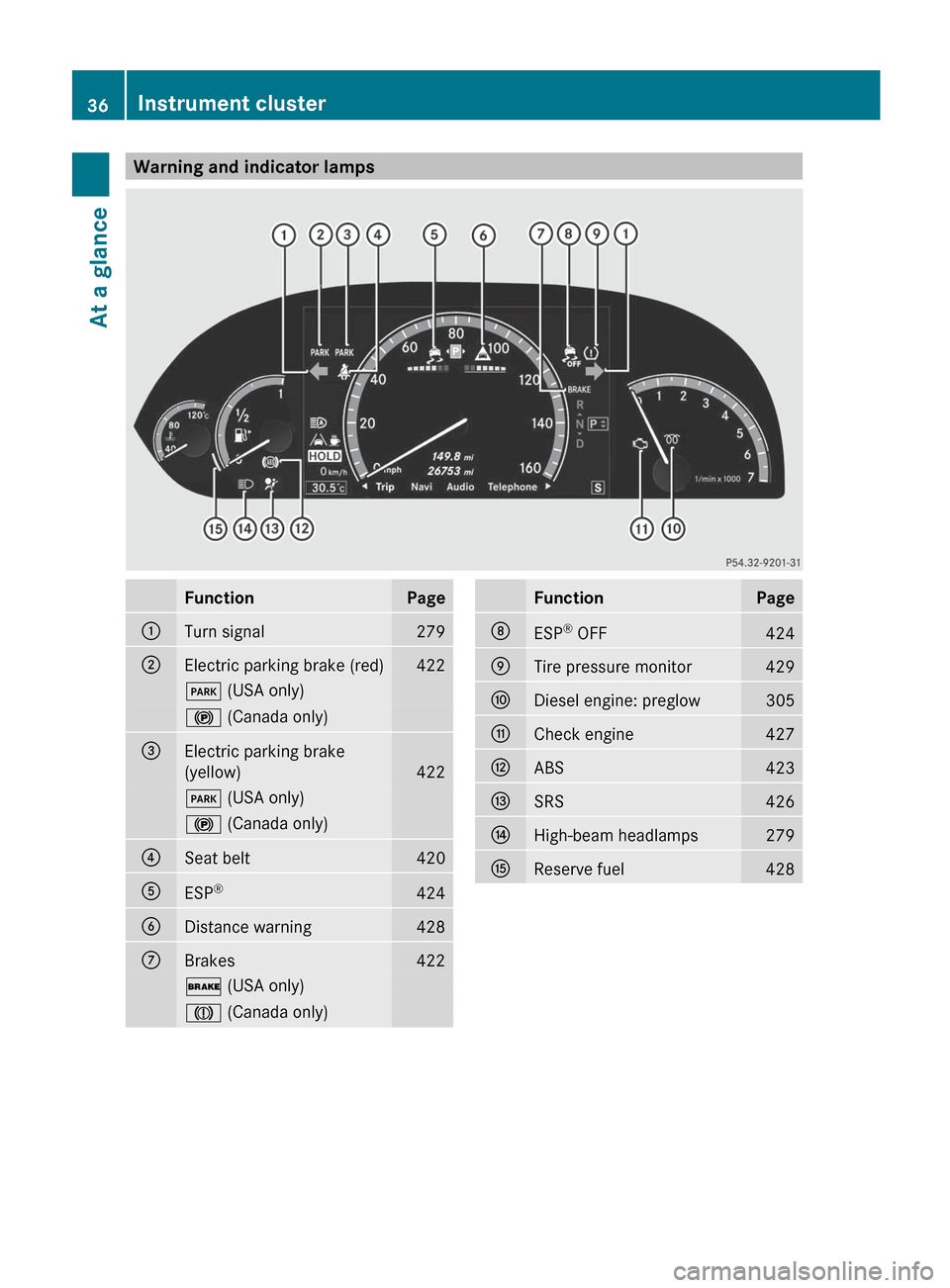
Warning and indicator lampsFunctionPage:Turn signal279;Electric parking brake (red)422F (USA only)! (Canada only)=Electric parking brake
(yellow)
422
F (USA only)! (Canada only)?Seat belt420AESP®424BDistance warning428CBrakes422$
(USA only)J (Canada only)FunctionPageDESP®
OFF424ETire pressure monitor429FDiesel engine: preglow305GCheck engine427HABS423ISRS426JHigh-beam headlamps279KReserve fuel42836Instrument clusterAt a glance
Page 55 of 536

System self-test
The 42 indicator lamp
illuminates when you:
R turn the SmartKey to position 1 or 2 in the
ignition lock
R press the KEYLESS-GO Start/Stop button
once or twice
If an adult occupant is properly sitting on the
passenger seat and the OCS classifies the
occupant as an adult, the 42
indicator lamp illuminates and goes out again
after approximately 6 seconds.
If the seat is not occupied and the OCS
classifies the front passenger seat as being
unoccupied, the 42 indicator
lamp will illuminate and not go out.
GWARNING
If the 4 2 indicator lamp does
not illuminate, the system is not functioning.
You must contact an authorized Mercedes-
Benz Center before seating any child on the
front passenger seat.
For more information, see "Problems with the
Occupant Classification System"
( Y page 54).
GWARNING
Never place anything between seat cushion
and child seat (e.g. a pillow), since it reduces
the effectiveness of the OCS. The underside
and rear side child restraint system must be
placed entirely on the seat cushion and the
backrest of the front-passenger seat
backrest.
If necessary, adjust the tilt of the passenger
seat backrest.
An incorrectly mounted child seat could cause
injuries to the child in case of an accident,
instead of increasing protection for the child.
Follow the manufacturer's instructions for
installation of child restraint systems.
Occupant safety53SafetyZ
Page 71 of 536

RADAPTIVE BRAKE
R PRE-SAFE ®
Brake
Important safety notes
GWARNING
The following factors increase the risk of
accidents:
R Excessive speed, especially in turns
R Wet and slippery road surfaces
R Following another vehicle too closely
The driving safety systems described in this
section cannot reduce these risks or prevent
the natural laws of physics from acting on the
vehicle. They cannot increase braking or
steering efficiency beyond that afforded by
the condition of the vehicle brakes and tires
or the traction afforded.
Only a safe, attentive, and skillful driver can
prevent accidents.
The capabilities of a vehicle equipped with the
driving safety systems described in this
section must never be exploited in a reckless
or dangerous manner which could jeopardize
the user's safety or the safety of others.
Always adjust your driving style to the
prevailing road and weather conditions and
keep a safe distance to other road users and
objects on the street.
If a driving system malfunctions, other driving
safety systems may also switch off. Observe
indicator and warning lamps that may come
on as well as messages in the multifunction
display that may appear.
GWARNING
HYBRID vehicles: It is imperative that you read
the HYBRID Supplemental Operating
Instructions included in your vehicle literature
portfolio. You may otherwise not receive all
necessary safety information and warning for
the operation of your vehicle.
i Please note that the driving safety
systems described only work as effectively
as possible when there is adequate contact
between the tires and the road surface. Pay
particular attention to the information
regarding tires, recommended minimum
tire tread depths etc. in the "Wheels and
tires" section ( Y page 490).
In wintry driving conditions, always use
winter tires (M+S tires) and if necessary,
snow chains. Only in this way will the
driving safety systems described in this
section work as effectively as possible.
ABS (Anti-lock Braking System)
Important safety notes
i Observe the "Important safety notes"
section ( Y page 69).
ABS regulates brake pressure in such a way
that the wheels do not lock when you brake.
This allows you to continue steering the
vehicle when braking.
ABS works from a speed of about
5 mph(8 km/h) upwards, regardless of road-
surface conditions. ABS works on slippery
surfaces, even when you only brake gently.
GWARNING
If the ABS malfunctions, other driving systems
such as the BAS or the ESP ®
are also switched
off. Observe indicator and warning lamps that
may come on as well as messages in the
multifunction display that may appear.
If the ABS malfunctions, the wheels may lock
during hard braking, reducing the steering
capability and extending the braking distance.
The ! warning lamp in the instrument
cluster lights up when the ignition is switched
on. It goes out when the engine is running.
Braking
If ABS intervenes when braking, you will feel
a pulsing in the brake pedal.
Driving safety systems69SafetyZ