2012 MERCEDES-BENZ CLS COUPE boot
[x] Cancel search: bootPage 354 of 373
Emergency spare wheel
Important safety notes
G
WARNING
The wheel/tyr edimension sand th etyret ype
of th espar ew heel/emergency spar ewheel
and th ewheel to be replaced may differ. Fit-
tin gas parew heel/emergency spar ewheel
may severel yimpair th edriving characteris-
tics. Ther eisarisk of accident.
To prevent hazardous situations:
R Adap tyour driving style accordingly and
drive carefully.
R Never fit more than one spare wheel/emer-
gency spare wheel if the dimesions are dif-
ferent to those of the wheel being replaced.
R Only use aspare wheel/emergency spare
wheel briefly if the dimesions are different
to those of the wheel being replaced.
R Do not switch off ESP ®
.
R Have the spare wheel/emergency spare
wheel in question replaced at the nearest
qualified specialist workshop. Make sure
that the wheel/tyre dimensions and tyre
type are correct.
When using an emergenc yspare wheel or
spare wheel of adifferent size, you must not
exceed the maximum speed of 80 km/h.
Snow chains must not be fitted to emergency
spare wheels. General notes
You should regularly check the pressure of all
your tyres, including the emergenc yspare
wheel, particularly prior to long trips, and cor-
rect the pressure as necessary (Y page 331).
The applicabl evalue is found on the wheel or
under "Technical data" (Y page 354).
An emergenc yspare wheel may also be fitted
against the direction of rotation .Observe the
time restriction on use as well as the speed
limitation specified on the emergency spare
wheel. Replace the tyres after six years at the latest,
regardless of wear. This also applies to the
emergency spare wheel.
i
When you are drivin gwith the collapsible
emergency spare wheel fitted, the tyre
pressure loss warning system or the tyre
pressure monitor cannot function reliably.
Only restart the tyre pressure loss warning
system/tyre pressure monitor when the
defective wheel has been replaced with a
new wheel.
Vehicles with tyr epressure monitor:
after mounting an emergency spare wheel,
the system may still display the tyre pres-
sure of the removed wheel for afew
minutes. The value displayed for the moun-
ted emergency spare wheel is not the same
as the curren ttyre pressure of the emer-
genc yspare wheel. Removing the "Minispare" emer-
gency spar
ewheel/collapsible emer-
gency spar ewheel
Removing the "Minispare" emergency
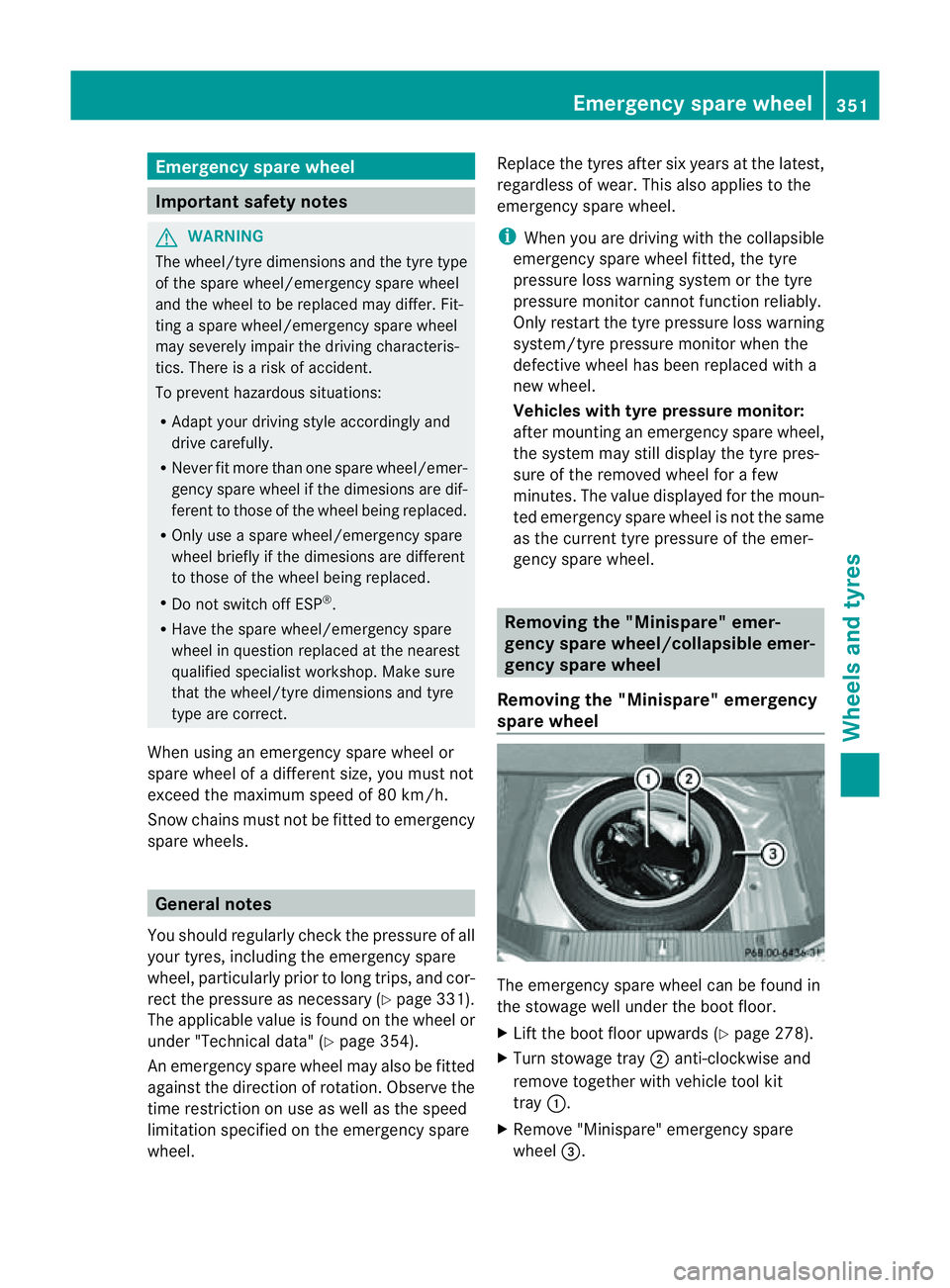
spar ewheel The emergency spare wheel can be found in
the stowage well under the boot floor.
X Lift the boot floor upwards (Y page 278).
X Turn stowage tray ;anti-clockwise and
remov etogether with vehicle tool kit
tray :.
X Remove "Minispare" emergency spare
wheel =. Emergency spare wheel
351Wheels and tyres Z
Page 355 of 373
Removin
gthe collapsibl eemergency
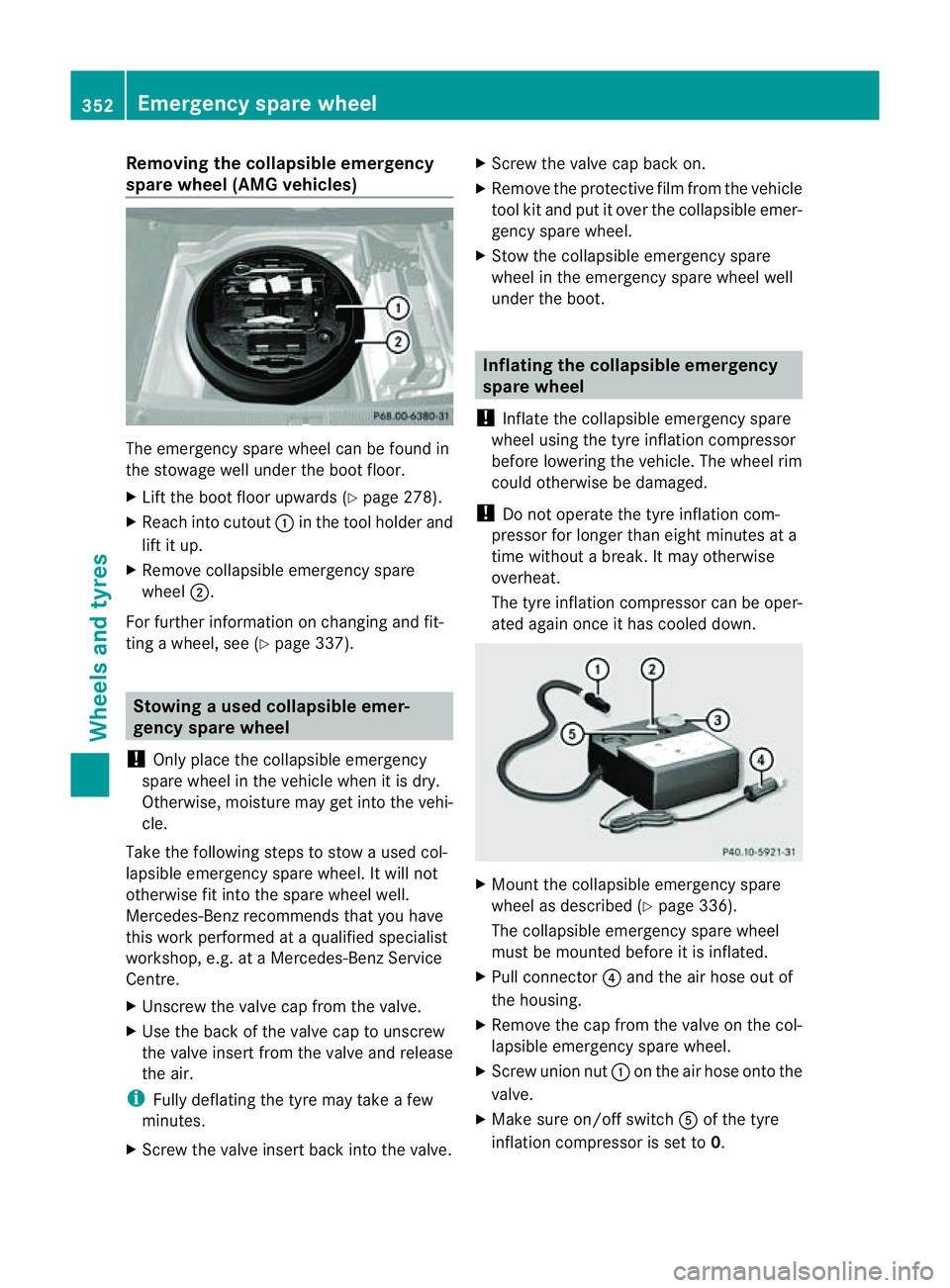
spare wheel (AMG vehicles) The emergency spare wheel can be found in
the stowag ewellu nder the boo tfloor.
X Lift the boot floor upwards ( Ypage 278).
X Reach int ocutout :in the too lholder and
lift it up.
X Remove collapsible emergency spare
wheel ;.
For further information on changing and fit-
tin gaw heel, see (Y page 337). Stowing
aused collapsible emer-
gency spar ewheel
! Only place the collapsible emergency
spare wheel in the vehicle when it is dry.
Otherwise, moisture may get into the vehi-
cle.
Take the following steps to stow aused col-
lapsible emergency spare wheel. It will not
otherwise fit into the spare wheel well.
Mercedes-Benz recommends that you have
this work performed at aqualified specialist
workshop, e.g. at aMercedes-Ben zService
Centre.
X Unscrew the valve cap from the valve.
X Use the back of the valve cap to unscrew
the valve insert from the valve and release
the air.
i Fully deflating the tyre may take afew
minutes.
X Screw the valve insert back intot he valve.X
Screw the valve cap back on.
X Remove the protective film from the vehicle
tool kit and put it over the collapsible emer-
genc yspare wheel.
X Stow the collapsible emergency spare
wheel in the emergency spare wheel well
under the boot. Inflating the collapsible emergency
spar
ewheel
! Inflate the collapsible emergency spare
wheel using the tyre inflation compressor
before lowering the vehicle. The wheel rim
could otherwise be damaged.
! Do not operate the tyre inflation com-
pressor for longer than eight minutes at a
time without abreak. It may otherwise
overheat.
The tyre inflation compressor can be oper-
ated again onceith as cooled down. X
Mount the collapsible emergency spare
wheel as described (Y page 336).
The collapsible emergency spare wheel
must be mounted before it is inflated.
X Pull connector ?and the air hose out of
the housing.
X Remove the cap from the valve on the col-
lapsible emergency spare wheel.
X Screw union nut :on the air hose ontot he
valve.
X Make sure on/off switch Aof the tyre
inflation compressor is set to 0.352
Emergency spar
ewheelWheels and tyres
Page 360 of 373
This is the case:
R
if they cause achange of the vehicle type
from that for which the vehicle's general
operating permit was granted
R if other road users could be endangered
R if the emission or noise levels are adversely
affected.
Always specify the vehicle identification num-
ber (VIN) (Y page 359) and the engine num-
ber (Y page 359) when ordering genuine
Mercedes-Benz parts. Vehicle electronics
Tampering with the engine electron-
ics
G
WARNING
Always have work on the engine electronics
and related components carried out at aquali-
fied specialist workshop. Otherwise, the vehi-
cle's operating safety could be affected.
! Only have work carried out on the engine
electronics and its associated parts, such
as control units, sensors and connector
leads, at aqualified specialist workshop.
Vehicle componentsm ay otherwise wear
more quickly and the vehicle's operating
permit may be invalidated. Retrofitting two-way radios and
mobile phones (RF transmitters)
G
WARNING
Incorrect retrofittin gofRFtransmitters can
cause the vehicle electronics to malfunction.
The vehicle's operating safety and thus your
own safety are impaired.
Have aftermarket radio frequency transmit-
ting equipment installed at aqualified spe-
cialist workshop. G
WARNING
Incorrect retrofittin gofRFtransmitters can
lead to increased electromagnetic radiation in
the vehicle interior. Using an exterior aerial
takes into account curren tscientific discus-
sions relating to the possible health hazards
that may result from electromagnetic fields.
Have aftermarket radio frequency transmit-
ting equipment installed at aqualified spe-
cialist workshop.
! The operating permit may be invalidated
if the instructions for installation and use of
RF transmitters are not observed.
In particular, the following conditions must
be complied with:
R only approved wavebands may be used.
R the maximum permissible output in
these wavebands must be complied with.
R the approved aerial positions must be
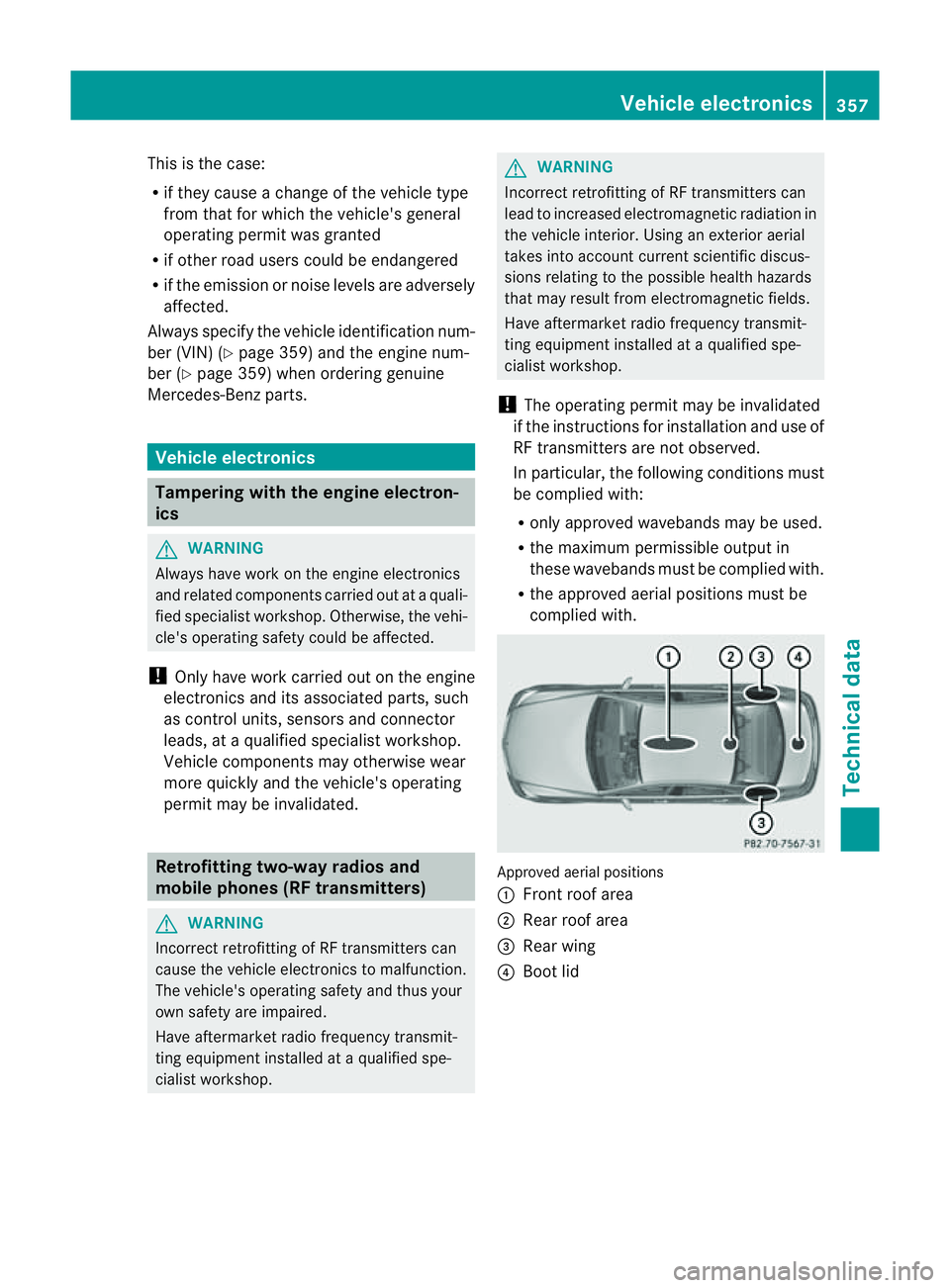
complied with. Approved aerial positions
:
Frontr oof area
; Rear roof area
= Rear wing
? Boot lid Vehicle electronics
357Technical data Z
Page 361 of 373
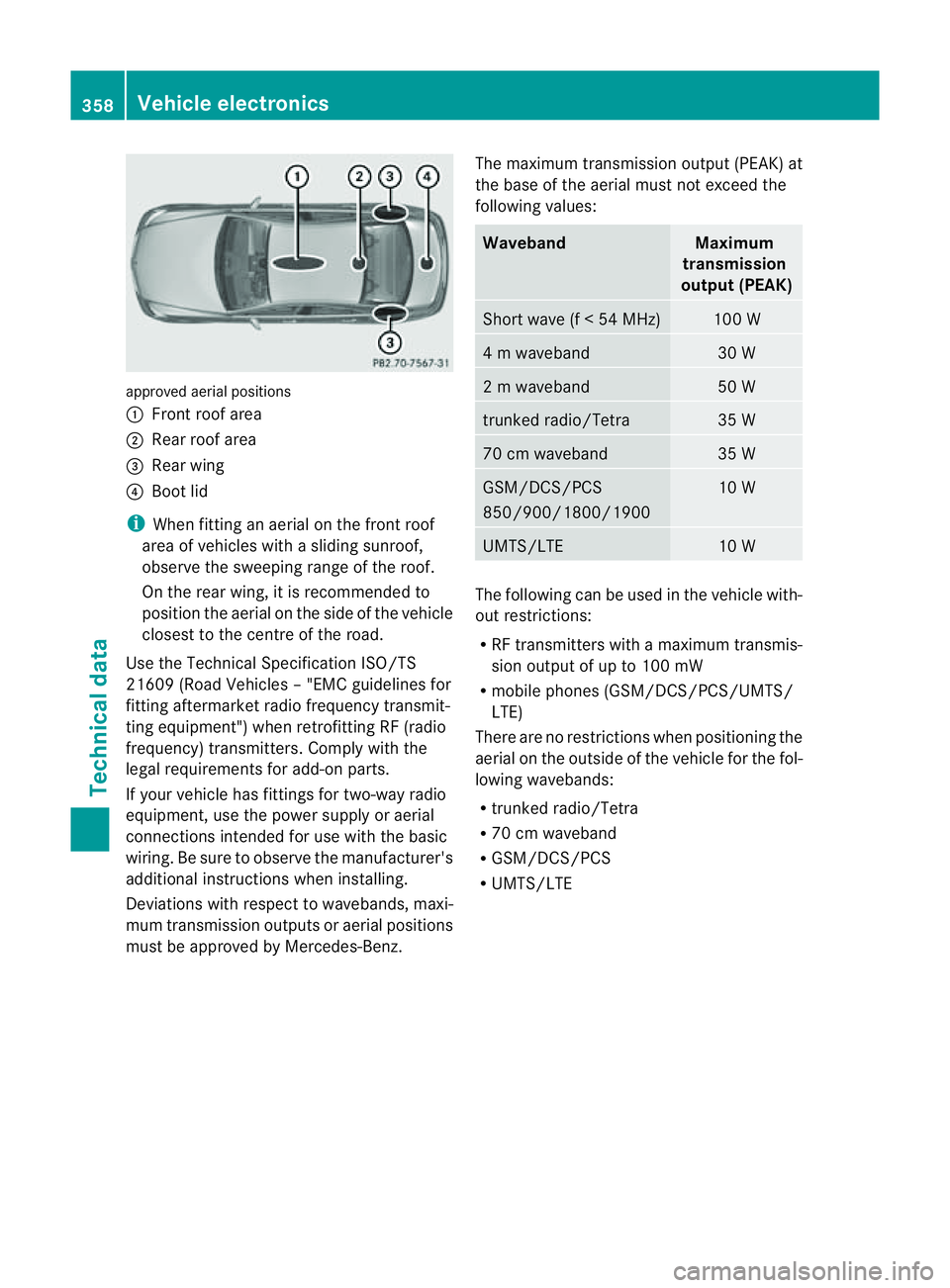
approved aerial positions
:
Fron troo fa rea
; Rear roo farea
= Rearw ing
? Boot lid
i When fittin ganaerial on the front roof
area of vehicles with aslidin gsunroof,
observe the sweepin grang eoft he roof.
On the rear wing, it is recommende dto
position the aerial on the side of the vehicle
closest to the centr eofthe road.
Use the Technical Specification ISO/TS
21609 (Road Vehicles –"EMC guideline sfor
fitting aftermarket radi ofrequency transmit-
ting equipment") when retrofitting RF (radio
frequency )transmitters .Comply with the
legal requirements for add-on parts.
If your vehicle has fittings for two-way radio
equipment, use the power supply or aerial
connection sintended for use with the basic
wiring. Be sure to observe the manufacturer's
additional instructions when installing.
Deviation swith respect to wavebands, maxi-
mum transmission outputs or aerial positions
must be approved by Mercedes-Benz. The maximum transmission output (PEAK)at
the base of the aerial must not exceed the
following values: Waveband Maximum
transmission
output( PEAK) Short wave (f
<54MHz) 100 W
4mw
aveband 30 W
2mw
aveband 50 W
trunked radio/Tetra 35 W
70 cm waveband 35 W
GSM/DCS/PCS
850/900/1800/1900 10 W
UMTS/LTE 10 W
The following can be used in the vehicle with-
out restrictions:
R
RF transmitters with amaximum transmis-
sion output of up to 10 0mW
R mobile phones (GSM/DCS/PCS/UMTS/
LTE)
Ther eare no restriction swhen positioning the
aerial on the outside of the vehicle for the fol-
lowing wavebands:
R trunked radio/Tetra
R 70 cm waveband
R GSM/DCS/PCS
R UMTS/LTE 358
Vehicle electronicsTechnical data
Page 370 of 373
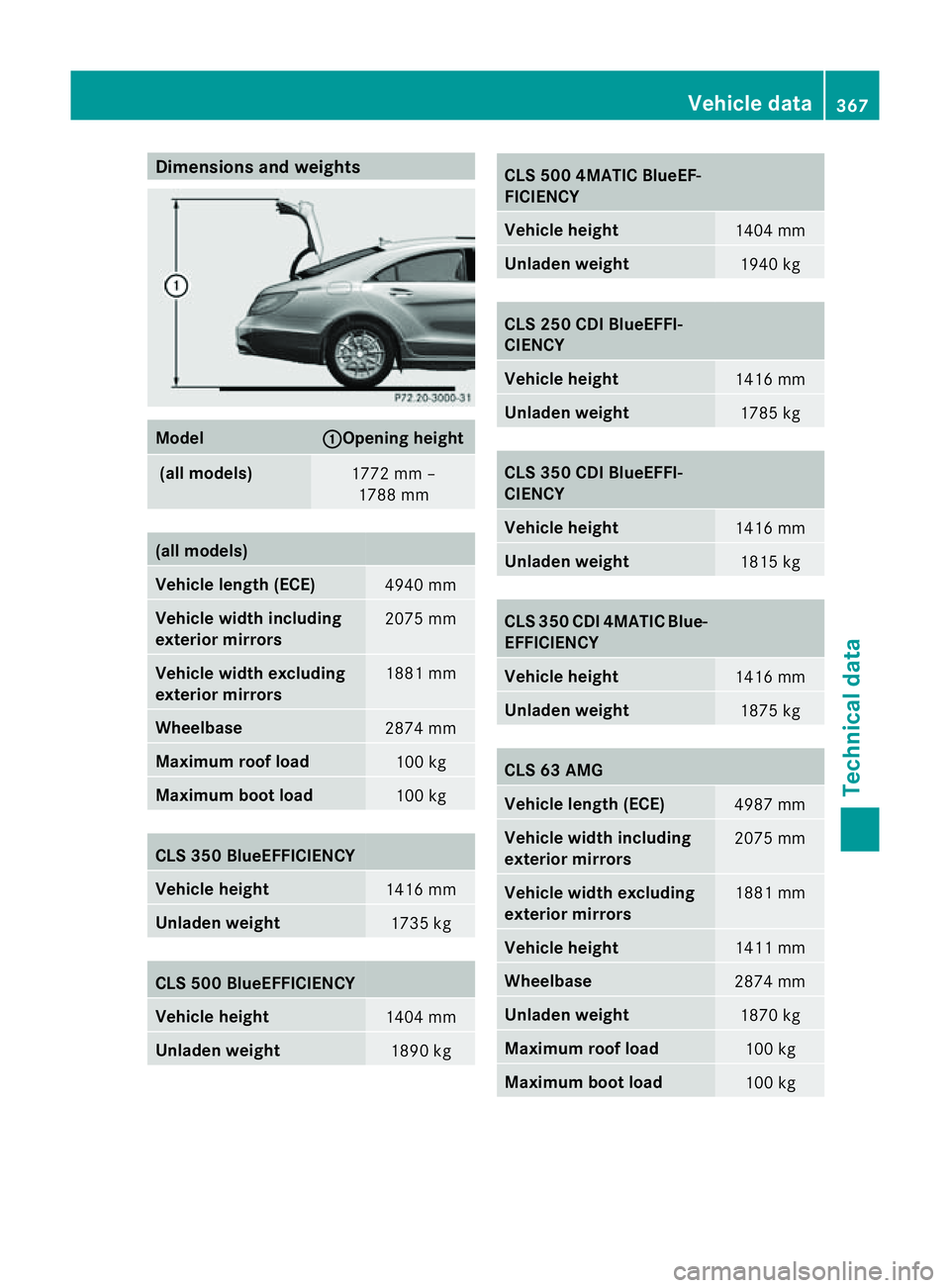
Dimensions an
dweights Model : Opening height
(all models)
1772 mm –
1788 mm (all models)
Vehicle lengt
h(ECE) 4940 mm
Vehicle widt
hincluding
exterior mirrors 2075 mm
Vehicle width excluding
exterior mirrors
1881 mm
Wheelbase
2874 mm
Maximum roof load
100 kg
Maximum boot load
100 kg
CLS 350 BlueEFFICIENCY
Vehicle height
1416 mm
Unladen weight
1735 kg
CLS 500 BlueEFFICIENCY
Vehicle height
1404 mm
Unladen weight
1890 kg CLS 500 4MATIC BlueEF-
FICIENCY
Vehicle height
1404 mm
Unladen weight
1940 kg
CLS 250 CDI BlueEFFI-
CIENCY
Vehicle height
1416 mm
Unladen weight
1785 kg
CLS 350 CDI BlueEFFI-
CIENCY
Vehicle height
1416 mm
Unladen weight
1815 kg
CLS 350 CDI 4MATIC Blue-
EFFICIENCY
Vehicle height
1416 mm
Unladen weight
1875 kg
CLS 63 AMG
Vehicle length (ECE)
4987 mm
Vehicle width including
exterior mirrors
2075 mm
Vehicle width excluding
exterior mirrors
1881 mm
Vehicle height
1411 mm
Wheelbase
2874 mm
Unladen weight
1870 kg
Maximum roof load
100 kg
Maximum boot load
100 kgVehicle data
367Technical data Z