Page 759 of 914

739
7 7-1. Essential information
When trouble arises
GS350/250_EE (OM30C36E)
If your vehicle has to be stopped in an emergency
Steadily step on the brake pedal with both feet and firmly depress
it.
Do not pump the brake pedal repeatedly as this will increase the effort
required to slow the vehicle.
Shift the shift lever to N.
If the shift lever is shifted to N
After slowing down, stop the vehicle in a safe place by the road.
Stop the engine.
If the shift lever cannot be shifted to N
Keep depressing the brake pedal with both feet to reduce vehicle
speed as much as possible.
To stop the engine, press and
hold the engine switch for 2
consecutive seconds or more,
or press it briefly 3 times or
more in succession.
Stop the vehicle in a safe place by the road.
Only in an emergency, such as if it becomes impossible to stop the
vehicle in the normal way, stop the vehicle using the following
procedure:
1
2
3
4
3
Press and hold for 2 seconds or
more or press briefly 3 times or
4
5
Page 762 of 914
7417-2. Steps to take in an emergency
7
When trouble arises
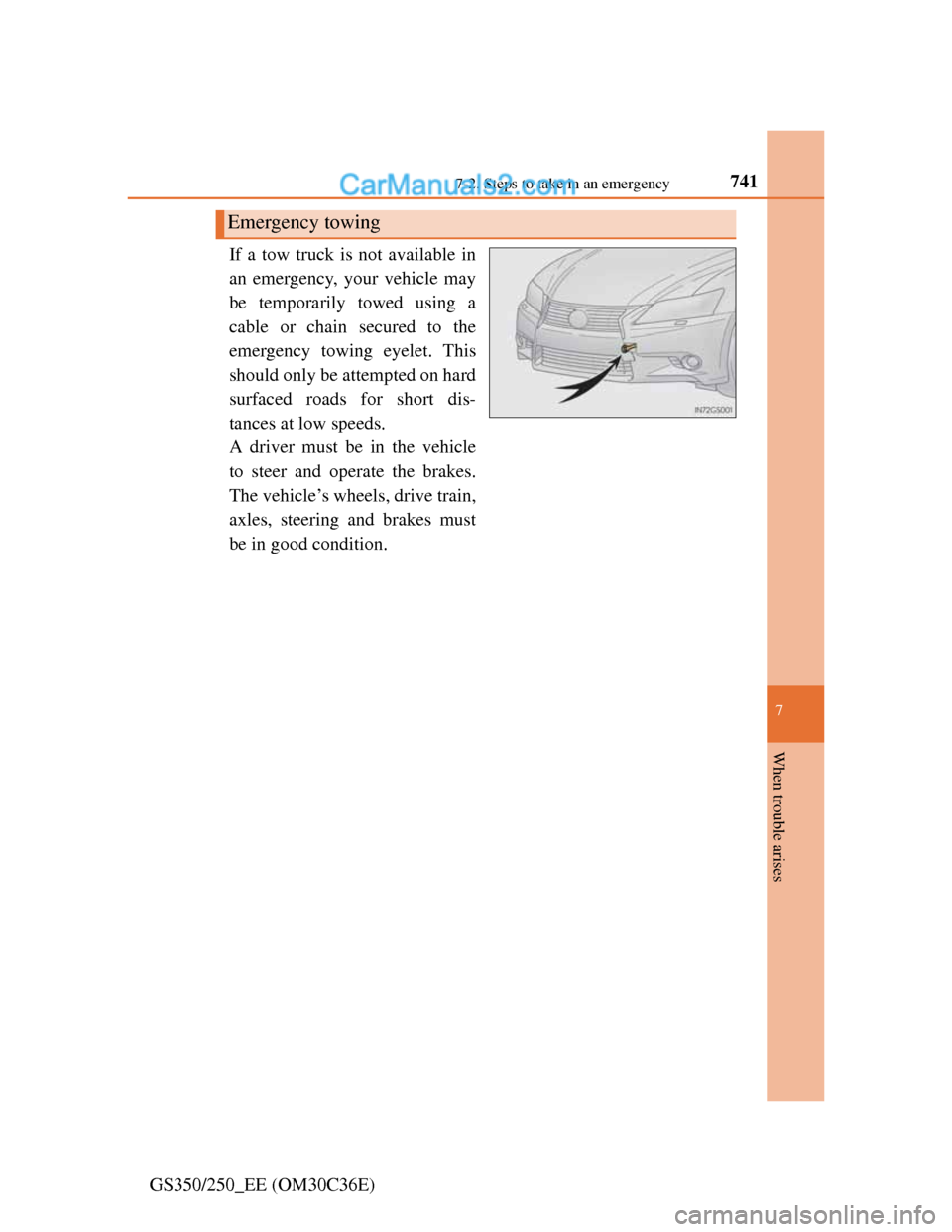
GS350/250_EE (OM30C36E)If a tow truck is not available in
an emergency, your vehicle may
be temporarily towed using a
cable or chain secured to the
emergency towing eyelet. This
should only be attempted on hard
surfaced roads for short dis-
tances at low speeds.
A driver must be in the vehicle
to steer and operate the brakes.
The vehicle’s wheels, drive train,
axles, steering and brakes must
be in good condition.
Emergency towing
Page 763 of 914
7427-2. Steps to take in an emergency
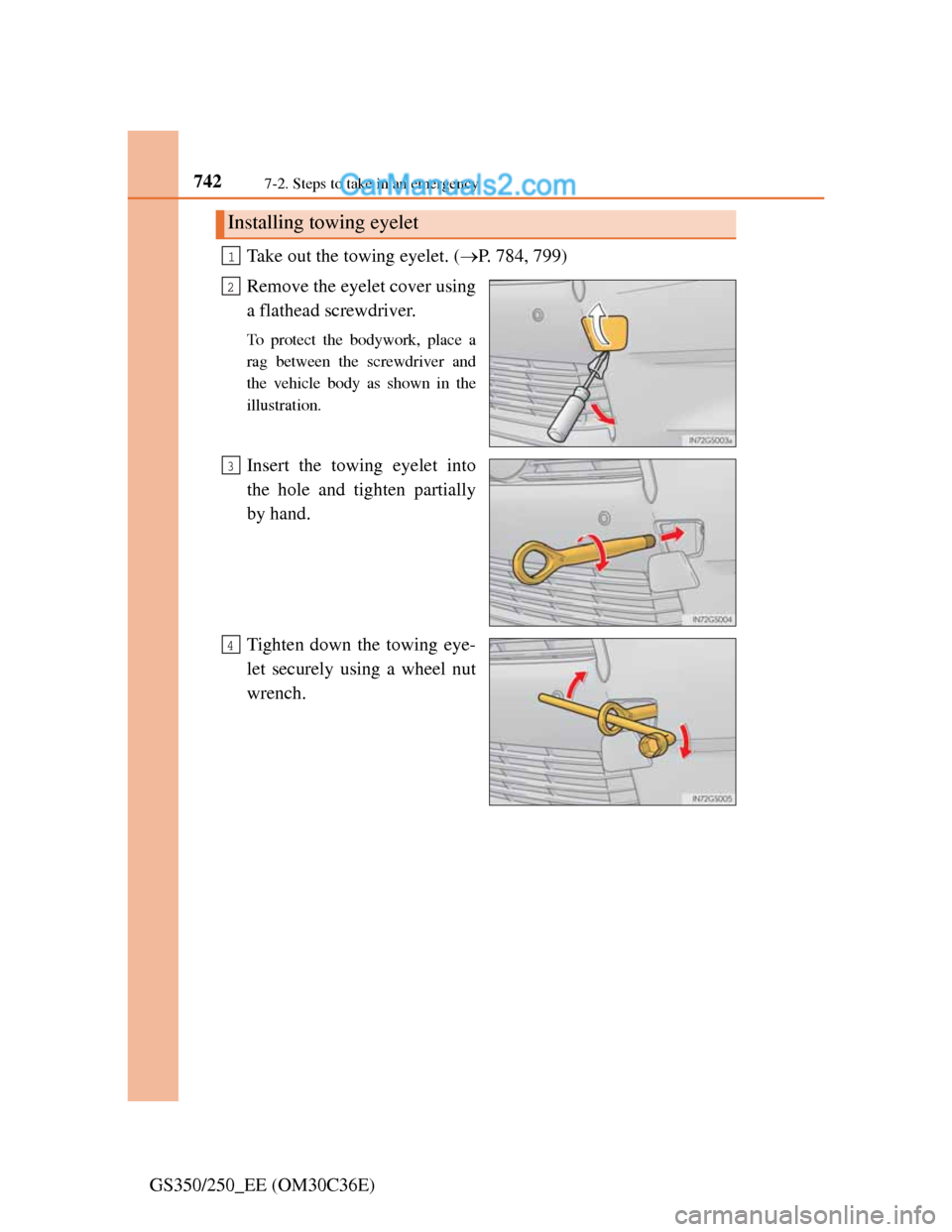
GS350/250_EE (OM30C36E)Take out the towing eyelet. (P. 784, 799)
Remove the eyelet cover using
a flathead screwdriver.
To protect the bodywork, place a
rag between the screwdriver and
the vehicle body as shown in the
illustration.
Insert the towing eyelet into
the hole and tighten partially
by hand.
Tighten down the towing eye-
let securely using a wheel nut
wrench.
Installing towing eyelet
1
2
3
4
Page 766 of 914
7457-2. Steps to take in an emergency
7
When trouble arises
GS350/250_EE (OM30C36E)
Before emergency towing
Release the parking brake.
Shift the shift lever to N.
Turn the engine switch to ACCESSORY (engine off) or IGNITION ON
(engine running) mode.
CAUTION
Observe the following precautions.
Failure to do so may result in death or serious injury.
Caution while towing
Use extreme caution when towing the vehicle.
Avoid sudden starts or erratic driving maneuvers which place excessive
stress on the emergency towing eyelets and the cables or chains. Always
be cautious of the surroundings and other vehicles while towing.
If the engine is not running, the power assist for the brakes and steering
will not function, making steering and braking more difficult.
Installing towing eyelets to the vehicle
Make sure that towing eyelets are installed securely.
If not securely installed, towing eyelets may come loose during towing.
1
2
3
Page 800 of 914
7797-2. Steps to take in an emergency
7
When trouble arises
GS350/250_EE (OM30C36E)
Inte-
rior
buzzerExterior
buzzerWarning messageDetailsCorrection
procedure
Once
• When the doors
were unlocked
with the
mechanical key
and then the
engine switch
was pressed, the
electronic key
could not be
detected in the
vehicle.
• The electronic
key could not
be detected in
the vehicle even
after the engine
switch was
pressed two
consecutive
times.
To u c h t h e
electronic
key to the
engine
switch
while
depressing
the brake
pedal.
Once
An attempt was
made to start the
engine with the
shift lever in an
incorrect position.Shift the
shift lever
to P and
start the
engine.
(Flashes)
(Flashes)
Page 809 of 914
7887-2. Steps to take in an emergency
GS350/250_EE (OM30C36E)
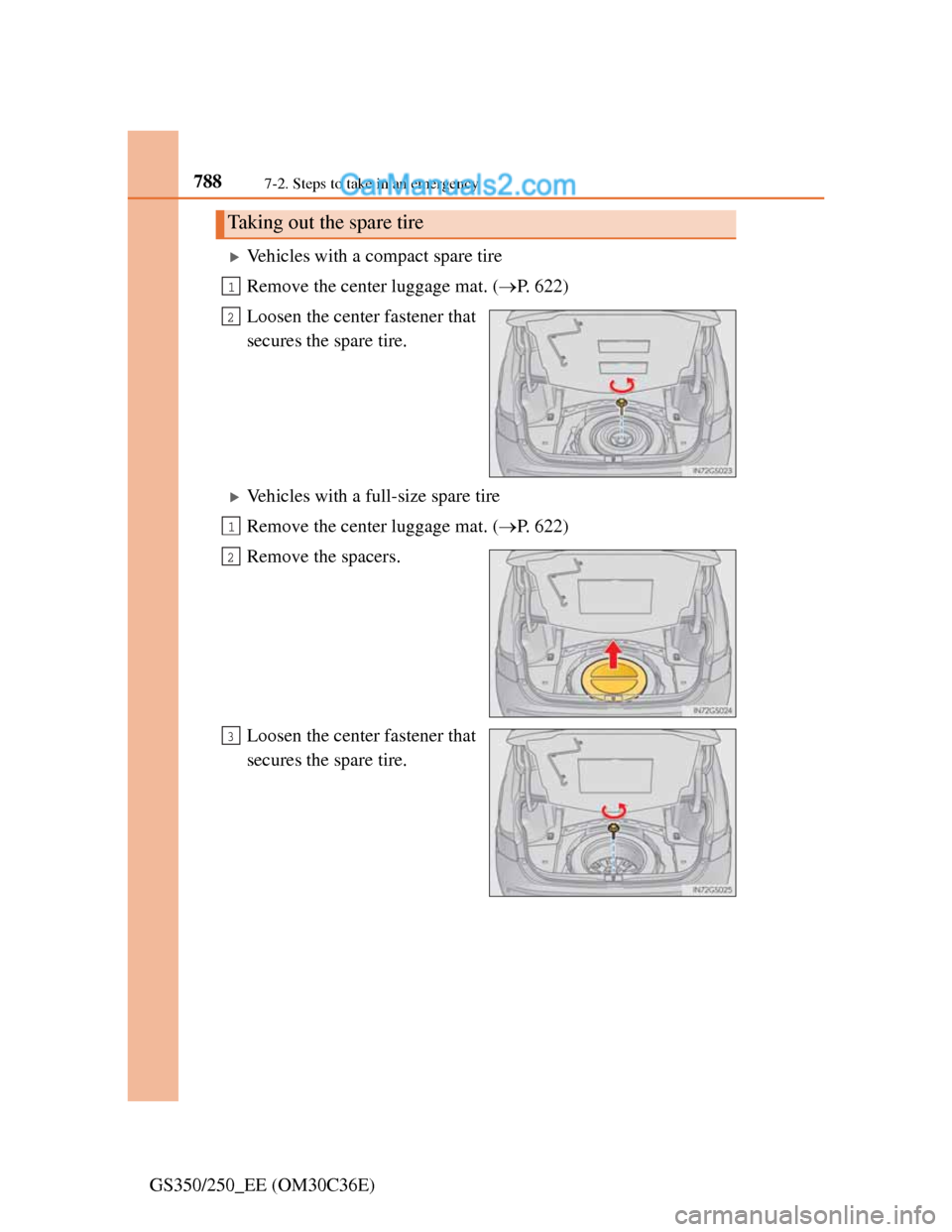
Vehicles with a compact spare tire
Remove the center luggage mat. (P. 622)
Loosen the center fastener that
secures the spare tire.
Vehicles with a full-size spare tire
Remove the center luggage mat. (P. 622)
Remove the spacers.
Loosen the center fastener that
secures the spare tire.
Taking out the spare tire
1
2
1
2
3
Page 818 of 914
797
7 7-2. Steps to take in an emergency
When trouble arises
GS350/250_EE (OM30C36E)
CAUTION
Speed limit when using the compact spare tire
Do not drive at speeds in excess of 80 km/h (50 mph) when a compact
spare tire is installed on the vehicle.
The compact spare tire is not designed for driving at high speeds. Failure to
observe this precaution may lead to an accident causing death or serious
injury.
After using the tools and jack
Before driving, make sure all the tools and jack are securely in place in
their storage location to reduce the possibility of personal injury during a
collision or sudden braking.
NOTICE
Driving with tire chains and the compact spare tire
Do not fit tire chains to the compact spare tire.
Tire chains may damage the vehicle body and adversely affect driving per-
formance.
When replacing the tires
When removing or fitting the wheels, tires or the tire pressure warning
valve and transmitter, contact any authorized Lexus dealer or repairer, or
another duly qualified and equipped professional as the tire pressure warn-
ing valve and transmitter may be damaged if not handled correctly.
Page 835 of 914

8147-2. Steps to take in an emergency
GS350/250_EE (OM30C36E)
CAUTION
When fixing the flat tire
Stop your vehicle in a safe and flat area.
Connect the valve and hose securely with the tire installed on the vehicle.
If the hose is not properly connected to the valve, air leakage may occur or
sealant may be sprayed out.
If the hose comes off the valve while inflating the tire, there is a risk that
the hose will move abruptly due to air pressure.
After inflation of the tire has completed, the sealant may splatter when the
hose is disconnected or some air is let out of the tire.
Keep back from the tire while it is being repaired, as there is a chance of it
bursting while the repair operation is being performed. If you notice any
cracks or deformation of the tire, turn off the compressor switch and stop
the repair operation immediately.
The kit may overheat if operated for a long period of time. Do not operate
the compressor continuously for more than 10 minutes.
Parts of the kit become hot during operation. Be careful handling the kit
during and after operation.
Do not attach the vehicle speed warning sticker to an area other than the
one indicated. If the sticker is attached to an area where an SRS airbag is
located, such as the pad of the steering wheel, it may prevent the SRS air
bag from operating properly.
Driving to spread the liquid sealant evenly
Drive the vehicle carefully at a low speed. Be especially careful when
turning and cornering.
If the vehicle does not drive straight or you feel a pull through the steering
wheel, stop the vehicle and check the following:
• Tire condition. The tire may have separated from the wheel.
• Tire inflation pressure. If tire inflation pressure is 130 kPa (1.3 kgf/cm
2
or bar, 19 psi) or below, this may indicate severe tire damage.