2012 KIA Sportage air condition
[x] Cancel search: air conditionPage 70 of 387
Safety features of your vehicle
48
3
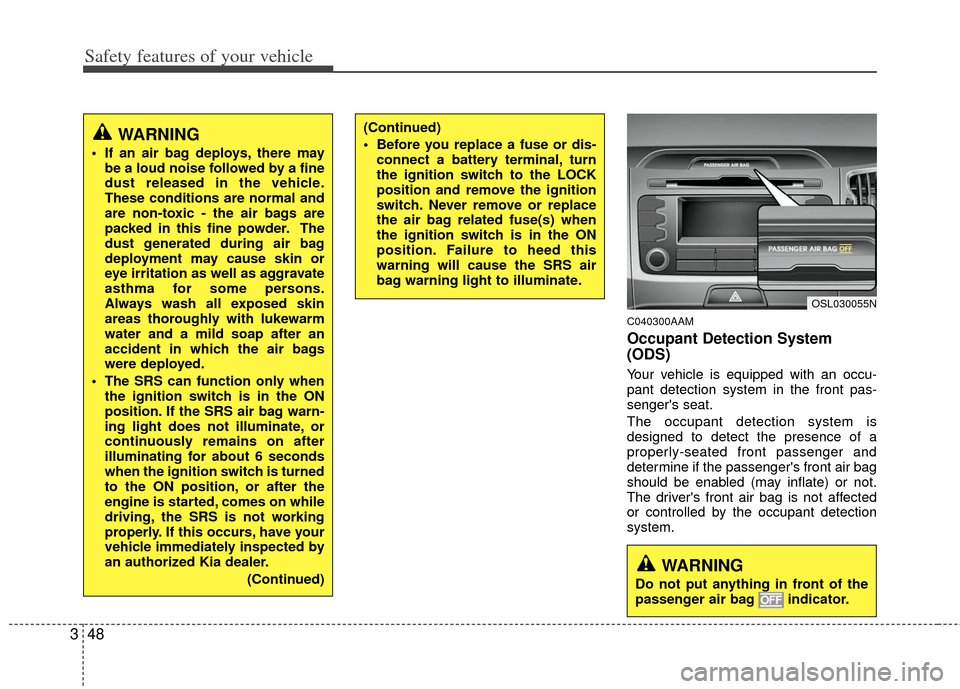
C040300AAM
Occupant Detection System
(ODS)
Your vehicle is equipped with an occu-
pant detection system in the front pas-
senger's seat.
The occupant detection system is
designed to detect the presence of a
properly-seated front passenger and
determine if the passenger's front air bag
should be enabled (may inflate) or not.
The driver's front air bag is not affected
or controlled by the occupant detection
system.
WARNING
If an air bag deploys, there may
be a loud noise followed by a fine
dust released in the vehicle.
These conditions are normal and
are non-toxic - the air bags are
packed in this fine powder. The
dust generated during air bag
deployment may cause skin or
eye irritation as well as aggravate
asthma for some persons.
Always wash all exposed skin
areas thoroughly with lukewarm
water and a mild soap after an
accident in which the air bags
were deployed.
The SRS can function only when the ignition switch is in the ON
position. If the SRS air bag warn-
ing light does not illuminate, or
continuously remains on after
illuminating for about 6 seconds
when the ignition switch is turned
to the ON position, or after the
engine is started, comes on while
driving, the SRS is not working
properly. If this occurs, have your
vehicle immediately inspected by
an authorized Kia dealer.
(Continued)
(Continued)
Before you replace a fuse or dis-connect a battery terminal, turn
the ignition switch to the LOCK
position and remove the ignition
switch. Never remove or replace
the air bag related fuse(s) when
the ignition switch is in the ON
position. Failure to heed this
warning will cause the SRS air
bag warning light to illuminate.
WARNING
Do not put anything in front of the
passenger air bag indicator.
OSL030055N
Page 71 of 387
349
Safety features of your vehicle
Main components of the occupantdetection system
A detection device located within the front passenger seat cushion.
An electronic system which deter- mines whether the passenger air bag
systems should be activated or deacti-
vated.
A indicator light located on the instru- ment panel which illuminates the
words PASSENGER AIR BAG “OFF”
indicating the front passenger air bag
system is deactivated.
The instrument panel air bag warning light is interconnected with the occu-
pant detection system. If the front passenger seat is occupied by
a person that the system determines to
be of appropriate size, and he/she sits
properly (sitting upright with the seatback
in an upright position, centered on the
seat cushion with their seat belt on, legs
comfortably extended and their feet on
the floor), the PASSENGER AIR BAG
“OFF” indicator will turn off and the front
passenger's air bag will be able to inflate,
if necessary, in frontal crashes.
You will find the PASSENGER AIR BAG
“OFF” indicator on the center facia panel.
This system detects the conditions 1~4
in the following table and activates or
deactivates the front passenger air bag
based on these conditions. Always be sure that you and all vehicle
occupants are seated and restrained
properly (sitting upright with the seat in
an upright position, centered on the seat
cushion, with the person’s legs comfort-
ably extended, feet on the floor, and
wearing the safety belt properly) for the
most effective protection by the air bag
and the safety belt.
The ODS (Occupant Detection System)
may not function properly if the passen-
ger takes actions which can defeat the
detection system. These include:
(1) Failing to sit in an upright position.
(2) Leaning against the door or center console.
(3) Sitting towards the sides or the front of the seat.
(4) Putting legs on the dashboard or rest- ing them on other locations which
reduce the passenger weight on the
front seat.
(5) Improperly wearing the safety belt.
(6) Reclining the seat back.
Page 72 of 387
Safety features of your vehicle
50
3
WARNING
Riding in an improper position or
placing weight on the front passen-
ger's seat when it is unoccupied by
a passenger adversely affects the
Occupant Detection System (ODS).
Your ODS is designed to resist
electronic waves, but do not place
an electronic device such as laptop
computer on or near the seat cush-
ion since it may defeat the proper
functioning of the ODS.
(Continued)
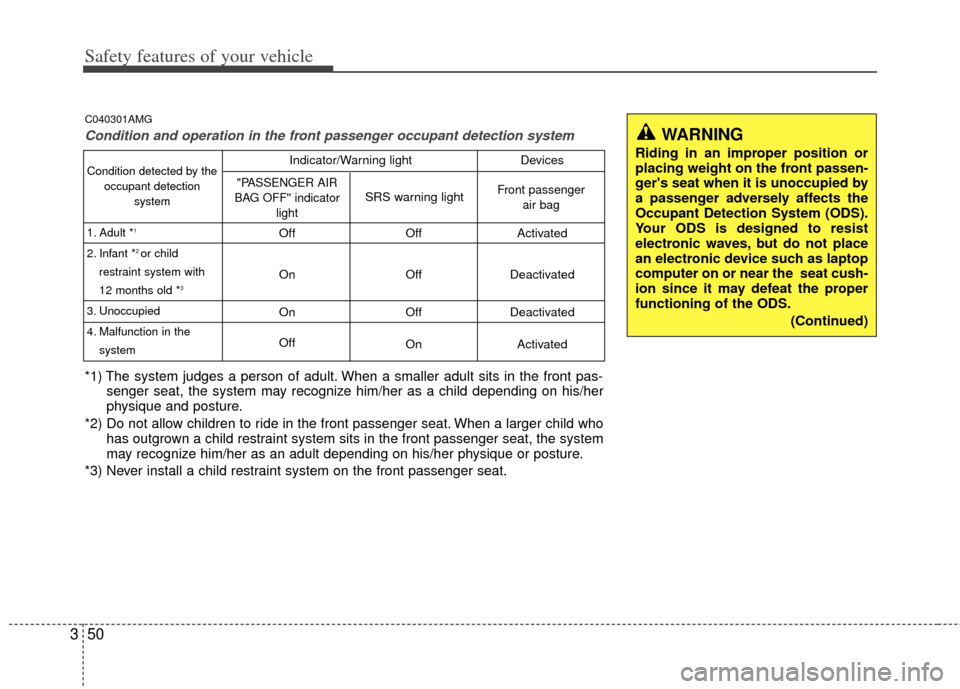
C040301AMG
Condition and operation in the front passenger occupant detection system
*1) The system judges a person of adult. When a smaller adult sits in the front pas-senger seat, the system may recognize him/her as a child depending on his/her
physique and posture.
*2) Do not allow children to ride in the front passenger seat. When a larger child who has outgrown a child restraint system sits in the front passenger seat, the system
may recognize him/her as an adult depending on his/her physique or posture.
*3) Never install a child restraint system on the front passenger seat.
Condition detected by the
occupant detection system
1. Adult *
1
2. Infant *2 or child
restraint system with
12 months old *
3
3. Unoccupied
4. Malfunction in the system
Off
On
On
Off Off
Off
Off
On Activated
Deactivated
Deactivated Activated
"PASSENGER AIR
BAG OFF" indicator lightSRS warning lightFront passenger air bag
Indicator/Warning light Devices
Page 75 of 387
353
Safety features of your vehicle
WARNING
Even though your vehicle isequipped with the occupant
detection system, never install a
child restraint system in the front
passenger's seat. A deploying air
bag can forcefully strike a child
resulting in serious injuries or
death. Any child age 12 and
under should ride in the rear seat.
Children too large for child
restraints should use the avail-
able lap/shoulder belts. No matter
what type of crash, children of all
ages are safer when restrained in
the rear seat.
If the PASSENGER AIR BAG “OFF” indicator is illuminated
when the front passenger's seat
is occupied by an adult and
he/she sits properly (sitting
upright with the seatback in an
upright position, centered on the
seat cushion with their seat belt
on, legs comfortably extended
and their feet on the floor), have
that person sit in the rear seat.
(Continued)
(Continued)
Accident statistics show that chil-dren are safer if they are
restrained in the rear, as opposed
to the front seat. It is recommend-
ed that child restraints be secured
in a rear seat, including an infant
riding in a rear-facing infant seat,
a child riding in a forward-facing
child seat and an older child rid-
ing in a booster seat.
Air bags can only be used once – have an authorized Kia dealer
replace the air bag immediately
after deployment.
The occupant detection system may not work properly if water,
coffee or any other liquid includ-
ing rain gets on the seat. Keep
the front seat dry at all times.
Do not place an electronic device such as a laptop computer on the
front passenger seat. Its electron-
ic field may cause the ODS to
switch to the "on" condition and
thus allow the passenger airbag
to deploy needlessly in a colli-
sion, increasing your repair
costs.(Continued)
If the front passenger seat isoccupied by a child who is not in
a CRS, the "PASSENGER AIR
BAG OFF" indicator may or may
not be on and the passenger
airbag may or may not deploy in a
collision. Have the child move to
a rear seat to increase their safe-
ty.
Do not modify or replace the driv- er or front passenger seat. Don't
place anything on or attach any-
thing such as a blanket or seat
heater to the driver or front pas-
senger seat. This can adversely
affect the occupant detection
system.
Do not place sharp objects on the front passenger seat. These may
damage the occupant detection
system, if they puncture the seat
cushion.
Do not use accessory seat cov- ers on the front seats.
(Continued)
Page 77 of 387
355
Safety features of your vehicle
The seat belt buckle sensors determine if
the driver and front passenger's seat
belts are fastened.These sensors provide the ability to con-
trol the SRS deployment based on
whether or not the seat belts are fas-
tened, and how severe the impact is.
The advanced SRS offers the ability to
control the air bag inflation with two lev-
els. A first stage level is provided for mod-
erate-severity impacts. A second stage
level is provided for more severe impacts.
The passenger’s front air bag is designed
to help reduce the injury of children sit-
ting close to the instrument panel in low
speed collisions. However, children are
safer if they are restrained in the rear
seat.
According to the impact severity and seat
belt usage, the SRSCM (SRS Control
Module) controls the air bag inflation.
Failure to properly wear seat belts can
increase the risk or severity of injury in
an accident.
Additionally, your vehicle is equipped
with an occupant detection system in the
front passenger's seat. The occupant
detection system detects the presence of
a passenger in the front passenger's seat
and will turn off the front passenger's air
bag under certain conditions. For more
detail, see "Occupant detection system"
in this section.
WARNING
If the occupant detection system is
not working properly, the SRS air
bag warning light on the instru-
ment panel will illuminate because
the SRS air bag warning light is
connected with the occupant
detection system. If the SRS air bag
warning light does not illuminate
when the ignition switch is turned
to the ON position, remains illumi-
nated after approximately 6 sec-
onds when the ignition switch is
turned to the ON position, or if it
illuminates while the vehicle is
being driven, have an authorized
Kia dealer inspect the advanced
SRS air bag system as soon as
possible.
WARNING
Modification to the seat structure
can cause the air bag to deploy at
a different level than should be
provided.
Do not place any objects under- neath the front seats as they
could damage or interfere with
the occupant detection system.
Page 81 of 387
359
Safety features of your vehicle
The purpose of the air bag is to provide
the vehicle's driver and/or the front pas-
senger with additional protection than
that offered by the seat belt alone.
The side impact air bags are designedto deploy during certain side-impact
collisions, depending on the crash
severity, angle, speed and point of
impact.
The side impact air bags do not only deploy on the side of the impact but
also on the opposite side.
Also, both sides of the side impact air bags deploy in certain rollover situa-
tions.
The side impact air bags are not designed to deploy in all side impact or
rollover situations.(Continued)
Do not install any accessories onthe side or near the side impact
air bag.
Do not place any objects over the air bag or between the air bag
and yourself.
Do not place any objects (an umbrella, bag, etc.) between the
front door and the front seat.
Such objects may become dan-
gerous projectiles and cause
injury if the supplemental side air
bag inflates.
To prevent unexpected deploy- ment of the side impact air bag
that may result in personal injury,
avoid impact to the side impact
sensor when the ignition switch
is on.
If seat or seat cover is damaged, have the vehicle checked and
repaired by an authorized Kia
dealer. Inform the dealer that your
vehicle is equipped with side
impact air bags and an occupant
detection system.WARNING
The side impact air bag is sup-plemental to the driver's and the
passenger's seat belt systems
and is not a substitute for them.
Therefore your seat belts must be
worn at all times while the vehicle
is in motion. The air bags deploy
only in certain side impact or
rollover conditions severe
enough to cause significant
injury to the vehicle occupants.
For best protection from the side air bag system and to avoid being
injured by the deploying side air
bag, both front seat occupants
should sit in an upright position
with the seat belt properly fas-
tened. The driver's hands should
be placed on the steering wheel
at the 9:00 and 3:00 positions.
The passenger's arms and hands
should be placed on their laps.
Do not use any accessory seat covers.
Use of seat covers could reduce or prevent the effectiveness of
the system.
(Continued)
WARNING
Do not allow the passengers to lean
their heads or bodies onto doors,
put their arms on the doors, stretch
their arms out of the window, or
place objects between the doors
and passengers when they are
seated on seats equipped with side
and/or curtain air bags.
Page 83 of 387
361
Safety features of your vehicle
C040800AAM
Why didn’t my air bag go off in a
collision? (Inflation and non-infla-
tion conditions of the air bag)
There are many types of accidents in
which the air bag would not be expect-
ed to provide additional protection.
These include rear impacts, second or
third collisions in multiple impact
accidents, as well as low speed
impacts. In other words, just because
your vehicle is damaged and even if it
is totally unusable, don’t be surprised
that the air bags did not inflate.
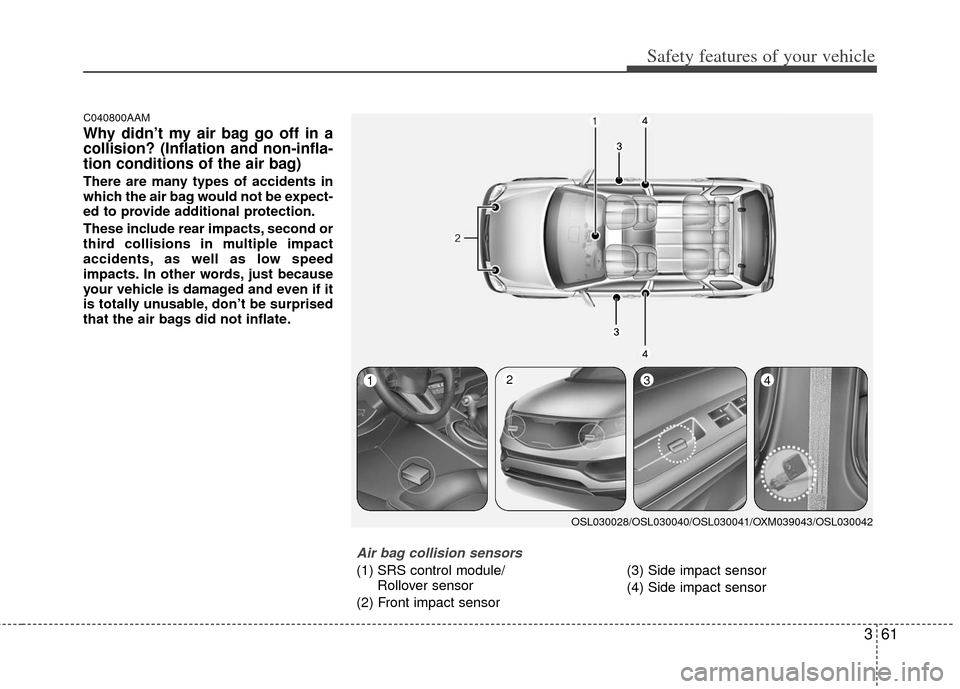
Air bag collision sensors
(1) SRS control module/Rollover sensor
(2) Front impact sensor (3) Side impact sensor
(4) Side impact sensor
OSL030028/OSL030040/OSL030041/OXM039043/OSL030042
1234
Page 84 of 387
Safety features of your vehicle
62
3
C040801AAM
Air bag inflation conditions
Front air bags
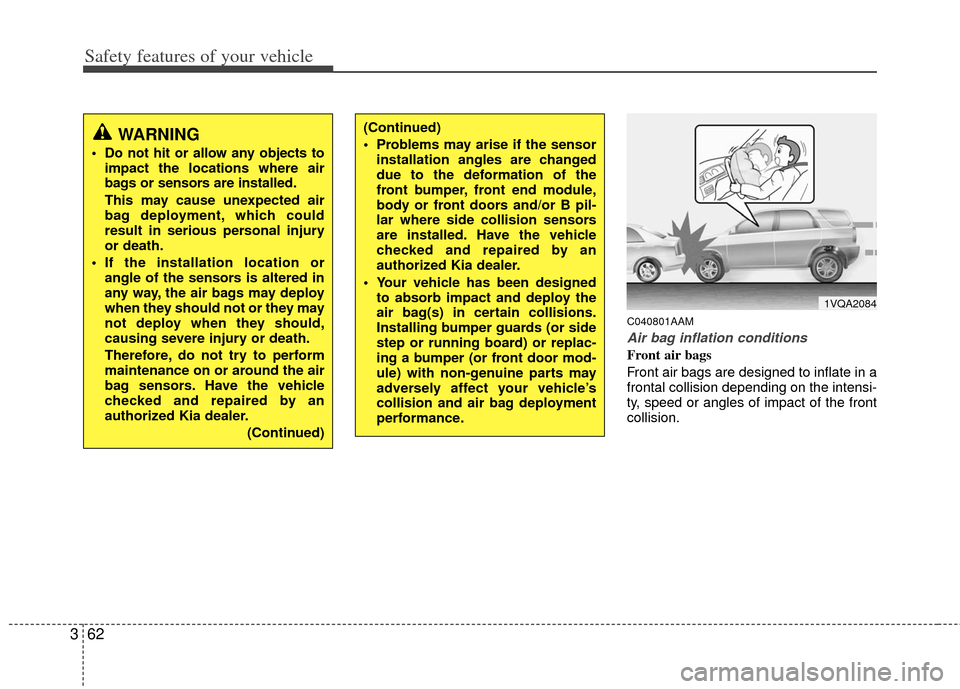
Front air bags are designed to inflate in a
frontal collision depending on the intensi-
ty, speed or angles of impact of the front
collision.
1VQA2084
WARNING
Do not hit or allow any objects to
impact the locations where air
bags or sensors are installed.
This may cause unexpected air
bag deployment, which could
result in serious personal injury
or death.
If the installation location or angle of the sensors is altered in
any way, the air bags may deploy
when they should not or they may
not deploy when they should,
causing severe injury or death.
Therefore, do not try to perform
maintenance on or around the air
bag sensors. Have the vehicle
checked and repaired by an
authorized Kia dealer.
(Continued)
(Continued)
Problems may arise if the sensorinstallation angles are changed
due to the deformation of the
front bumper, front end module,
body or front doors and/or B pil-
lar where side collision sensors
are installed. Have the vehicle
checked and repaired by an
authorized Kia dealer.
Your vehicle has been designed to absorb impact and deploy the
air bag(s) in certain collisions.
Installing bumper guards (or side
step or running board) or replac-
ing a bumper (or front door mod-
ule) with non-genuine parts may
adversely affect your vehicle’s
collision and air bag deployment
performance.