Page 210 of 558
WARNING!
Do not operate this vehicle with a console compart-
ment lid in the open position. Cellular phones, music
players, and other handheld electronic devices
should be stowed while driving. Use of these devices
while driving can cause an accident due to distrac-
tion, resulting in death or injury.
CARGO AREA FEATURES
Cargo Load Floor
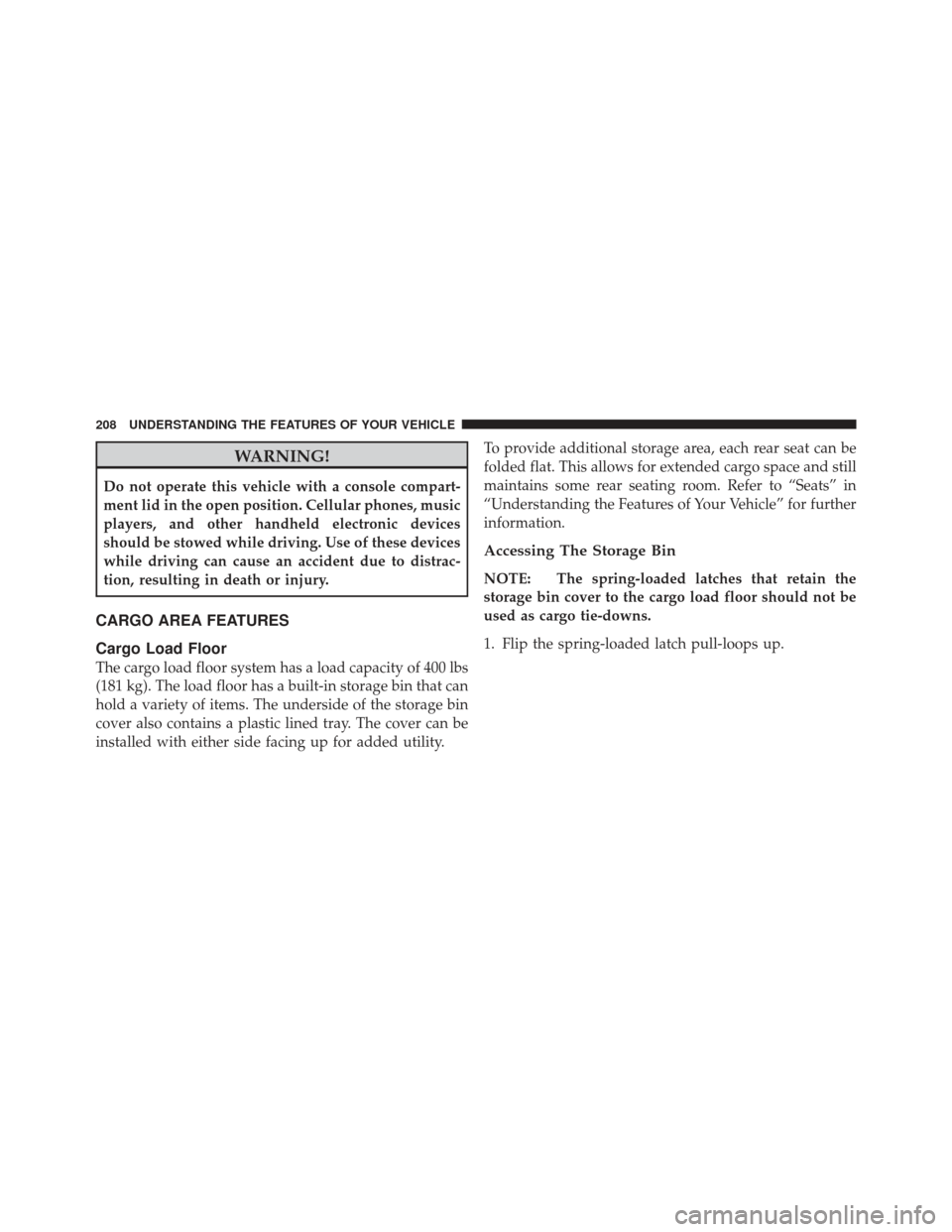
The cargo load floor system has a load capacity of 400 lbs
(181 kg). The load floor has a built-in storage bin that can
hold a variety of items. The underside of the storage bin
cover also contains a plastic lined tray. The cover can be
installed with either side facing up for added utility.To provide additional storage area, each rear seat can be
folded flat. This allows for extended cargo space and still
maintains some rear seating room. Refer to “Seats” in
“Understanding the Features of Your Vehicle” for further
information.
Accessing The Storage Bin
NOTE: The spring-loaded latches that retain the
storage bin cover to the cargo load floor should not be
used as cargo tie-downs.
1. Flip the spring-loaded latch pull-loops up.
208 UNDERSTANDING THE FEATURES OF YOUR VEHICLE
Page 215 of 558
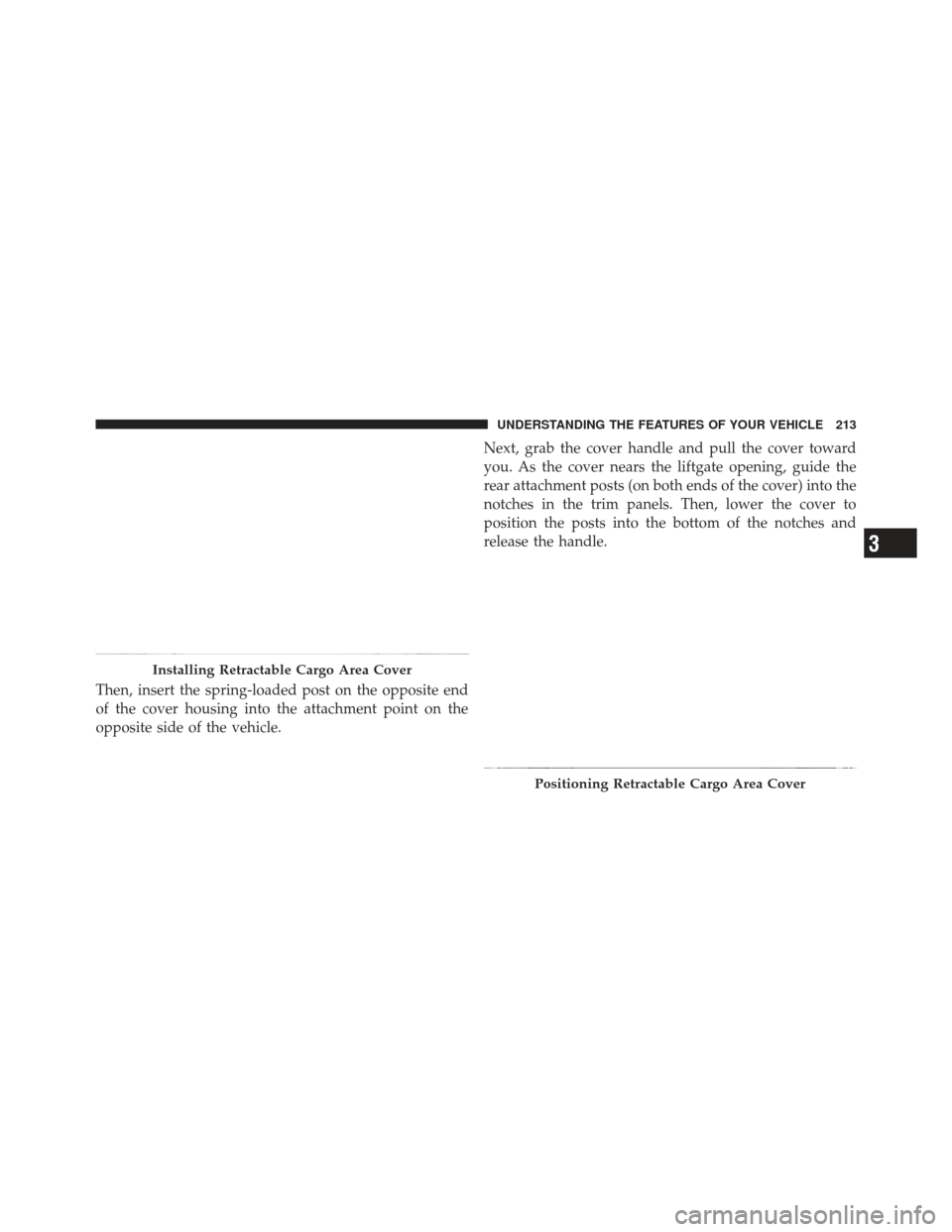
Then, insert the spring-loaded post on the opposite end
of the cover housing into the attachment point on the
opposite side of the vehicle.Next, grab the cover handle and pull the cover toward
you. As the cover nears the liftgate opening, guide the
rear attachment posts (on both ends of the cover) into the
notches in the trim panels. Then, lower the cover to
position the posts into the bottom of the notches and
release the handle.
Installing Retractable Cargo Area Cover
Positioning Retractable Cargo Area Cover
3
UNDERSTANDING THE FEATURES OF YOUR VEHICLE 213
Page 228 of 558

5. Electronic Throttle Control (ETC) LightThis light informs you of a problem with the
Electronic Throttle Control (ETC) system. If a
problem is detected, the light will come on
while the engine is running. Cycle the ignition
key when the vehicle has completely stopped and the
shift lever is placed in the PARK position. The light
should turn off. If the light remains lit with the engine
running, your vehicle will usually be drivable; however,
see an authorized dealer for service as soon as possible. If
the light is flashing when the engine is running, imme-
diate service is required and you may experience reduced
performance, an elevated/rough idle or engine stall and
your vehicle may require towing. The light will come on
when the ignition is first turned to ON/RUN and remain
on briefly as a bulb check. If the light does not come on
during starting, have the system checked by an autho-
rized dealer. 6. Malfunction Indicator Light (MIL)
The Malfunction Indicator Light (MIL) is part of
an onboard diagnostic system, called OBD, that
monitors engine and automatic transmission con-
trol systems. The light will illuminate when the key is in
the ON/RUN position, before engine start. If the bulb
does not come on when turning the key from OFF to
ON/RUN, have the condition checked promptly.
Certain conditions, such as a loose or missing gas cap,
poor fuel quality, etc., may illuminate the MIL after
engine start. The vehicle should be serviced if the light
stays on through several of your typical driving cycles. In
most situations, the vehicle will drive normally and will
not require towing.
226 UNDERSTANDING YOUR INSTRUMENT PANEL
Page 229 of 558
CAUTION!
Prolonged driving with the MIL on could cause
damage to the engine control system. It also could
affect fuel economy and drivability. If the MIL is
flashing, severe catalytic converter damage and
power loss will soon occur. Immediate service is
required.
WARNING!
A malfunctioning catalytic converter, as referenced
above, can reach higher temperatures than in normal
operating conditions. This can cause a fire if you
drive slowly or park over flammable substances such
as dry plants, wood, cardboard, etc. This could result
in death or serious injury to the driver, occupants or
others.7. High Beam Indicator
This indicator shows that the high beam head-
lights are on. Pull the multifunction control lever
on the left side of the steering column toward you to
switch to low beam.
8. Front Fog Light Indicator — If Equipped This indicator will illuminate when the front fog
lights are on.
9. Speedometer
Shows the vehicle speed in Miles Per Hour (MPH) or
kilometers per hour (km/h).
10. Turn Signal Indicators The arrow will flash with the exterior turn signal
when the turn signal lever is operated.
4
UNDERSTANDING YOUR INSTRUMENT PANEL 227
Page 232 of 558
green area, you are driving the vehicle in a fuel efficient
manner. Before the pointer reaches the red area, ease up
on the accelerator to prevent engine damage.
16. 4WD LOW Indicator — If EquippedThis light alerts the driver that the vehicle is in
the 4WD LOW mode. In this mode, the front
driveshaft and rear driveshaft are mechanically
locked together forcing the front and rear
wheels to rotate at the same speed.
17. Hill Descent Control Indicator — If Equipped The symbol indicates the status of the Hill
Descent Control (HDC) feature. The lamp will
be on solid when HDC is armed. HDC can only
be armed when the transfer case is in the “4WD
LOW” position and the vehicle speed is less then 30 mph
(48 km/h). If these conditions are not met while attempt-
ing to use the HDC feature, the HDC indicator light will
flash on/off. 18. TOW/HAUL Indicator — If Equipped
This light will illuminate when selecting
TOW/HAUL. The TOW/HAUL button is lo-
cated on the gearshift bezel.
19. 4WD Indicator — Vehicles Equipped with
Command-Trac� This light alerts the driver that the vehicle is in
the four-wheel drive mode. In this mode, the
front driveshaft and rear driveshaft are me-
chanically locked together forcing the front and
rear wheels to rotate at the same speed.
20. Electronic Stability Control (ESC) OFF Indicator
Light — If Equipped This light indicates the Electronic Stability Con-
trol (ESC) is off.
230 UNDERSTANDING YOUR INSTRUMENT PANEL
Page 233 of 558
21. SERV (Service) 4WD Indicator Light — If EquippedThe “SERV 4WD Indicator Light” will turn on
when the ignition key is turned to the ON/
RUN position and it will stay on for two
seconds. If the light stays on or turns on during
driving, it means that the 4WD system is not functioning
properly and that service is required.
22. Engine Temperature Warning Light This light warns of an overheated engine condi-
tion. As engine coolant temperatures rise and the
gauge approaches H,this indicator will illuminate
and a single chime will sound after reaching a set
threshold. Further overheating will cause the tempera-
ture gauge to pass H,the indicator will continuously
flash and a continuous chime will occur until the engine
is allowed to cool. If the light turns on while driving, safely pull over and
stop the vehicle. If the A/C system is on, turn it off. Also,
shift the transmission into NEUTRAL and idle the ve-
hicle. If the temperature reading does not return to
normal, turn the engine off immediately and call for
service. Refer to “If Your Engine Overheats” in “What To
Do In Emergencies” for further information.
23. Temperature Gauge
The temperature gauge shows engine coolant tempera-
ture. Any reading within the normal range indicates that
the engine cooling system is operating satisfactorily.
The gauge pointer will likely indicate a higher tempera-
ture when driving in hot weather, up mountain grades,
or when towing a trailer. It should not be allowed to
exceed the upper limits of the normal operating range.
4
UNDERSTANDING YOUR INSTRUMENT PANEL 231
Page 234 of 558
CAUTION!
Driving with a hot engine cooling system could
damage your vehicle. If the temperature gauge reads
“H” pull over and stop the vehicle. Idle the vehicle
with the air conditioner turned off until the pointer
drops back into the normal range. If the pointer
remains on the “H” and you hear continuous chimes,
turn the engine off immediately and call an autho-
rized dealership for service.
WARNING!
A hot engine cooling system is dangerous. You or
others could be badly burned by steam or boiling
coolant. You may want to call an authorized dealer-
ship for service if your vehicle overheats. If you
decide to look under the hood yourself, see “Main-
taining Your Vehicle”. Follow the warnings under the
Cooling System Pressure Cap paragraph.
24. Transmission Temperature Warning Light — If
Equipped This light indicates that the transmission fluid
temperature is running hot. This may occur
with severe usage, such as trailer towing. If this
light turns on, safely pull over and stop the
vehicle. Then, shift the transmission into NEUTRAL and
run the engine at idle or faster until the light turns off.
232 UNDERSTANDING YOUR INSTRUMENT PANEL
Page 305 of 558
PanelAir is directed through the outlets in the instrument
panel. These outlets can be adjusted to direct airflow.
NOTE: The center instrument panel outlets can be
aimed so that they are directed toward the rear seat
passengers for maximum airflow to the rear.
Bi-Level Air is directed through the panel and floor outlets.
NOTE: For all settings, except full cold or full hot, there
is a difference in temperature between the upper and
lower outlets. The warmer air flows to the floor outlets.
This feature gives improved comfort during sunny but
cool conditions. Floor
Air is directed through the floor outlets with a
small amount flowing through the defrost and side
window demist outlets.
Mix Air is directed through the floor, defrost, and side
window demist outlets. This setting works best in
cold or snowy conditions that require extra heat to
the windshield. This setting is good for maintaining
comfort while reducing moisture on the windshield.
Defrost Air is directed through the windshield and side
window demist outlets. Use this mode with maxi-
mum blower and temperature settings for best wind-
shield and side window defrosting.
4
UNDERSTANDING YOUR INSTRUMENT PANEL 303