Page 79 of 497

WARNING!
Rearward-facing child seats must never be used in
the front seat of a vehicle with the front passenger air
bag. An air bag deployment could cause severe
injury or death to infants in this position.
Older Children And Child Restraints
Children who are two years old or who have outgrown
their rear-facing convertible child seat can ride forward-
facing in the vehicle. Forward-facing child seats and
convertible child seats used in the forward-facing direc-
tion are for children who are over two years old or who
have outgrown the rear-facing weight or height limit of
their rear-facing convertible child seat. Children should
remain in a forward-facing child seat with a harness for
as long as possible, up to the highest weight or height
allowed by the child seat. These child seats are also heldin the vehicle by the lap/shoulder belt or the LATCH
child restraint anchorage system. Refer to “Lower An-
chors and Tether for CHildren (LATCH)”.
All children whose weight or height is above the
forward-facing limit for the child seat should use a
belt-positioning booster seat until the vehicle’s seat belts
fit properly. If the child cannot sit with knees bent over
the vehicle’s seat cushion while the child’s back is against
the seatback, they should use a belt-positioning booster
seat. The child and belt-positioning booster seat are held
in the vehicle by the lap/shoulder belt.
NOTE: For additional information, refer to
www.seatcheck.org or call 1–866–SEATCHECK. Cana-
dian residents should refer to Transport Canada’s web-
site for additional information: http://www.tc.gc.ca/
roadsafety/safedrivers/childsafety/index.htm
2
THINGS TO KNOW BEFORE STARTING YOUR VEHICLE 77
Page 82 of 497

around, and insert the latch plate into the buckle
again. If you still can’t make the child restraint secure,
try a different seating position.
•Buckle the child into the seat according to the child
restraint manufacturer ’s directions.
WARNING!
When your child restraint is not in use, secure it in
the vehicle with the seat belt or remove it from the
vehicle. Do not leave it loose in the vehicle. In a
sudden stop or accident, it could strike the occupants
or seatbacks and cause serious personal injury.
Children Too Large For Booster Seats
Children who are large enough to wear the shoulder belt
comfortably and whose legs are long enough to bend
over the front of the seat when their back is against the
seatback should use the lap/shoulder belt in a rear seat.
•Make sure that the child is upright in the seat.
•The lap portion should be low on the hips and as snug
as possible.
•Check belt fit periodically. A child’s squirming or
slouching can move the belt out of position.
•If the shoulder belt contacts the face or neck, move the
child closer to the center of the vehicle. Never allow a
child to put the shoulder belt under an arm or behind
their back.
Lower Anchors and Tether for CHildren (LATCH)
Your vehicle is equipped with the child restraint anchor-
age system called LATCH, which stands for Lower
Anchors and Tether for CHildren. The LATCH system
provides for the installation of the child restraint without
using the vehicle seat belt. All three rear seating positions
have lower anchorages that are capable of accommodat-
ing LATCH-compatible child seats having flexible,
80 THINGS TO KNOW BEFORE STARTING YOUR VEHICLE
Page 83 of 497

webbing-mounted lower attachments. Child seats with
fixed lower attachments must be installed in the out-
board positions only. Regardless of the specific type of
lower attachment, never install LATCH-compatible child
seats such that two seats share a common lower anchor-
age. If you are installing LATCH-compatible child re-
straints in adjacent rear seating positions, you can use the
LATCH anchors or the vehicle’s seat belt for the outboard
position, but you must use the vehicle’s seat belt at the
center position. If your child restraints are not LATCH-
compatible, you can only install the child restraints using
the vehicle’s seat belts. Please refer to “Installing The
Child Restraint System” for typical installation instruc-
tions.Child restraints systems having attachments designed to
connect to the lower anchorages are now available. Child
restraints having tether straps and hooks for connection
to the top tether anchorage, have been available for some
time. In fact, many child restraint manufacturers will
Rear Seat LATCH
2
THINGS TO KNOW BEFORE STARTING YOUR VEHICLE 81
Page 87 of 497

SAFETY TIPS
Transporting Passengers
NEVER TRANSPORT PASSENGERS IN THE CARGO
AREA.
WARNING!
•Do not leave children or animals inside parked
vehicles in hot weather. Interior heat build-up may
cause serious injury or death.
•It is extremely dangerous to ride in a cargo area,
inside or outside of a vehicle. In a collision, people
riding in these areas are more likely to be seri-
ously injured or killed.
•Do not allow people to ride in any area of your
vehicle that is not equipped with seats and seat
belts.
•Be sure everyone in your vehicle is in a seat and
using a seat belt properly.
Exhaust Gas
WARNING!
Exhaust gases can injure or kill. They contain carbon
monoxide (CO), which is colorless and odorless.
Breathing it can make you unconscious and can
eventually poison you. To avoid breathing (CO),
follow these safety tips:
•Do not run the engine in a closed garage or in
confined areas any longer than needed to move
your vehicle in or out of the area.
•If you are required to drive with the trunk/liftgate
open, make sure that all windows are closed and
the climate control BLOWER switch is set at high
speed. DO NOT use the recirculation mode.(Continued)
2
THINGS TO KNOW BEFORE STARTING YOUR VEHICLE 85
Page 92 of 497

�Voice Command — If Equipped ........... 128
▫ Voice Command System Operation ........ 128
▫ Commands ........................ 129
▫ Voice Training ...................... 133
� Seats .............................. 133
▫ Power Seats — If Equipped ............. 134
▫ Heated Seats — If Equipped ............ 135
▫ Manual Front Seat Adjustment ........... 136
▫ Manual Seat Height Adjustment — If
Equipped .......................... 138
▫ Manual Lumbar — If Equipped .......... 138
▫ Driver’s Seatback Recline ............... 139
▫ Fold-Flat Front Passenger Seat ........... 140▫
Head Restraints ..................... 141
▫ Folding Rear Seat .................... 144
▫ Reclining Rear Seat — If Equipped ........ 145
� To Open And Close The Hood ............ 146
� Lights ............................. 148
▫ Multifunction Lever .................. 148
▫ Headlights And Parking Lights .......... 148
▫ Daytime Running Lights — If Equipped .... 149
▫ Lights-On Reminder .................. 149
▫ Fog Lights — If Equipped .............. 149
▫ Turn Signals ........................ 150
▫ High/Low Beam Switch ............... 150
▫ Flash-To-Pass ....................... 150
90 UNDERSTANDING THE FEATURES OF YOUR VEHICLE
Page 135 of 497

Voice Training
For users experiencing difficulty with the system recog-
nizing their voice commands or numbers the Uconnect™
Voice “Voice Training” feature may be used.
1. Press the Voice Command
button, say “System
Setup” and once you are in that menu then say “Voice
Training.” This will train your own voice to the system
and will improve recognition.
2. Repeat the words and phrases when prompted by
Uconnect™ Voice. For best results, the “Voice Training”
session should be completed when the vehicle is parked,
engine running, all windows closed, and the blower fan
switched off. This procedure may be repeated with a new
user. The system will adapt to the last trained voice only.
SEATS
Seats are a part of the Occupant Restraint System of the
vehicle.
WARNING!
•It is dangerous to ride in a cargo area, inside or
outside of a vehicle. In a collision, people riding in
these areas are more likely to be seriously injured
or killed.
•Do not allow people to ride in any area of your
vehicle that is not equipped with seats and seat
belts. In a collision, people riding in these areas
are more likely to be seriously injured or killed.
•Be sure everyone in your vehicle is in a seat and
using a seat belt properly.
3
UNDERSTANDING THE FEATURES OF YOUR VEHICLE 133
Page 136 of 497
Power Seats — If Equipped
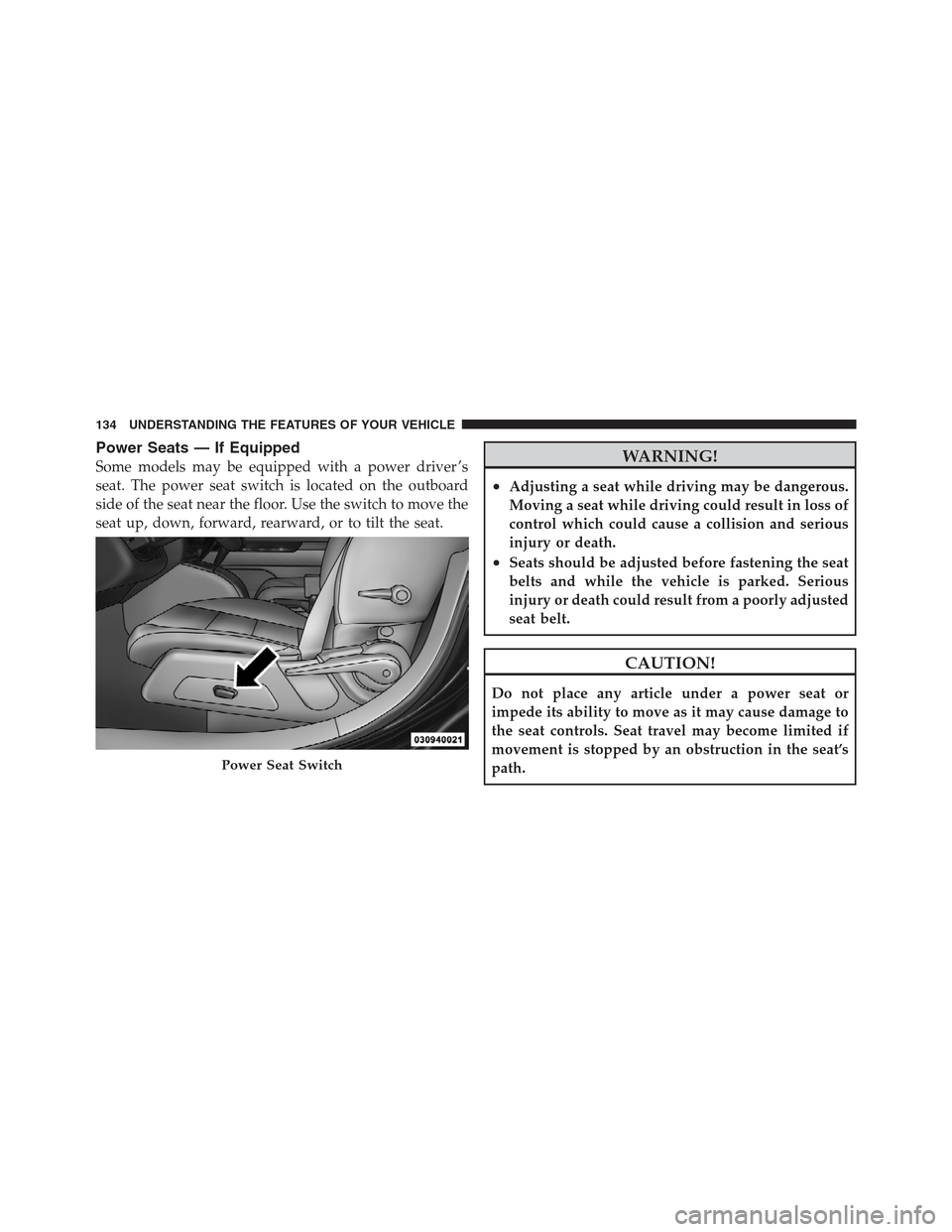
Some models may be equipped with a power driver ’s
seat. The power seat switch is located on the outboard
side of the seat near the floor. Use the switch to move the
seat up, down, forward, rearward, or to tilt the seat.WARNING!
•Adjusting a seat while driving may be dangerous.
Moving a seat while driving could result in loss of
control which could cause a collision and serious
injury or death.
•Seats should be adjusted before fastening the seat
belts and while the vehicle is parked. Serious
injury or death could result from a poorly adjusted
seat belt.
CAUTION!
Do not place any article under a power seat or
impede its ability to move as it may cause damage to
the seat controls. Seat travel may become limited if
movement is stopped by an obstruction in the seat’s
path.
Power Seat Switch
134 UNDERSTANDING THE FEATURES OF YOUR VEHICLE
Page 137 of 497
Adjusting The Seat Forward Or Rearward
The seat can be adjusted both forward and rearward.
Push the seat switch forward or rearward, the seat will
move in the direction of the switch. Release the switch
when you have reached the desired position.
Adjusting The Seat Up Or Down
The height of the seats can be adjusted up or down. Pull
upward or push downward on the seat switch, the seat
will move in the direction of the switch. Release the
switch when you have reached the desired position.
Tilting The Seat Up Or Down
The angle of the seat cushion can be adjusted in four
directions. Pull upward or push downward on the front
or rear of the seat switch, the front or rear of the seat
cushion will move in the direction of the switch. Release
the switch when you have reached the desired position.
Heated Seats — If Equipped
On some models, the front driver and passenger seats
may be equipped with heaters in both the seat cushions
and seatbacks. The controls for the front heated seats are
located on the center instrument panel area.
You can choose from HIGH, LOW or OFF heat settings.
Amber indicator lights in each switch indicate the level of
heat in use. Two indicator lights will illuminate for
HIGH, one for LOW and none for OFF.Press the switch once to select HIGH-level
heating. Press the switch a second time to select
LOW-level heating. Press the switch a third
time to shut the heating elements OFF.
If HIGH-level heating is selected, the system automati-
cally switches to LOW-level heating and turns one indi-
cator light OFF after a maximum of 60 minutes of
continuous operation. It will turn the heater and the
remaining indicator light OFF after an a maximum of
3
UNDERSTANDING THE FEATURES OF YOUR VEHICLE 135