Page 4 of 429
�µ
Calif ornia Proposition 65 Warning
This product contains or emits chemicals known to the State of Calif ornia to cause cancer and birth
def ects or other reproductive harm.
Service Diagnostic Recorders
This vehicle is equipped with service-related devices that record inf ormation a bout powertrain perf ormance. The data
can be used to verif y emissions law requirements and/or help technicians diagnose and solve serv ice problems. It may
also be combined with data f rom other sources f or research purposes, but it remains conf ident ial.
Calif ornia Perchlorate Contamination Prevention Act
The airbags, seat belt tensioners, and CR type batteries in this vehicle m ay contain perchlorate materials special
handling may apply. See
www.dtsc.ca.gov/hazardouswaste/perchlorate/
WARNING:
Introduction
iii
Main Menu
Page 8 of 429
(f luid capacities and tire pressures)
(seat belts, SRS, and child protection)
(main controls)
(indicators, gauges, multi-inf ormation display, dashboard, and steering column)
(fuel, vehicle break-in, and cargo loading)
(
)
(engine and transmission operation) (minder, f luid checking, minor services, and vehicle storage)
(f lat tire, jump starting, overheating, and f uses)
(vehicle specif ications, tires, and emissions controls)
(warranty and contact inf ormation)
(how to order)
climate control, audio, steering wheel, security, cruise control, HomeLink, and other convenience items
Contents
................................................................................................................................................
Index .I
..................................................
Service Inf ormation Summary . last page
............................................................
Driver and Passenger Saf ety .5
...............................................................................................
Your Vehicle at a Glance .3
.......
Instruments and Controls .59
.......................................................................
Bef ore Driving .247
..............
Features .145
.........................................................................................
Driving .269
.................................................
Maintenance .313
........................................
T aking Care of the Unexpected .361
..............................................
T echnical Inf ormation .387
..................
Warranty and Customer Relations (U.S. and Canada only) . 405
..................................................................................
A uthorized Manuals (U.S. only) .409INDEX
1
Note: All page numbers referenced in this document are hyperlinked.
2012 Pilot Online Reference Owner's Manual
Page 12 of 429
�µ
This section gives you important
inf ormation about how to protect
yourself and your passengers. It
shows you how to use seat belts. It
explains how your airbags work. And
it tells you how to properly restrain
inf ants and children in your vehicle.
.........
Important Safety Precautions . 6
.......
Your Vehicle
Page 14 of 429
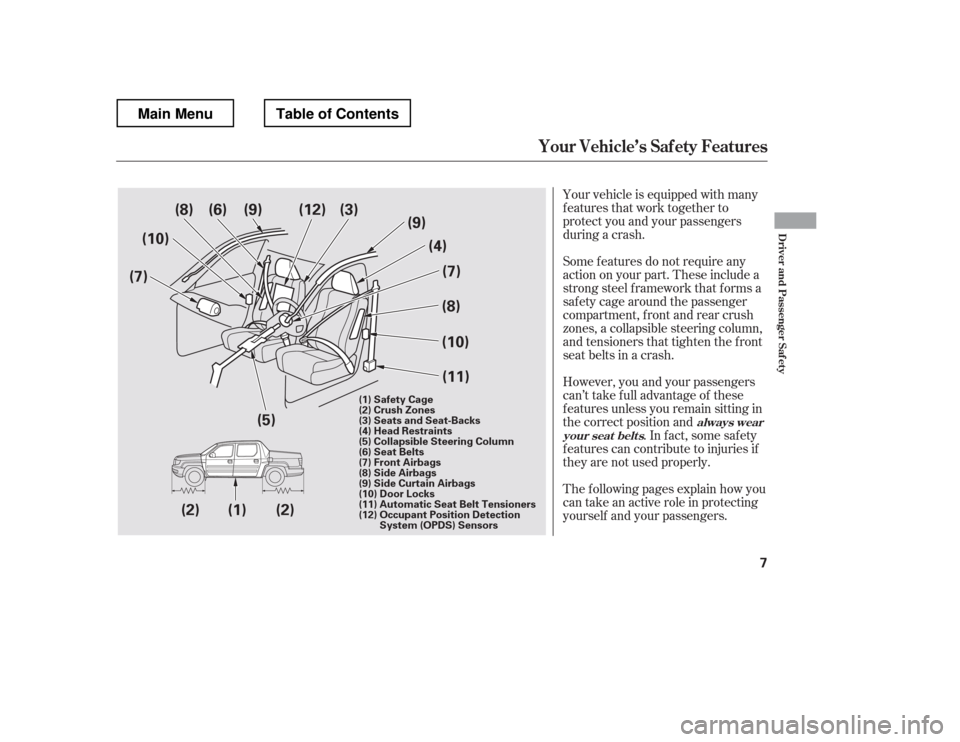
Your vehicle is equipped with many
features that work together to
protect you and your passengers
during a crash.
Some f eatures do not require any
action on your part. These include a
strong steel f ramework that f orms a
saf ety cage around the passenger
compartment, front and rear crush
zones, a collapsible steering column,
and tensioners that tighten the f ront
seat belts in a crash.
However, you and your passengers
can
Page 15 of 429
�µ �µ�µ�µ
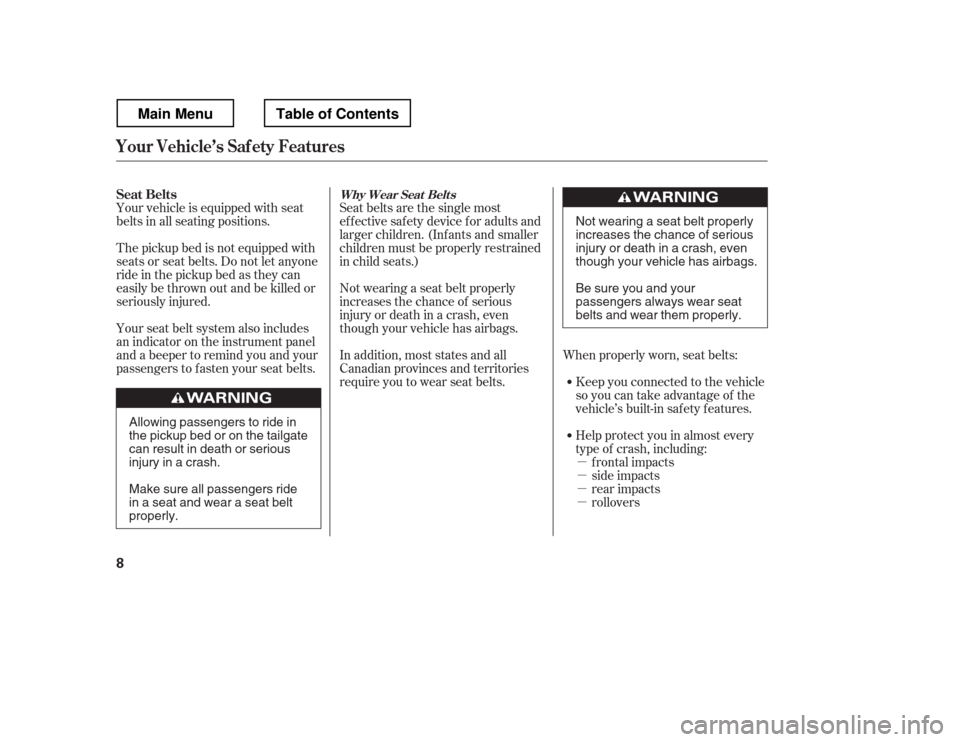
Your vehicle is equipped with seat
belts in all seating positions.
Seat belts are the single most
effectivesafetydeviceforadultsand
larger children. (Inf ants and smaller
children must be properly restrained
in child seats.)
Not wearing a seat belt properly
increases the chance of serious
injury or death in a crash, even
though your vehicle has airbags.
The pickup bed is not equipped with
seats or seat belts. Do not let anyone
ride in the pickup bed as they can
easily be thrown out and be killed or
seriously injured.
In addition, most states and all
Canadian provinces and territories
require you to wear seat belts.
Your seat belt system also includes
an indicator on the instrument panel
and a beeper to remind you and your
passengers to f asten your seat belts.
Keep you connected to the vehicle
so you can take advantage of the
vehicle
Page 16 of 429
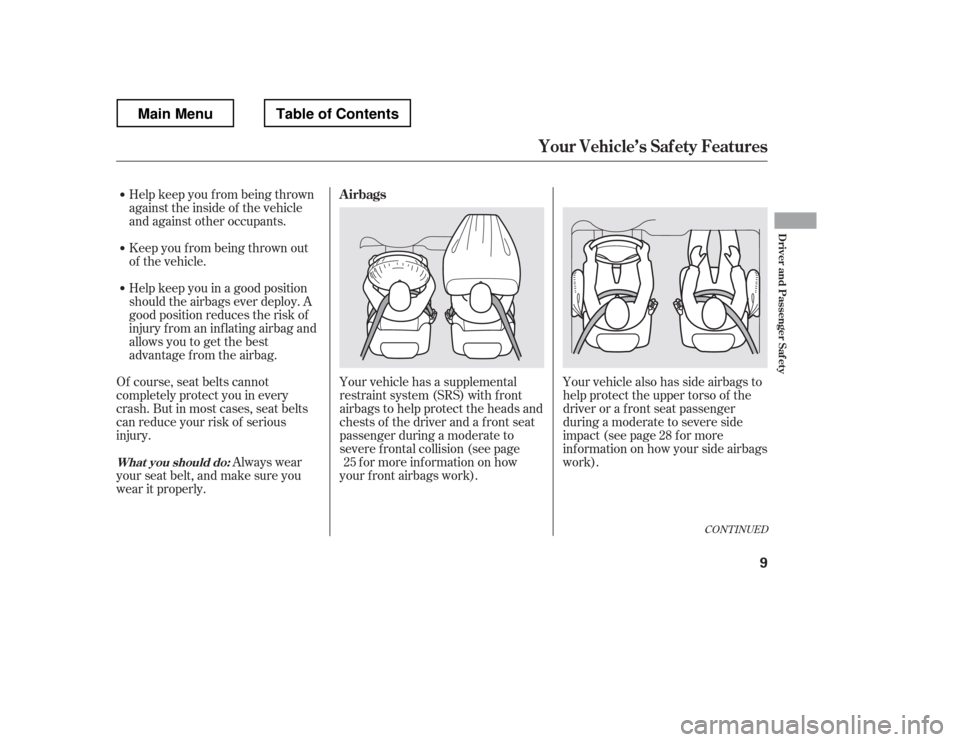
Your vehicle has a supplemental
restraint system (SRS) with f ront
airbags to help protect the heads and
chests of the driver and a front seat
passenger during a moderate to
severe f rontal collision (see pagef or more inf ormation on how
your f ront airbags work). Your vehicle also has side airbags to
help protect the upper torso of the
driver or a f ront seat passenger
during a moderate to severe side
impact (see page f or more
information on how your side airbags
work).
Help keep you in a good position
should the airbags ever deploy. A
good position reduces the risk of
injury f rom an inf lating airbag and
allows you to get the best
advantage f rom the airbag.
Of course, seat belts cannot
completely protect you in every
crash.Butinmostcases,seatbelts
can reduce your risk of serious
injury. Always wear
your seat belt, and make sure you
wear it properly. Help keep you f rom being thrown
against the inside of the vehicle
and against other occupants.
Keep you f rom being thrown out
of the vehicle.
25 28
CONT INUED
Your Vehicle
Page 17 of 429
The rest of this section gives more
detailed inf ormation about how you
can maximize your saf ety.
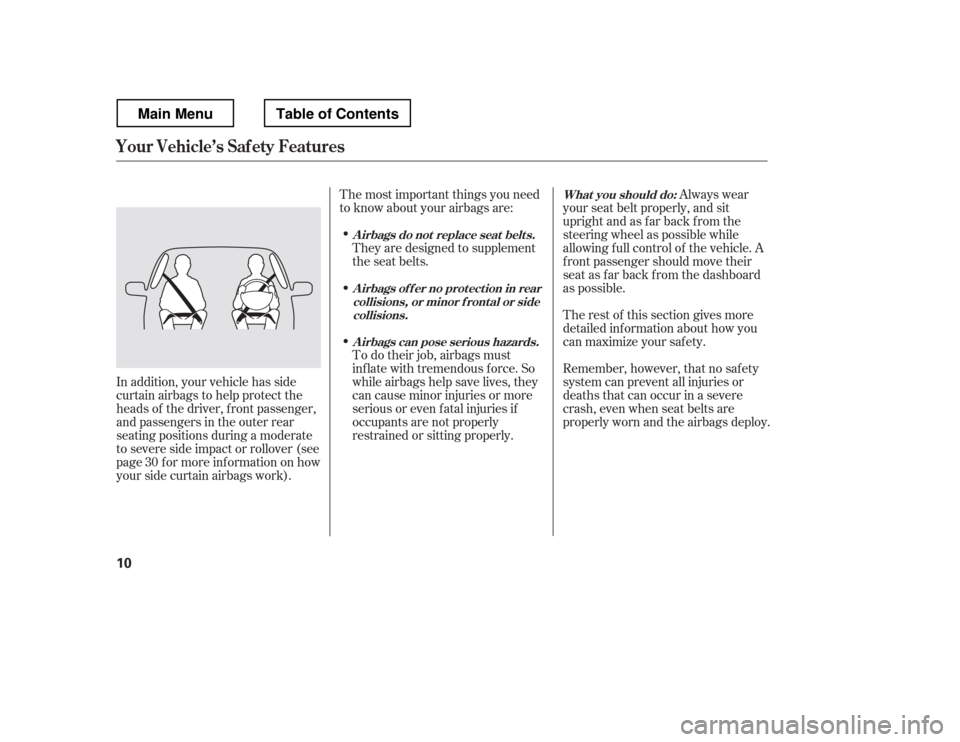
The most important things you need
to know about your airbags are:
They are designed to supplement
the seat belts.
Remember, however, that no saf ety
system can prevent all injuries or
deaths that can occur in a severe
crash, even when seat belts are
properly worn and the airbags deploy.Always wear
your seat belt properly, and sit
upright and as f ar back f rom the
steering wheel as possible while
allowing f ull control of the vehicle. A
f ront passenger should move their
seat as far back from the dashboard
as possible.
To do their job, airbags must
inf late with tremendous f orce. So
while airbags help save lives, they
can cause minor injuries or more
serious or even fatal injuries if
occupants are not properly
restrained or sitting properly.
In addition, your vehicle has side
curtain airbags to help protect the
heads of the driver, f ront passenger,
and passengers in the outer rear
seating positions during a moderate
to severe side impact or rollover (see
page f or more inf ormation on how
your side curtain airbags work).
30
Your Vehicle
Page 23 of 429
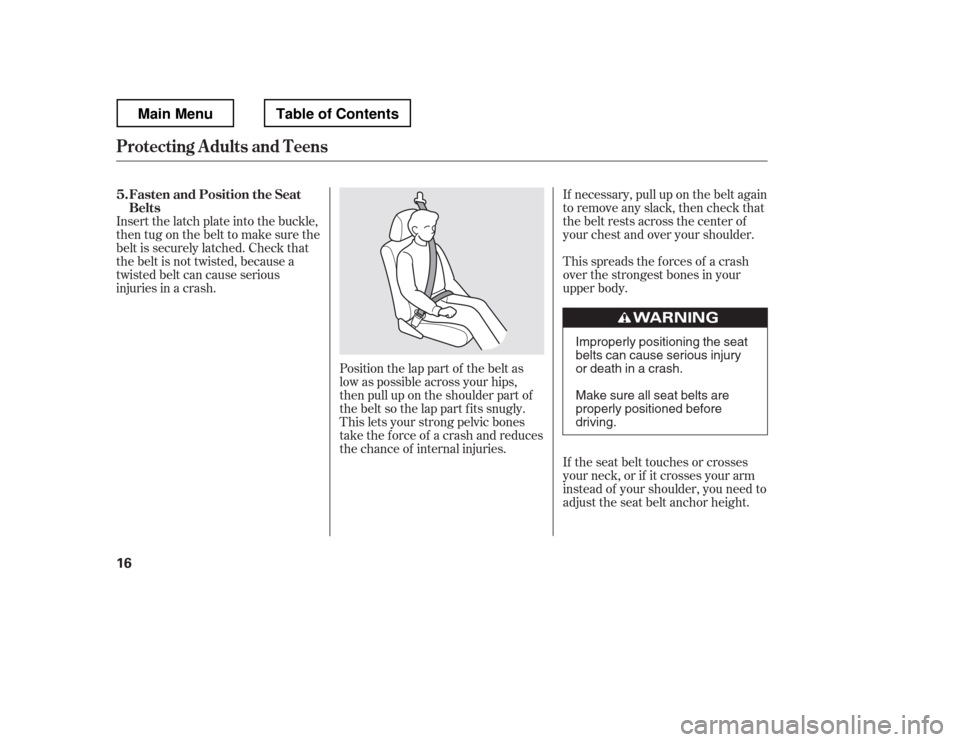
Position the lap part of the belt as
low as possible across your hips,
then pull up on the shoulder part of
the belt so the lap part f its snugly.
This lets your strong pelvic bones
take the force of a crash and reduces
the chance of internal injuries.
Insert the latch plate into the buckle,
then tug on the belt to make sure the
belt is securely latched. Check that
the belt is not twisted, because a
twisted belt can cause serious
injuries in a crash.
If necessary, pull up on the belt again
to remove any slack, then check that
the belt rests across the center of
your chest and over your shoulder.
This spreads the f orces of a crash
over the strongest bones in your
upper body.
If the seat belt touches or crosses
your neck, or if it crosses your arm
instead of your shoulder, you need to
adjust the seat belt anchor height.
Fasten and Position the Seat
Belts
5.
Protecting A dults and Teens
16 Improperly positioning the seat
belts can cause serious injury
or death in a crash.
Make sure all seat belts are
properly positioned beforedriving.
Table of ContentsMain Menu