Page 366 of 441
365
uuReplacing Light BulbsuHigh-Mount Brake Light Bulb
Maintenance
High-Mount Brake Light BulbWhen replacing, use the following bulb.
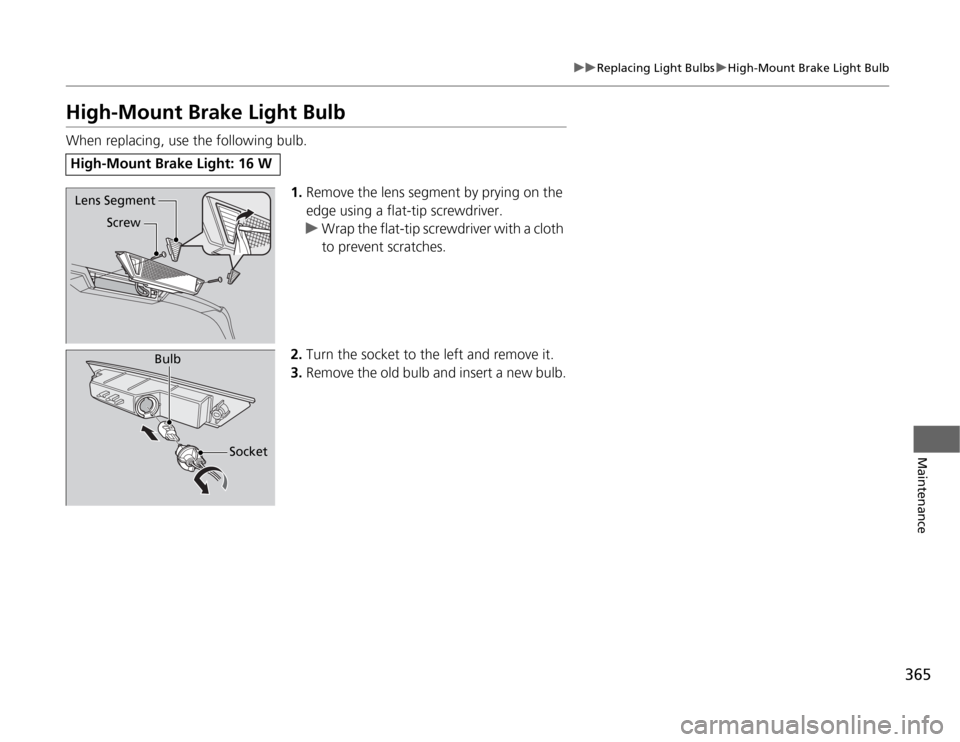
1.Remove the lens segment by prying on the
edge using a flat-tip screwdriver.
uWrap the flat-tip screwdriver with a cloth
to prevent scratches.
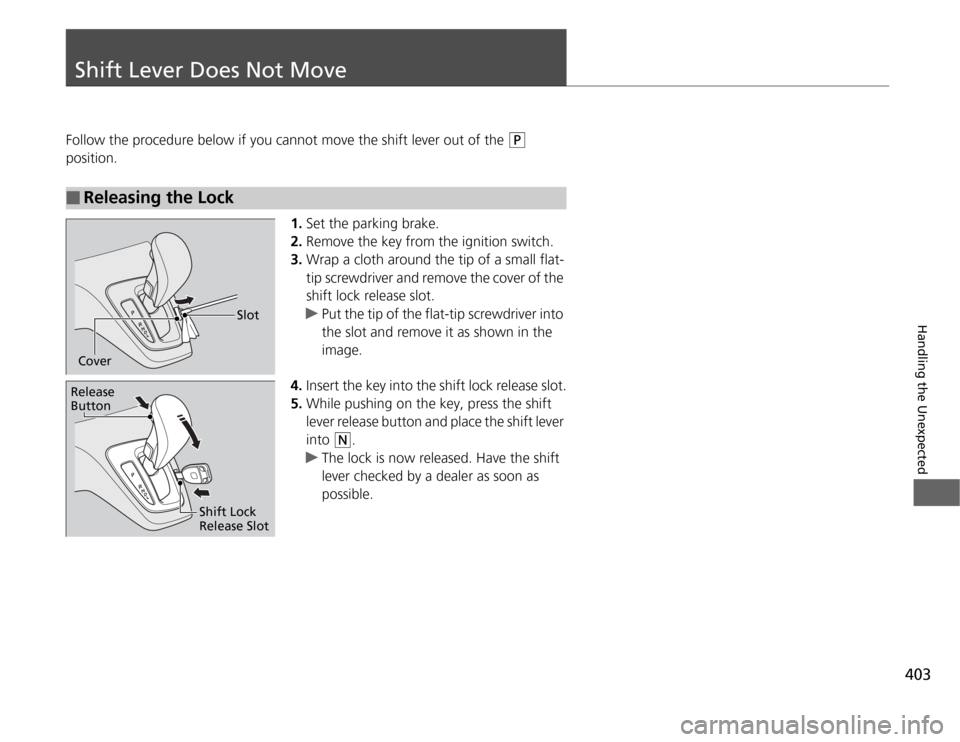
2.Turn the socket to the left and remove it.
3.Remove the old bulb and insert a new bulb.High-Mount Brake Light: 16 W
Screw
Lens Segment
Bulb
Socket
Page 379 of 441
378
uuChecking and Maintaining TiresuWinter Tires
Maintenance
Winter TiresIf driving on snowy or frozen roads, mount all season marked ”M+S” tires, snow
tires, or tire chains; reduce speed; and maintain sufficient distance between vehicles
when driving.
Be particularly careful when operating the steering wheel or brakes to prevent
skidding.
Use tire chains, snow tires, or all season tires when necessary or according to the law.
When mounting, refer to the following points.
For winter tires:
•Select the size and load ranges that are the same as the original tires.
•Mount the tires to all four wheels.
For tire chains:
•Install them on the front tires only.
•Because your vehicle has limited tire clearance, we strongly recommend using the
chains listed below:
•Follow the chain manufacturer's instruction when installing. Mount them as
tightly as you can.
•Check that the chains do not touch the brake lines or suspension.
•Drive slowly.
Cable-type: SCC Super Z-6# SZ-429
1Winter Tires
NOTICETraction devices that are the wrong size or improperly
installed can damage your vehicle's brake lines,
suspension, body, and wheels. Stop driving if they are
hitting any part of the vehicle.
When tire chains are mounted, follow the chain
manufacturer's instructions regarding vehicle
operational limits.
If your vehicle is equipped with summer tires, be
aware that these tires are not designed for winter
driving conditions. For more information, contact a
dealer.
3
WARNING
Using the wrong chains, or not properly
installing chains, can damage the brake
lines and cause a crash in which you can be
seriously injured or killed.
Follow all instructions in this owner's
manual regarding the selection and use of
tire chains.
Page 390 of 441
389
Handling the Unexpected
This chapter explains how to handle unexpected troubles.
Tools
Types of Tools .................................. 390
If a Tire Goes Flat
Changing a Flat Tire ......................... 391
Engine Does Not Start
Checking the Engine ........................ 400
Jump Starting.................................... 401
Shift Lever Does Not Move.............. 403
Overheating
How to Handle Overheating ............. 404Indicator, Coming On/Blinking
If the Low Oil Pressure Indicator Comes
On ............................................. 406If the Charging System Indicator Comes
On ................................................. 406
If the Malfunction Indicator Lamp Comes
On or Blinks ................................... 407If the Brake System Indicator Comes On ....... 408If the Low Tire Pressure Indicator Comes
On ................................................. 409
If the TPMS Indicator Comes On ...... 409If the Low Tire Pressure/TPMS Indicator
Comes On or Blinks ....................... 410
Fuses
Fuse Locations ................................. 411
Inspecting and Changing Fuses ........ 416
Emergency Towing........................... 417
When You Cannot Open or Close the
Tailgate............................................ 418
Page 392 of 441

391
Continued
Handling the Unexpected
If a Tire Goes FlatChanging a Flat TireIf a tire goes flat while driving, grasp the steering wheel firmly, and brake gradually
to reduce speed. Then, stop in a safe place. Replace the flat tire with a compact
spare tire. Go to a dealer as soon as possible to have the full-size tire repaired or
replaced.
1.Park the vehicle on firm, level, and non-slippery ground.
2.Put the shift lever in
(P
.
3.Set the parking brake.
4.Turn on the hazard warning lights and turn the ignition switch to LOCK
(0
.
1Changing a Flat Tire
Periodically check the tire pressure of the compact
spare. It should be set to the specified pressure.
Specified Pressure: 60 psi (420 kPa, 4.2 kgf/cm
2)
When driving with the compact spare tire, keep the
vehicle speed under 50 mph (80 km/h). Replace with
a full-size tire as soon as possible.
The compact spare tire and wheel in your vehicle are
specifically for this model.
Do not use them with another vehicle.
Do not use another type of compact spare tire or
wheel with your vehicle.
Do not mount tire chains on a compact spare tire.
If a chain-mounted front tire goes flat, remove one of
the full-size rear tires and replace it with the compact
spare tire. Remove the flat front tire and replace it
with the full-size tire that was removed from the rear.
Mount the tire chains on the front tire.
Do not use a puncture-repairing agent on a flat tire,
as it can damage the tire pressure sensor.
U.S. models only
Page 404 of 441
403
Handling the Unexpected
Shift Lever Does Not MoveFollow the procedure below if you cannot move the shift lever out of the
(P
position.
1.Set the parking brake.
2.Remove the key from the ignition switch.
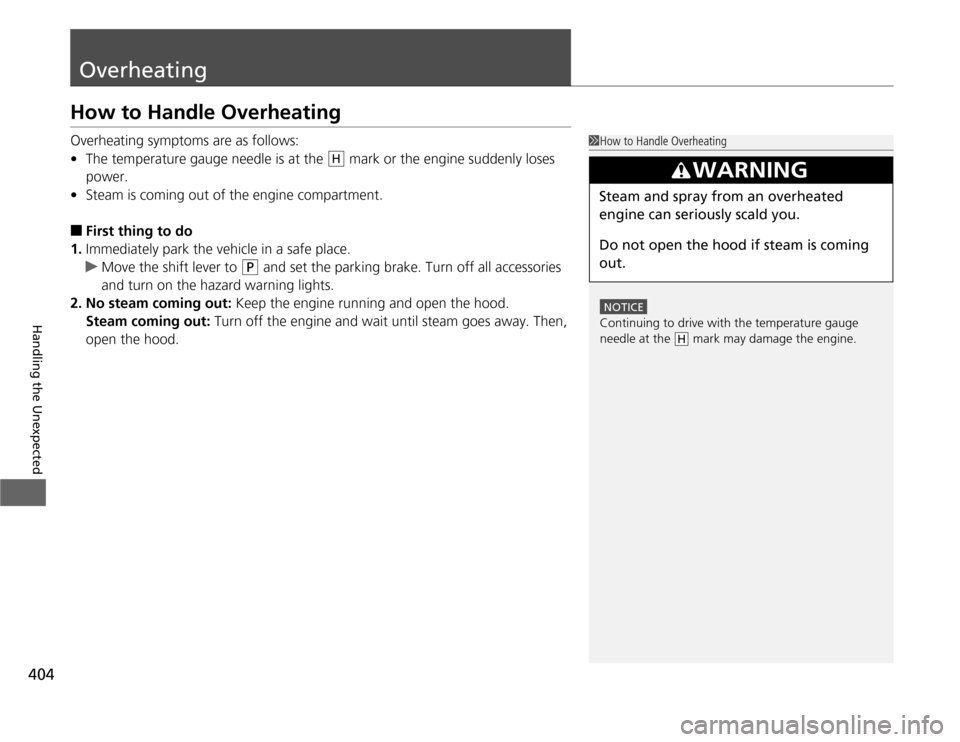
3.Wrap a cloth around the tip of a small flat-
tip screwdriver and remove the cover of the
shift lock release slot.
uPut the tip of the flat-tip screwdriver into
the slot and remove it as shown in the
image.
4.Insert the key into the shift lock release slot.
5.While pushing on the key, press the shift
lever release button and place the shift lever
into
(N
.
uThe lock is now released. Have the shift
lever checked by a dealer as soon as
possible.
■
Releasing the Lock
Slot
Cover
Release
Button
Shift Lock
Release Slot
Page 405 of 441
404Handling the Unexpected
OverheatingHow to Handle OverheatingOverheating symptoms are as follows:
•The temperature gauge needle is at the mark or the engine suddenly loses
power.
•Steam is coming out of the engine compartment.■
First thing to do
1.Immediately park the vehicle in a safe place.
uMove the shift lever to
(P
and set the parking brake. Turn off all accessories
and turn on the hazard warning lights.
2. No steam coming out: Keep the engine running and open the hood.
Steam coming out: Turn off the engine and wait until steam goes away. Then,
open the hood.
1How to Handle Overheating
NOTICEContinuing to drive with the temperature gauge
needle at the mark may damage the engine.
3
WARNING
Steam and spray from an overheated
engine can seriously scald you.
Do not open the hood if steam is coming
out.
H
H
Page 409 of 441

408
uuIndicator, Coming On/BlinkinguIf the Brake System Indicator Comes On
Handling the Unexpected
If the Brake System Indicator Comes On
■
Reasons for the indicator to come on
•The brake fluid is low.
•There is a malfunction in the brake system.
■
What to do when the indicator comes on while driving
Press the brake pedal lightly to check pedal pressure.
•If normal, check the brake fluid level the next time you stop.
•If abnormal, take immediate action. If necessary, downshift the
transmission to slow the vehicle using engine braking.
1If the Brake System Indicator Comes On
Have your vehicle repaired immediately.
It is dangerous to drive with low brake fluid. If there
is no resistance from the brake pedal, stop
immediately in a safe place. If necessary downshift
the gears.
If the brake system indicator and ABS indicator come
on simultaneously, the electronic brake distribution
system is not working. This can result in vehicle
instability under sudden braking.
Have your vehicle inspected by a dealer immediately.
U.S.
Canada
Page 421 of 441
420Information
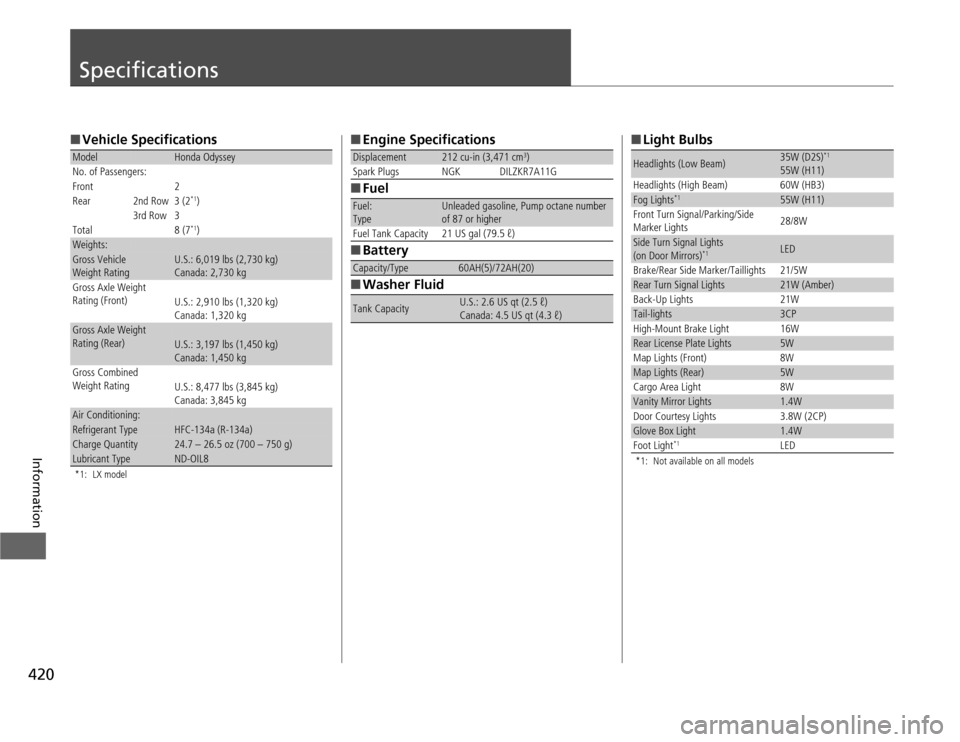
Specifications■Vehicle Specifications*1: LX modelModel
Honda Odyssey
No. of Passengers:
Front 2
Rear 2nd Row 3 (2
*1)
3rd Row 3
Total 8 (7*1)
Weights:Gross Vehicle
Weight Rating
U.S.: 6,019 lbs (2,730 kg)
Canada: 2,730 kg
Gross Axle Weight
Rating (Front)
U.S.: 2,910 lbs (1,320 kg)
Canada: 1,320 kg
Gross Axle Weight
Rating (Rear)
U.S.: 3,197 lbs (1,450 kg)
Canada: 1,450 kg
Gross Combined
Weight Rating
U.S.: 8,477 lbs (3,845 kg)
Canada: 3,845 kg
Air Conditioning:Refrigerant Type
HFC-134a (R-134a)
Charge Quantity
24.7 – 26.5 oz (700 – 750 g)
Lubricant Type
ND-OIL8
■Engine Specifications
■Fuel
■Battery
■Washer FluidDisplacement
212 cu-in (3,471 cm
3)
Spark Plugs NGK DILZKR7A11G
Fuel:
Type
Unleaded gasoline, Pump octane number
of 87 or higher
Fuel Tank Capacity 21 US gal (79.5 ℓ)
Capacity/Type
60AH(5)/72AH(20)
Tank Capacity
U.S.: 2.6 US qt (2.5 ℓ)
Canada: 4.5 US qt (4.3 ℓ)
■Light Bulbs*1: Not available on all modelsHeadlights (Low Beam)
35W (D2S)
*1
55W (H11)
Headlights (High Beam) 60W (HB3)
Fog Lights
*1
55W (H11)
Front Turn Signal/Parking/Side
Marker Lights28/8W
Side Turn Signal Lights
(on Door Mirrors)
*1
LED
Brake/Rear Side Marker/Taillights 21/5W
Rear Turn Signal Lights
21W (Amber)
Back-Up Lights 21W
Tail-lights
3CP
High-Mount Brake Light 16W
Rear License Plate Lights
5W
Map Lights (Front) 8W
Map Lights (Rear)
5W
Cargo Area Light 8W
Vanity Mirror Lights
1.4W
Door Courtesy Lights 3.8W (2CP)
Glove Box Light
1.4W
Foot Light
*1
LED