Page 234 of 345
233
Driving
Parking Your Vehicle
When Stopped 1.Always use the parking brake when you park your vehicle.
2. Make sure the parking brake is set firmly, or your vehicle may roll if parked on an
incline.
Parking 1.Depress the brake pedal firmly with the shift lever in
(D .
2. Apply the parking brake while holding the brake pedal down.
3. Move the shift lever to
(P .
4. Turn off the engine.
1Parking Your Vehicle
Do not park your vehicle near flammable objects,
such as dry grass, oil, or timber.
Heat from the exhaust can cause a fire.
1When Stopped
NOTICE
The following can damage the transmission: •Depressing the accelerator and brake pedals
simultaneously.
• Holding the vehicle in place when facing uphill by
depressing the accelerator pedal.
• Moving the shift lever into
(P before the vehicle
stops completely.
Automatic transmission models
1Parking
Raise the wiper arms when snow is expected.Automatic transmission models
Page 242 of 345
241
uuBefore Performing MaintenanceuSafety When Performing Maintenance
Maintenance
Safety When Performing Maintenance
Some of the most important safety precautions are given here.
However, we cannot warn you of every conceivable hazard that can arise in
performing maintenance. Only you can decide whether or not you should perform
a given task. • To reduce the possibility of fire or explosion, keep cigarettes, sparks, and flames
away from the battery and all fuel related parts.
• To clean parts, use a commercially available degreaser or parts cleaner, not
gasoline.
• Wear eye protection and protective clothing when working with the battery or
compressed air.
• Engine exhaust contains carbon monoxide, which is poisonous and can kill you.
uOnly operate the engine if there is sufficient ventilation.
• The vehicle must be in a stationary condition.
uMake sure your vehicle is parked on level ground, the parking brake is set, and
the engine is off.
• Be aware that hot parts can burn you.
uMake sure to let the engine and exhaust system cool thoroughly before
touching vehicle parts.
• Be aware that moving parts can injure you.
uDo not start the engine unless instructed, and keep your hands and limbs away
from moving parts.
■Maintenance Safety
■Vehicle Safety
1Safety When Performing Maintenance
3WARNING
Improperly maintaining this vehicle or
failing to correct a problem before driving
can cause a crash in which you can be
seriously hurt or killed.
Always follow the inspection and
maintenance recommendations according
to the schedules in this owner's manual.
3WARNING
Failure to properly follow maintenance
instructions and precautions can cause you
to be seriously hurt or killed.
Always follow the procedures and
precautions in this owner's manual.
Page 254 of 345

253
uuMaintenance Under the HooduOpening the Hood
Maintenance
Opening the Hood1.Park the vehicle on a level surface, and set
the parking brake.
2. Pull the hood release handle under the
lower left corner of the dashboard.
uThe hood will pop up slightly.
3. Push up the hood latch lever in the center
of the hood to release the lock mechanism,
and open the hood.
4. Remove the support rod from the clamp
using the grip. Mount the support rod in
the hood.
When closing, remove the support rod, and
stow it in the clamp, then gently lower the
hood. Remove your hand at a height of
approximately 12 inches (30 cm) and let the
hood close.
1Opening the Hood
NOTICE
Do not open the hood when the wiper arms are raised.
The hood will strike the wipers, and may damage
either the hood or the wipers.
When closing the hood, check that the hood is
securely latched.
If the hood latch lever moves stiffly, or if you can
open the hood without lifting the lever, the latch
mechanism should be cleaned and lubricated.
Hood Release Handle
Pull
Lever
Support Rod Grip
Clamp
Page 300 of 345

299
Continued
Handling the Unexpected
If a Tire Goes Flat
Changing a Flat Tire
If a tire goes flat while driving, grasp the steering wheel firmly, and brake gradually
to reduce speed. Then, stop in a safe place. Replace the flat tire with a compact
spare tire. Go to a dealer as soon as possible to have the full size tire repaired or
replaced. 1.
Park the vehicle on firm, level, and non-slippery ground.
2. Put the shift lever in
(P .
2. Put the shift lever in
(R .
3. Set the parking brake.
4. Turn on the hazard warning lights and turn the ignition switch to LOCK
(0.
1Changing a Flat Tire
Periodically check the tire pressure of the compact
spare. It should be set to the specified pressure.
Specified Pressure: 60 psi (420 kPa, 4.2 kgf/cm 2
)
When driving with the compact spare tire, keep the
vehicle speed under 50 mph (80 km/h). Replace with
a full size tire as soon as possible.
The compact spare tire and wheel in your vehicle are
specifically for this model.
Do not use them with another vehicle.
Do not use another type of compact spare tire or
wheel with your vehicle.
Do not mount tire chains on a compact spare tire.
If a chain-mounted front tire goes flat, remove one of
the full-size rear tires and replace it with the compact
spare tire. Remove the flat front tire and replace it
with the full size tire that was removed from the rear.
Mount the tire chains on the front tire.
Do not use a puncture-repairing agent on a flat tire,
as it can damage the tire pressure sensor.
U.S. models only
Automatic transmission models
Manual transmission models
All models
Page 311 of 345
310
Handling the Unexpected
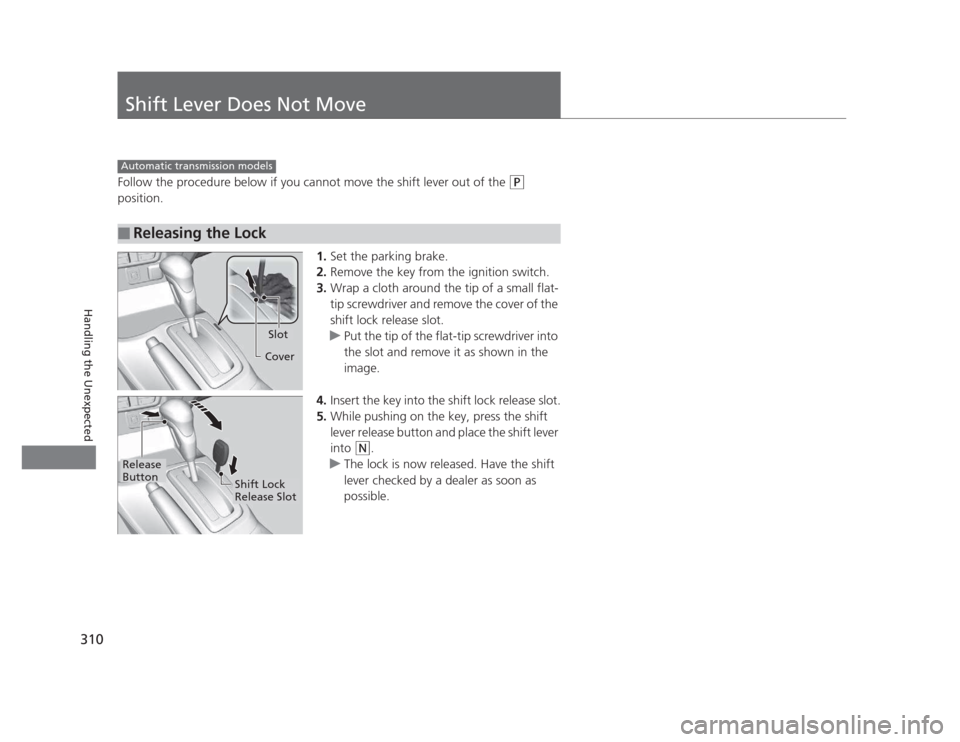
Shift Lever Does Not Move
Follow the procedure below if you cannot move the shift lever out of the (P
position.
1.Set the parking brake.
2. Remove the key from the ignition switch.
3. Wrap a cloth around the tip of a small flat-
tip screwdriver and remove the cover of the
shift lock release slot.
uPut the tip of the flat-tip screwdriver into
the slot and remove it as shown in the image.
4. Insert the key into the shift lock release slot.
5. While pushing on the key, press the shift
lever release button and place the shift lever
into
(N .
uThe lock is now released. Have the shift
lever checked by a dealer as soon as
possible.
■Releasing the Lock
Automatic transmission models
Slot
Cover
Release
Button
Shift Lock
Release Slot
Page 312 of 345
311
Continued
Handling the Unexpected
Overheating
How to Handle Overheating
Overheating symptoms are as follows: •
The high temperature indicator comes on or the engine suddenly loses power.
• Steam is coming out of the engine compartment.
■ First thing to do
1. Immediately park the vehicle in a safe place.
uMove the shift lever to (P and set the parking brake. Turn off all accessories
and turn on the hazard warning lights.
uMove the shift lever to (N and set the parking brake. Turn off all accessories
and turn on the hazard warning lights.
2. No steam coming out: Keep the engine running and open the hood.
Steam coming out: Turn off the engine and wait until steam goes away. Then,
open the hood.
1How to Handle Overheating
NOTICE
Continuing to drive with the high temperature
indicator on may damage the engine.
3WARNING
Steam and spray from an overheated
engine can seriously scald you.
Do not open the hood if steam is coming
out.
Automatic transmission models
Manual transmission models
Page 325 of 345

324
Information
Specifications
■Vehicle Specifications
*1: DX, LX and HF models
*2: EX and EX-L models
ModelHonda Civic 4-Door
No. of Passengers:
Front 2
Rear 3
Total 5
Weights:
Gross Vehicle
Weight Rating U.S.: 3,660 lbs (1,660 kg) *1
Canada: 1,660 kg *1
U.S.: 3,792 lbs (1,720 kg) *2
Canada: 1,720 kg *2
Gross Axle Weight
Rating (Front)
U.S.: 1,985 lbs (900 kg)
*1
Canada: 900 kg *1
U.S.: 2,029 lbs (920 kg) *2
Canada: 920 kg *2
Gross Axle Weight
Rating (Rear)
U.S.: 1,742 lbs (790 kg) *1
Canada: 790 kg *1
U.S.: 1,786 lbs (810 kg) *2
Canada: 810 kg *2
Air Conditioning:
Refrigerant Type HFC-134a (R-134a)
Charge Quantity 13.2 – 15.0 oz (375 – 425 g)
Lubricant Type SP-10
1.8 � engine models■Engine Specifications
■Fuel
■Battery
■Washer Fluid
Displacement110 cu-in (1,798 cm 3
)
Spark Plugs NGK DILZKR7B11GS
DENSO DXU22HCR-D11S
Fuel: TypeUnleaded gasoline, Pump octane number
of 87 or higher
Fuel Tank Capacity 13.2 US gal (50 ℓ)
Capacity/Type36AH(5)/45AH(20)
36AH(5)/47AH(20)
38AH(5)/47AH(20)
Tank CapacityU.S.: 2.6 US qt (2.5 ℓ)
Canada: 4.8 US qt (4.5 ℓ)
■Light Bulbs
*3: Not available on all models
Headlights (Low Beam)51W (HB4)
Headlights (High Beam) 60W (HB3)
Front Turn Signal/Parking/Side
Marker Lights28/8W
Brake/Taillights 21/5W
Back-Up Lights21W
Rear Turn Signal Lights 21W (Amber)
Rear Side Marker Lights3CP
High-Mount Brake Light 21W
Rear License Plate Light5W
Trunk Light 5W
Interior Lights
Map Lights *38W
Ceiling Light8W
Page 327 of 345

326
uuSpecificationsu
Information
■Vehicle Specifications
ModelHonda Civic 4-Door
No. of Passengers:
Front 2
Rear 3
Total 5
Weights:
Gross Vehicle
Weight Rating U.S.: 3,924 lbs (1,780 kg)
Canada: 1,780 kg
Gross Axle Weight
Rating (Front)
U.S.: 2,116 lbs (960 kg)
Canada: 960 kg
Gross Axle Weight
Rating (Rear)
U.S.: 1,830 lbs (830 kg)
Canada: 830 kg
Air Conditioning:
Refrigerant Type HFC-134a (R-134a)
Charge Quantity 13.2 – 15.0 oz (375 – 425 g)
Lubricant Type SP-10
2.4 � engine models■Engine Specifications
■Fuel
■Battery
■Washer Fluid
Displacement144 cu-in (2,354 cm 3
)
Spark Plugs NGK ILZKR7B-11S
DENSO SXU22HCR11S
Fuel: TypeUnleaded gasoline, Pump octane number
of 91 or higher
Fuel Tank Capacity 13.2 US gal (50 ℓ)
Capacity/Type38AH(5)/47AH(20)
Tank CapacityU.S.: 2.6 US qt (2.5 ℓ)
Canada: 4.8 US qt (4.5 ℓ)
■Light Bulbs
Headlights (Low Beam)51W (HB4)
Headlights (High Beam) 60W (HB3)
Fog Lights55W (H11)
Front Turn Signal/Parking/Side
Marker Lights 28/8W
Brake/Taillights21/5W
Back-Up Lights 21W
Rear Turn Signal Lights21W (Amber)
Rear Side Marker Lights 3CP
High-Mount Brake LightLED
Rear License Plate Light 5W
Trunk Light5W
Interior Lights Map Lights 8W
Ceiling Light 8W