2012 FORD SUPER DUTY remove seats
[x] Cancel search: remove seatsPage 81 of 454
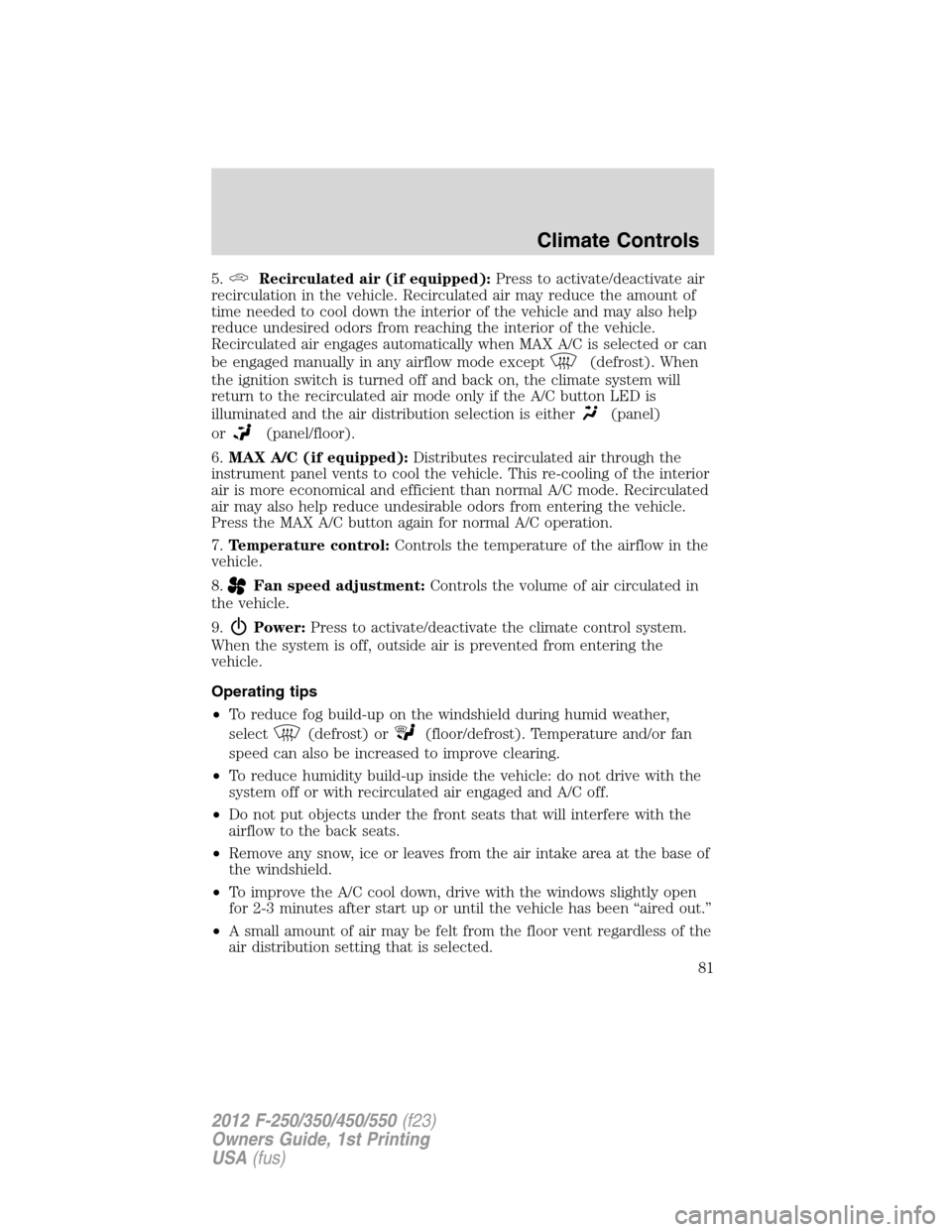
5.Recirculated air (if equipped):Press to activate/deactivate air
recirculation in the vehicle. Recirculated air may reduce the amount of
time needed to cool down the interior of the vehicle and may also help
reduce undesired odors from reaching the interior of the vehicle.
Recirculated air engages automatically when MAX A/C is selected or can
be engaged manually in any airflow mode except
(defrost). When
the ignition switch is turned off and back on, the climate system will
return to the recirculated air mode only if the A/C button LED is
illuminated and the air distribution selection is either
(panel)
or
(panel/floor).
6.MAX A/C (if equipped):Distributes recirculated air through the
instrument panel vents to cool the vehicle. This re-cooling of the interior
air is more economical and efficient than normal A/C mode. Recirculated
air may also help reduce undesirable odors from entering the vehicle.
Press the MAX A/C button again for normal A/C operation.
7.Temperature control:Controls the temperature of the airflow in the
vehicle.
8.
Fan speed adjustment:Controls the volume of air circulated in
the vehicle.
9.
Power:Press to activate/deactivate the climate control system.
When the system is off, outside air is prevented from entering the
vehicle.
Operating tips
•To reduce fog build-up on the windshield during humid weather,
select
(defrost) or(floor/defrost). Temperature and/or fan
speed can also be increased to improve clearing.
•To reduce humidity build-up inside the vehicle: do not drive with the
system off or with recirculated air engaged and A/C off.
•Do not put objects under the front seats that will interfere with the
airflow to the back seats.
•Remove any snow, ice or leaves from the air intake area at the base of
the windshield.
•To improve the A/C cool down, drive with the windows slightly open
for 2-3 minutes after start up or until the vehicle has been “aired out.”
•A small amount of air may be felt from the floor vent regardless of the
air distribution setting that is selected.
Climate Controls
81
2012 F-250/350/450/550(f23)
Owners Guide, 1st Printing
USA(fus)
Page 85 of 454
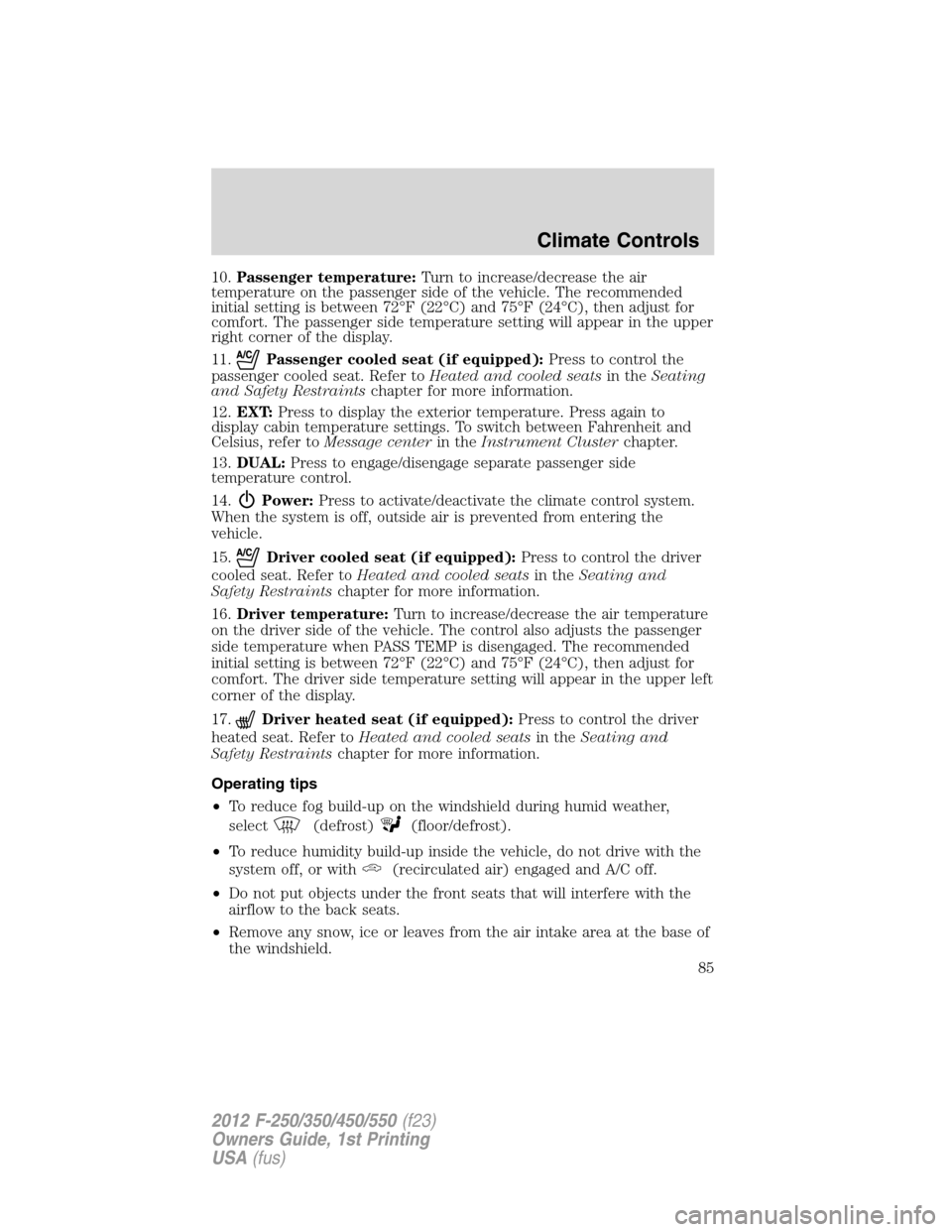
10.Passenger temperature:Turn to increase/decrease the air
temperature on the passenger side of the vehicle. The recommended
initial setting is between 72°F (22°C) and 75°F (24°C), then adjust for
comfort. The passenger side temperature setting will appear in the upper
right corner of the display.
11.
Passenger cooled seat (if equipped):Press to control the
passenger cooled seat. Refer toHeated and cooled seatsin theSeating
and Safety Restraintschapter for more information.
12.EXT:Press to display the exterior temperature. Press again to
display cabin temperature settings. To switch between Fahrenheit and
Celsius, refer toMessage centerin theInstrument Clusterchapter.
13.DUAL:Press to engage/disengage separate passenger side
temperature control.
14.
Power:Press to activate/deactivate the climate control system.
When the system is off, outside air is prevented from entering the
vehicle.
15.
Driver cooled seat (if equipped):Press to control the driver
cooled seat. Refer toHeated and cooled seatsin theSeating and
Safety Restraintschapter for more information.
16.Driver temperature:Turn to increase/decrease the air temperature
on the driver side of the vehicle. The control also adjusts the passenger
side temperature when PASS TEMP is disengaged. The recommended
initial setting is between 72°F (22°C) and 75°F (24°C), then adjust for
comfort. The driver side temperature setting will appear in the upper left
corner of the display.
17.
Driver heated seat (if equipped):Press to control the driver
heated seat. Refer toHeated and cooled seatsin theSeating and
Safety Restraintschapter for more information.
Operating tips
•To reduce fog build-up on the windshield during humid weather,
select
(defrost)(floor/defrost).
•To reduce humidity build-up inside the vehicle, do not drive with the
system off, or with
(recirculated air) engaged and A/C off.
•Do not put objects under the front seats that will interfere with the
airflow to the back seats.
•Remove any snow, ice or leaves from the air intake area at the base of
the windshield.
Climate Controls
85
2012 F-250/350/450/550(f23)
Owners Guide, 1st Printing
USA(fus)
Page 87 of 454
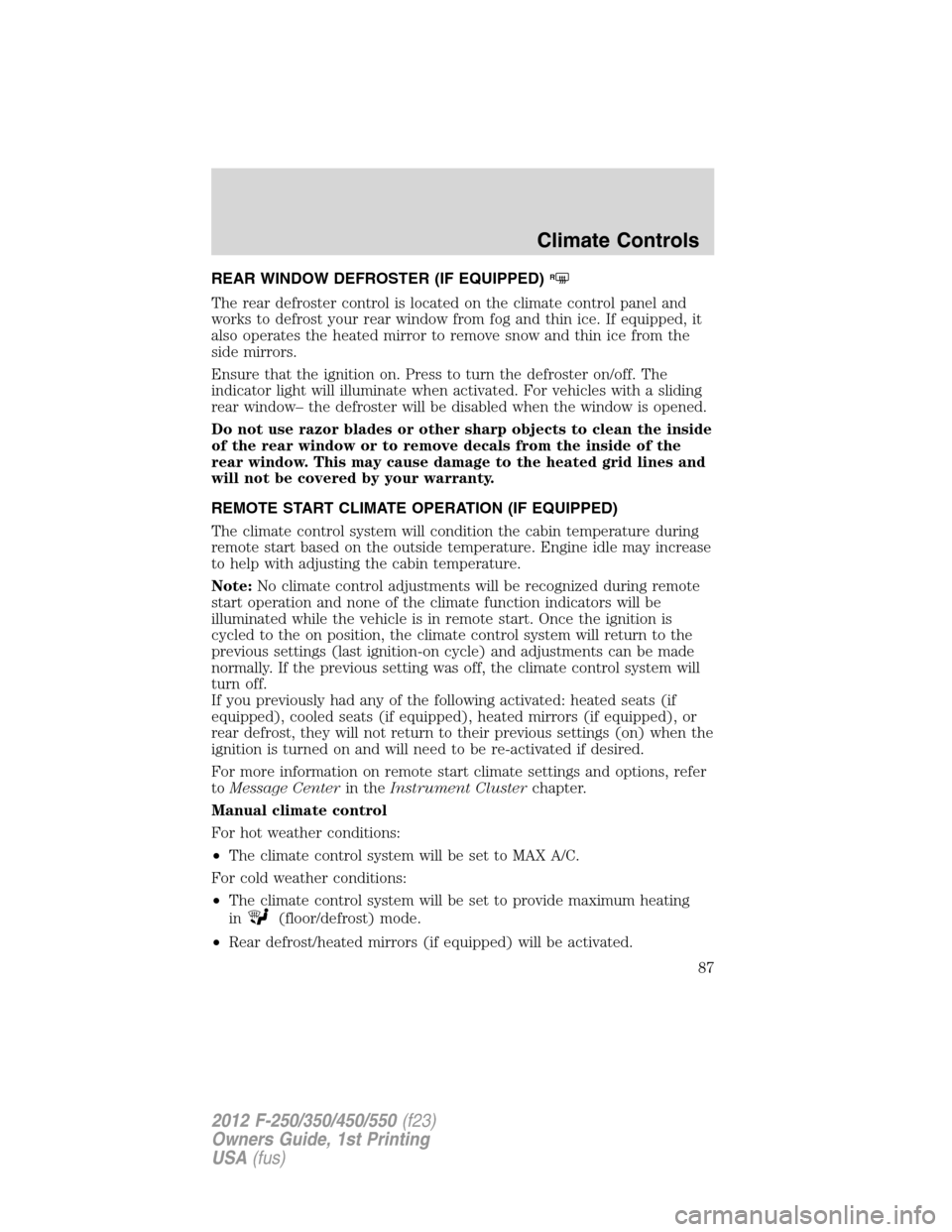
REAR WINDOW DEFROSTER (IF EQUIPPED)R
The rear defroster control is located on the climate control panel and
works to defrost your rear window from fog and thin ice. If equipped, it
also operates the heated mirror to remove snow and thin ice from the
side mirrors.
Ensure that the ignition on. Press to turn the defroster on/off. The
indicator light will illuminate when activated. For vehicles with a sliding
rear window– the defroster will be disabled when the window is opened.
Do not use razor blades or other sharp objects to clean the inside
of the rear window or to remove decals from the inside of the
rear window. This may cause damage to the heated grid lines and
will not be covered by your warranty.
REMOTE START CLIMATE OPERATION (IF EQUIPPED)
The climate control system will condition the cabin temperature during
remote start based on the outside temperature. Engine idle may increase
to help with adjusting the cabin temperature.
Note:No climate control adjustments will be recognized during remote
start operation and none of the climate function indicators will be
illuminated while the vehicle is in remote start. Once the ignition is
cycled to the on position, the climate control system will return to the
previous settings (last ignition-on cycle) and adjustments can be made
normally. If the previous setting was off, the climate control system will
turn off.
If you previously had any of the following activated: heated seats (if
equipped), cooled seats (if equipped), heated mirrors (if equipped), or
rear defrost, they will not return to their previous settings (on) when the
ignition is turned on and will need to be re-activated if desired.
For more information on remote start climate settings and options, refer
toMessage Centerin theInstrument Clusterchapter.
Manual climate control
For hot weather conditions:
•The climate control system will be set to MAX A/C.
For cold weather conditions:
•The climate control system will be set to provide maximum heating
in
(floor/defrost) mode.
•Rear defrost/heated mirrors (if equipped) will be activated.
Climate Controls
87
2012 F-250/350/450/550(f23)
Owners Guide, 1st Printing
USA(fus)
Page 166 of 454
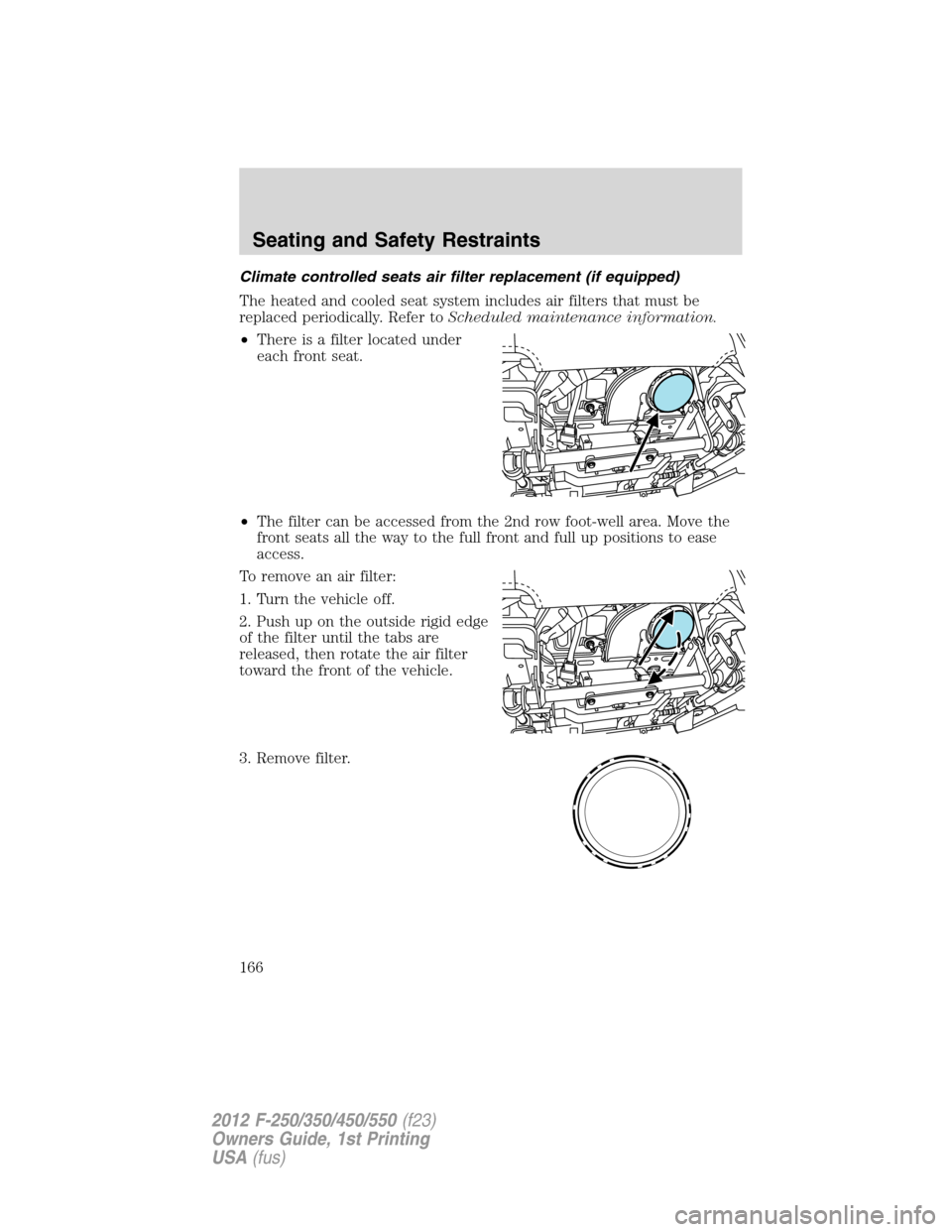
Climate controlled seats air filter replacement (if equipped)
The heated and cooled seat system includes air filters that must be
replaced periodically. Refer toScheduled maintenance information.
•There is a filter located under
each front seat.
•The filter can be accessed from the 2nd row foot-well area. Move the
front seats all the way to the full front and full up positions to ease
access.
To remove an air filter:
1. Turn the vehicle off.
2. Push up on the outside rigid edge
of the filter until the tabs are
released, then rotate the air filter
toward the front of the vehicle.
3. Remove filter.
Seating and Safety Restraints
166
2012 F-250/350/450/550(f23)
Owners Guide, 1st Printing
USA(fus)
Page 168 of 454
Easy-access/easy-out feature (if equipped)
The easy entry feature can be turned off or on through the vehicle
message center. Refer toMessage centerin theInstrument Cluster
chapter.
The easy entry feature automatically moves the driver’s seat 2 inches
(5 cm) forward when:
•the transmission is in P (Park)
•the key is inserted into the ignition cylinder
(If the seat is located less than 2 inches [5 cm] from the front of the seat
track, the seat will travel up to
14inch (6 mm) to the front of the seat
track).
The easy out feature automatically moves the driver’s seat 2 inches
(5 cm) backward when:
•the transmission is in P (Park)
•the key is removed from the ignition cylinder
(If the seat is located less than 2 inches (5 cm) from the rear of the seat
track, the seat will travel up to
14inch (6 mm) to the rear of the seat
track).
If the memory setting is programmed through the remote transmitter,
upon unlocking the door via remote entry system, the seat position will
travel to the desired memory setting less 2 inches (5 cm). Once entering
the vehicle and inserting the key in the ignition while in P (Park), the
easy entry feature will move the seat an additional 2 inches (5 cm) to
the desired memory location. SeeLocks and Securityfor activating the
memory seat feature through the remote entry system.
REAR SEATS
Non-adjustable second-row head restraints
Your vehicle is equipped with second row head restraints that are
non-adjustable.
WARNING:To minimize the risk of neck injury in the event of a
crash, the driver and passenger occupants should not sit in
and/or operate the vehicle, until the head restraint is placed in its
proper position. The driver should never adjust the head restraint
while the vehicle is in motion.
Seating and Safety Restraints
168
2012 F-250/350/450/550(f23)
Owners Guide, 1st Printing
USA(fus)
Page 177 of 454
Automatic locking mode
In this mode, the shoulder belt is automatically pre-locked. The belt will
still retract to remove any slack in the shoulder belt. The automatic
locking mode is not available on the driver safety belt or the optional
front or rear seat center safety belt.
When to use the automatic locking mode
This mode should be usedany timea child safety seat is installed in a
front outboard passenger seating position or any outboard rear seating
position (if equipped). The optional front and rear seat center safety belt
have a cinch mechanism. Refer toSafety belt with cinch tongueearlier
in this chapter. Children 12 years old and under should be properly
restrained in a rear seat whenever possible. Refer toSafety restraints
for childrenorSafety seats for childrenlater in this chapter.
How to use the automatic locking mode
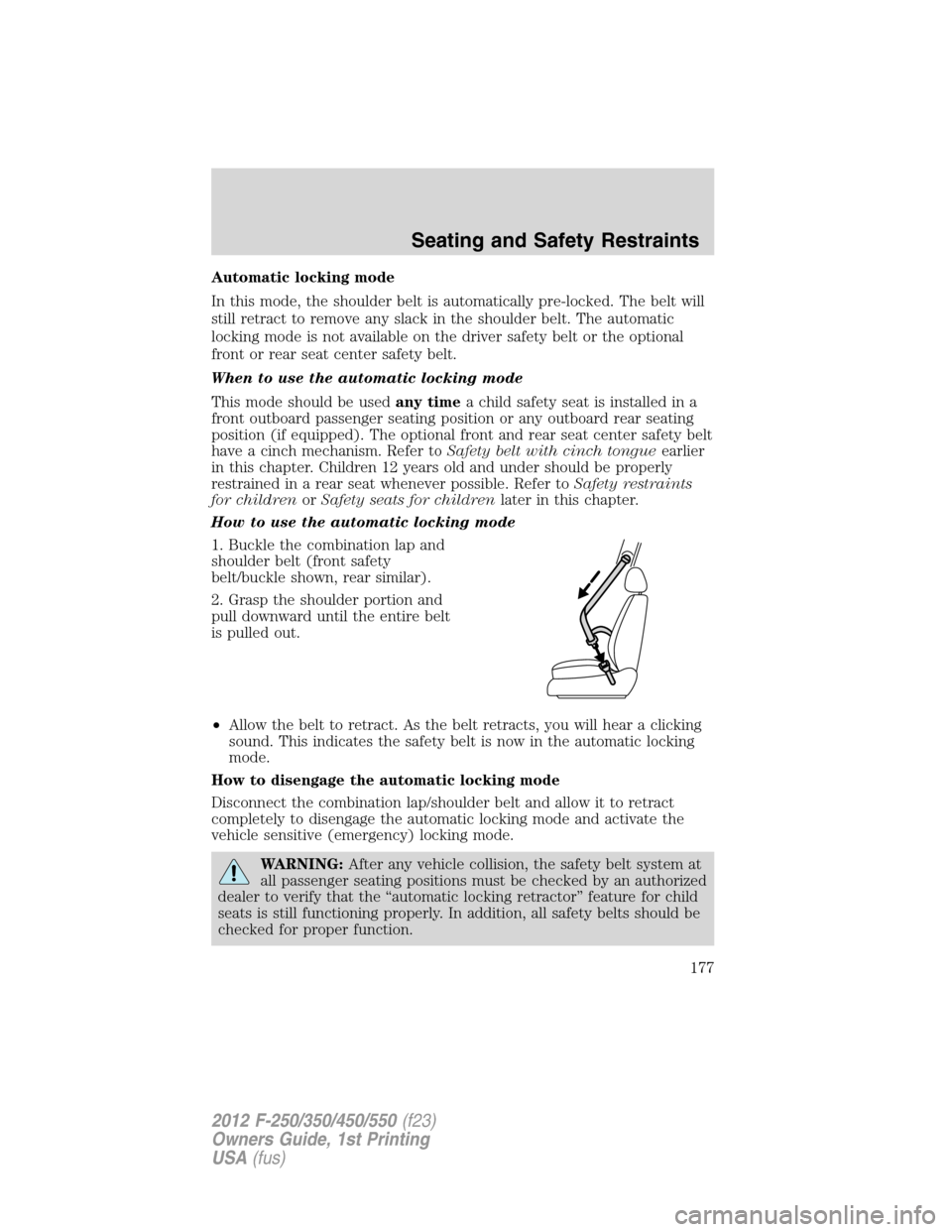
1. Buckle the combination lap and
shoulder belt (front safety
belt/buckle shown, rear similar).
2. Grasp the shoulder portion and
pull downward until the entire belt
is pulled out.
•Allow the belt to retract. As the belt retracts, you will hear a clicking
sound. This indicates the safety belt is now in the automatic locking
mode.
How to disengage the automatic locking mode
Disconnect the combination lap/shoulder belt and allow it to retract
completely to disengage the automatic locking mode and activate the
vehicle sensitive (emergency) locking mode.
WARNING:After any vehicle collision, the safety belt system at
all passenger seating positions must be checked by an authorized
dealer to verify that the “automatic locking retractor” feature for child
seats is still functioning properly. In addition, all safety belts should be
checked for proper function.
Seating and Safety Restraints
177
2012 F-250/350/450/550(f23)
Owners Guide, 1st Printing
USA(fus)
Page 207 of 454
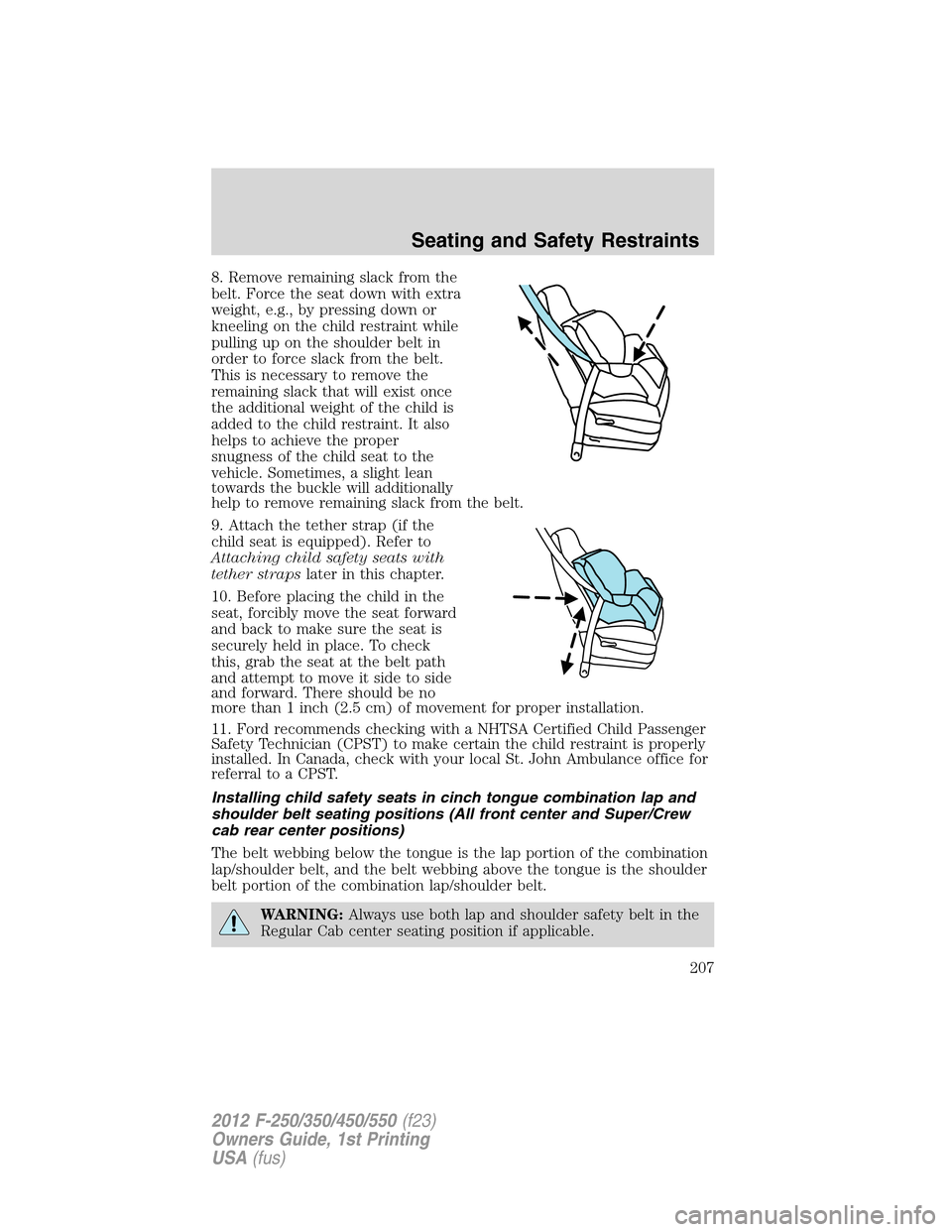
8. Remove remaining slack from the
belt. Force the seat down with extra
weight, e.g., by pressing down or
kneeling on the child restraint while
pulling up on the shoulder belt in
order to force slack from the belt.
This is necessary to remove the
remaining slack that will exist once
the additional weight of the child is
added to the child restraint. It also
helps to achieve the proper
snugness of the child seat to the
vehicle. Sometimes, a slight lean
towards the buckle will additionally
help to remove remaining slack from the belt.
9. Attach the tether strap (if the
child seat is equipped). Refer to
Attaching child safety seats with
tether strapslater in this chapter.
10. Before placing the child in the
seat, forcibly move the seat forward
and back to make sure the seat is
securely held in place. To check
this, grab the seat at the belt path
and attempt to move it side to side
and forward. There should be no
more than 1 inch (2.5 cm) of movement for proper installation.
11. Ford recommends checking with a NHTSA Certified Child Passenger
Safety Technician (CPST) to make certain the child restraint is properly
installed. In Canada, check with your local St. John Ambulance office for
referral to a CPST.
Installing child safety seats in cinch tongue combination lap and
shoulder belt seating positions (All front center and Super/Crew
cab rear center positions)
The belt webbing below the tongue is the lap portion of the combination
lap/shoulder belt, and the belt webbing above the tongue is the shoulder
belt portion of the combination lap/shoulder belt.
WARNING:Always use both lap and shoulder safety belt in the
Regular Cab center seating position if applicable.
Seating and Safety Restraints
207
2012 F-250/350/450/550(f23)
Owners Guide, 1st Printing
USA(fus)
Page 209 of 454
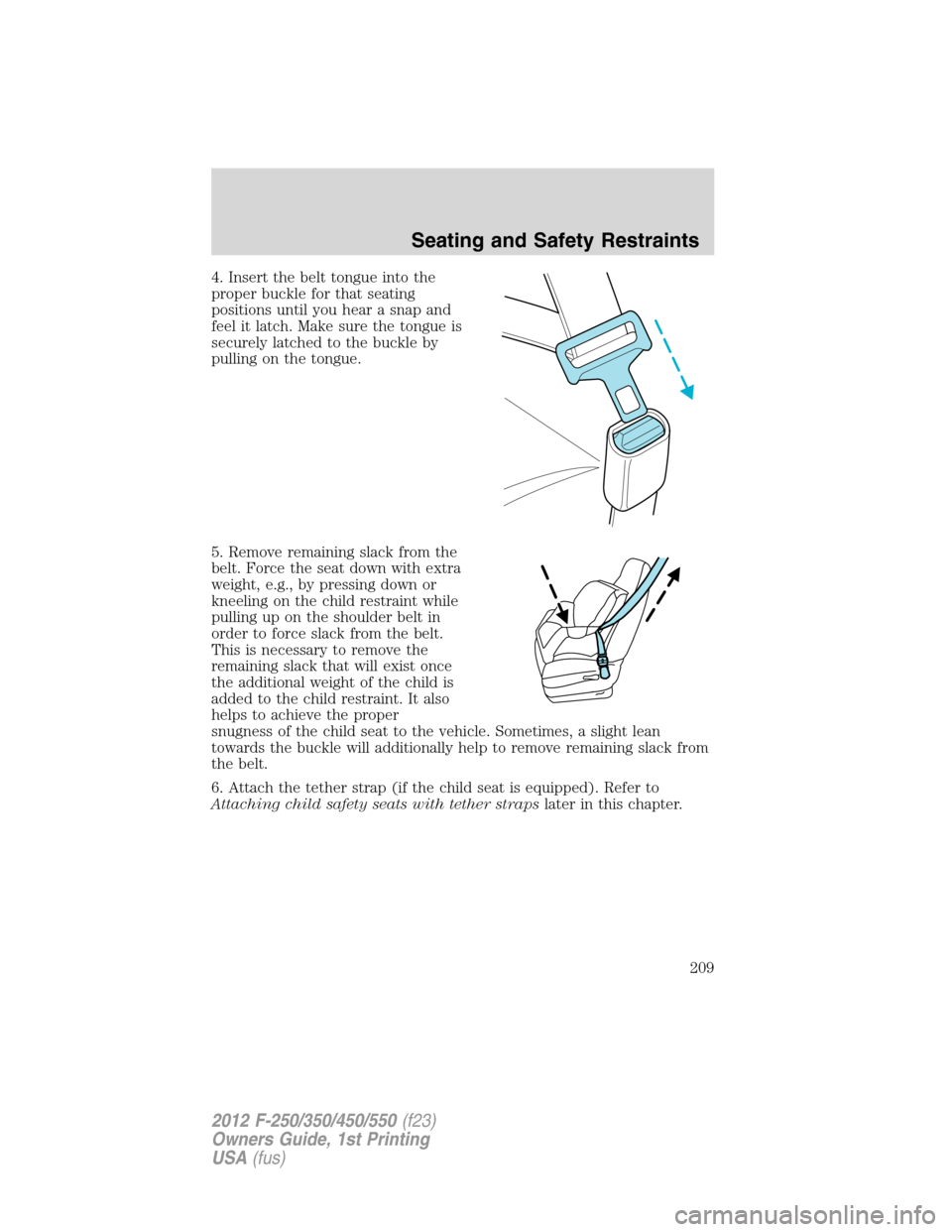
4. Insert the belt tongue into the
proper buckle for that seating
positions until you hear a snap and
feel it latch. Make sure the tongue is
securely latched to the buckle by
pulling on the tongue.
5. Remove remaining slack from the
belt. Force the seat down with extra
weight, e.g., by pressing down or
kneeling on the child restraint while
pulling up on the shoulder belt in
order to force slack from the belt.
This is necessary to remove the
remaining slack that will exist once
the additional weight of the child is
added to the child restraint. It also
helps to achieve the proper
snugness of the child seat to the vehicle. Sometimes, a slight lean
towards the buckle will additionally help to remove remaining slack from
the belt.
6. Attach the tether strap (if the child seat is equipped). Refer to
Attaching child safety seats with tether strapslater in this chapter.
Seating and Safety Restraints
209
2012 F-250/350/450/550(f23)
Owners Guide, 1st Printing
USA(fus)