2012 FORD FOCUS ELECTRIC brake
[x] Cancel search: brakePage 274 of 380
DRIVING THROUGH WATER
Note:Driving through deep water may allow water into the transmission
and motor causing internal damage. Have the fluid checked and, if water
is found, replace the fluid.
Do not drive quickly through standing water, especially if the depth is
unknown. Traction or brake capability may be limited and if enough
water is present, the vehicle may stall.
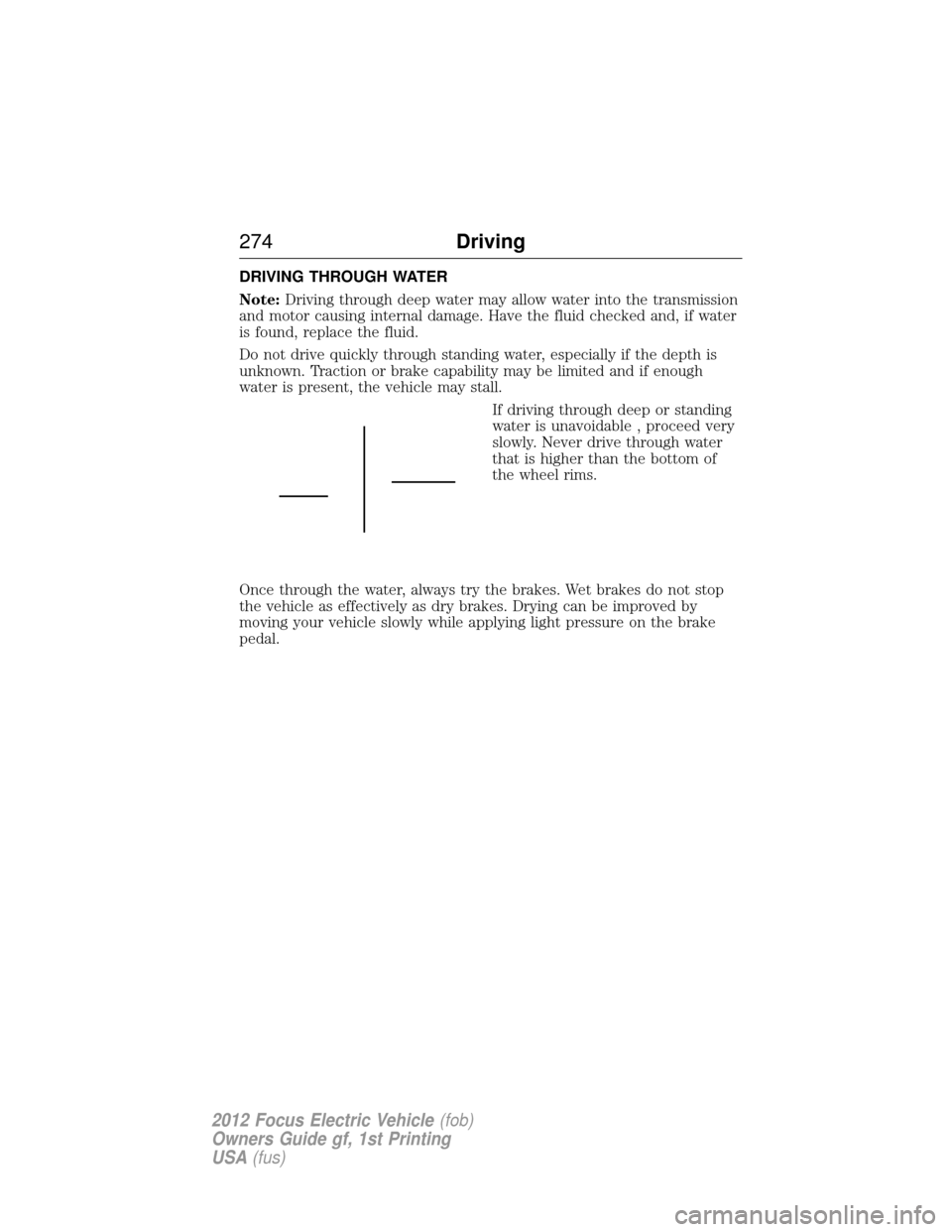
If driving through deep or standing
water is unavoidable , proceed very
slowly. Never drive through water
that is higher than the bottom of
the wheel rims.
Once through the water, always try the brakes. Wet brakes do not stop
the vehicle as effectively as dry brakes. Drying can be improved by
moving your vehicle slowly while applying light pressure on the brake
pedal.
274 Driving
2012 Focus Electric Vehicle (fob)
Owners Guide gf, 1st Printing
USA (fus)
Page 277 of 380
HIGH-VOLTAGE SHUTOFF
In the event of a crash:
•Take the same actions as you would take in a crash involving a
gasoline-powered vehicle — exit the vehicle safely or await the
assistance of an emergency responder if they are unable to get out on
their own, move a safe distance away from the vehicle, and notify the
authorities of the crash.
• If possible, inform emergency responders that the vehicle is electric
powered.
• Vehicle owners should not store a severely damaged vehicle in a
garage or near other vehicles.
The high-voltage shutoff operation shuts off power from the high voltage
battery after a collision, or if your vehicle receives a substantial physical
jolt.
To reactivate the vehicle after either event perform the following steps:
1. Press the POWER START/STOP button to power the vehicle on.
2. Press the POWER START/STOP button to power the vehicle off.
3. Press the POWER START/STOP button to power the vehicle on again.
Note: After completing this procedure the vehicle will detect if the
electrical system is safe and reactivate automatically. Once your vehicle
determines the electrical system safe you can start your vehicle as you
would normally by pressing the brake pedal in combination with the
POWER START/STOP button.
Roadside Emergencies 277
2012 Focus Electric Vehicle(fob)
Owners Guide gf, 1st Printing
USA (fus)
Page 284 of 380
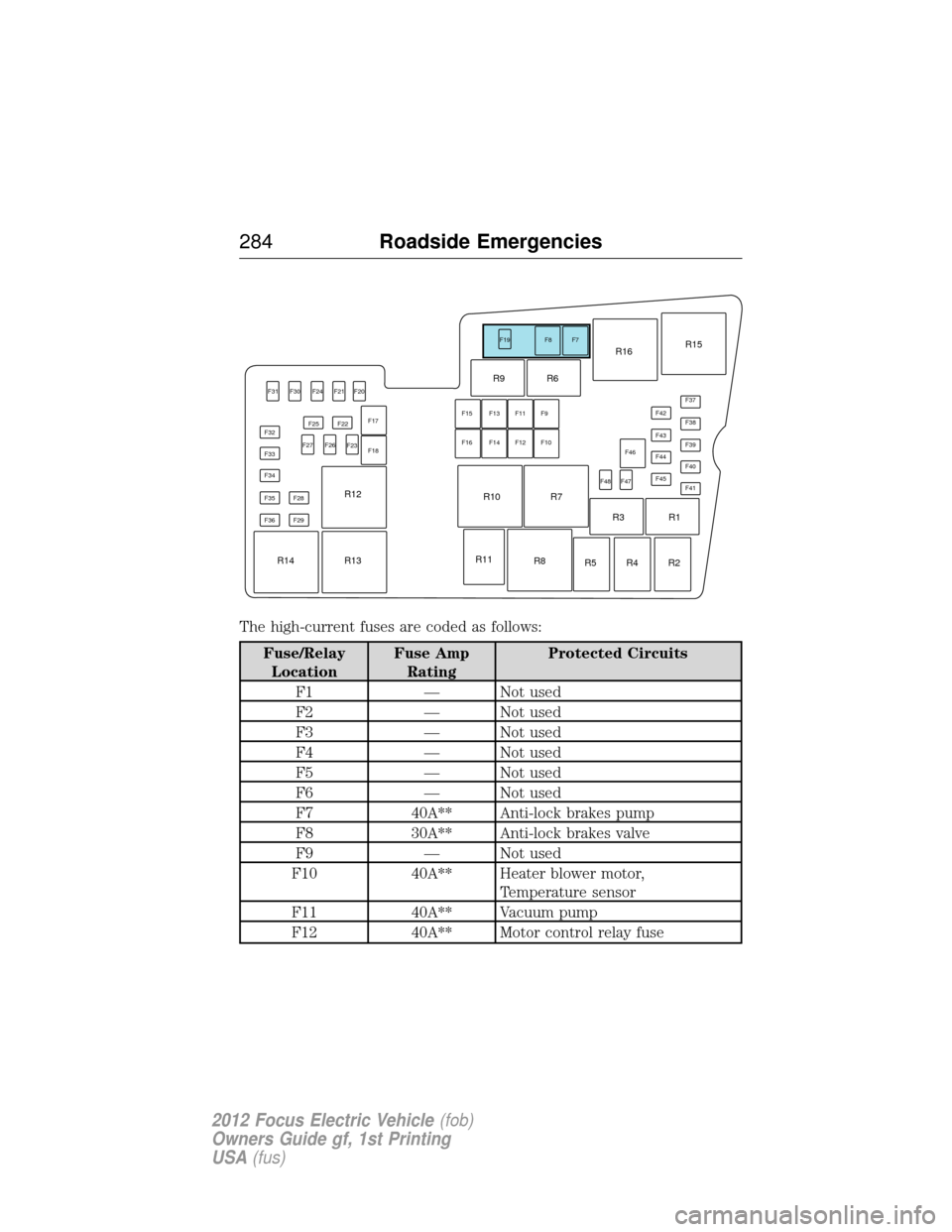
The high-current fuses are coded as follows:
Fuse/RelayLocation Fuse Amp
Rating Protected Circuits
F1 — Not used
F2 — Not used
F3 — Not used
F4 — Not used
F5 — Not used
F6 — Not used
F7 40A** Anti-lock brakes pump
F8 30A** Anti-lock brakes valve
F9 — Not used
F10 40A** Heater blower motor,
Temperature sensor
F11 40A** Vacuum pump
F12 40A** Motor control relay fuse
F30
F31
F24 F21 F20
F25 F22 F23F17
R10R9 R6
F15
F19
F8 F7
F37
F38
F39
F40
F41
F43
F42
F44
F45
F46
F48
F47
F13 F11 F9
F16 F14 F12 F10
R11 R8R7 R16
R15
R3
R5 R4 R2 R1
F18
F26
F27
F32
F33
F34
F35 F28
F29
R12
R13
R14
F36
284 Roadside Emergencies
2012 Focus Electric Vehicle (fob)
Owners Guide gf, 1st Printing
USA (fus)
Page 285 of 380
Fuse/RelayLocation Fuse Amp
Rating Protected Circuits
F13 40A** On-board charger
F14 40A** Heater element 1
F15 — Not used
F16 40A** Heater element 2
F17 — Not used
F18 20A** Front wiper motor
F19 5A* Anti-lock brake control module
F20 15A* Horn
F21 5A* Stop light switch
F22 15A* Battery monitoring sensor
F23 5A* Relay coils
F24 5A* Light switch module
F25 — Not used
F26 10A* Powertrain Control Module (PCM)
F27 15A* Charger port light ring
F28 5A* Vacuum pump monitor
F29 — Not used
F30 5A* Transmission control module
F31 10A* Smart datalink connector;
Diagnostic connector
F32 10A* Compressor bypass valves,
Coolant valves, Electronic fan
control module relay
F33 10A* PCM (PSR feedback), A/C
compressor solenoid
F34 15A* PCM (contactor sense), Battery
electronics control module (PSR)
F35 — Not used
F36 20A* Coolant water pumps
F37 5A* Vehicle audible speaker for
pedestrians
Roadside Emergencies 285
2012 Focus Electric Vehicle(fob)
Owners Guide gf, 1st Printing
USA (fus)
Page 287 of 380
CHANGING THE TIRES
If you get a flat tire while driving, do not apply the brake heavily.
Instead, gradually decrease your speed. Hold the steering wheel firmly
and slowly move to a safe place on the side of the road.
Note:The tire pressure monitoring system (TPMS) indicator light will
illuminate when the spare tire is in use. To restore the full functionality
of the monitoring system, all road wheels equipped with tire pressure
monitoring sensors must be mounted on the vehicle.
Have a flat serviced by an authorized dealer in order to prevent damage to
the TPMS sensors, refer to Tire pressure monitoring system (TPMS) in
the Tires, Wheels and Loading chapter. Replace the spare tire with a road
tire as soon as possible. During repairing or replacing of the flat tire, have
the authorized dealer inspect the TPMS sensor for damage.
WARNING: The use of tire sealants may damage your tire
pressure monitoring system (TPMS) and should not be used.
However, if you must use a sealant, the TPMS sensor and valve stem on
the wheel must be replaced by an authorized Ford dealer.
WARNING: Refer toTire pressure monitoring system (TPMS)
in the Tires, Wheels and Loading chapter for important
information. If the tire pressure monitor sensor becomes damaged, it
will no longer function.
Dissimilar Spare Tire and Wheel Assembly Information
WARNING: Failure to follow these guidelines could result in an
increased risk of loss of vehicle control, injury or death.
If you have a dissimilar spare tire and wheel assembly , then it is
intended for temporary use only. This means that if you need to use it,
you should replace it as soon as possible with a road tire and wheel
assembly that is the same size and type as the road tires and wheels that
were originally provided by Ford. If the dissimilar spare tire or wheel is
damaged, it should be replaced rather than repaired.
A dissimilar spare tire and wheel assembly is defined as a spare tire or
wheel that is different in brand, size or appearance from the road tires
and wheels and can be one of three types:
1. T-type mini-spare: This spare tire begins with the letter “T” for tire
size and may have “Temporary Use Only” molded in the sidewall
Roadside Emergencies 287
2012 Focus Electric Vehicle(fob)
Owners Guide gf, 1st Printing
USA (fus)
Page 291 of 380
Tips for use of the Temporary Mobility Kit
Read the following list of tips to ensure safe operation of the temporary
mobility kit:
•Before operating the temporary mobility kit, make sure your vehicle is
safely off the road and away from moving traffic. Turn on the hazard
lights.
• Always set the parking brake to ensure the vehicle doesn’t move
unexpectedly.
• Do not remove any foreign objects, such as nails or screws, from the
tire.
• When using the temporary mobility kit, leave the motor running so the
compressor doesn’t drain the vehicle’s battery.
• Do not allow the compressor to operate continuously for more than
15 minutes; this will help prevent the compressor from overheating.
• Never leave the temporary mobility kit unattended when it is
operating.
• Sealant compound contains latex. Make sure that you use the
non-latex gloves provided to avoid an allergic reaction.
• Keep the temporary mobility kit away from children.
• Only use the temporary mobility kit when the ambient temperature is
between -22°F (–30°C) and 158°F (70°C).
• Only use the sealing compound before the use by date. The use by
date is on the lower right hand corner of the label located on the
sealant canister (bottle). Note:Check the use by date regularly and
replace the canister after four years.
• Do not store the temporary mobility kit unsecured inside the
passenger compartment of the vehicle as it may cause injury during a
sudden stop or collision. Always store the kit in its original location.
• After sealant use, the TPMS sensor and valve stem on the wheel must
be replaced by an authorized Ford dealer.
• When inflating a tire or other objects, use the black air hose only. Do
not use the transparent hose which is designed for sealant application
only.
• Operating the temporary mobility kit could cause an electrical
disturbance in radio, CD, and DVD player operation (if equipped). .
Roadside Emergencies 291
2012 Focus Electric Vehicle(fob)
Owners Guide gf, 1st Printing
USA (fus)
Page 292 of 380
What to do when a Tire Is Punctured
A tire puncture within the tire’s tread area can be repaired in two stages
with the temporary mobility kit:
•In the first stage, the tire will be reinflated with a sealing compound
and air. After the tire has been reinflated, you will need to drive the
vehicle a short distance (approximately 4 miles [6 km]) to distribute
the sealant in the tire.
• In the second stage, you will need to check the tire pressure and
adjust, if necessary, to the vehicle’s tire inflation pressure.
First Stage: Reinflating the Tire with Sealing Compound and Air
WARNING: Do not stand directly over the temporary mobility
kit while inflating the tire. If you notice any unusual bulges or
deformations in the tire’s sidewall during inflation, stop and call
roadside assistance.
WARNING: If the tire doesn’t inflate to the recommended tire
pressure within 15 minutes, stop and call roadside assistance.
Preparation
Park the vehicle in a safe, level and secure area, away from moving
traffic. Turn the hazard lights on. Apply the parking brake and turn the
motor off. Inspect the flat tire for visible damage.
Sealant compound contains latex. To avoid any allergic reactions, use the
non-latex gloves located in the accessory box on the underside of the
temporary mobility kit housing.
Do not remove any foreign object that has pierced the tire. If a puncture
is located in the tire sidewall, stop and call roadside assistance.
1. Remove the valve cap from the tire valve.
2. Unwrap the clear tube from the compressor housing.
3. Remove the tube cap and fasten the metal connector of the tube to the
tire valve, turning clockwise. Make sure the connection is tightly fastened.
292 Roadside Emergencies
2012 Focus Electric Vehicle (fob)
Owners Guide gf, 1st Printing
USA (fus)
Page 298 of 380
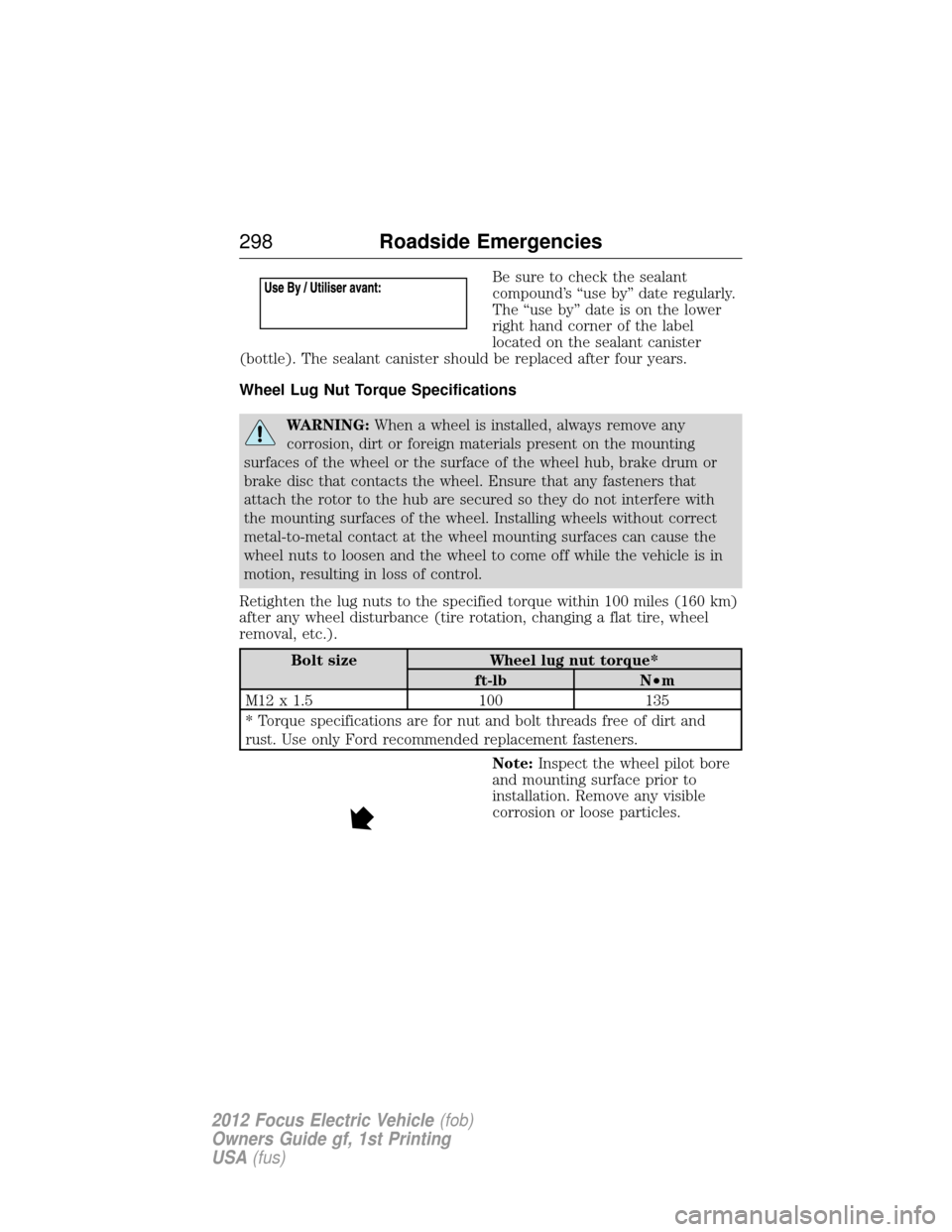
Be sure to check the sealant
compound’s “use by” date regularly.
The “use by” date is on the lower
right hand corner of the label
located on the sealant canister
(bottle). The sealant canister should be replaced after four years.
Wheel Lug Nut Torque Specifications
WARNING: When a wheel is installed, always remove any
corrosion, dirt or foreign materials present on the mounting
surfaces of the wheel or the surface of the wheel hub, brake drum or
brake disc that contacts the wheel. Ensure that any fasteners that
attach the rotor to the hub are secured so they do not interfere with
the mounting surfaces of the wheel. Installing wheels without correct
metal-to-metal contact at the wheel mounting surfaces can cause the
wheel nuts to loosen and the wheel to come off while the vehicle is in
motion, resulting in loss of control.
Retighten the lug nuts to the specified torque within 100 miles (160 km)
after any wheel disturbance (tire rotation, changing a flat tire, wheel
removal, etc.).
Bolt size Wheel lug nut torque*
ft-lb N•m
M12 x 1.5 100135
* Torque specifications are for nut and bolt threads free of dirt and
rust. Use only Ford recommended replacement fasteners.
Note:Inspect the wheel pilot bore
and mounting surface prior to
installation. Remove any visible
corrosion or loose particles.
298 Roadside Emergencies
2012 Focus Electric Vehicle (fob)
Owners Guide gf, 1st Printing
USA (fus)