Page 230 of 306
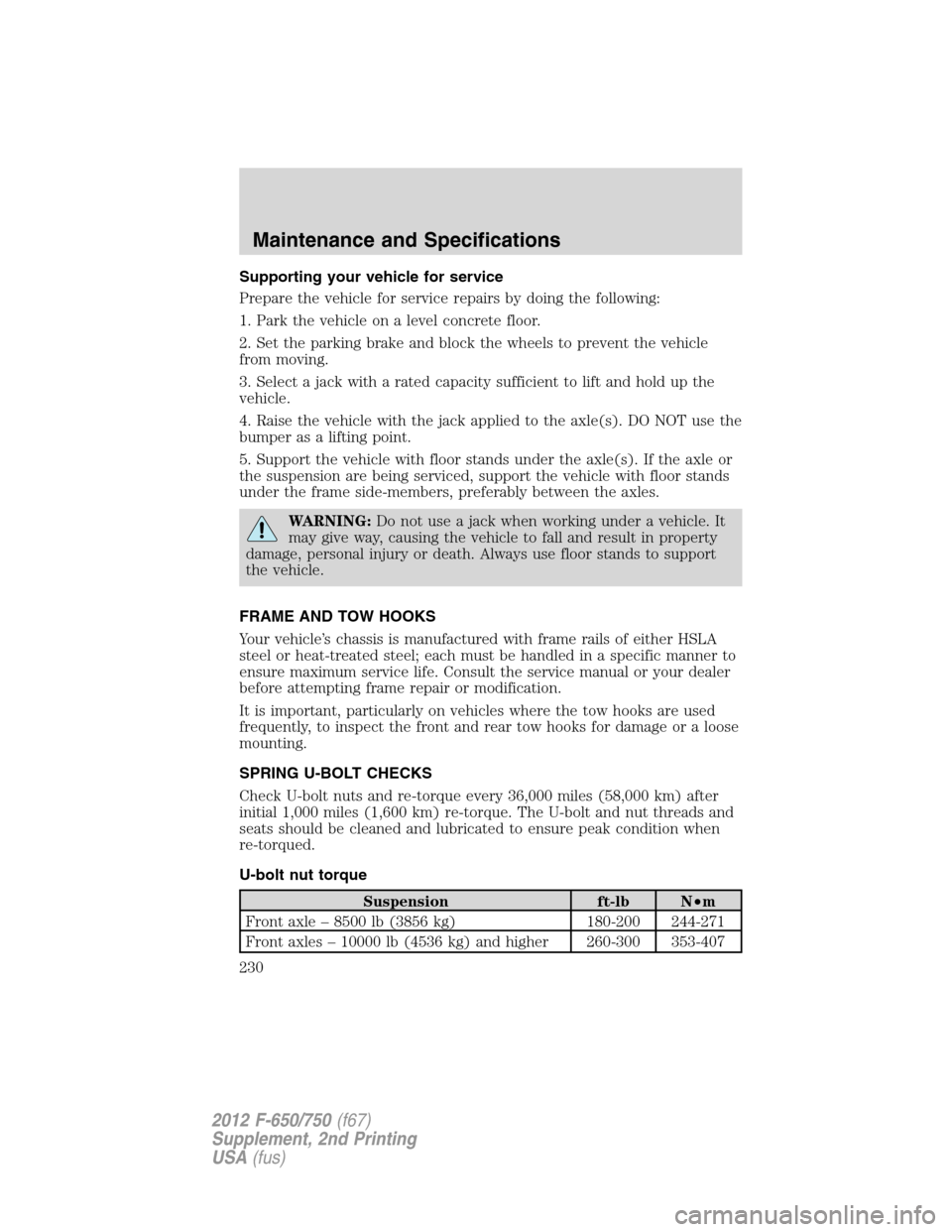
Supporting your vehicle for service
Prepare the vehicle for service repairs by doing the following:
1. Park the vehicle on a level concrete floor.
2. Set the parking brake and block the wheels to prevent the vehicle
from moving.
3. Select a jack with a rated capacity sufficient to lift and hold up the
vehicle.
4. Raise the vehicle with the jack applied to the axle(s). DO NOT use the
bumper as a lifting point.
5. Support the vehicle with floor stands under the axle(s). If the axle or
the suspension are being serviced, support the vehicle with floor stands
under the frame side-members, preferably between the axles.
WARNING:Do not use a jack when working under a vehicle. It
may give way, causing the vehicle to fall and result in property
damage, personal injury or death. Always use floor stands to support
the vehicle.
FRAME AND TOW HOOKS
Your vehicle’s chassis is manufactured with frame rails of either HSLA
steel or heat-treated steel; each must be handled in a specific manner to
ensure maximum service life. Consult the service manual or your dealer
before attempting frame repair or modification.
It is important, particularly on vehicles where the tow hooks are used
frequently, to inspect the front and rear tow hooks for damage or a loose
mounting.
SPRING U-BOLT CHECKS
Check U-bolt nuts and re-torque every 36,000 miles (58,000 km) after
initial 1,000 miles (1,600 km) re-torque. The U-bolt and nut threads and
seats should be cleaned and lubricated to ensure peak condition when
re-torqued.
U-bolt nut torque
Suspension ft-lb N•m
Front axle – 8500 lb (3856 kg) 180-200 244-271
Front axles – 10000 lb (4536 kg) and higher 260-300 353-407
Maintenance and Specifications
230
2012 F-650/750(f67)
Supplement, 2nd Printing
USA(fus)
Page 243 of 306

If rib tire is used on front axle and lug or off-road type on rear axle
positions:
1.Front (Steering) Axle:Replace tires at front wheels when tread is
worn to 4/32 inch (3 mm) or less.
2.Rear Axles:Tires must be removed when the tread is worn to
2/32 inch (2 mm) or less. Tires identified with the word “re-groovable”
molded on the sidewall can be re-grooved. A minimum of 3/32 inch
(2.5 mm) of under-tread must be left at the bottom of the grooves.
Wheel and tire balancing
Out-of-round or out-of-balance wheels or tires can cause vehicle
vibration, bounce and shimmy. Replace damaged or out-of-round wheels.
Out-of-round tires and wheel assemblies can be corrected by re-clocking
the tire relative to the wheel.
The tire and wheel assembly should then be dynamically balanced.
Wear
Radial tires can exhibit three types of normal wear patterns:
1. Even
2. Erosion
3. Chamfer
Even wearis a sign that the tire is being properly used and maintained.
Erosion wearhas also been called rolling wear, channel or river wear.
Erosion wear is found more often at free rolling tires. This is an
indication that the tire is being used in a slow wearing operation. What
happens is that the belt plies are held very rigid and the tread is not
allowed to distort as it passes through the contact area. Wear only occurs
at the edge of the tread. No corrective action required. If erosion gets to
be 1/16 inch (2 mm) or more, the tire may be rotated to a drive axle.
Chamfer or shoulder wear,with tires inflated properly, is a normal
tendency of most radial tire designs. If both inside and outside shoulders
are wearing evenly around the tire, no further action is required.
Over-inflation is not effective in correcting this effect.
Tires: Irregular Wear
If irregular wear is present, check the axle alignment, tire pressure,
wheel balancing, shock and suspension component condition, and wheel
bearing end play.
This condition not only shortens tire life, but adversely affects the
handling of your vehicle, which is dangerous.
Maintenance and Specifications
243
2012 F-650/750(f67)
Supplement, 2nd Printing
USA(fus)
Page 256 of 306
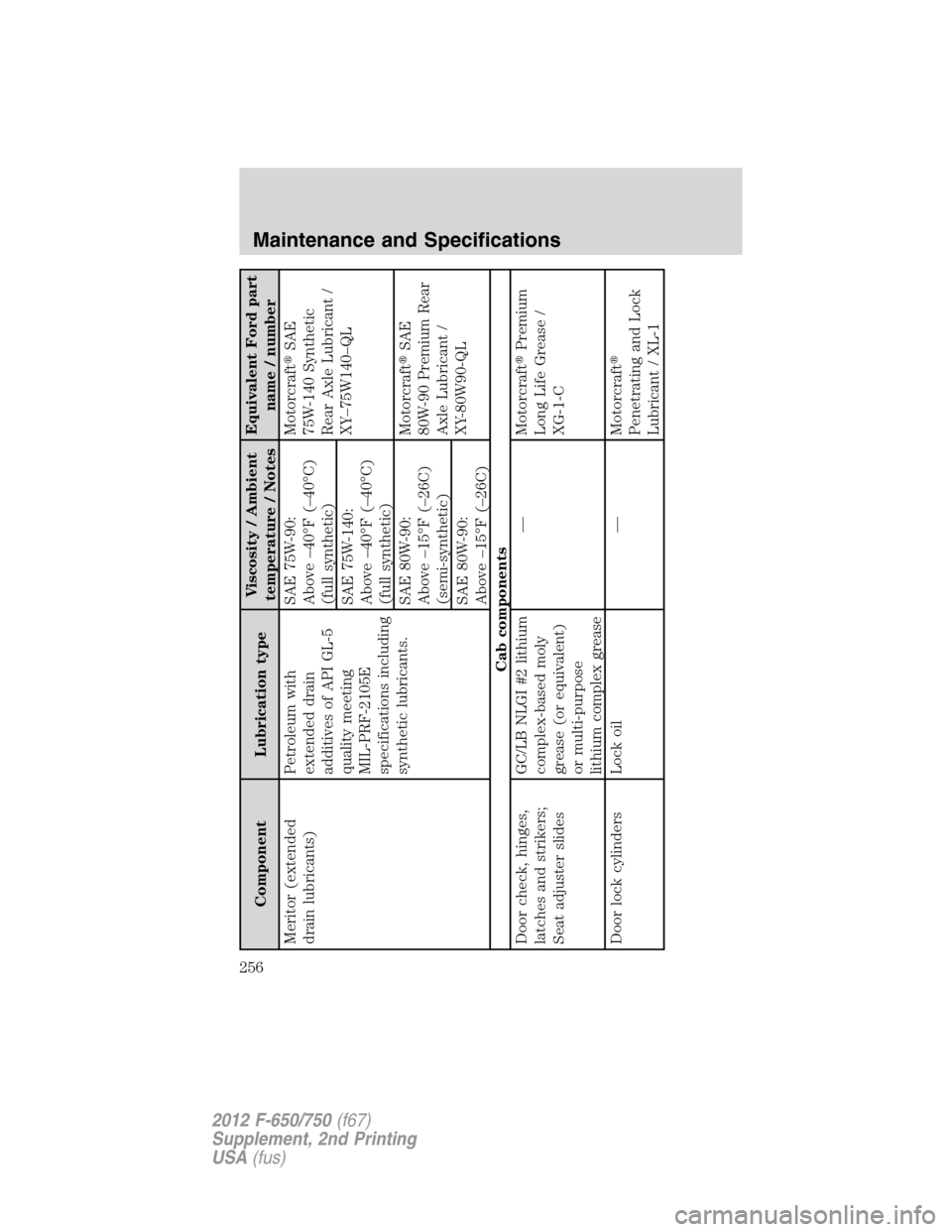
Component Lubrication typeViscosity / Ambient
temperature / NotesEquivalent Ford part
name / number
Meritor (extended
drain lubricants)Petroleum with
extended drain
additives of API GL-5
quality meeting
MIL-PRF-2105E
specifications including
synthetic lubricants.SAE 75W-90:
Above –40°F (–40°C)
(full synthetic)Motorcraft�SAE
75W-140 Synthetic
Rear Axle Lubricant /
XY–75W140–QL
SAE 75W-140:
Above –40°F (–40°C)
(full synthetic)
SAE 80W-90:
Above –15°F (–26C)
(semi-synthetic)Motorcraft�SAE
80W-90 Premium Rear
Axle Lubricant /
XY-80W90-QL
SAE 80W-90:
Above –15°F (–26C)
Cab components
Door check, hinges,
latches and strikers;
Seat adjuster slidesGC/LB NLGI #2 lithium
complex-based moly
grease (or equivalent)
or multi-purpose
lithium complex grease— Motorcraft�Premium
Long Life Grease /
XG-1-C
Door lock cylinders Lock oil — Motorcraft�
Penetrating and Lock
Lubricant / XL-1
Maintenance and Specifications
256
2012 F-650/750(f67)
Supplement, 2nd Printing
USA(fus)
Page 259 of 306
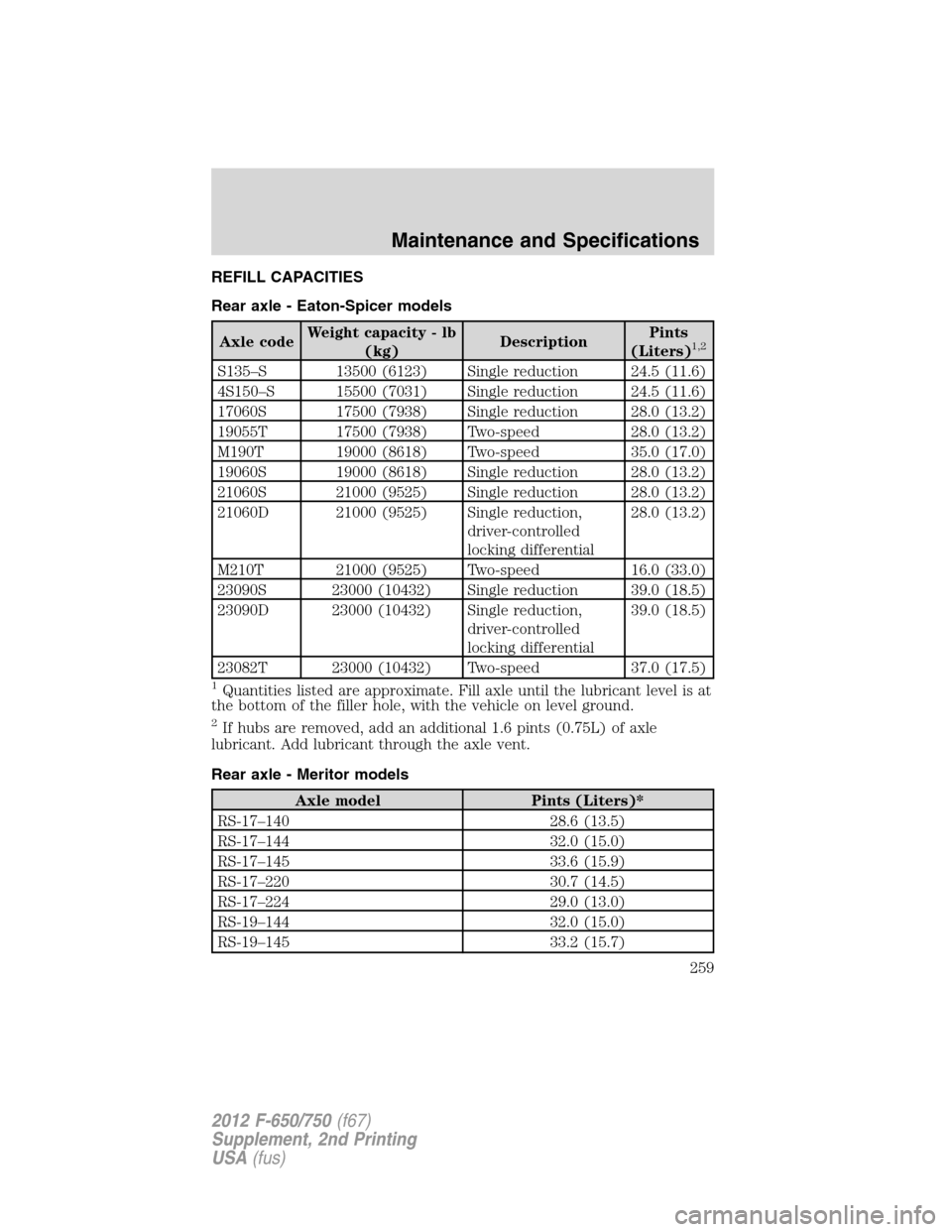
REFILL CAPACITIES
Rear axle - Eaton-Spicer models
Axle codeWeight capacity - lb
(kg)DescriptionPints
(Liters)1,2
S135–S 13500 (6123) Single reduction 24.5 (11.6)
4S150–S 15500 (7031) Single reduction 24.5 (11.6)
17060S 17500 (7938) Single reduction 28.0 (13.2)
19055T 17500 (7938) Two-speed 28.0 (13.2)
M190T 19000 (8618) Two-speed 35.0 (17.0)
19060S 19000 (8618) Single reduction 28.0 (13.2)
21060S 21000 (9525) Single reduction 28.0 (13.2)
21060D 21000 (9525) Single reduction,
driver-controlled
locking differential28.0 (13.2)
M210T 21000 (9525) Two-speed 16.0 (33.0)
23090S 23000 (10432) Single reduction 39.0 (18.5)
23090D 23000 (10432) Single reduction,
driver-controlled
locking differential39.0 (18.5)
23082T 23000 (10432) Two-speed 37.0 (17.5)
1Quantities listed are approximate. Fill axle until the lubricant level is at
the bottom of the filler hole, with the vehicle on level ground.
2If hubs are removed, add an additional 1.6 pints (0.75L) of axle
lubricant. Add lubricant through the axle vent.
Rear axle - Meritor models
Axle model Pints (Liters)*
RS-17–140 28.6 (13.5)
RS-17–144 32.0 (15.0)
RS-17–145 33.6 (15.9)
RS-17–220 30.7 (14.5)
RS-17–224 29.0 (13.0)
RS-19–144 32.0 (15.0)
RS-19–145 33.2 (15.7)
Maintenance and Specifications
259
2012 F-650/750(f67)
Supplement, 2nd Printing
USA(fus)
Page 269 of 306
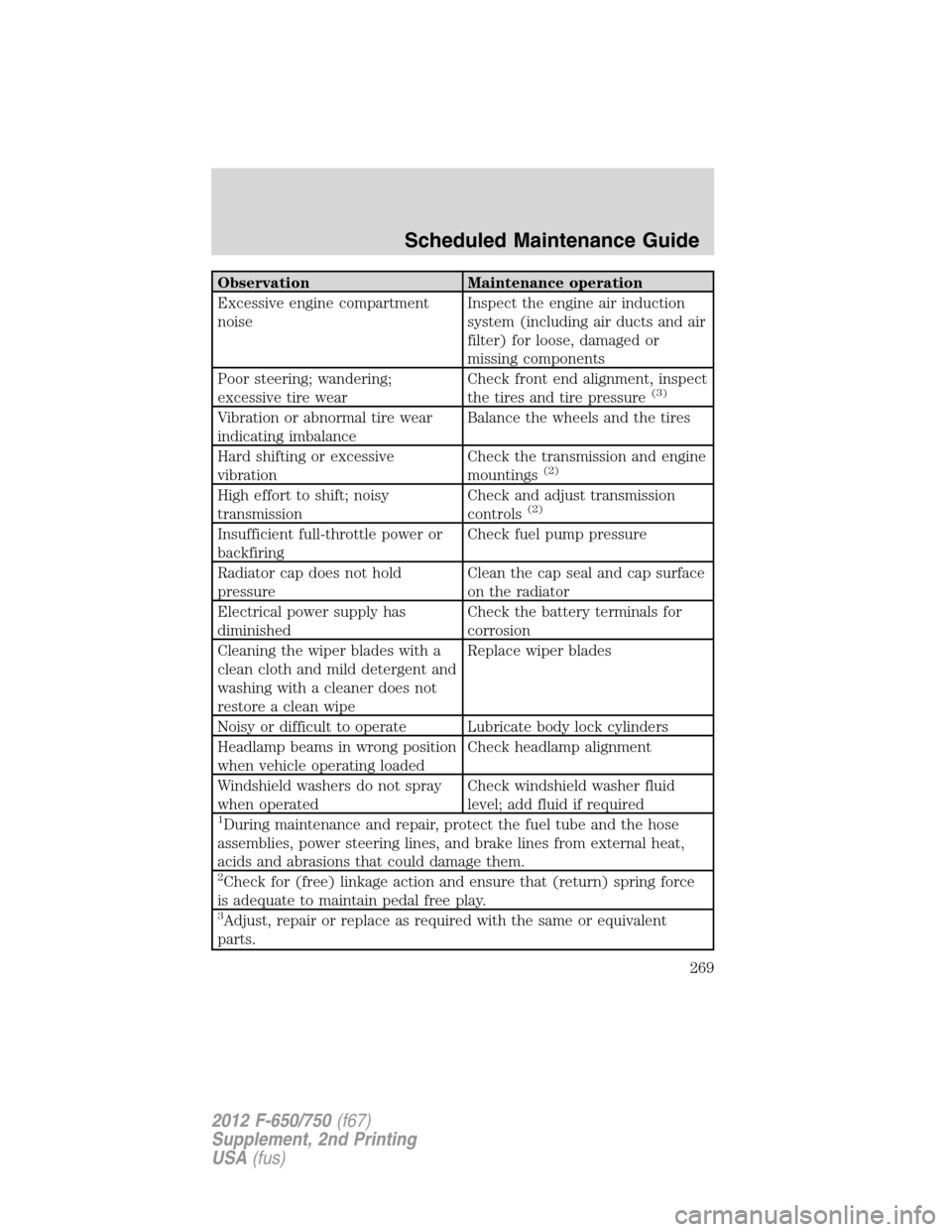
Observation Maintenance operation
Excessive engine compartment
noiseInspect the engine air induction
system (including air ducts and air
filter) for loose, damaged or
missing components
Poor steering; wandering;
excessive tire wearCheck front end alignment, inspect
the tires and tire pressure
(3)
Vibration or abnormal tire wear
indicating imbalanceBalance the wheels and the tires
Hard shifting or excessive
vibrationCheck the transmission and engine
mountings
(2)
High effort to shift; noisy
transmissionCheck and adjust transmission
controls(2)
Insufficient full-throttle power or
backfiringCheck fuel pump pressure
Radiator cap does not hold
pressureClean the cap seal and cap surface
on the radiator
Electrical power supply has
diminishedCheck the battery terminals for
corrosion
Cleaning the wiper blades with a
clean cloth and mild detergent and
washing with a cleaner does not
restore a clean wipeReplace wiper blades
Noisy or difficult to operate Lubricate body lock cylinders
Headlamp beams in wrong position
when vehicle operating loadedCheck headlamp alignment
Windshield washers do not spray
when operatedCheck windshield washer fluid
level; add fluid if required
1During maintenance and repair, protect the fuel tube and the hose
assemblies, power steering lines, and brake lines from external heat,
acids and abrasions that could damage them.
2Check for (free) linkage action and ensure that (return) spring force
is adequate to maintain pedal free play.
3Adjust, repair or replace as required with the same or equivalent
parts.
Scheduled Maintenance Guide
269
2012 F-650/750(f67)
Supplement, 2nd Printing
USA(fus)
Page 277 of 306
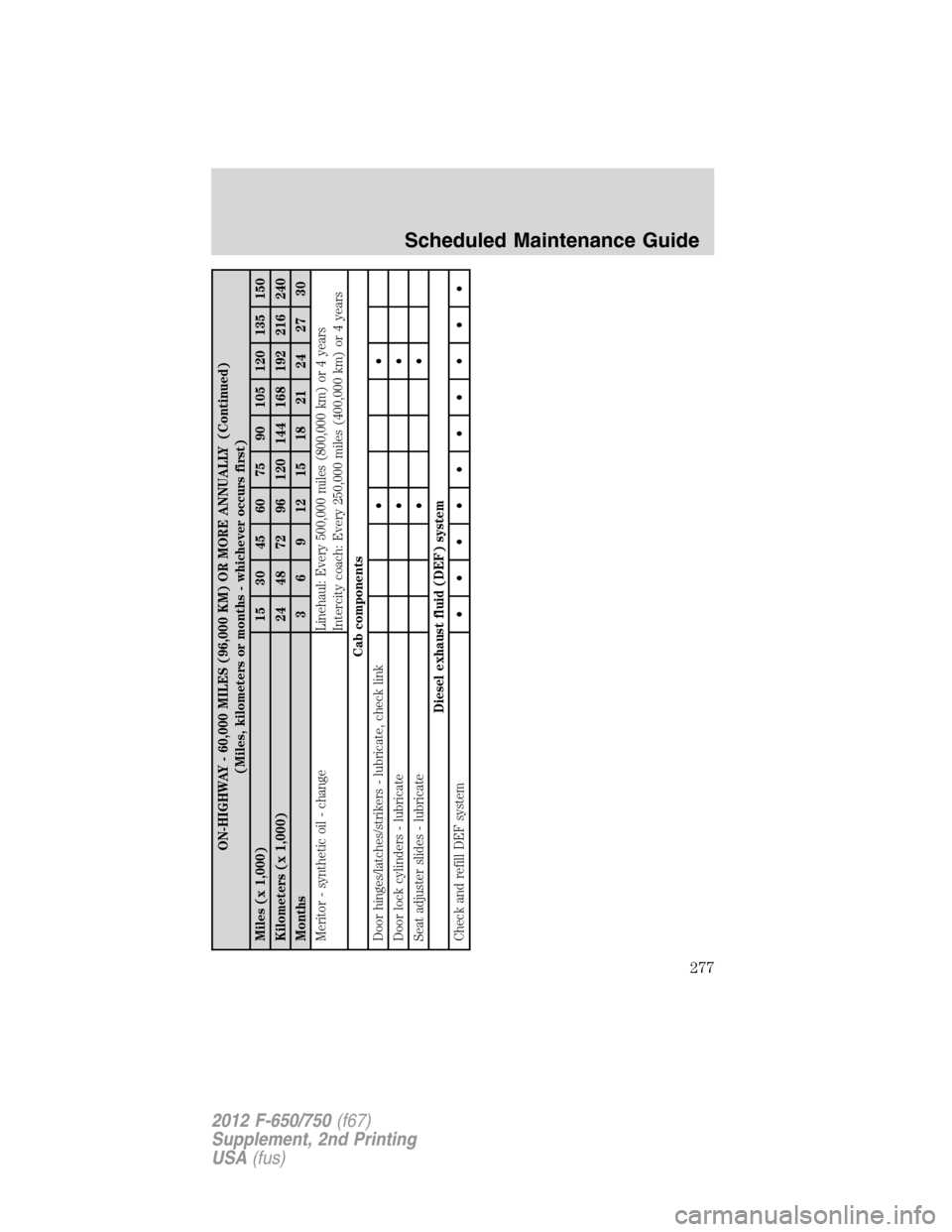
ON-HIGHWAY - 60,000 MILES (96,000 KM) OR MORE ANNUALLY (Continued)
(Miles, kilometers or months - whichever occurs first)
Miles (x 1,000) 15 30 45 60 75 90 105 120 135 150
Kilometers (x 1,000) 24 48 72 96 120 144 168 192 216 240
Months 3 6 9 12 15 18 21 24 27 30
Meritor - synthetic oil - change Linehaul: Every 500,000 miles (800,000 km) or 4 years
Intercity coach: Every 250,000 miles (400,000 km) or 4 years
Cab components
Door hinges/latches/strikers - lubricate, check link••
Door lock cylinders - lubricate••
Seat adjuster slides - lubricate••
Diesel exhaust fluid (DEF) system
Check and refill DEF system••••••••••
Scheduled Maintenance Guide
277
2012 F-650/750(f67)
Supplement, 2nd Printing
USA(fus)
Page 281 of 306
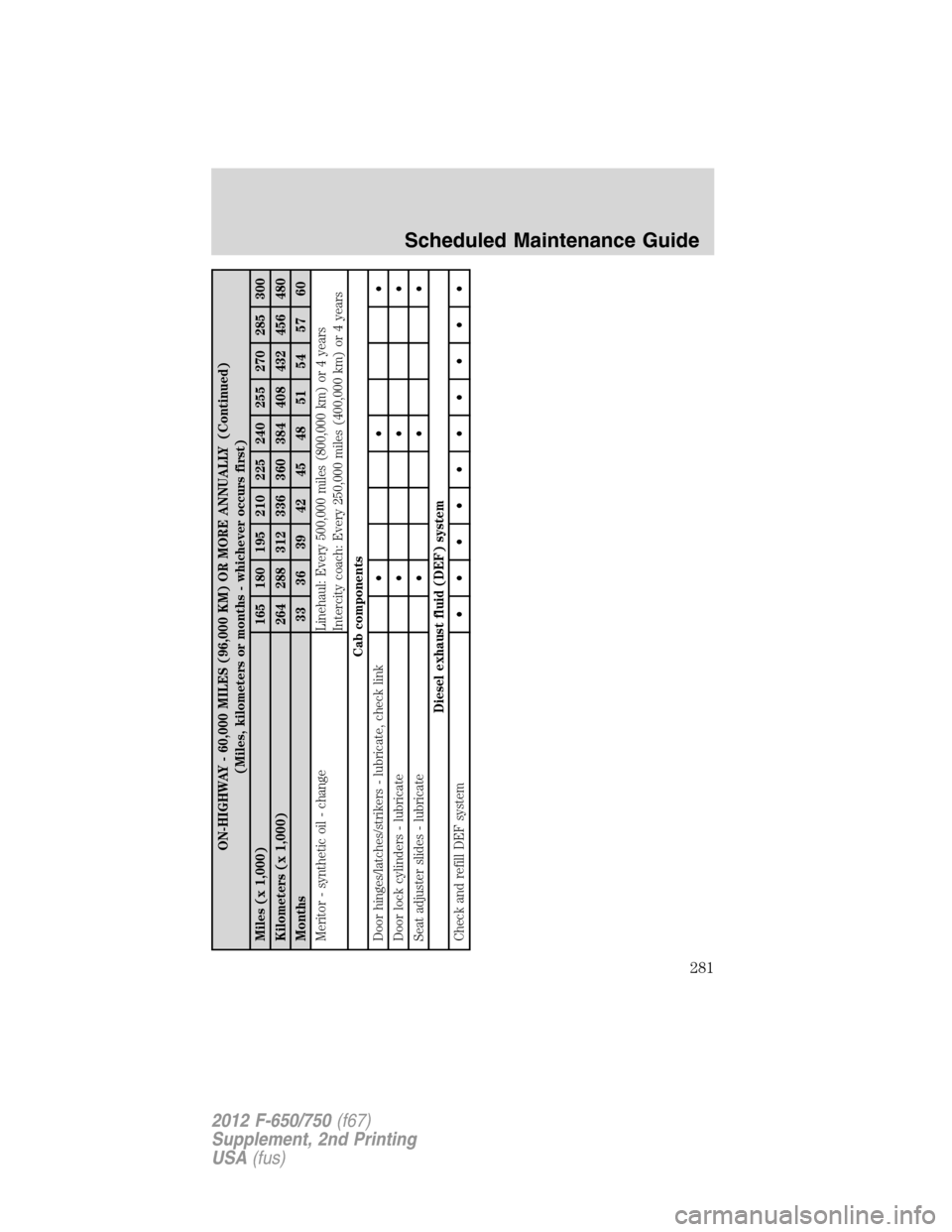
ON-HIGHWAY - 60,000 MILES (96,000 KM) OR MORE ANNUALLY (Continued)
(Miles, kilometers or months - whichever occurs first)
Miles (x 1,000) 165 180 195 210 225 240 255 270 285 300
Kilometers (x 1,000) 264 288 312 336 360 384 408 432 456 480
Months 33 36 39 42 45 48 51 54 57 60
Meritor - synthetic oil - change Linehaul: Every 500,000 miles (800,000 km) or 4 years
Intercity coach: Every 250,000 miles (400,000 km) or 4 years
Cab components
Door hinges/latches/strikers - lubricate, check link•••
Door lock cylinders - lubricate•••
Seat adjuster slides - lubricate•••
Diesel exhaust fluid (DEF) system
Check and refill DEF system••••••••••
Scheduled Maintenance Guide
281
2012 F-650/750(f67)
Supplement, 2nd Printing
USA(fus)
Page 285 of 306
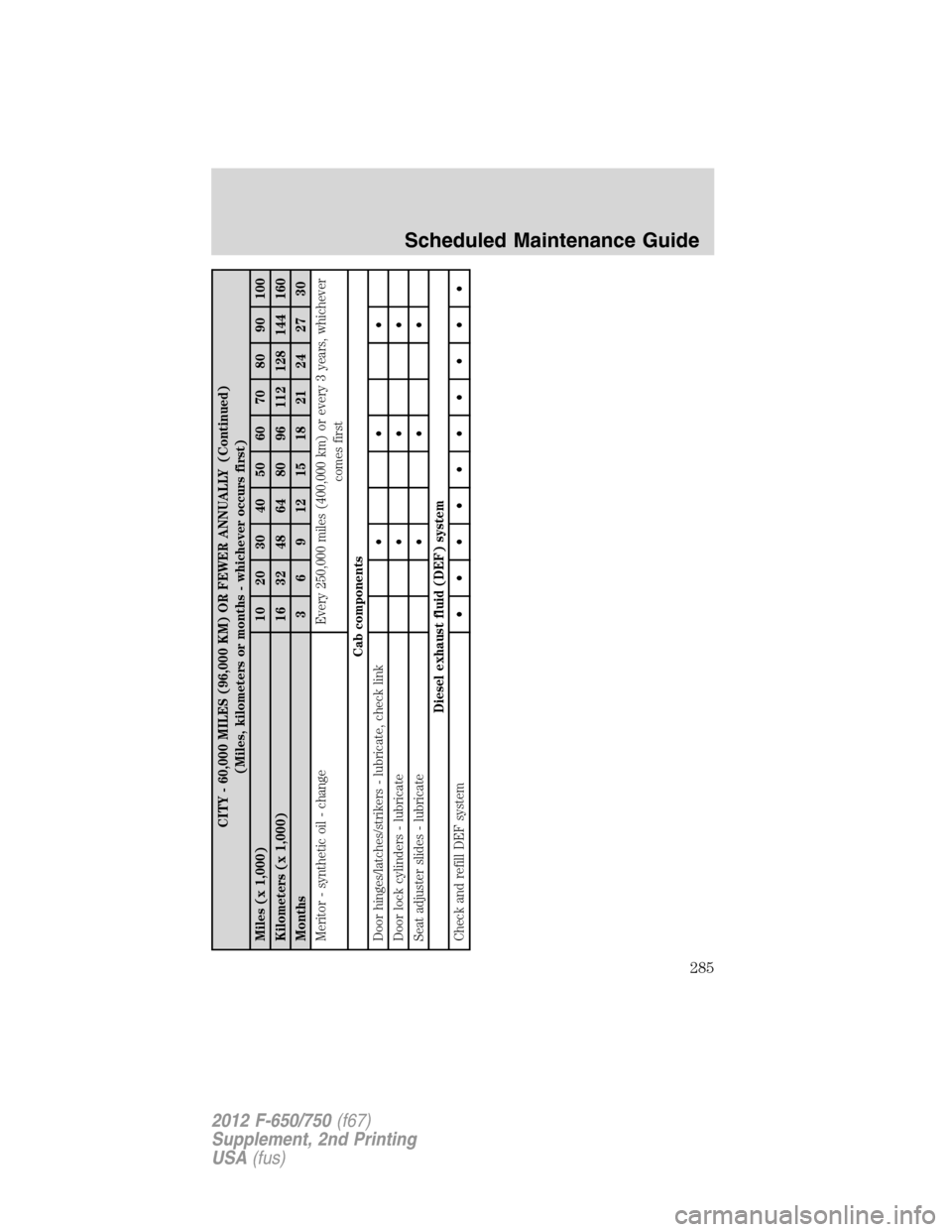
CITY - 60,000 MILES (96,000 KM) OR FEWER ANNUALLY (Continued)
(Miles, kilometers or months - whichever occurs first)
Miles (x 1,000) 10 20 30 40 50 60 70 80 90 100
Kilometers (x 1,000) 16 32 48 64 80 96 112 128 144 160
Months 3 6 9 12 15 18 21 24 27 30
Meritor - synthetic oil - change Every 250,000 miles (400,000 km) or every 3 years, whichever
comes first
Cab components
Door hinges/latches/strikers - lubricate, check link•••
Door lock cylinders - lubricate•••
Seat adjuster slides - lubricate•••
Diesel exhaust fluid (DEF) system
Check and refill DEF system••••••••••
Scheduled Maintenance Guide
285
2012 F-650/750(f67)
Supplement, 2nd Printing
USA(fus)