2012 FORD F650 maintenance
[x] Cancel search: maintenancePage 269 of 306
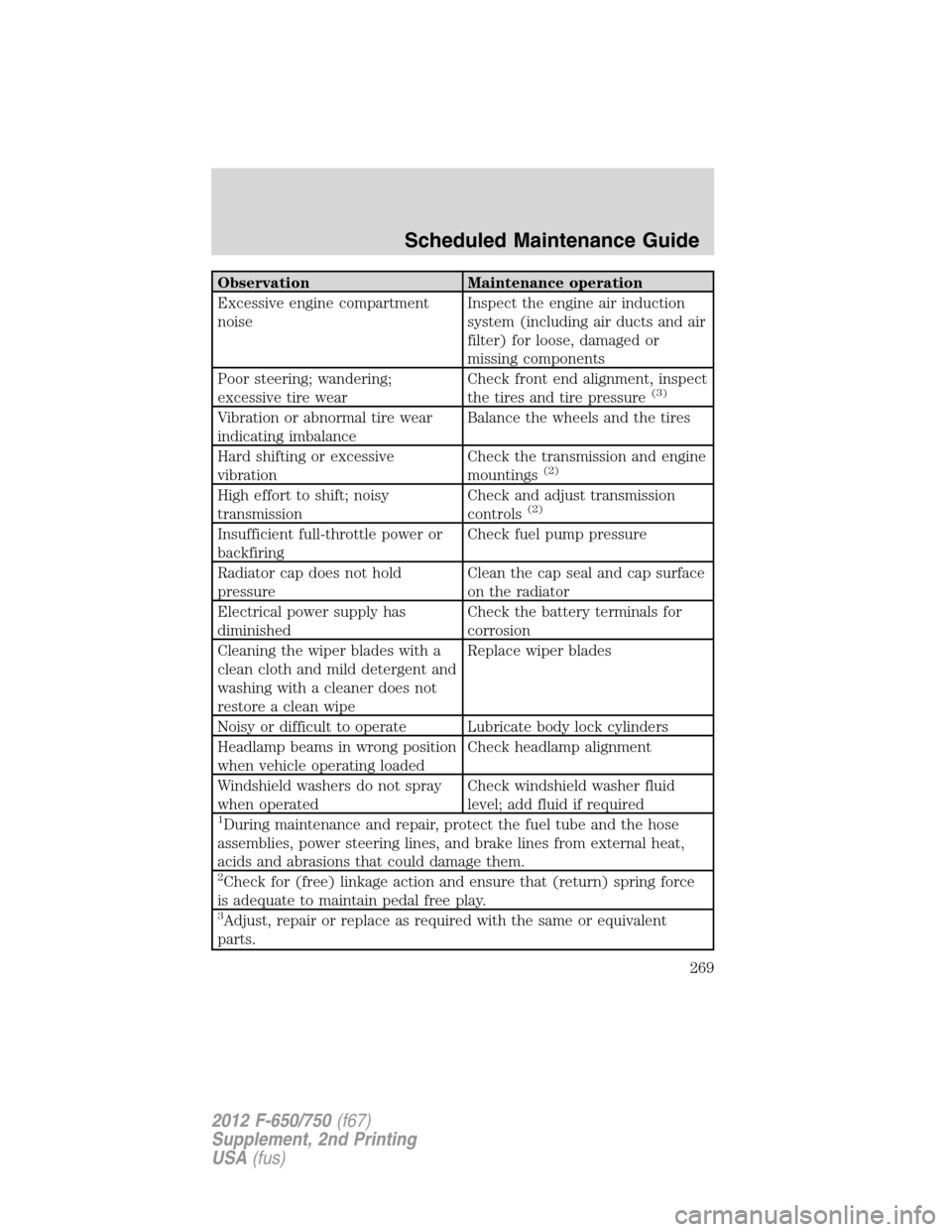
Observation Maintenance operation
Excessive engine compartment
noiseInspect the engine air induction
system (including air ducts and air
filter) for loose, damaged or
missing components
Poor steering; wandering;
excessive tire wearCheck front end alignment, inspect
the tires and tire pressure
(3)
Vibration or abnormal tire wear
indicating imbalanceBalance the wheels and the tires
Hard shifting or excessive
vibrationCheck the transmission and engine
mountings
(2)
High effort to shift; noisy
transmissionCheck and adjust transmission
controls(2)
Insufficient full-throttle power or
backfiringCheck fuel pump pressure
Radiator cap does not hold
pressureClean the cap seal and cap surface
on the radiator
Electrical power supply has
diminishedCheck the battery terminals for
corrosion
Cleaning the wiper blades with a
clean cloth and mild detergent and
washing with a cleaner does not
restore a clean wipeReplace wiper blades
Noisy or difficult to operate Lubricate body lock cylinders
Headlamp beams in wrong position
when vehicle operating loadedCheck headlamp alignment
Windshield washers do not spray
when operatedCheck windshield washer fluid
level; add fluid if required
1During maintenance and repair, protect the fuel tube and the hose
assemblies, power steering lines, and brake lines from external heat,
acids and abrasions that could damage them.
2Check for (free) linkage action and ensure that (return) spring force
is adequate to maintain pedal free play.
3Adjust, repair or replace as required with the same or equivalent
parts.
Scheduled Maintenance Guide
269
2012 F-650/750(f67)
Supplement, 2nd Printing
USA(fus)
Page 270 of 306

EMISSIONS CONTROL SYSTEM
To ensure the emissions control systems operate effectively, you should
have the services listed in the maintenance schedule performed at the
specified time and mileage intervals. You should avoid running out of fuel
or turning off the ignition while the vehicle is in motion, especially at
high speeds.
WARNING:Because of high engine compartment and exhaust
system temperatures resulting from emissions equipment, do not
park, idle or operate your vehicle in dry grass or other dry ground
cover where the possibility of ground fire exists.
Do not make unauthorized modifications to the engine or vehicle.
Modifications causing increased amounts of unburned fuel to reach the
exhaust system can significantly increase the temperature of the engine
compartment and/or the exhaust system.
Avoid driving your vehicle if it does not operate properly. If the engine
diesels (more than five seconds of engine run-on after shut-off), misfires,
surges, stalls or backfires, see your dealer. Be alert for fluid leakage,
odor, smoke, loss of oil pressure, or charge indicator or over temperature
warning.
Vehicles equipped with a diesel engine CANNOT use diesel fuel blended
with waste oil if equipped with a catalytic converter-muffler. Waste lube
oil blending in fuel plugs the catalytic converter-muffler, resulting in a
significant loss of engine power.
Noise emissions warranty, prohibited tampering acts and
maintenance
On January 1, 1978, Federal regulations became effective governing the
noise emissions on trucks over 10,000 lb. (4,536 kg) GVWR. The
following statements concerning prohibited tampering acts and
maintenance and the noise warranty are found in the Warranty Guide,
and are applicable to completed trucks.
Tampering with noise control system prohibited
Federal law prohibits the following acts or the causing thereof: (1) The
removal or rendering inoperative, by any person other than for purposes
of maintenance, repair or replacement, of any device or element of
design incorporated into any new vehicle for the purpose of noise control
prior to its sale or delivery to the ultimate purchaser or while it is in use,
or (2) the use of the vehicle after such device or element of design has
been removed or rendered inoperative by any person.
Scheduled Maintenance Guide
270
2012 F-650/750(f67)
Supplement, 2nd Printing
USA(fus)
Page 271 of 306

Among those acts presumed to constitute tampering are the following
acts listed:
Vehicle system Acts
Acoustical shielding Removal of noise shields, hood blanket, tunnel
liner or acoustical absorptive material.
Engine Removal or rendering inoperative the engine
speed governor so as to allow engine speed to
exceed manufacturer specifications. Removal of
engine mounted noise shield or oil pan enclosure.
Engine air induction Removal of the air duct, silencer, air cleaner,
and/or air cleaner element and baffle in air
cleaner; re-indexing of air cleaner.
Exhaust Removal or rendering inoperative exhaust system
components including the catalytic converter -
muffler assembly, inlet pipe, outlet pipe,
resonator and flexpipe. Rotation of horizontal
exhaust system directional outlet pipe to cause
the exhaust to be emitted in a direction other
than the orientation the vehicle was originally
produced with.
Engine cooling Removal or rendering inoperative the fan clutch.
Removal or modification of the fan shroud.
Replacing a fixed fan with a fan of increased
diameter, different number of blades or different
pitch width.
DEF (Diesel
exhaust fluid)Removal or rendering inoperative DEF system
components including the DEF tank, dosing
module, dosing supply module, dosing control
unit, NOx electronic module or NOx sensor.
Emissions control system(s) laws
Federal law prohibits vehicle manufacturers, dealers and other persons
engaged in the business of repairing, servicing, selling, leasing or trading
motor vehicles, as well as fleet operators from knowingly removing or
rendering an emissions control device or system inoperative. Further,
modifications of the emissions control system(s) could create liability on
the part of individual owners under the laws of some states. In Canada,
modification of the emissions control system could create liability under
applicable Federal or Provincial laws.
Scheduled Maintenance Guide
271
2012 F-650/750(f67)
Supplement, 2nd Printing
USA(fus)
Page 272 of 306
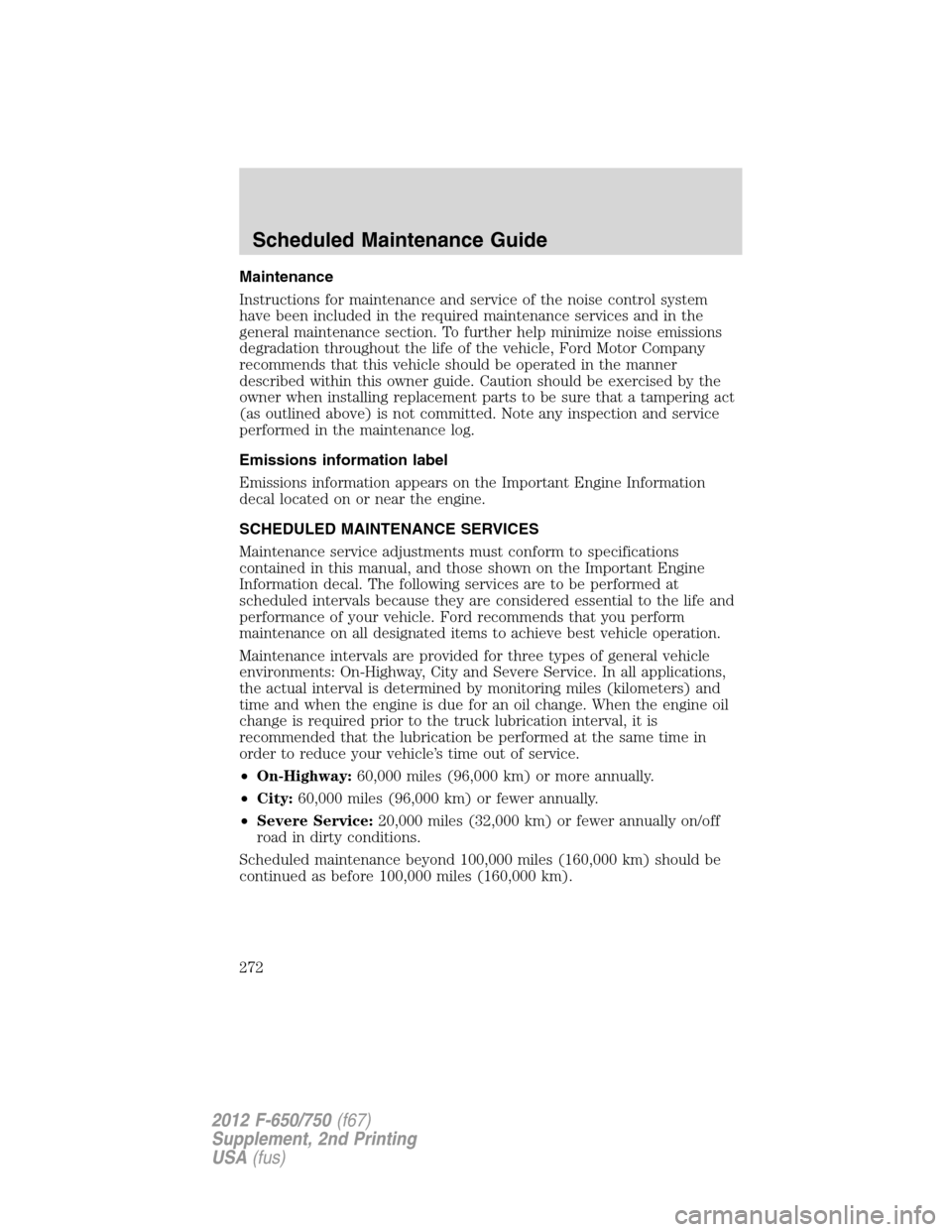
Maintenance
Instructions for maintenance and service of the noise control system
have been included in the required maintenance services and in the
general maintenance section. To further help minimize noise emissions
degradation throughout the life of the vehicle, Ford Motor Company
recommends that this vehicle should be operated in the manner
described within this owner guide. Caution should be exercised by the
owner when installing replacement parts to be sure that a tampering act
(as outlined above) is not committed. Note any inspection and service
performed in the maintenance log.
Emissions information label
Emissions information appears on the Important Engine Information
decal located on or near the engine.
SCHEDULED MAINTENANCE SERVICES
Maintenance service adjustments must conform to specifications
contained in this manual, and those shown on the Important Engine
Information decal. The following services are to be performed at
scheduled intervals because they are considered essential to the life and
performance of your vehicle. Ford recommends that you perform
maintenance on all designated items to achieve best vehicle operation.
Maintenance intervals are provided for three types of general vehicle
environments: On-Highway, City and Severe Service. In all applications,
the actual interval is determined by monitoring miles (kilometers) and
time and when the engine is due for an oil change. When the engine oil
change is required prior to the truck lubrication interval, it is
recommended that the lubrication be performed at the same time in
order to reduce your vehicle’s time out of service.
•On-Highway:60,000 miles (96,000 km) or more annually.
•City:60,000 miles (96,000 km) or fewer annually.
•Severe Service:20,000 miles (32,000 km) or fewer annually on/off
road in dirty conditions.
Scheduled maintenance beyond 100,000 miles (160,000 km) should be
continued as before 100,000 miles (160,000 km).
Scheduled Maintenance Guide
272
2012 F-650/750(f67)
Supplement, 2nd Printing
USA(fus)
Page 273 of 306
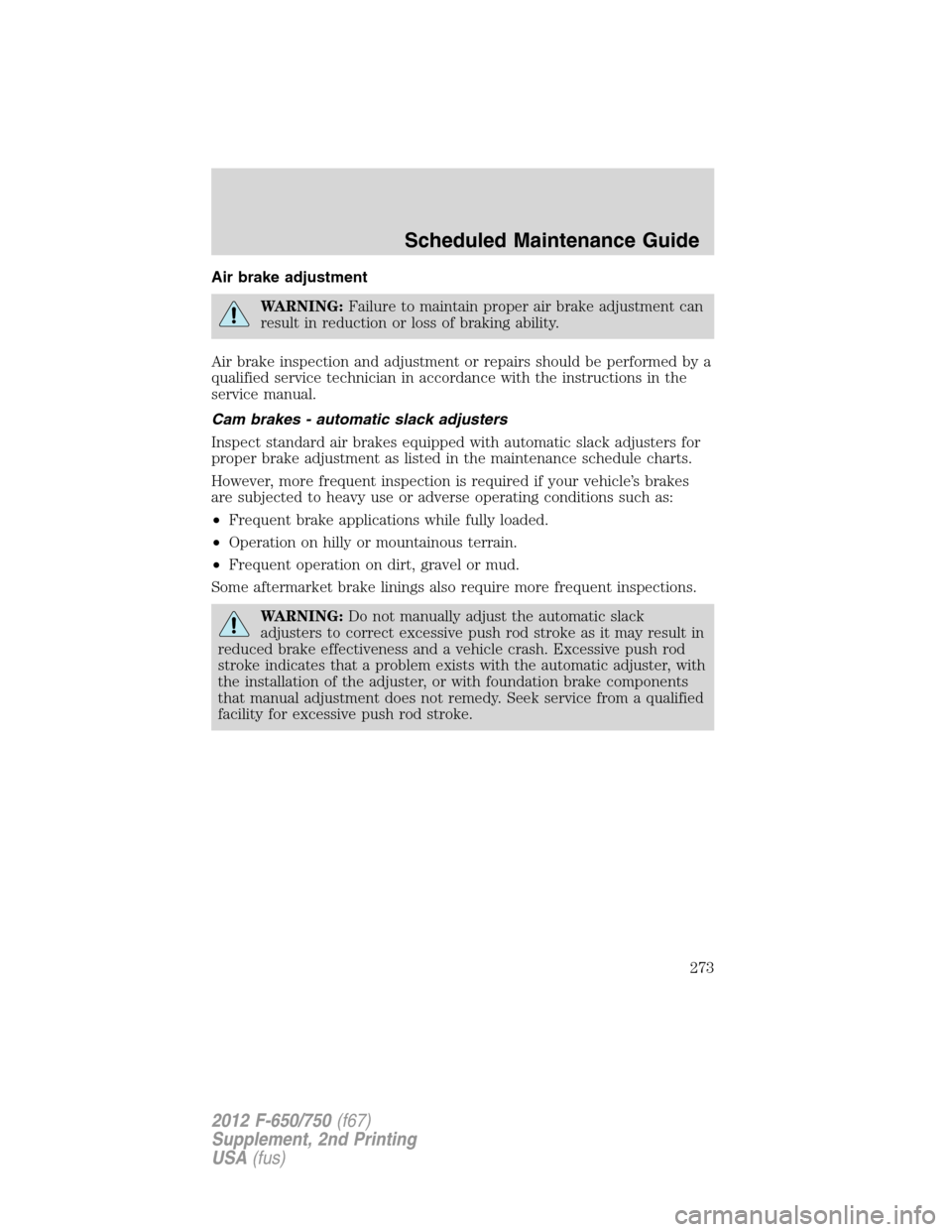
Air brake adjustment
WARNING:Failure to maintain proper air brake adjustment can
result in reduction or loss of braking ability.
Air brake inspection and adjustment or repairs should be performed by a
qualified service technician in accordance with the instructions in the
service manual.
Cam brakes - automatic slack adjusters
Inspect standard air brakes equipped with automatic slack adjusters for
proper brake adjustment as listed in the maintenance schedule charts.
However, more frequent inspection is required if your vehicle’s brakes
are subjected to heavy use or adverse operating conditions such as:
•Frequent brake applications while fully loaded.
•Operation on hilly or mountainous terrain.
•Frequent operation on dirt, gravel or mud.
Some aftermarket brake linings also require more frequent inspections.
WARNING:Do not manually adjust the automatic slack
adjusters to correct excessive push rod stroke as it may result in
reduced brake effectiveness and a vehicle crash. Excessive push rod
stroke indicates that a problem exists with the automatic adjuster, with
the installation of the adjuster, or with foundation brake components
that manual adjustment does not remedy. Seek service from a qualified
facility for excessive push rod stroke.
Scheduled Maintenance Guide
273
2012 F-650/750(f67)
Supplement, 2nd Printing
USA(fus)
Page 274 of 306

Maintenance intervals
ON-HIGHWAY - 60,000 MILES (96,000 KM) OR MORE ANNUALLY
(Miles, kilometers or months - whichever occurs first)
Miles (x 1,000) 15 30 45 60 75 90 105 120 135 150
Kilometers (x 1,000) 24 48 72 96 120 144 168 192 216 240
Months 3 6 9 12 15 18 21 24 27 30
Engine
Engine oil and filter - change (diesel engine) Refer to manufacturer’s recommendation
Engine oil and filter - change (gasoline engine) Every 7,500 miles (12,000 km) or 6 months
Engine coolant - check level••••••••••
Engine coolant - check freeze-protection and additive
strength (corrosion inhibitor) (diesel engine)••••••••••
Extended life engine coolant - add extender (diesel
engine)Refer to manufacturer’s recommendation
Extended life engine coolant - replace (diesel engine) Refer to manufacturer’s recommendation
Engine coolant - replace (gasoline engine) Initial change at 6 years or 100,000 miles (160,000 km)
(whichever occurs first); every 3 years or 50,000 miles
(80,000 km) thereafter
Engine air filter - inspect (gasoline engine)••••••••••
Engine air filter - replace (gasoline engine)•••••
Replace spark plugs••
Inspect accessory drive belt(s) Inspect at 100,000 miles (160,000 km) and 120,000 miles
(192,000 km); replace at 150,000 (240,000 km) miles if not
replaced in the last 100,000 miles (160,000 km)
Scheduled Maintenance Guide
274
2012 F-650/750(f67)
Supplement, 2nd Printing
USA(fus)
Page 275 of 306

ON-HIGHWAY - 60,000 MILES (96,000 KM) OR MORE ANNUALLY (Continued)
(Miles, kilometers or months - whichever occurs first)
Miles (x 1,000) 15 30 45 60 75 90 105 120 135 150
Kilometers (x 1,000) 24 48 72 96 120 144 168 192 216 240
Months 3 6 9 12 15 18 21 24 27 30
Non-driving front axle
Drag link - lubricate••••••••••
Kingpin and bushing - lubricate••••••••••
Tie rod ends - lubricate••••••••••
Wheel bearing - grease type - repack•••••
Wheel bearing - oil type - change oil•
Wheel bearing - oil type - check level••••••••••
Brake system - air
S-cam - lubricate••••••••••
Slack adjusters - lubricate••
Brake system - hydraulic
Master cylinder - check level••••••••••
Parking brake relay lever/linkage - lubricate••
Steering
Power steering filter - replacement Every 5 years or 500,000 miles (800,000 km)
Power steering fluid - change•
Power steering fluid - check level••••••••••
Steering column U-joints/slip joint - lubricate••••••••••
Steering gear Ross TAS - output shaft - lubricate•••
Scheduled Maintenance Guide
275
2012 F-650/750(f67)
Supplement, 2nd Printing
USA(fus)
Page 276 of 306
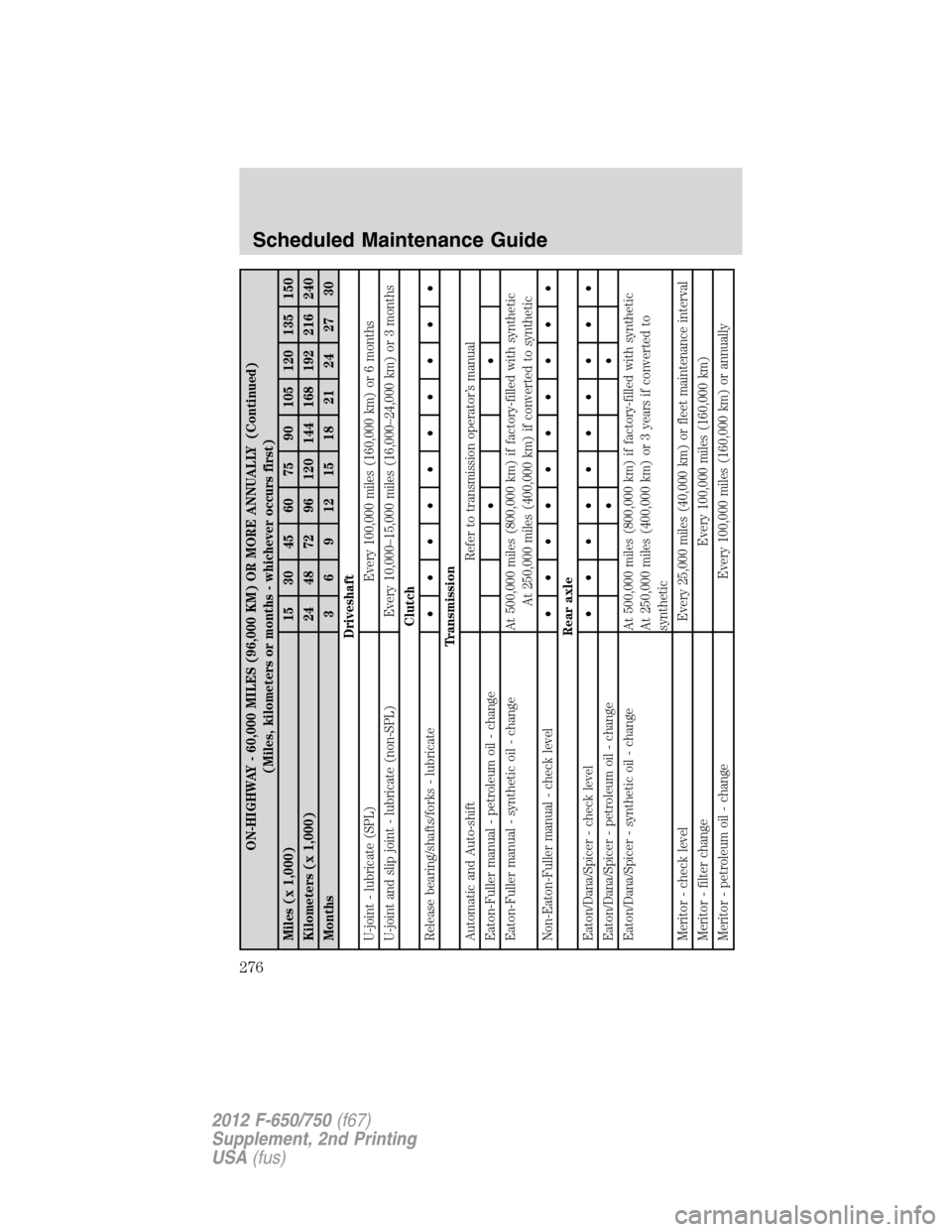
ON-HIGHWAY - 60,000 MILES (96,000 KM) OR MORE ANNUALLY (Continued)
(Miles, kilometers or months - whichever occurs first)
Miles (x 1,000) 15 30 45 60 75 90 105 120 135 150
Kilometers (x 1,000) 24 48 72 96 120 144 168 192 216 240
Months 3 6 9 12 15 18 21 24 27 30
Driveshaft
U-joint - lubricate (SPL) Every 100,000 miles (160,000 km) or 6 months
U-joint and slip joint - lubricate (non-SPL) Every 10,000–15,000 miles (16,000–24,000 km) or 3 months
Clutch
Release bearing/shafts/forks - lubricate••••••••••
Transmission
Automatic and Auto-shift Refer to transmission operator’s manual
Eaton-Fuller manual - petroleum oil - change••
Eaton-Fuller manual - synthetic oil - change At 500,000 miles (800,000 km) if factory-filled with synthetic
At 250,000 miles (400,000 km) if converted to synthetic
Non-Eaton-Fuller manual - check level••••••••••
Rear axle
Eaton/Dana/Spicer - check level••••••••••
Eaton/Dana/Spicer - petroleum oil - change••
Eaton/Dana/Spicer - synthetic oil - change At 500,000 miles (800,000 km) if factory-filled with synthetic
At 250,000 miles (400,000 km) or 3 years if converted to
synthetic
Meritor - check level Every 25,000 miles (40,000 km) or fleet maintenance interval
Meritor - filter change Every 100,000 miles (160,000 km)
Meritor - petroleum oil - change Every 100,000 miles (160,000 km) or annually
Scheduled Maintenance Guide
276
2012 F-650/750(f67)
Supplement, 2nd Printing
USA(fus)