2012 FORD F150 ECU
[x] Cancel search: ECUPage 219 of 462

4. Insert the belt tongue into the
proper buckle (the buckle closest to
the direction the tongue is coming
from) for that seating position until
you hear a snap and feel the latch
engage. Make sure the tongue is
latched securely by pulling on it.
5. While pushing down with your
knee on the child seat pull up on
the shoulder belt portion to tighten
the lap belt portion of the
combination lap and shoulder belt.
6. Allow the safety belt to retract and remove any slack in the belt to
securely tighten the child safety seat in the vehicle.
7. Attach the tether strap (if the child seat is equipped). Refer to
Attaching child safety seats with tether strapslater in this chapter.
Seating and Safety Restraints
219
2012 F-150(f12)
Owners Guide, 1st Printing
USA(fus)
Page 220 of 462

8. Before placing the child into the
child seat, forcibly pull the child
seat forward and back to make sure
that the seat is held securely in
place. To check this, grab the seat
at the belt path and attempt to
move it side to side and forward and
back. There should be no more than
1 inch (2.5 cm) of movement for
proper installation.
9. Check from time to time to be
sure that there is no slack in the lap/shoulder belt. The shoulder belt
must be snug to keep the lap belt tight during a collision.
10. Ford recommends checking with a NHTSA Certified Child Passenger
Safety Technician (CPST) to make certain the child restraint is properly
installed. In Canada, check with your local St. John Ambulance office for
referral to a CPST.
WARNING:Airbags can kill or injure a child in a child seat. If
you must use a forward-facing child seat in the front seat, move
seat all the way back.
WARNING:Rear facing child seats should NEVER be placed in
front of an active airbag.
Attaching child safety seats with LATCH (Lower Anchors and
Tethers for CHildren) attachments
The LATCH system is composed of three vehicle anchor points: two (2)
lower anchors located where the vehicle seat back and seat cushion meet
(called the “seat bight”) and one (1) top tether anchor located behind
that seating position.
LATCH compatible child safety seats have two rigid or webbing mounted
attachments that connect to the two lower anchors at the LATCH
equipped seating positions in your vehicle. This type of attachment
method eliminates the need to use safety belts to attach the child seat,
however the safety belt can still be used to attach the child seat if the
lower anchors are not used. For forward-facing child seats, the top tether
strap must also be attached to the proper top tether anchor, if a top
tether strap has been provided with your child seat. SeeAttaching child
safety seats with tether strapsin this chapter for more information.
Seating and Safety Restraints
220
2012 F-150(f12)
Owners Guide, 1st Printing
USA(fus)
Page 221 of 462

Your vehicle is equipped with LATCH lower anchors for child seat
installation at the following seating positions (LATCH is not available on
F150 Regular cab) :
•F150 SuperCab and SuperCrew
The lower LATCH anchors are
located at the rear section of the
rear seat between the cushion and
seatback. Follow the child seat
manufacturer’s instructions to
properly install a child seat with
LATCH attachments.
Follow the instructions later in this chapter on attaching child safety
seats with tether straps.
Attach LATCH lower attachments of the child seat only to the anchors
shown.
WARNING:Never attach two child safety seats to the same
anchor. In a crash, one anchor may not be strong enough to hold
two child safety seat attachments and may break, causing serious
injury or death.
WARNING:Depending on where you secure a child restraint,
and depending on the child restraint design, you may block
access to certain safety belt buckle assemblies and/or LATCH lower
anchors, rendering those features potentially unusable. To avoid risk of
injury, occupants should only use seating positions where they are able
to be properly restrained.
Seating and Safety Restraints
221
2012 F-150(f12)
Owners Guide, 1st Printing
USA(fus)
Page 222 of 462

Use of inboard lower anchors from the outboard seating positions
(center seating use)
The lower anchors at the center of the second row rear seat are spaced
25.7 inches (652 mm) apart. The standardized spacing for LATCH lower
anchors is 11 inches (280 mm) center to center. A child seat with rigid
LATCH attachments cannot be installed at the center seating position.
LATCH compatible child seats (with attachments on belt webbing) can
only be used at this seating position provided that the child seat
manufacturer’s instructions permit use with the anchor spacing stated.
Do not attach a child seat to any lower anchor if an adjacent child seat is
attached to that anchor.
WARNING:The standardized spacing for LATCH lower anchors
is 280 mm (11 inches) center to center. Do not use LATCH
lower anchors for the center seating position unless the child seat
manufacturer’s instructions permit and specify using anchors spaced at
least as far apart as those in this vehicle.
Each time you use the safety seat, check that the seat is properly
attached to the lower anchors and tether anchor, if applicable. Tug the
child seat from side to side and forward and back where it is secured to
the vehicle. The seat should move less than one inch when you do this
for a proper installation.
If the safety seat is not anchored properly, the risk of a child being
injured in a crash greatly increases.
Combining safety belt and LATCH lower anchors for attaching
child safety seats
When used in combination, either the safety belt or the LATCH lower
anchors may be attached first, provided a proper installation is achieved.
Attach the tether strap afterward, if included with the child seat. Refer
toRecommendations for attaching child safety restraints for children
in this chapter.
Attaching child safety seats with tether straps
Many forward-facing child safety seats include a tether strap which
extends from the back of the child safety seat and hooks to an anchoring
point called the top tether anchor. Tether straps are available as an
accessory for many older safety seats. Contact the manufacturer of your
child seat for information about ordering a tether strap, or to obtain a
longer tether strap if the tether strap on your safety seat does not reach
the appropriate top tether anchor in the vehicle.
Seating and Safety Restraints
222
2012 F-150(f12)
Owners Guide, 1st Printing
USA(fus)
Page 226 of 462
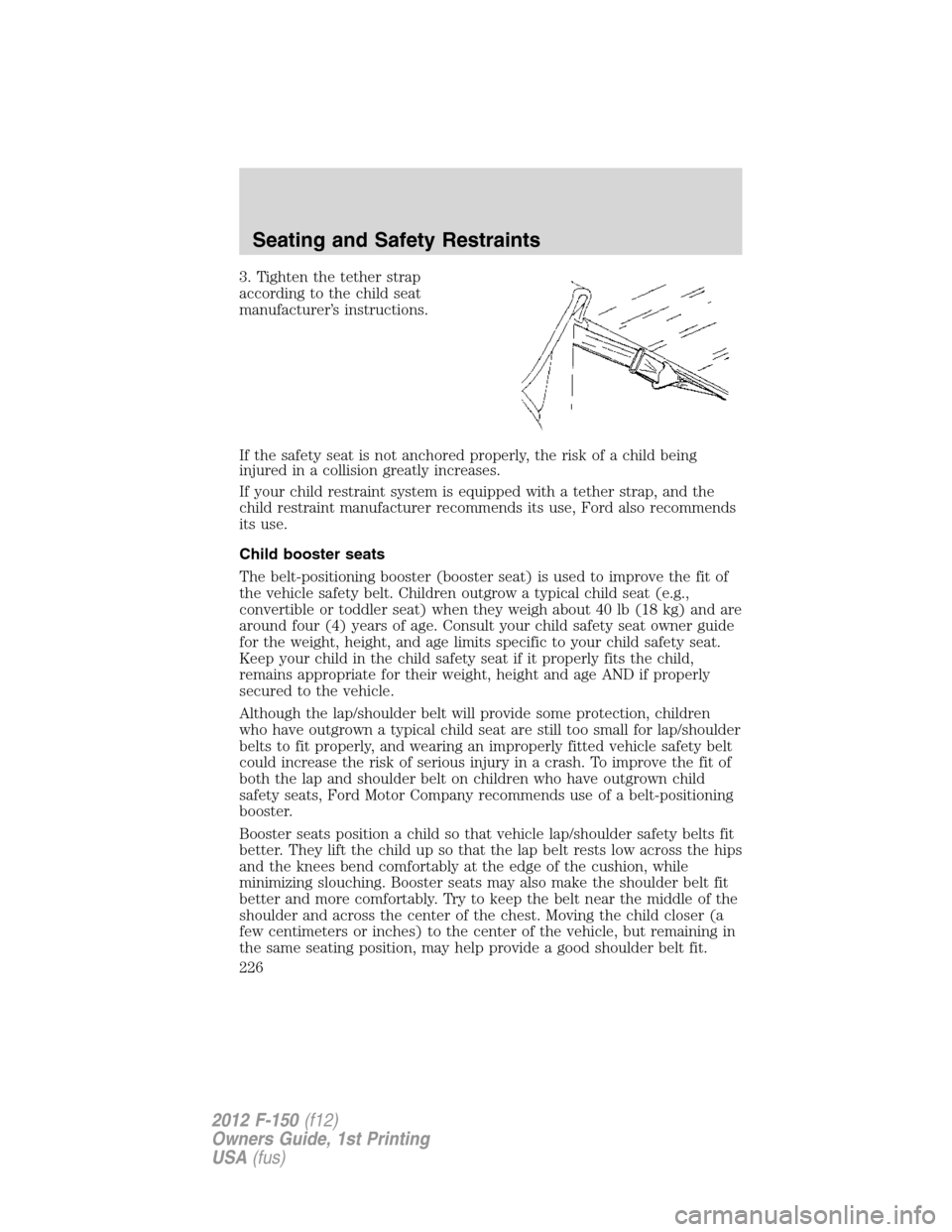
3. Tighten the tether strap
according to the child seat
manufacturer’s instructions.
If the safety seat is not anchored properly, the risk of a child being
injured in a collision greatly increases.
If your child restraint system is equipped with a tether strap, and the
child restraint manufacturer recommends its use, Ford also recommends
its use.
Child booster seats
The belt-positioning booster (booster seat) is used to improve the fit of
the vehicle safety belt. Children outgrow a typical child seat (e.g.,
convertible or toddler seat) when they weigh about 40 lb (18 kg) and are
around four (4) years of age. Consult your child safety seat owner guide
for the weight, height, and age limits specific to your child safety seat.
Keep your child in the child safety seat if it properly fits the child,
remains appropriate for their weight, height and age AND if properly
secured to the vehicle.
Although the lap/shoulder belt will provide some protection, children
who have outgrown a typical child seat are still too small for lap/shoulder
belts to fit properly, and wearing an improperly fitted vehicle safety belt
could increase the risk of serious injury in a crash. To improve the fit of
both the lap and shoulder belt on children who have outgrown child
safety seats, Ford Motor Company recommends use of a belt-positioning
booster.
Booster seats position a child so that vehicle lap/shoulder safety belts fit
better. They lift the child up so that the lap belt rests low across the hips
and the knees bend comfortably at the edge of the cushion, while
minimizing slouching. Booster seats may also make the shoulder belt fit
better and more comfortably. Try to keep the belt near the middle of the
shoulder and across the center of the chest. Moving the child closer (a
few centimeters or inches) to the center of the vehicle, but remaining in
the same seating position, may help provide a good shoulder belt fit.
Seating and Safety Restraints
226
2012 F-150(f12)
Owners Guide, 1st Printing
USA(fus)
Page 255 of 462
Note:The suspension insulation and bumpers will help prevent vehicle
damage. Do not remove these components from your vehicle when using
snow tires and chains.
Note:Do not place chains on the following tires sizes: P265/60R18,
P275/65R18, LT275/65R18, LT315/70R17, P275/55R20, and P275/45R22.
Follow these guidelines when using snow tires and chains:
•If possible, avoid fully loading your vehicle.
•Use only SAE Class S chains.
•Install chains securely, verifying that the chains do not touch any
wiring, brake lines or fuel lines.
•Drive cautiously. If you hear the chains rub or bang against your
vehicle, stop and retighten the chains. If this does not work, remove
the chains to prevent damage to your vehicle.
•Remove the tire chains when they are no longer needed. Do not use
tire chains on dry roads.
VEHICLE LOADING – WITH AND WITHOUT A TRAILER
This section will guide you in the proper loading of your vehicle and/or
trailer, to keep your loaded vehicle weight within its design rating
capability, with or without a trailer. Properly loading your vehicle will
provide maximum return of vehicle design performance. Before loading
your vehicle, familiarize yourself with the following terms for determining
your vehicle’s weight ratings, with or without a trailer, from the vehicle’s
Tire Label or Safety Compliance Certification Label:
Base Curb Weight– is the weight of the vehicle including a full tank of
fuel and all standard equipment. It does not include passengers, cargo, or
optional equipment.
Vehicle Curb Weight– is the weight of your new vehicle when you
picked it up from your authorized dealer plus any aftermarket
equipment.
Tires, Wheels and Loading
255
2012 F-150(f12)
Owners Guide, 1st Printing
USA(fus)
Page 276 of 462

RECREATIONAL TOWING
Note:Put your climate control system in recirculated air mode to
prevent exhaust fumes from entering the vehicle. Refer to theClimate
Controlschapter.
Follow these guidelines if you need to tow your vehicle behind another
vehicle, such as a motor home. The guidelines are designed to prevent
damage to your vehicle and its transmission after it is hooked-up to the
tow vehicle or tow dolly.
2WD vehiclescannot be towed with any wheels on the ground as
vehicle or transmission damage may occur. The vehicle must be towed
with all four wheels off the ground (i.e. with a car-hauling trailer).
4WD vehiclescan only be towed with all wheels on the ground by
placing the transfer case in its neutral position and engaging the
four-wheel-down towing feature. Perform the steps outlined in the
Four-wheel-down towingsection after positioning your vehicle behind
the tow vehicle and properly securing them together
Four-wheel-down towing
1. Turn the ignition to the on position; do not start the engine.
2. Press and hold the brake pedal.
3. Shift the 4WD switch to 2H.
4. Shift the transmission to N (Neutral).
5. Rotate the 4WD switch from 2H to 4L and back to 2H five times
within seven seconds.
•If completed successfully, the instrument cluster displaysNEUTRAL
TOW LEAVE IN NorNEUTRAL TOW ENABLED LEAVE
TRANSMISSION IN NEUTRAL, indicating that the vehicle is safe
to tow with all wheels on the ground.
•If the message is not shown in the display, the procedure must be
performed again from the beginning.
•An audible noise may be heard as the transfer case shifts into its
neutral position; this is normal.
6. Leave the transmission in N (Neutral) and turn the ignition as far as it
will go toward the off position (it will not turn fully off when the
transmission is in N [Neutral]). The key must be left in the ignition while
towing. To lock and unlock your vehicle, use the keyless entry keypad or
extra set of keys.
7. Release the brake pedal.
Tires, Wheels and Loading
276
2012 F-150(f12)
Owners Guide, 1st Printing
USA(fus)
Page 277 of 462

WARNING:Do not disconnect the battery during recreational
towing. Doing so will prevent the transfer case from shifting
properly and may cause the vehicle to roll even if the transmission is in
P (Park).
WARNING:Shifting the transfer case to its neutral position for
recreational towing may cause the vehicle to be able to roll even
if the transmission is in P (Park). The driver or others could be
injured. Make sure the foot brake is depressed and the vehicle is in a
secure and safe position while the transfer case is being shifted to its
neutral position.
WARNING:Failing to put the transfer case in its neutral
position will damage vehicle components.
Note:Four-wheel-down towing status can be checked at any time by
opening the driver’s door or turning the ignition to the accessory or on
position and verifying the NEUTRAL TOW ENABLED message is
displayed in the cluster.
To exit four-wheel-down towing and return the transfer case to its 2H
position:
1. With the vehicle still properly secured to the tow vehicle, press and
hold the brake pedal.
2. Turn the ignition to the on position; do not start the engine.
3. Shift the transmission out of N (Neutral) and into any gear.
4. Release the brake pedal.
•If completed successfully, the instrument cluster displays4X2,and
NEUTRAL TOW DISABLED.
•If the indicator light and message do not display, the procedure must
be performed again from the beginning.
•An audible noise may be heard as the transfer case shifts out of its
neutral position; this is normal.
5. Apply the parking brake, then disconnect the vehicle from the tow vehicle.
6. Release the parking brake, start the engine, and shift the transmission
to D (Drive) to make sure the transfer case is out of N (Neutral).
7. If the transfer case will not successfully shift out of N (Neutral), set
the parking brake until the vehicle can be serviced.
Tires, Wheels and Loading
277
2012 F-150(f12)
Owners Guide, 1st Printing
USA(fus)