Page 20 of 358
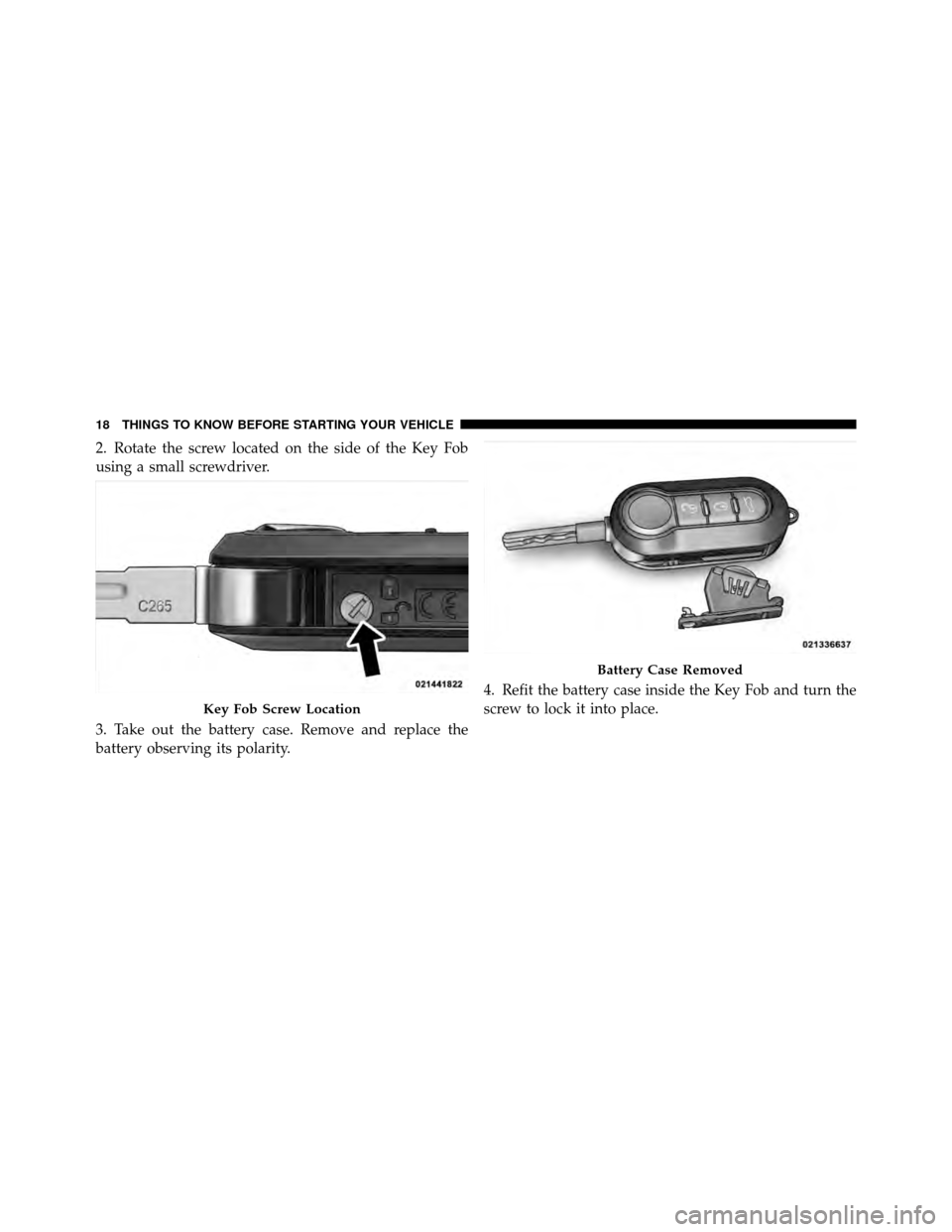
2. Rotate the screw located on the side of the Key Fob
using a small screwdriver.
3. Take out the battery case. Remove and replace the
battery observing its polarity.4. Refit the battery case inside the Key Fob and turn the
screw to lock it into place.
Key Fob Screw Location
Battery Case Removed
18 THINGS TO KNOW BEFORE STARTING YOUR VEHICLE
Page 21 of 358
DOOR LOCKS
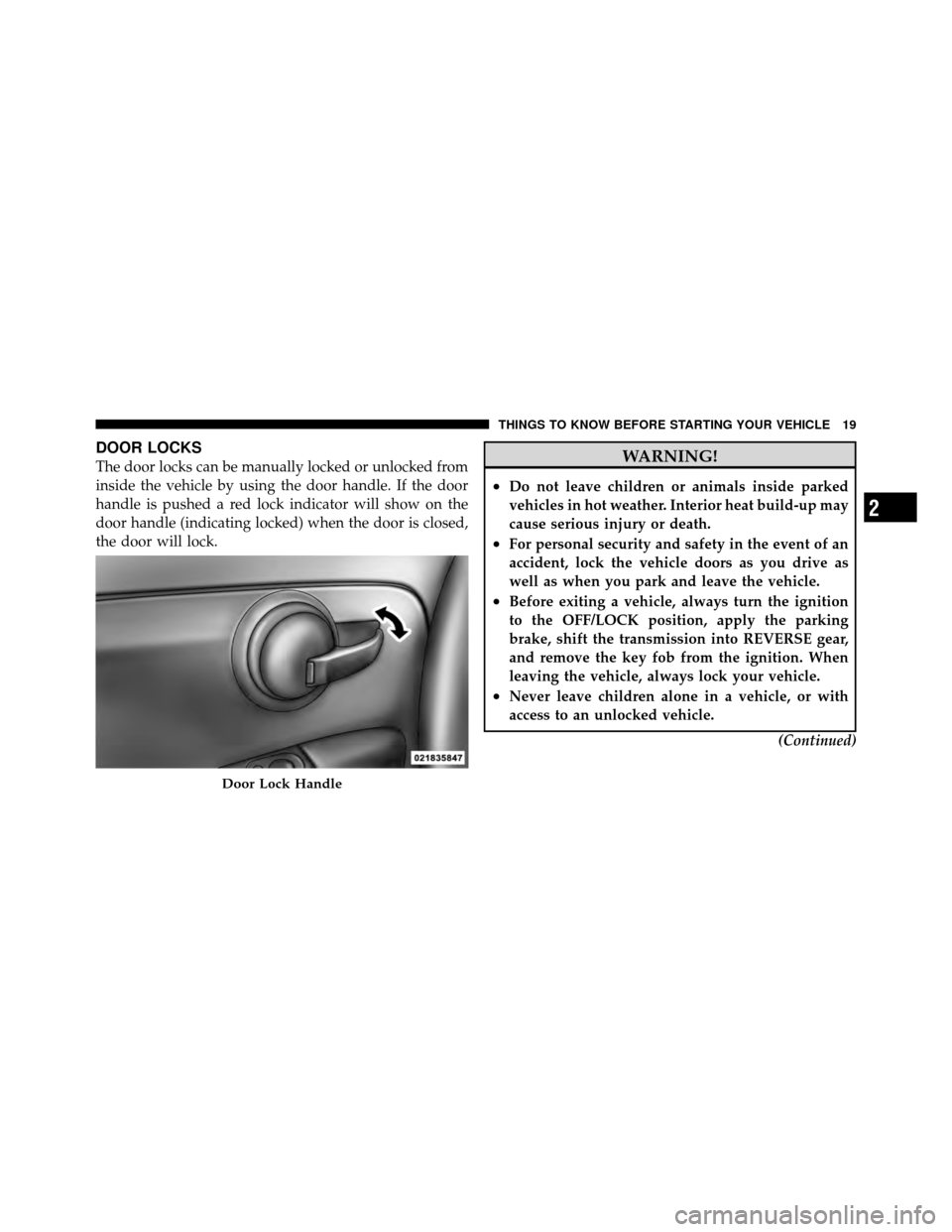
The door locks can be manually locked or unlocked from
inside the vehicle by using the door handle. If the door
handle is pushed a red lock indicator will show on the
door handle (indicating locked) when the door is closed,
the door will lock.WARNING!
•Do not leave children or animals inside parked
vehicles in hot weather. Interior heat build-up may
cause serious injury or death.
•For personal security and safety in the event of an
accident, lock the vehicle doors as you drive as
well as when you park and leave the vehicle.
•Before exiting a vehicle, always turn the ignition
to the OFF/LOCK position, apply the parking
brake, shift the transmission into REVERSE gear,
and remove the key fob from the ignition. When
leaving the vehicle, always lock your vehicle.
•Never leave children alone in a vehicle, or with
access to an unlocked vehicle.(Continued)
Door Lock Handle
2
THINGS TO KNOW BEFORE STARTING YOUR VEHICLE 19
Page 22 of 358
WARNING! (Continued)
•Allowing children to be in a vehicle unattended is
dangerous for a number of reasons. A child or
others could be seriously or fatally injured. Chil-
dren should be warned not to touch the parking
brake, brake pedal or the shift lever.
•Do not leave the key fob in or near the vehicle, and
do not leave the ignition in the ACC or ON/RUN
position. A child could operate power windows,
other controls, or move the vehicle.
CAUTION!
An unlocked vehicle is an invitation to thieves.
Always remove the key from the ignition and lock all
of the doors when leaving the vehicle unattended.
Power Door Locks
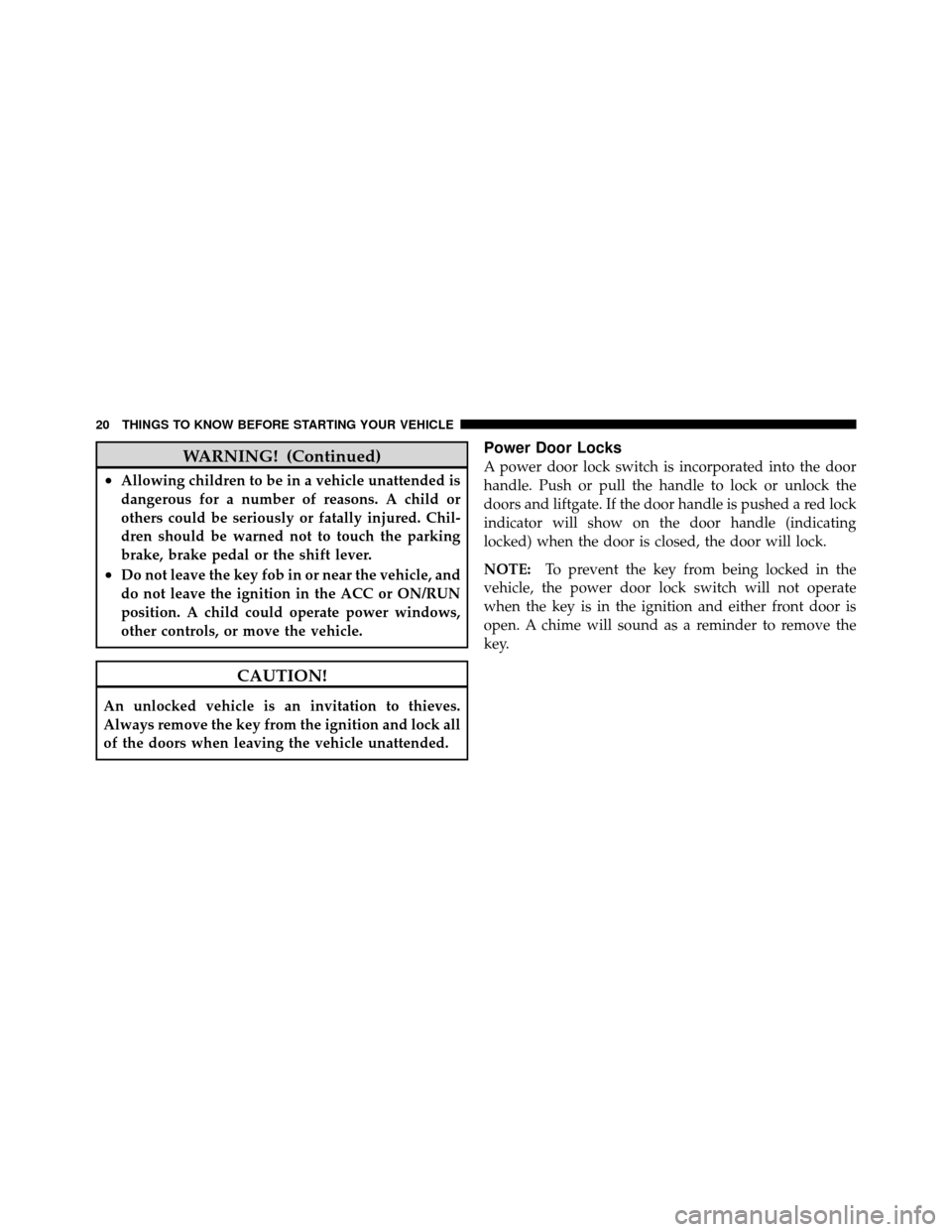
A power door lock switch is incorporated into the door
handle. Push or pull the handle to lock or unlock the
doors and liftgate. If the door handle is pushed a red lock
indicator will show on the door handle (indicating
locked) when the door is closed, the door will lock.
NOTE:To prevent the key from being locked in the
vehicle, the power door lock switch will not operate
when the key is in the ignition and either front door is
open. A chime will sound as a reminder to remove the
key.
20 THINGS TO KNOW BEFORE STARTING YOUR VEHICLE
Page 24 of 358
POWER WINDOWS
Power Window Switches
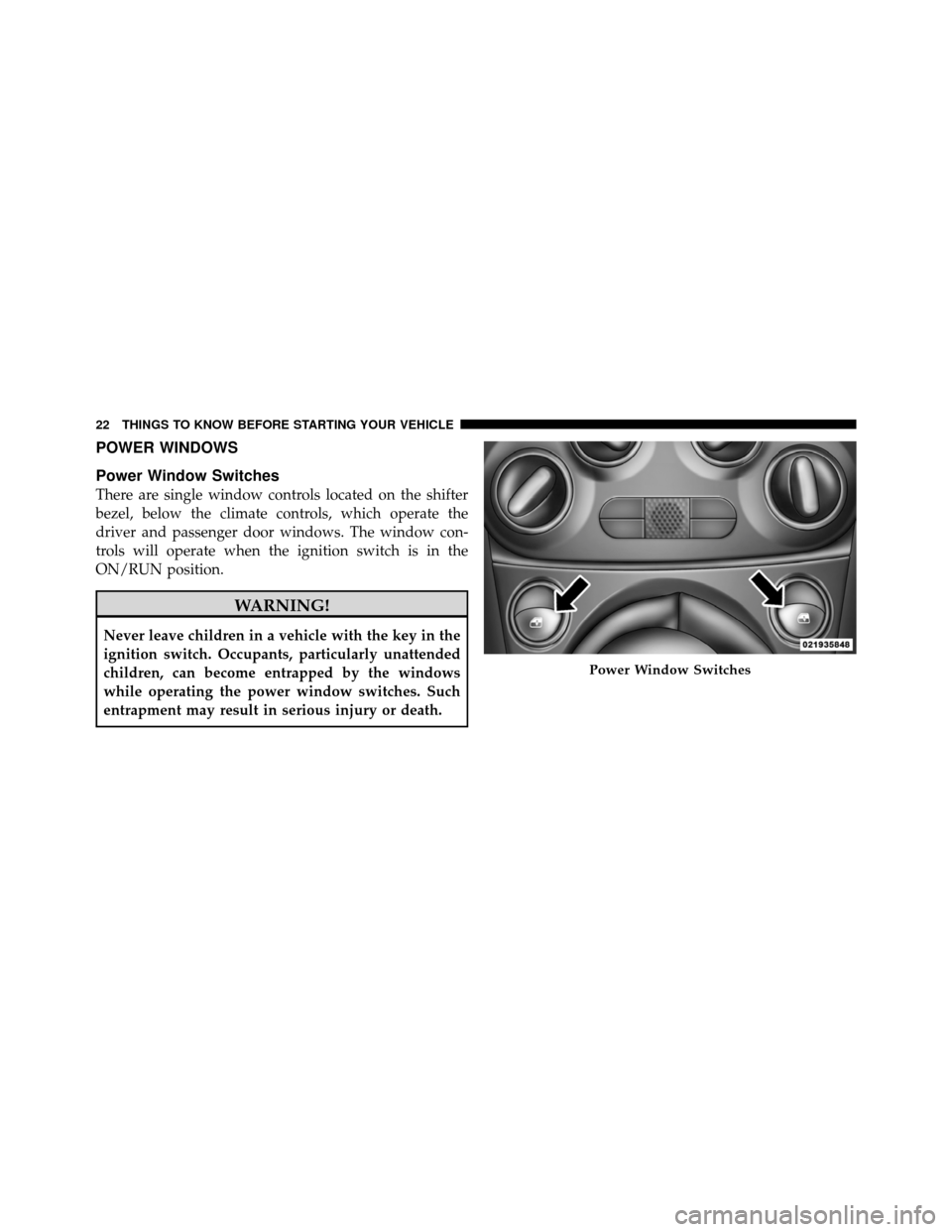
There are single window controls located on the shifter
bezel, below the climate controls, which operate the
driver and passenger door windows. The window con-
trols will operate when the ignition switch is in the
ON/RUN position.
WARNING!
Never leave children in a vehicle with the key in the
ignition switch. Occupants, particularly unattended
children, can become entrapped by the windows
while operating the power window switches. Such
entrapment may result in serious injury or death.
Power Window Switches
22 THINGS TO KNOW BEFORE STARTING YOUR VEHICLE
Page 25 of 358

Auto-Down — If Equipped
The driver’s door window switch may have an Auto-
Down feature. Press the window switch for approxi-
mately one second, release, and the window will go
down automatically. To cancel the Auto-Down move-
ment, operate the switch in either the up or down
direction and release the switch.
Wind Buffeting
Wind buffeting can be described as the perception of
pressure on the ears or a helicopter-type sound in the
ears. Your vehicle may exhibit wind buffeting with the
windows down, or the sunroof (if equipped) in certain
open or partially open positions. This is a normal occur-
rence and can be minimized. If the buffeting occurs with
the sunroof open, adjust the sunroof opening to minimize
the buffeting or open any window.
LIFTGATE
To unlock the liftgate, use the Remote Keyless Entry
(RKE) transmitter or activate the power door lock
switches located on the front door handles.
To open the liftgate, squeeze the liftgate release handle
and pull the liftgate open with one fluid motion.
Liftgate Handle
2
THINGS TO KNOW BEFORE STARTING YOUR VEHICLE 23
Page 46 of 358

Advanced Front Air Bags may deploy in crashes with
little vehicle front-end damage but that produce a severe
initial deceleration.
The side air bags will not deploy in all side collisions.
Side air bag deployment will depend on the severity and
type of collision.
Because air bag sensors measure vehicle deceleration
over time, vehicle speed and damage by themselves are
not good indicators of whether or not an air bag should
have deployed.
Seat belts are necessary for your protection in all colli-
sions, and also are needed to help keep you in position,
away from an inflating air bag.
The ORC monitors the readiness of the electronic parts of
the air bag system whenever the ignition switch is in theON/RUN or START position. If the key is in the OFF/
LOCK position, or not in the ignition, the air bag system
is not on and the air bags will not inflate.
The ORC contains a backup power supply system that
may deploy the air bags even if the battery loses power or
it becomes disconnected prior to deployment.
Also, the ORC turns on the Air Bag Warning
Light in the instrument panel for approxi-
mately four to eight seconds for a self-check
when the ignition is first turned on. After the
self-check, the Air Bag Warning Light will turn off. If the
ORC detects a malfunction in any part of the system, it
turns on the Air Bag Warning Light, either momentarily
or continuously. A single chime will sound if the light
comes on again after initial startup.
It also includes diagnostics that will illuminate the instru-
ment cluster Air Bag Warning Light if a malfunction is
44 THINGS TO KNOW BEFORE STARTING YOUR VEHICLE
Page 49 of 358

the outside edge of the headliner out of the way and
covers the window. The air bag inflates in about 30
milliseconds (about one-quarter of the time that it takes
to blink your eyes) with enough force to injure you if you
are not belted and seated properly, or if items are
positioned in the area where the side curtain air bag
inflates. This especially applies to children. The side
curtain air bag is about 3-1/2 in (9 cm) thick when it is
inflated.
Because air bag sensors estimate deceleration over time,
vehicle speed and damage are not good indicators of
whether or not an air bag should have deployed.
Front And Side Impact Sensors
In front and side impacts, impact sensors can aid the
ORC in determining appropriate response to impact
events.
Enhanced Accident Response System
In the event of an impact causing air bag deployment, if
the communication network remains intact, and the
power remains intact, depending on the nature of the
event, the ORC will determine whether to have the
Enhanced Accident Response System perform the follow-
ing functions:
•Cut off fuel to the engine.
•Flash hazard lights as long as the battery has power or
until the ignition key is turned off.
•Turn on the interior lights, which remain on as long as
the battery has power or until the ignition key is
removed.
•Unlock the doors automatically.
After the event occurs, when the system is active, the
message �Fuel Cutoff See Handbook� is displayed.
2
THINGS TO KNOW BEFORE STARTING YOUR VEHICLE 47
Page 81 of 358
list or directly pronouncing the phone number, to
answer a call and also to answer another incoming
phone call.
•To interact with BLUE&ME™ you can use either the
buttons on the steering wheel or voice commands.
With voice recognition, you can perform system func-
tions by speaking voice commands, also identified as
“keywords”. When the system recognizes a keyword,
it will respond with the appropriate action. Voice
recognition is an easy and convenient way to use
BLUE&ME™.
All the system functions are available within the
BLUE&ME™ Main Menu. When the car is not moving,
you can scroll through the complete menu by using either
the buttons on the steering wheel or the voice commands.
When you are travelling, you can interact with
BLUE&ME™ by using the buttons on the steering wheel
or voice commands relevant only to phone functions (LAST CALLS and PHONEBOOK ) and the media
player. To activate settings when travelling you can only
use voice commands.
The hands-free kit enables the following operations:
•Contact Calling By Voice
— you can call a contact in
your mobile phone phonebook using your voice. You
can also call a contact in your phonebook by scanning
through the entries on the multifunction display. (To
use this option you have to transfer your mobile phone
contacts to the hands-free kit phonebook).
•Digit Dialing By Voice — you can dial a phone
number by pressing the VR button on the steering
wheel and speaking the digits to be dialed.
•To Call The SMS Text Sender — call directly the last
SMS text sender or the sender of a message received
and stored in the BLUE&ME™ inbox.
3
UNDERSTANDING THE FEATURES OF YOUR VEHICLE 79