2012 Citroen C5 instrument panel
[x] Cancel search: instrument panelPage 133 of 316

IX
!
131
DRIVING
)
On sloping ground: immobilise
the vehicle by placing the chocks
(if your vehicle has them) in front
or behind the two front wheels,
against the slope
On level ground: immobilise the
vehicle by placing the chocks
(if your vehicle has them) in
front and behind one of the front
wheels.
)
Open the lower compartment of
the centre armrest by pulling it.
)
Ensure that the cup holder B
is
folded away.
)
Remove the rubber mat covering
the base of the armrest.
This strap does not permit
application of the parking
brake.
To re-engage the electric parking
brake (after rectifying the malfunc-
tion or battery failure), give a long
pull on the control A
until the park-
ing brake warning lamp (!) fl ashes
in the instrument panel then give a
second long pull until this warning
lamp is on fi xed.
The time required for the subse-
quent application may be longer
than during normal operation.
It is essential that the ignition is
not switched on until the parking
brake has re-engaged (fl ashing of
the warning lamp (!) in the instru-
ment panel then the warning lamp
on fi xed) to avoid damage to the
parking brake.
Take care not to allow moisture or
dust in the proximity of the diagnos-
tic socket D
which is essential for
the maintenance of your vehicle.
)
Release the strap from its loca-
tion C
.
)
Pull the strap to release the
brake. A loud knock confi rms the
release of the brake.
)
Take care to put the strap
back in its location C
correct-
ly. Otherwise, it will no longer
be possible to apply the brake.
Contact a CITROËN dealer or a
qualifi ed workshop.
)
Put the rubber mat back in place
on the base of the armrest.
Page 136 of 316

IX!
134
DRIVING
HILL START ASSIST
System which keeps your vehicle
immobilised temporarily (approxi-
mately 2 seconds) when starting on
a gradient, the time to move your
foot from the brake pedal to the ac-
celerator pedal.
This function is only active when:
- the vehicle is completely station-
ary, with your foot on the brake
pedal,
- in certain conditions on a gradient,
- with the driver’s door closed.
The hill start assist function cannot
be deactivated.
Operation
On an ascending gradient, with
the vehicle stationary, the vehicle
is held for a brief moment when
you release the brake pedal:
- provided you are in fi rst gear or
neutral on a manual gearbox,
- provided you are in D
or M
on an
automatic gearbox.
On a descending gradient, with
the vehicle stationary and reverse
gear engaged, the vehicle is held
for a brief moment when you re-
lease the brake pedal.
Do not exit the vehicle while
it is being held in the hill start
assist phase.
If you need to leave the vehicle with
the engine running, apply the park-
ing brake manually and ensure that
the parking brake warning lamp (in
the instrument panel) is on fi xed
(not fl ashing).
Page 140 of 316

IX
138
DRIVING
The position of the gear lever the the
driving mode are displayed in dial C
of the instrument panel.
A selection grille alongside the gear
lever also allows you to see the se-
lected position.
Displays in the instrument panel
Moving off
)
To start the engine, the gear le-
ver must be in position N
.
)
Press the brake pedal down fully.
)
Operate the starter
.
N
appears in the instrument panel
screen.
N
fl ashes in the instrument panel,
accompanied by an audible signal
and a message in the multifunction
screen, if the gear lever is not in
position N
on starting.
)
Select fi rst gear (position M
or A
)
or reverse (position R
).
)
Release the parking brake un-
less it is programmed in auto-
matic mode.
)
Release the brake pedal, then
accelerate.
)
With your foot on the brake, push
the lever forwards.
Reverse
Only engage reverse with
the vehicle immobilised.
To avoid any jerking, wait a
moment before accelerating.
Neutral
Never select position N
with
the vehicle moving.
Page 142 of 316

IX
!
140
DRIVING
When immobilising the ve-
hicle, with the engine running,
you must place the gear lever
in neutral N
.
Before carrying out any work in the
engine compartment, check that
the gear lever is in neutral N
and
that the parking brake is applied.
SPORT programme
Stopping the vehicle
Before switching off the engine, you
can choose to:
- move to position N
to engage
neutral,
- leave the gear engaged; in this
case, it will not be possible to
move the vehicle.
In both cases, you must apply the park-
ing brake to immobilise the vehicle.
Operating fault
With the ignition on, the fl ashing of
AUTO
, accompanied by an audible
signal and a message in the mul-
tifunction screen, indicates a fault
with the gearbox.
Have it checked by a CITROËN
dealer or a qualifi ed workshop.
)
Wit the gear lever at A
and the
engine running, press button S
to
activate the SPORT
programme,
which provides a more dynamic
driving style.
S
appears in the instrument panel.
)
Press the S
button again to
switch it off.
S
then disappears from the instru-
ment panel screen.
You must press the brake pedal
when starting the engine.
Whatever the circumstances, you
must manually apply the parking
brake when parking, unless the
parking brake is programmed in au-
tomatic mode.
Page 143 of 316

IX!
141
DRIVING
STOP & START
The Stop & Start system puts the en-
gine temporarily into standby - STOP
mode - during stops in the traffi c
(red lights, traffi c jams, or other...).
The engine restarts automatically -
START mode - as soon as you want
to move off. The restart takes place
instantly, quickly and silently.
Perfect for urban use, the Stop &
Start system reduces fuel consump-
tion and exhaust emissions as well
as the noise level when stationary.
Operation
- with the electronic gearbox
system
, at speeds below 4 mph
(6 km/h), press the brake pedal or
put the gear lever in position N
.
Going into engine STOP mode
The "ECO"
warning lamp comes
on in the instrument panel and
the engine goes into standby:
If your vehicle is fi tted
with the system, a time
counter calculates the
sum of the periods in
STOP mode during a journey. It rests
itself to zero every time the ignition
is switched on with the key.
For your comfort, during parking
maoeuvres, STOP mode is not
available for a few seconds after
coming out of reverse gear.
STOP mode does not affect the func-
tionality of the vehicle, such as for ex-
ample, braking, power steering...
Never refuel with the engine
in STOP mode; you must
switch off the ignition with the
key.
Special cases: STOP mode not
available
In this case, the "ECO"
warning lamp fl ashes for a
few seconds then goes off.
This operation is perfectly normal.
STOP mode is not invoked when:
- the driver's door is open,
- the driver's seat belt is not fas-
tened,
- the vehicle has not exceeded
6 mph (10 km/h) since the last
engine start using the key,
- the electric parking brake is ap-
plied or being applied,
- the engine is needed to maintain
a comfortable temperature in the
passenger compartment,
- demisting is active,
- some special conditions (battery
charge, engine temperature,
braking assistance, ambient
temperature...) where the engine
is needed to assure control of a
system.
Page 146 of 316
IX
!
144
DRIVING
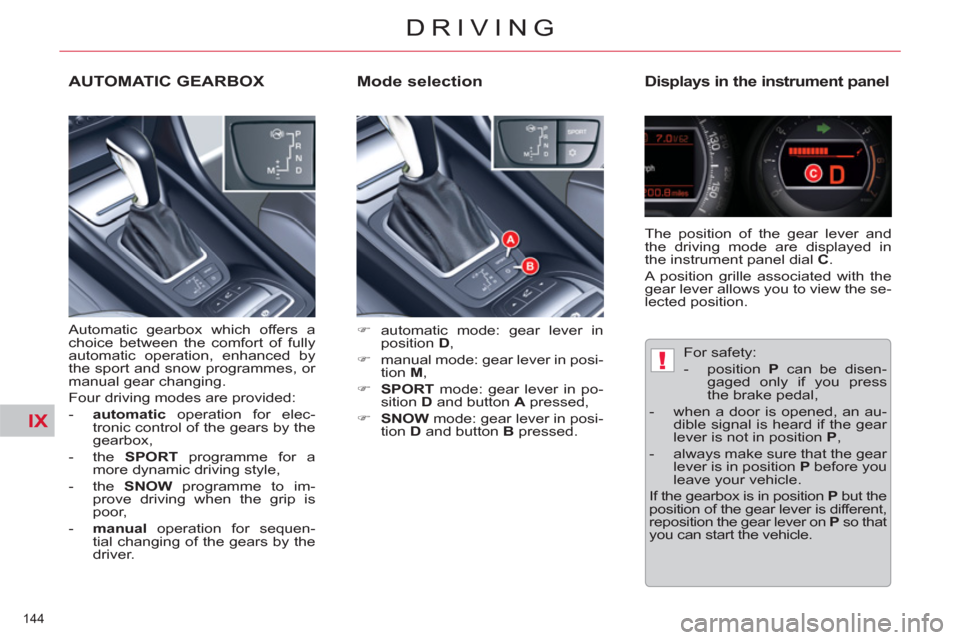
Mode selection
Displays in the instrument panel
)
automatic mode: gear lever in
position D
,
)
manual mode: gear lever in posi-
tion M
,
)
SPORT
mode: gear lever in po-
sition D
and button A
pressed,
)
SNOW
mode: gear lever in posi-
tion D
and button B
pressed.
The position of the gear lever and
the driving mode are displayed in
the instrument panel dial C
.
A position grille associated with the
gear lever allows you to view the se-
lected position.
For safety:
- position P
can be disen-
gaged only if you press
the brake pedal,
- when a door is opened, an au-
dible signal is heard if the gear
lever is not in position P
,
- always make sure that the gear
lever is in position P
before you
leave your vehicle.
If the gearbox is in position P
but the
position of the gear lever is different,
reposition the gear lever on P
so that
you can start the vehicle.
AUTOMATIC GEARBOX
Automatic gearbox which offers a
choice between the comfort of fully
automatic operation, enhanced by
the sport and snow programmes, or
manual gear changing.
Four driving modes are provided:
- automatic
operation for elec-
tronic control of the gears by the
gearbox,
- the SPORT
programme for a
more dynamic driving style,
- the SNOW
programme to im-
prove driving when the grip is
poor,
- manual
operation for sequen-
tial changing of the gears by the
driver.
Page 147 of 316

IX
!
145
DRIVING
Never select positions P
or R
if the vehicle is not stationary.
If, while the vehicle is moving, po-
sition N
is engaged inadvertently,
allow the engine to idle before en-
gaging position D
or M
.
Moving off
)
To start the engine, the gear le-
ver must be in position P
or N
.
)
Operate the starter.
)
When the engine is running,
place the gear lever on R
, D
or M as required.
)
Check, in the instrument panel,
the position engaged.
)
Release the brake pedal and ac-
celerate.
)
To avoid a possible difference
between the position of the gear
lever and the actual position of
the gearbox, always exit from
position P
with the ignition on
and brake pedal applied.
Otherwise, when the ignition is on or
the engine is running:
)
reposition the gear lever in posi-
tion P
,
)
put your foot on the brake ped-
al and then select the gear you
want.
Park
This position of the gear le-
ver is used to prevent the
vehicle from moving when
you are stationary.
)
To select position P, move the
gear lever back to the highest
position (towards R
), then push
it forwards and then to the left.
)
To exit position P
, move the gear
lever to the right and then to the
position you want.
)
Only engage this position when
the vehicle is completely sta-
tionary. In this position, the front
wheels are locked. Make sure
that the gear lever is correctly
positioned.
Reverse gear
Only engage this position
when the vehicle is station-
ary. To prevent snatching,
do not accelerate too soon
after selection.
Neutral
Never select position N
if
the vehicle is moving.
Page 149 of 316

IX
!
147
DRIVING
SPORT and SNOW
programmes
SPORT programme "S" These two special programmes sup-
plement the automatic operation in
very particular conditions of use.
)
With the gear lever in po-
sition D
and the engine
running, press button A
.
SNOW programme " 7
"
)
With the gear lever in position D
and the engine running, press
button B
.
The gearbox adapts to driving on
slippery roads.
This programme makes moving off
easier and improves traction in con-
ditions of poor grip.
7
appears in the instrument
panel.
The gearbox automatically favours a
dynamic driving style.
S
appears in the instrument panel.
Return to automatic operation
)
At any time, press the button se-
lected again to exit from the pro-
gramme engaged and return to
auto-adaptive mode.
A strong snatch may be felt
when selecting R
for reverse
gear.
In the event of a fault, the gearbox is
blocked in one gear; do not exceed
a speed of 62 mph (100 km/h).
Do not turn off the engine while the
gear selector is in position D
or R
.
Never press the accelerator and
brake pedals simultaneously. Braking
and acceleration should be done
with the right foot only. Pressing both
pedals simultaneously may damage
the gearbox.
Contact a CITROËN dealer or a
qualifi ed workshop.