Page 300 of 374

Black plate (58,1)Chevrolet Impala Owner Manual - 2012
10-58 Vehicle Care
3. For all wheel types, find thejacking location using the
diagram above and the
corresponding jacking notches
located on the bottom side of the
plastic molding. The notches in
the plastic molding are marked
with a triangle shape to help you
find them.
The front location is about
17.7 cm (7.0 in) from the rear
edge of the front wheel well. The
rear location is about 11.4 cm
(4.5 in) from the front edge of the
rear wheel well. 4. Put the compact spare tire
near you.
{WARNING
Getting under a vehicle when it is
jacked up is dangerous. If the
vehicle slips off the jack you could
be badly injured or killed. Never
get under a vehicle when it is
supported only by a jack.
{WARNING
Raising the vehicle with the jack
improperly positioned can
damage the vehicle and even
make the vehicle fall. To help
avoid personal injury and vehicle
damage, be sure to fit the jack lift
head into the proper location
before raising the vehicle.
{WARNING
Lifting a vehicle and getting
under it to do maintenance or
repairs is dangerous without the
appropriate safety equipment and
training. If a jack is provided with
the vehicle, it is designed only for
changing a flat tire. If it is used for
anything else, you or others could
be badly injured or killed if the
vehicle slips off the jack. If a jack
is provided with the vehicle, only
use it for changing a flat tire.
Page 301 of 374

Black plate (59,1)Chevrolet Impala Owner Manual - 2012
Vehicle Care 10-59
5. Raise the vehicle by turning thejack handle clockwise. Raise the
vehicle far enough off the
ground to install the compact
spare tire.
6. Remove all wheel nuts and the flat tire.
{WARNING
Rust or dirt on a wheel, or on the
parts to which it is fastened, can
make wheel nuts become loose
after time. The wheel could come
(Continued)
WARNING (Continued)
off and cause an accident. When
changing a wheel, remove any
rust or dirt from places where the
wheel attaches to the vehicle. In
an emergency, a cloth or a paper
towel can be used; however, use
a scraper or wire brush later to
remove all rust or dirt.
7. Remove any rust or dirt from thewheel bolts, mounting surfaces,
and spare wheel. 8. Install the compact spare tire.
{WARNING
Never use oil or grease on bolts
or nuts because the nuts might
come loose. The vehicle's wheel
could fall off, causing a crash.
9. Reinstall the wheel nuts with the
rounded end of the nuts toward
the wheel. Tighten each nut
clockwise by hand until the
wheel is held against the hub.
Page 302 of 374
Black plate (60,1)Chevrolet Impala Owner Manual - 2012
10-60 Vehicle Care
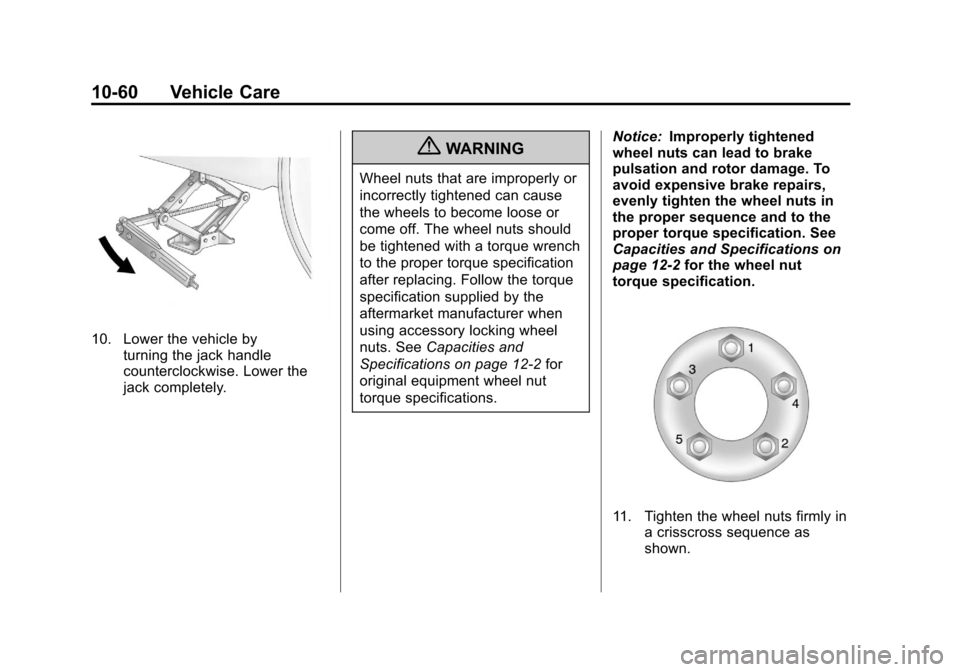
10. Lower the vehicle byturning the jack handle
counterclockwise. Lower the
jack completely.
{WARNING
Wheel nuts that are improperly or
incorrectly tightened can cause
the wheels to become loose or
come off. The wheel nuts should
be tightened with a torque wrench
to the proper torque specification
after replacing. Follow the torque
specification supplied by the
aftermarket manufacturer when
using accessory locking wheel
nuts. See Capacities and
Specifications on page 12‑2 for
original equipment wheel nut
torque specifications. Notice:
Improperly tightened
wheel nuts can lead to brake
pulsation and rotor damage. To
avoid expensive brake repairs,
evenly tighten the wheel nuts in
the proper sequence and to the
proper torque specification. See
Capacities and Specifications on
page 12‑2 for the wheel nut
torque specification.
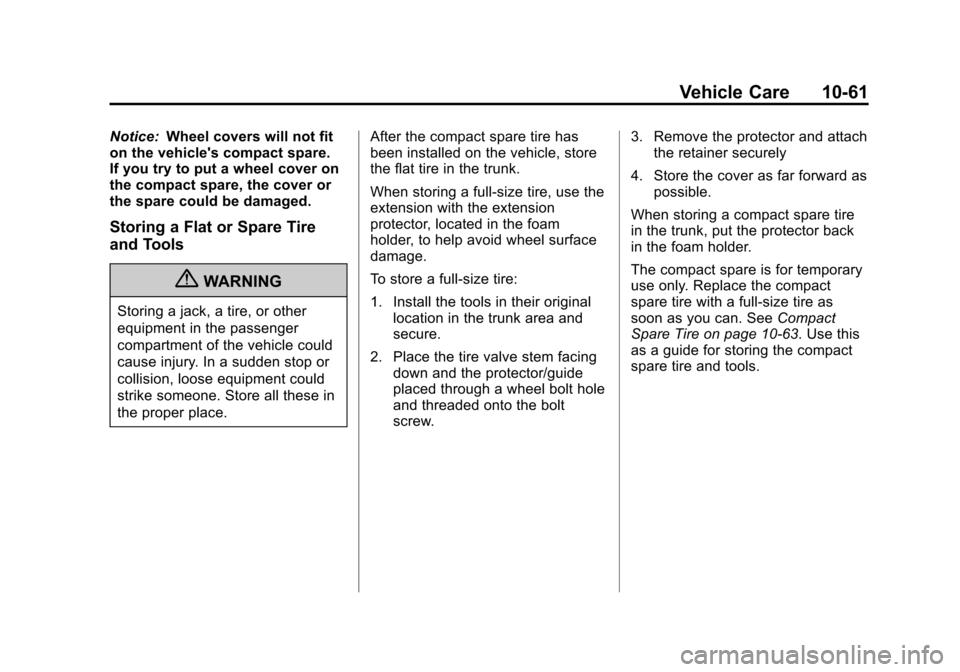
11. Tighten the wheel nuts firmly in a crisscross sequence as
shown.
Page 303 of 374
Black plate (61,1)Chevrolet Impala Owner Manual - 2012
Vehicle Care 10-61
Notice:Wheel covers will not fit
on the vehicle's compact spare.
If you try to put a wheel cover on
the compact spare, the cover or
the spare could be damaged.
Storing a Flat or Spare Tire
and Tools
{WARNING
Storing a jack, a tire, or other
equipment in the passenger
compartment of the vehicle could
cause injury. In a sudden stop or
collision, loose equipment could
strike someone. Store all these in
the proper place. After the compact spare tire has
been installed on the vehicle, store
the flat tire in the trunk.
When storing a full-size tire, use the
extension with the extension
protector, located in the foam
holder, to help avoid wheel surface
damage.
To store a full-size tire:
1. Install the tools in their original
location in the trunk area and
secure.
2. Place the tire valve stem facing down and the protector/guide
placed through a wheel bolt hole
and threaded onto the bolt
screw. 3. Remove the protector and attach
the retainer securely
4. Store the cover as far forward as possible.
When storing a compact spare tire
in the trunk, put the protector back
in the foam holder.
The compact spare is for temporary
use only. Replace the compact
spare tire with a full-size tire as
soon as you can. See Compact
Spare Tire on page 10‑63. Use this
as a guide for storing the compact
spare tire and tools.
Page 304 of 374
Black plate (62,1)Chevrolet Impala Owner Manual - 2012
10-62 Vehicle Care
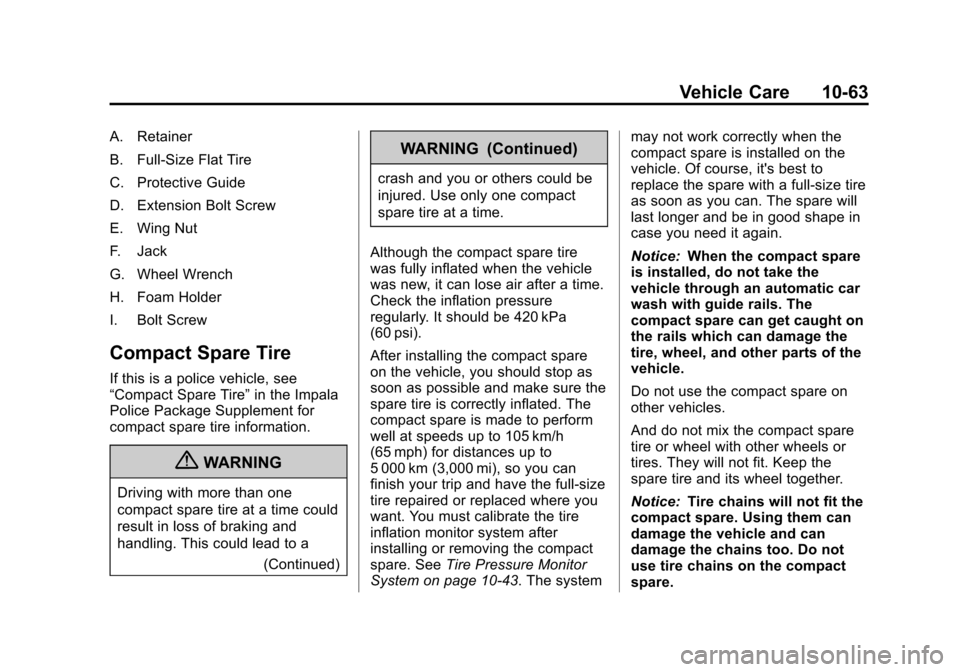
Compact Spare TireA. Cover
B. Retainer
C. Compact Spare Tire
D. Wing Nut
E. Jack
F. Wheel Wrench
G. Extension Protector
H. Foam Holder
I. Bolt ScrewFull-Size Flat Tire
Page 305 of 374
Black plate (63,1)Chevrolet Impala Owner Manual - 2012
Vehicle Care 10-63
A. Retainer
B. Full-Size Flat Tire
C. Protective Guide
D. Extension Bolt Screw
E. Wing Nut
F. Jack
G. Wheel Wrench
H. Foam Holder
I. Bolt Screw
Compact Spare Tire
If this is a police vehicle, see
“Compact Spare Tire”in the Impala
Police Package Supplement for
compact spare tire information.
{WARNING
Driving with more than one
compact spare tire at a time could
result in loss of braking and
handling. This could lead to a
(Continued)
WARNING (Continued)
crash and you or others could be
injured. Use only one compact
spare tire at a time.
Although the compact spare tire
was fully inflated when the vehicle
was new, it can lose air after a time.
Check the inflation pressure
regularly. It should be 420 kPa
(60 psi).
After installing the compact spare
on the vehicle, you should stop as
soon as possible and make sure the
spare tire is correctly inflated. The
compact spare is made to perform
well at speeds up to 105 km/h
(65 mph) for distances up to
5 000 km (3,000 mi), so you can
finish your trip and have the full-size
tire repaired or replaced where you
want. You must calibrate the tire
inflation monitor system after
installing or removing the compact
spare. See Tire Pressure Monitor
System on page 10‑43. The system may not work correctly when the
compact spare is installed on the
vehicle. Of course, it's best to
replace the spare with a full-size tire
as soon as you can. The spare will
last longer and be in good shape in
case you need it again.
Notice:
When the compact spare
is installed, do not take the
vehicle through an automatic car
wash with guide rails. The
compact spare can get caught on
the rails which can damage the
tire, wheel, and other parts of the
vehicle.
Do not use the compact spare on
other vehicles.
And do not mix the compact spare
tire or wheel with other wheels or
tires. They will not fit. Keep the
spare tire and its wheel together.
Notice: Tire chains will not fit the
compact spare. Using them can
damage the vehicle and can
damage the chains too. Do not
use tire chains on the compact
spare.
Page 309 of 374

Black plate (67,1)Chevrolet Impala Owner Manual - 2012
Vehicle Care 10-67
To disconnect the jumper cables
from both vehicles:
1. Disconnect the blacknegative (−) cable from the
vehicle that had the dead
battery.
2. Disconnect the black negative (−) cable from the
vehicle with the good battery.
3. Disconnect the red positive (+) cable from the vehicle with the
good battery.
4. Disconnect the red positive (+) cable from the other vehicle.
5. Return the caps over the positive (+) and negative (–)
terminals to their original
positions.Towing
Towing the Vehicle
Notice: To avoid damage, the
disabled vehicle should be towed
with all four wheels off the
ground. Care must be taken with
vehicles that have low ground
clearance and/or special
equipment. Always flatbed on a
car carrier.
Consult your dealer or a
professional towing service if the
disabled vehicle must be towed.
See Roadside Assistance Program
on page 13‑6.
To tow the vehicle behind another
vehicle for recreational purposes,
such as behind a motor home, see
“Recreational Vehicle Towing” in this
section.
Recreational Vehicle
Towing
Recreational vehicle towing means
towing the vehicle behind another
vehicle such as a motor home. The
two most common types of
recreational vehicle towing are
known as dinghy towing and dolly
towing. Dinghy towing is towing the
vehicle with all four wheels on the
ground. Dolly towing is towing the
vehicle with two wheels on the
ground and two wheels up on a
device known as a dolly.
Page 310 of 374
Black plate (68,1)Chevrolet Impala Owner Manual - 2012
10-68 Vehicle Care
Here are some important things to
consider before recreational vehicle
towing:
.What is the towing capacity
of the towing vehicle? Be
sure to read the tow vehicle
manufacturer's
recommendations.
.What is the distance that will be
travelled? Some vehicles have
restrictions on how far and how
long they can tow.
.Is the proper towing equipment
going to be used? See your
dealer or trailering professional
for additional advice and
equipment recommendations.
.Is the vehicle ready to be
towed? Just as preparing the
vehicle for a long trip, make sure
the vehicle is prepared to be
towed.
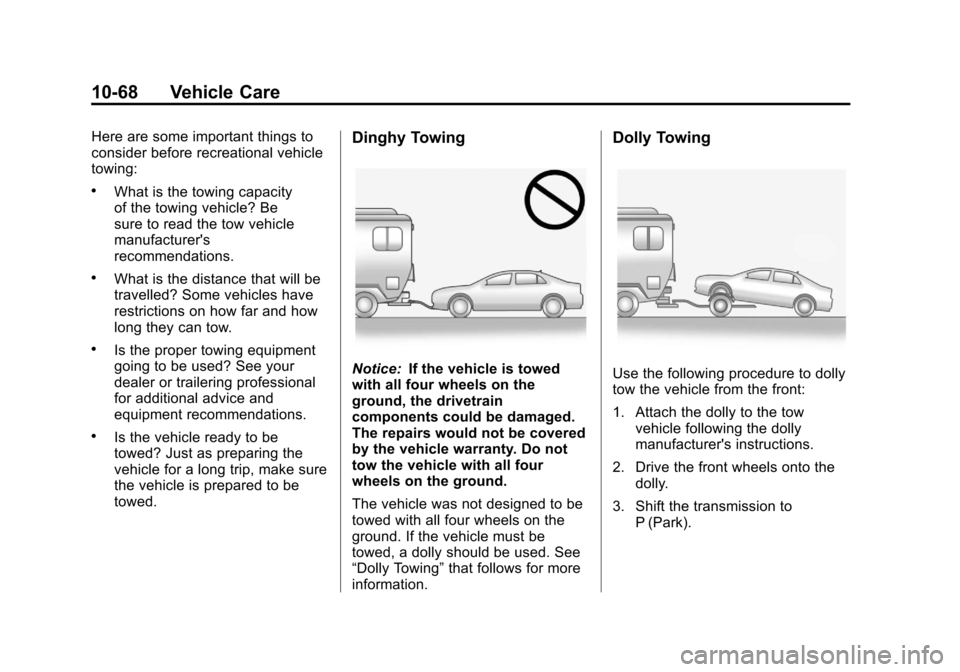
Dinghy Towing
Notice:If the vehicle is towed
with all four wheels on the
ground, the drivetrain
components could be damaged.
The repairs would not be covered
by the vehicle warranty. Do not
tow the vehicle with all four
wheels on the ground.
The vehicle was not designed to be
towed with all four wheels on the
ground. If the vehicle must be
towed, a dolly should be used. See
“Dolly Towing” that follows for more
information.
Dolly Towing
Use the following procedure to dolly
tow the vehicle from the front:
1. Attach the dolly to the tow vehicle following the dolly
manufacturer's instructions.
2. Drive the front wheels onto the dolly.
3. Shift the transmission to P (Park).