2012 CHEVROLET IMPALA trailer
[x] Cancel search: trailerPage 240 of 374
Black plate (48,1)Chevrolet Impala Owner Manual - 2012
9-48 Driving and Operating
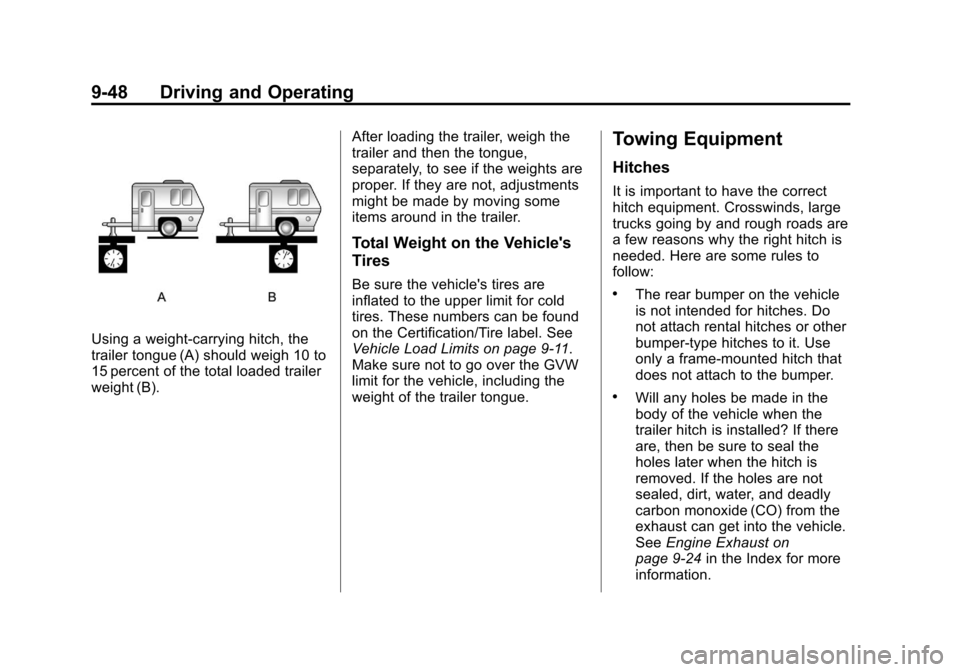
Using a weight-carrying hitch, the
trailer tongue (A) should weigh 10 to
15 percent of the total loaded trailer
weight (B).After loading the trailer, weigh the
trailer and then the tongue,
separately, to see if the weights are
proper. If they are not, adjustments
might be made by moving some
items around in the trailer.
Total Weight on the Vehicle's
Tires
Be sure the vehicle's tires are
inflated to the upper limit for cold
tires. These numbers can be found
on the Certification/Tire label. See
Vehicle Load Limits on page 9‑11.
Make sure not to go over the GVW
limit for the vehicle, including the
weight of the trailer tongue.
Towing Equipment
Hitches
It is important to have the correct
hitch equipment. Crosswinds, large
trucks going by and rough roads are
a few reasons why the right hitch is
needed. Here are some rules to
follow:
.The rear bumper on the vehicle
is not intended for hitches. Do
not attach rental hitches or other
bumper-type hitches to it. Use
only a frame-mounted hitch that
does not attach to the bumper.
.Will any holes be made in the
body of the vehicle when the
trailer hitch is installed? If there
are, then be sure to seal the
holes later when the hitch is
removed. If the holes are not
sealed, dirt, water, and deadly
carbon monoxide (CO) from the
exhaust can get into the vehicle.
See
Engine Exhaust on
page 9‑24 in the Index for more
information.
Page 241 of 374
Black plate (49,1)Chevrolet Impala Owner Manual - 2012
Driving and Operating 9-49
Safety Chains
Always attach chains between the
vehicle and the trailer. Cross the
safety chains under the tongue of
the trailer to help prevent the tongue
from contacting the road if it
becomes separated from the hitch.
Instructions about safety chains
may be provided by the hitch
manufacturer or by the trailer
manufacturer. Follow the
manufacturer's recommendation for
attaching safety chains and do not
attach them to the bumper. Always
leave just enough slack so the rig
can turn. Never allow safety chains
to drag on the ground.
Trailer Brakes
Because the vehicle has antilock
brakes, do not try to tap into the
vehicle's hydraulic brake system.
If you do, both brake systems will
not work well, or at all.
Does your trailer have its own
brakes? Be sure to read and follow
the instructions for the trailer brakes
so you will be able to install, adjust
and maintain them properly.
Conversions and
Add-Ons
Add-On Electrical
Equipment
Notice:Do not add anything
electrical to the vehicle unless
you check with your dealer first.
Some electrical equipment can
damage the vehicle and the
damage would not be covered by
the vehicle's warranty. Some
add-on electrical equipment can
keep other components from
working as they should.
Add-on equipment can drain the
vehicle's 12‐volt battery, even if the
vehicle is not operating.
The vehicle has an airbag system.
Before attempting to add anything
electrical to the vehicle, see
Servicing the Airbag-Equipped
Vehicle on page 3‑33 andAdding
Equipment to the Airbag-Equipped
Vehicle on page 3‑34.
Page 258 of 374

Black plate (16,1)Chevrolet Impala Owner Manual - 2012
10-16 Vehicle Care
Engine Overheating
There is a coolant temperature
gauge and a engine coolant
temperature warning light on the
instrument panel cluster that
indicate an overheated engine
condition. SeeEngine Coolant
Temperature Gauge on page 5‑12
and Engine Coolant Temperature
Warning Light on page 5‑21 for
more information.
If the decision is made not to lift the
hood when this warning appears,
get service help right away. See
Roadside Assistance Program on
page 13‑6.
If the decision is made to lift the
hood, make sure the vehicle is
parked on a level surface.
Then check to see if the engine
cooling fans are running. If the
engine is overheating, the fans
should be running. If not, do not
continue to run the engine and have
the vehicle serviced. Notice:
Engine damage from
running the engine without
coolant is not covered by the
warranty.
If Steam Is Coming from the
Engine Compartment
See Overheated Engine Protection
Operating Mode on page 10‑17 for
information on driving to a safe
place in an emergency.
If No Steam Is Coming from
the Engine Compartment
If an engine overheat warning is
displayed but no steam can be seen
or heard, the problem might not be
too serious. Sometimes the engine
can get a little too hot when the
vehicle:
.Climbs a long hill on a hot day.
.Stops after high-speed driving.
.Idles for long periods in traffic.
.Tows a trailer. If the overheat warning displays with
no sign of steam:
1. Turn the air conditioning off.
2. Turn the heater on to the highest
temperature and to the highest
fan speed. Open the windows as
necessary.
3. In heavy traffic, let the engine idle in N (Neutral) while stopped.
If it is safe to do so, pull off the
road, shift to P (Park) or
N (Neutral), and let the
engine idle.
If the temperature overheat gauge is
no longer in the overheat zone or an
engine coolant temperature warning
light no longer displays, the vehicle
can be driven. Continue to drive the
vehicle slowly for about 10 minutes.
Keep a safe vehicle distance from
the vehicle in front. If the warning
does not come back on, continue to
drive normally.
If the warning continues, pull over,
stop, and park the vehicle
right away.
Page 259 of 374

Black plate (17,1)Chevrolet Impala Owner Manual - 2012
Vehicle Care 10-17
If there is no sign of steam, idle the
engine for three minutes while
parked. If the warning is still
displayed, turn off the engine until it
cools down. Also, seeOverheated
Engine Protection Operating Mode
on page 10‑17.
Overheated Engine
Protection
Operating Mode
This emergency operating mode
allows the vehicle to be driven to a
safe place in an emergency
situation. If an overheated engine
condition exists, an overheat
protection mode which alternates
firing groups of cylinders helps
prevent engine damage. In this
mode, there is significant loss in
power and engine performance.
The engine coolant temperature
warning light comes on the
instrument panel, to indicate the
vehicle has entered overheated
engine protection operating mode.
The temperature gauge also indicates an overheat condition
exists. Driving extended km (miles)
and/or towing a trailer in the
overheat protection mode should be
avoided.
Power Steering Fluid
See
Engine Compartment Overview
on page 10‑6 for information on the
location of the power steering fluid
reservoir.
When to Check Power Steering
Fluid
It is not necessary to regularly
check power steering fluid unless a
leak is suspected in the system or
an unusual noise is heard. A fluid
loss in this system could indicate a
problem. Have the system inspected
and repaired.
How to Check Power Steering
Fluid
Check the level after the vehicle has
been driven for at least 20 minutes
so the fluid is warm.
To check the power steering fluid:
1. Turn the ignition to LOCK/OFF and let the engine compartment
cool down.
2. Wipe the cap and the top of the reservoir clean.
3. Unscrew the cap and pull it straight up.
4. Wipe the dipstick with a clean rag.
5. Replace the cap and completely tighten it.
6. Remove the cap again and look at the fluid level on the dipstick.
Page 310 of 374
Black plate (68,1)Chevrolet Impala Owner Manual - 2012
10-68 Vehicle Care
Here are some important things to
consider before recreational vehicle
towing:
.What is the towing capacity
of the towing vehicle? Be
sure to read the tow vehicle
manufacturer's
recommendations.
.What is the distance that will be
travelled? Some vehicles have
restrictions on how far and how
long they can tow.
.Is the proper towing equipment
going to be used? See your
dealer or trailering professional
for additional advice and
equipment recommendations.
.Is the vehicle ready to be
towed? Just as preparing the
vehicle for a long trip, make sure
the vehicle is prepared to be
towed.
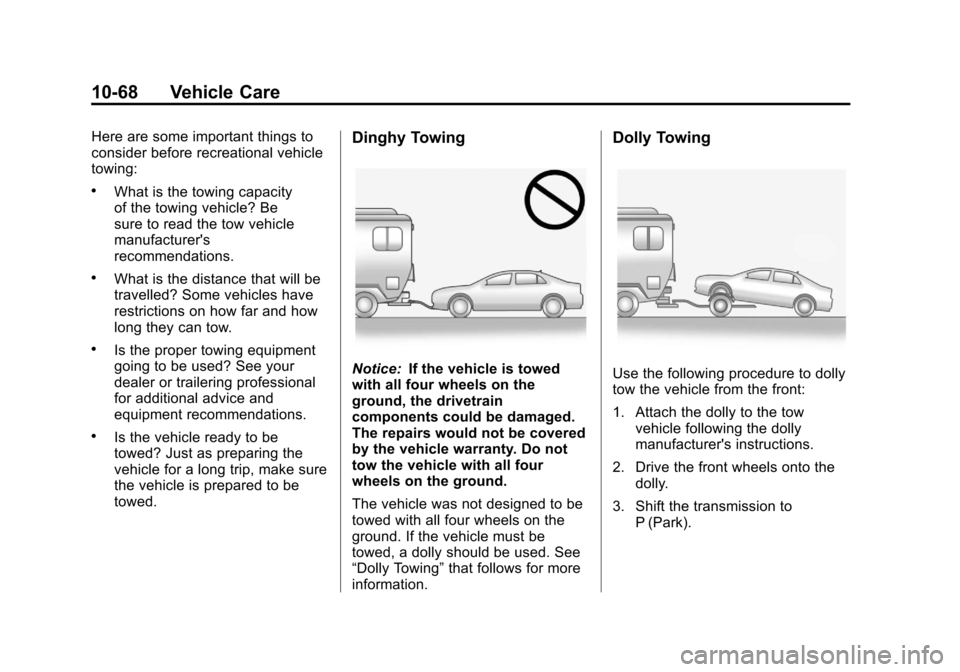
Dinghy Towing
Notice:If the vehicle is towed
with all four wheels on the
ground, the drivetrain
components could be damaged.
The repairs would not be covered
by the vehicle warranty. Do not
tow the vehicle with all four
wheels on the ground.
The vehicle was not designed to be
towed with all four wheels on the
ground. If the vehicle must be
towed, a dolly should be used. See
“Dolly Towing” that follows for more
information.
Dolly Towing
Use the following procedure to dolly
tow the vehicle from the front:
1. Attach the dolly to the tow vehicle following the dolly
manufacturer's instructions.
2. Drive the front wheels onto the dolly.
3. Shift the transmission to P (Park).
Page 320 of 374

Black plate (2,1)Chevrolet Impala Owner Manual - 2012
11-2 Service and Maintenance
Because of the way people use
vehicles, maintenance needs vary.
There may need to be more
frequent checks and services.
The Additional Required
Services‐Normal are for
vehicles that:
.Carry passengers and cargo
within recommended limits on
the Tire and Loading Information
label. See Vehicle Load Limits
on page 9‑11.
.Are driven on reasonable road
surfaces within legal driving
limits.
.Use the recommended fuel. See
Recommended Fuel on
page 9‑37.
Refer to the information in the
Maintenance Schedule Additional
Required Services ‐Normal chart. The Additional Required
Services
‐Severe are for vehicles
that are:
.Mainly driven in hilly or
mountainous terrain.
.Frequently towing a trailer.
.Used for high speed or
competitive driving.
.Used for taxi, police, or delivery
service.
Refer to the information in the
Maintenance Schedule Additional
Required Services ‐Severe chart.
{WARNING
Performing maintenance work can
be dangerous and can cause
serious injury. Perform
maintenance work only if the
required information, proper tools,
and equipment are available.
If they are not, see your dealer to
have a trained technician do the
work. See Doing Your Own
Service Work on page 10‑4.
Page 373 of 374

Black plate (11,1)Chevrolet Impala Owner Manual - 2012
INDEX i-11
T
Tachometer . . . . . . . . . . . . . . . . . . . . 5-11
TaillampsBulb Replacement . . . . . . . . . . 10-28
Text Telephone (TTY) Users . . . 13-4
Theft-Deterrent Systems . . . . . . . 2-12 Immobilizer . . . . . . . . . . . . . . . . . . . 2-12
Time . . . . . . . . . . . . . . . . . . . . . . . . . . . . 5-6
Tires Buying New Tires . . . . . . . . . . . 10-49
Chains . . . . . . . . . . . . . . . . . . . . . . 10-54
Changing . . . . . . . . . . . . . . . . . . . 10-56
Compact Spare . . . . . . . . . . . . . 10-63
Designations . . . . . . . . . . . . . . . 10-38
Different Size . . . . . . . . . . . . . . . 10-51
If a Tire Goes Flat . . . . . . . . . . 10-54
Inflation Monitor System . . . . 10-44
Inspection . . . . . . . . . . . . . . . . . . 10-47
Messages . . . . . . . . . . . . . . . . . . . . 5-36
Pressure Light . . . . . . . . . . . . . . . . 5-22
Pressure Monitor System . . . 10-43
Rotation . . . . . . . . . . . . . . . . . . . . 10-47
Sidewall Labeling . . . . . . . . . . . 10-36
Terminology andDefinitions . . . . . . . . . . . . . . . . . 10-38 Tires (cont.)
Uniform Tire Quality
Grading . . . . . . . . . . . . . . . . . . . 10-51
Wheel Alignment and Tire
Balance . . . . . . . . . . . . . . . . . . . 10-53
Wheel Replacement . . . . . . . . 10-53
When It Is Time for New Tires . . . . . . . . . . . . . . . . . . . . . . 10-48
Towing
Driving Characteristics . . . . . . . . 9-43
Equipment . . . . . . . . . . . . . . . . . . . . 9-48
General Information . . . . . . . . . . 9-42
Recreational Vehicle . . . . . . . . 10-67
Trailer . . . . . . . . . . . . . . . . . . . . . . . . 9-46
Vehicle . . . . . . . . . . . . . . . . . . . . . 10-67
Traction Control System (TCS) . . . . . . . . 9-30
Trailer Towing . . . . . . . . . . . . . . . . . 9-46
Transmission
Automatic . . . . . . . . . . . . . . . . . . . . . 9-26
Fluid, Automatic . . . . . . . . . . . . .10-11
Messages . . . . . . . . . . . . . . . . . . . . 5-36
Transportation Program,
Courtesy . . . . . . . . . . . . . . . . . . . . . 13-8 Trunk . . . . . . . . . . . . . . . . . . . . . . . . . . 2-10
Turn and Lane-Change
Signals . . . . . . . . . . . . . . . . . . . . . . . . 6-4
Turn Signal Bulb Replacement . . . . . . . . . . 10-28
U
Uniform Tire QualityGrading . . . . . . . . . . . . . . . . . . . . . 10-51
Universal Remote System . . . . . 5-43 Operation . . . . . . . . . . . . . . . . . . . . . 5-48
Programming . . . . . . . . . . . . . . . . . 5-43
Using This Manual . . . . . . . . . . . . . . . . iv
V
Vehicle
Canadian Owners . . . . . . . . . . . . . . . iii
Control . . . . . . . . . . . . . . . . . . . . . . . . 9-3
IdentificationNumber (VIN) . . . . . . . . . . . . . . . 12-1
Load Limits . . . . . . . . . . . . . . . . . . . 9-11
Messages . . . . . . . . . . . . . . . . . . . . 5-29
Personalization . . . . . . . . . . . . . . . 5-37
Reminder Messages . . . . . . . . . . 5-37