Page 406 of 508

Black plate (62,1)Chevrolet Avalanche Owner Manual - 2012
10-62 Vehicle Care
9. Turn the ignition to LOCK/OFF.
10. Set all four tires to therecommended air pressure
level as indicated on the Tire
and Loading Information label.
Tire Inspection
We recommend that the tires,
including the spare tire, if the
vehicle has one, be inspected
for signs of wear or damage at
least once a month.
Replace the tire if:
.The indicators at three or
more places around the tire
can be seen.
.There is cord or fabric
showing through the tire's
rubber.
.The tread or sidewall is
cracked, cut, or snagged
deep enough to show cord or
fabric.
.The tire has a bump, bulge,
or split.
.The tire has a puncture, cut,
or other damage that cannot
be repaired well because of
the size or location of the
damage.
Tire Rotation
Tires should be rotated every
12 000 km (7,500 mi). See
Maintenance Schedule on
page 11‑3.
Tires are rotated to achieve a
uniform wear for all tires. The
first rotation is the most
important.
Any time unusual wear is
noticed, rotate the tires as soon
as possible and check the wheel
alignment. Also check for
damaged tires or wheels. See
When It Is Time for New
Tires on page 10‑63 andWheel
Replacement on page 10‑68.
Use this rotation pattern when
rotating the tires.
Do not include the spare tire in
the tire rotation.
Page 410 of 508

Black plate (66,1)Chevrolet Avalanche Owner Manual - 2012
10-66 Vehicle Care
The Tire and Loading Information
label indicates the original
equipment tires on the vehicle. See
Vehicle Load Limits on page 9‑16
for the label location and more
information about the Tire and
Loading Information label.
Different Size Tires and
Wheels
If wheels or tires are installed that
are a different size than the original
equipment wheels and tires, vehicle
performance, including its braking,
ride and handling characteristics,
stability, and resistance to rollover
may be affected. If the vehicle has
electronic systems such as antilock
brakes, rollover airbags, traction
control, and electronic stability
control, the performance of these
systems can also be affected.
{WARNING
If different sized wheels are used,
there may not be an acceptable
level of performance and safety if
tires not recommended for those
wheels are selected. This
increases the chance of a crash
and serious injury. Only use GM
specific wheel and tire systems
developed for the vehicle, and
have them properly installed by a
GM certified technician.
See Buying New Tires on
page 10‑64 andAccessories and
Modifications on page 10‑3 for
additional information.
Uniform Tire Quality
Grading
Quality grades can be found
where applicable on the tire
sidewall between tread shoulder
and maximum section width. For
example:
Treadwear 200 Traction AA
Temperature A
The following information relates
to the system developed by the
United States National Highway
Traffic Safety Administration
(NHTSA), which grades tires by
treadwear, traction, and
temperature performance. This
applies only to vehicles sold in
the United States. The grades
are molded on the sidewalls of
most passenger car tires. The
Uniform Tire Quality Grading
(UTQG) system does not apply
to deep tread, winter-type snow
tires, space-saver, or temporary
Page 415 of 508
Black plate (71,1)Chevrolet Avalanche Owner Manual - 2012
Vehicle Care 10-71
{WARNING
Changing a tire can be
dangerous. The vehicle can slip
off the jack and roll over or fall
causing injury or death. Find a
level place to change the tire. To
help prevent the vehicle from
moving:1. Set the parking brake firmly.
2. Put the shift lever in P (Park).
3. For vehicles with four-wheel-drive with a
N (Neutral) transfer case
position, be sure the
transfer case is in a drive
gear —not in N (Neutral).
(Continued)
WARNING (Continued)
4. Turn off the engine and donot restart while the vehicle
is raised.
5. Do not allow passengers to remain in the vehicle.
6. Place wheel blocks on both sides of the tire at the
opposite corner of the tire
being changed.
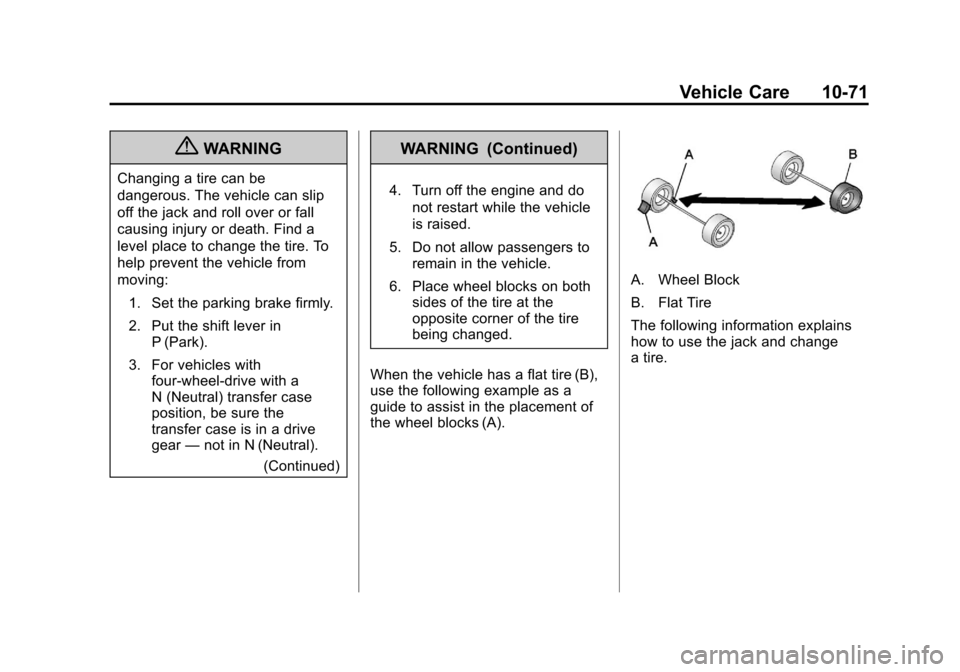
When the vehicle has a flat tire (B),
use the following example as a
guide to assist in the placement of
the wheel blocks (A).
A. Wheel Block
B. Flat Tire
The following information explains
how to use the jack and change
a tire.
Page 416 of 508
Black plate (72,1)Chevrolet Avalanche Owner Manual - 2012
10-72 Vehicle Care
Tire Changing
Removing the Spare Tire and
Tools
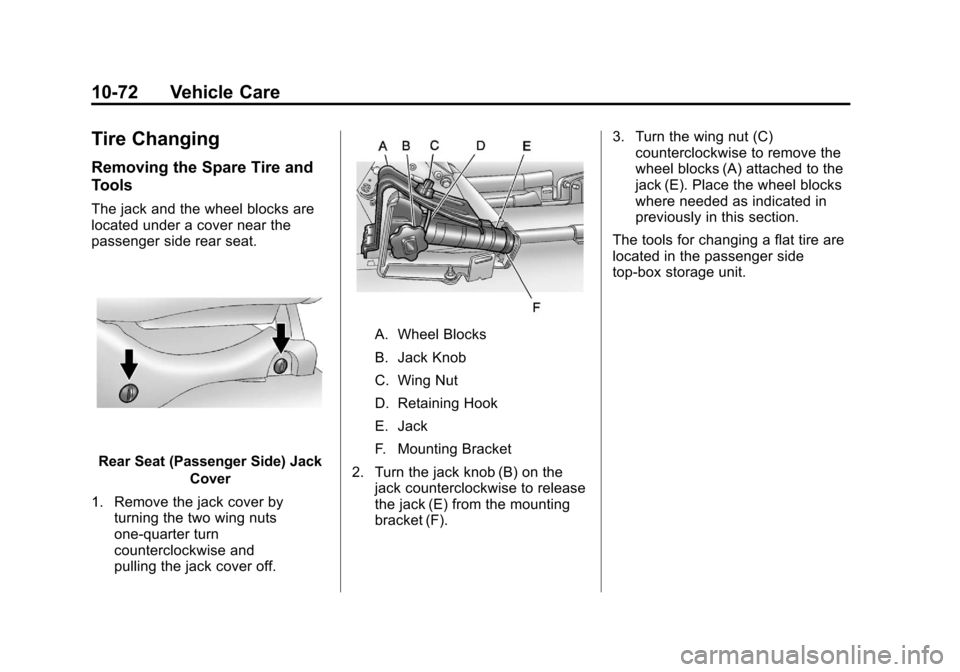
The jack and the wheel blocks are
located under a cover near the
passenger side rear seat.
Rear Seat (Passenger Side) JackCover
1. Remove the jack cover by turning the two wing nuts
one-quarter turn
counterclockwise and
pulling the jack cover off.
A. Wheel Blocks
B. Jack Knob
C. Wing Nut
D. Retaining Hook
E. Jack
F. Mounting Bracket
2. Turn the jack knob (B) on the jack counterclockwise to release
the jack (E) from the mounting
bracket (F). 3. Turn the wing nut (C)
counterclockwise to remove the
wheel blocks (A) attached to the
jack (E). Place the wheel blocks
where needed as indicated in
previously in this section.
The tools for changing a flat tire are
located in the passenger side
top-box storage unit.
Page 417 of 508
Black plate (73,1)Chevrolet Avalanche Owner Manual - 2012
Vehicle Care 10-73
To remove the tools:
1. Open the top door on thepassenger side top-box storage
unit. Use the ignition/door key to
unlock it if it is locked. See
Top-Box Storage on page 4‑2 for
more information.
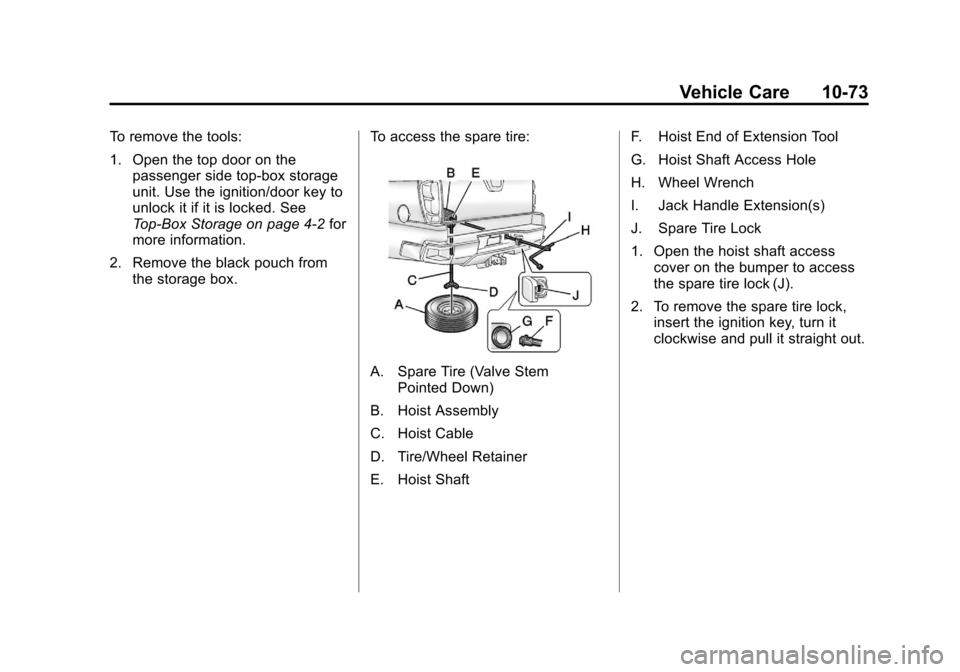
2. Remove the black pouch from the storage box. To access the spare tire:
A. Spare Tire (Valve Stem
Pointed Down)
B. Hoist Assembly
C. Hoist Cable
D. Tire/Wheel Retainer
E. Hoist Shaft F. Hoist End of Extension Tool
G. Hoist Shaft Access Hole
H. Wheel Wrench
I. Jack Handle Extension(s)
J. Spare Tire Lock
1. Open the hoist shaft access
cover on the bumper to access
the spare tire lock (J).
2. To remove the spare tire lock, insert the ignition key, turn it
clockwise and pull it straight out.
Page 418 of 508
Black plate (74,1)Chevrolet Avalanche Owner Manual - 2012
10-74 Vehicle Care
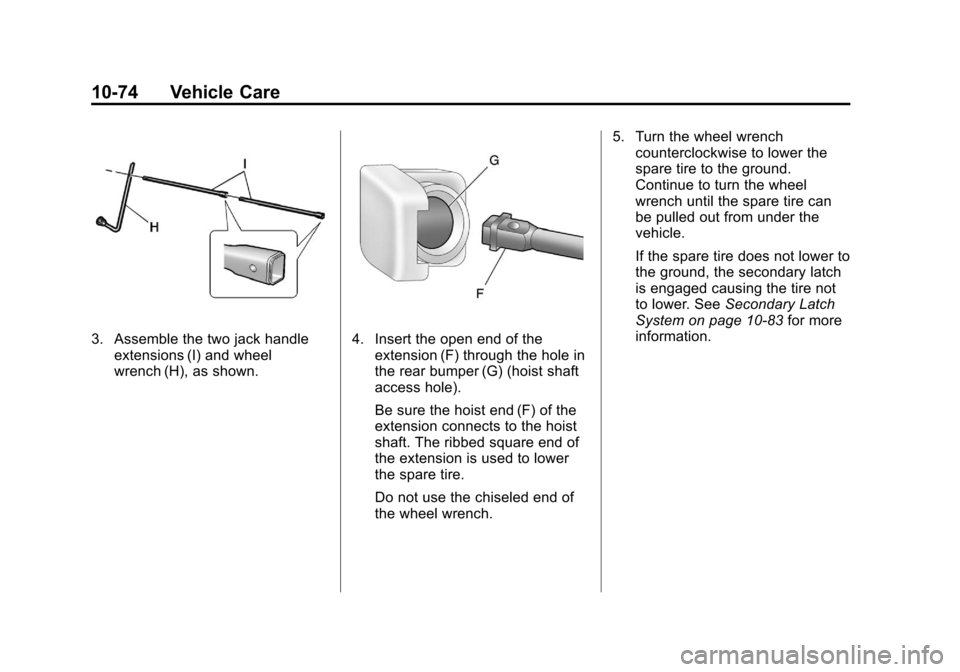
3. Assemble the two jack handleextensions (I) and wheel
wrench (H), as shown.4. Insert the open end of theextension (F) through the hole in
the rear bumper (G) (hoist shaft
access hole).
Be sure the hoist end (F) of the
extension connects to the hoist
shaft. The ribbed square end of
the extension is used to lower
the spare tire.
Do not use the chiseled end of
the wheel wrench. 5. Turn the wheel wrench
counterclockwise to lower the
spare tire to the ground.
Continue to turn the wheel
wrench until the spare tire can
be pulled out from under the
vehicle.
If the spare tire does not lower to
the ground, the secondary latch
is engaged causing the tire not
to lower. See Secondary Latch
System on page 10‑83 for more
information.
Page 420 of 508
Black plate (76,1)Chevrolet Avalanche Owner Manual - 2012
10-76 Vehicle Care
Removing the Flat Tire and
Installing the Spare Tire
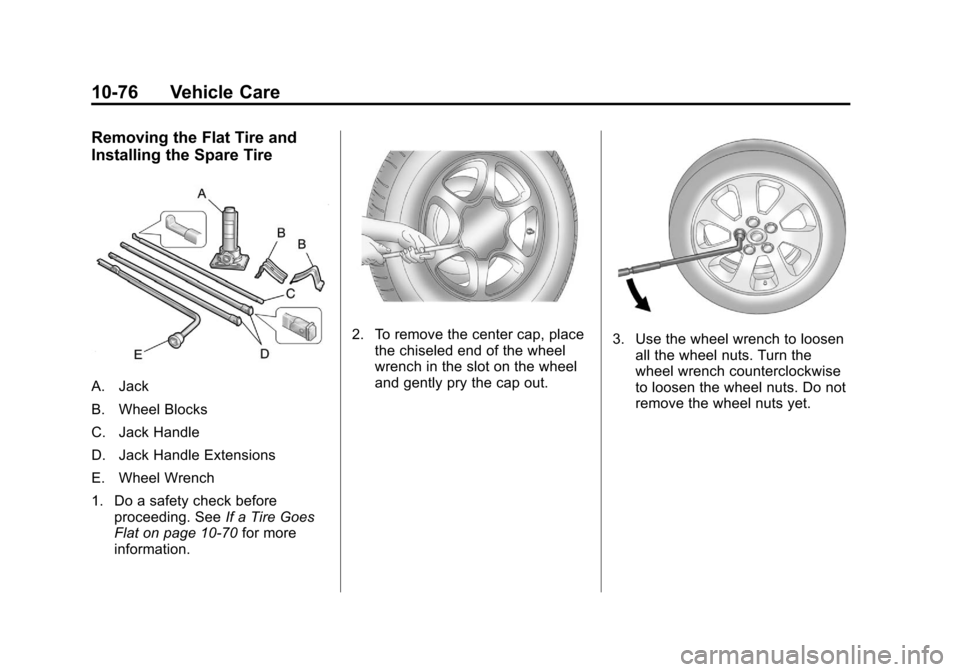
A. Jack
B. Wheel Blocks
C. Jack Handle
D. Jack Handle Extensions
E. Wheel Wrench
1. Do a safety check beforeproceeding. See If a Tire Goes
Flat on page 10‑70 for more
information.
2. To remove the center cap, place the chiseled end of the wheel
wrench in the slot on the wheel
and gently pry the cap out.3. Use the wheel wrench to loosenall the wheel nuts. Turn the
wheel wrench counterclockwise
to loosen the wheel nuts. Do not
remove the wheel nuts yet.
Page 422 of 508
Black plate (78,1)Chevrolet Avalanche Owner Manual - 2012
10-78 Vehicle Care
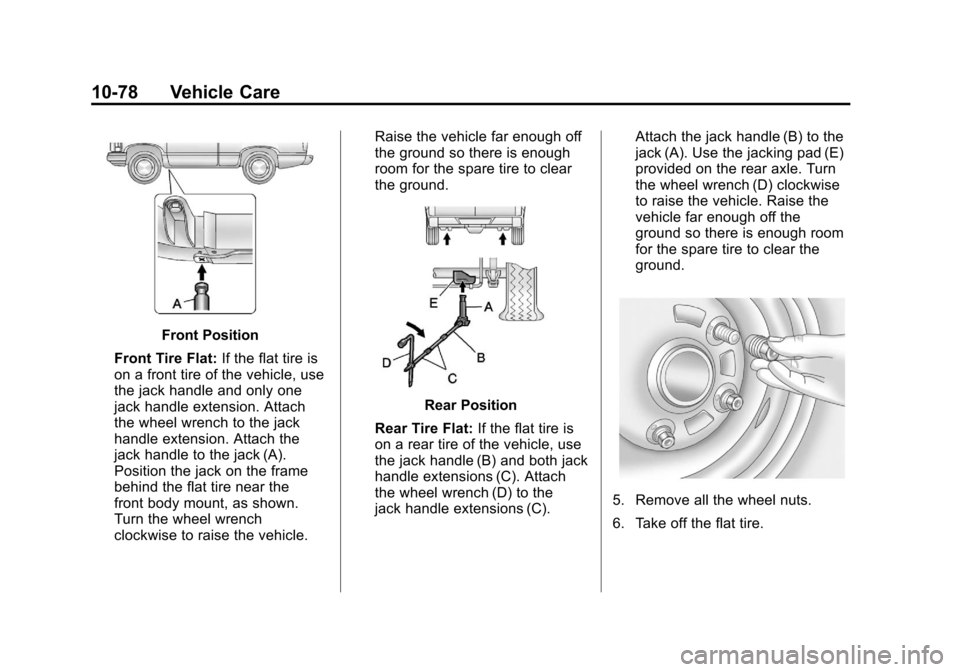
Front Position
Front Tire Flat: If the flat tire is
on a front tire of the vehicle, use
the jack handle and only one
jack handle extension. Attach
the wheel wrench to the jack
handle extension. Attach the
jack handle to the jack (A).
Position the jack on the frame
behind the flat tire near the
front body mount, as shown.
Turn the wheel wrench
clockwise to raise the vehicle. Raise the vehicle far enough off
the ground so there is enough
room for the spare tire to clear
the ground.
Rear Position
Rear Tire Flat: If the flat tire is
on a rear tire of the vehicle, use
the jack handle (B) and both jack
handle extensions (C). Attach
the wheel wrench (D) to the
jack handle extensions (C). Attach the jack handle (B) to the
jack (A). Use the jacking pad (E)
provided on the rear axle. Turn
the wheel wrench (D) clockwise
to raise the vehicle. Raise the
vehicle far enough off the
ground so there is enough room
for the spare tire to clear the
ground.
5. Remove all the wheel nuts.
6. Take off the flat tire.