Page 100 of 142

8-14
8
NOTICEECB00300�In order to prevent clutch slippage (since the
engine oil also lubricates the clutch), do not
mix any chemical additives. Do not use oils
with a diesel specification of “CD” or oils of
a higher quality than specified. In addition,
do not use oils labeled “ENERGY CONSERV-
ING II” or higher.�Make sure that no foreign material enters the
crankcase.10. Start the engine, and then let it idle for several
minutes while checking it for oil leakage. If oil
is leaking, immediately turn the engine off and
check for the cause.
11. Turn the engine off, wait at least ten minutes,
and then check the oil level and correct it if
necessary.EBU23707Cleaning the air filter element The air filter element should be cleaned at the in-
tervals specified in the periodic maintenance and
lubrication chart. Clean or, if necessary, replace
the air filter element more frequently if you are
riding in unusually wet or dusty areas.
TIPThere is a check hose at the bottom of the air filter
case. If dust or water collects in this hose, empty
the hose and clean the air filter element and air fil-
ter case.1. Place the ATV on a level surface.
2. Remove the seat. (See page 4-12.)
3. Remove the air filter case cover by unhooking
the holders.1. Air filter case check hose
1
U1BT61E0.book Page 14 Tuesday, April 6, 2010 1:28 PM
Page 104 of 142

8-18
817. Install the seat.
TIPThe air filter element should be cleaned every 20–
40 hours. It should be cleaned and lubricated more
often if the ATV is operated in extremely dusty ar-
eas. Each time the air filter element maintenance
is performed, check the air inlet of the air filter case
for obstructions. Check the air filter case rubber
joint to the carburetor fittings and the rubber joint
manifold fittings for an air-tight seal. Tighten all fit-
tings securely to avoid the possibility of unfiltered
air entering the engine.EBU28902Cleaning the spark arrester Be sure the exhaust pipe and muffler are cool be-
fore cleaning the spark arrester.
1. Remove the bolts.2. Remove the tailpipe by pulling it out of the
muffler, and then remove the gasket.
3. Tap the tailpipe lightly, and then use a wire
brush to remove any carbon deposits from the
spark arrester portion of the tailpipe and inside
of the tailpipe housing.
1. Bolt
2. Tailpipe
2
11
U1BT61E0.book Page 18 Tuesday, April 6, 2010 1:28 PM
Page 106 of 142

8-20
8ing, possibly leading to death, and start a fire.
Always let the exhaust system cool prior to
touching exhaust components.
EBU23940Adjusting the carburetor The carburetor should be checked and, if neces-
sary, adjusted at the intervals specified in the peri-
odic maintenance and lubrication chart. The
carburetor is an important part of the engine and
requires very sophisticated adjustment. Therefore,
most carburetor adjustments should be left to a
Yamaha dealer, who has the necessary profes-
sional knowledge and experience. The adjustment
described in the following section, however, may
be performed by the owner as part of routine main-
tenance.NOTICEECB00480The carburetor has been set and extensively
tested at the Yamaha factory. Changing these
settings without sufficient technical knowl-
edge may result in poor performance of or
damage to the engine.
EBU24000Adjusting the engine idling speed The engine idling speed must be checked and, if
necessary, adjusted as follows at the intervals
specified in the periodic maintenance and lubrica-
tion chart.TIPA diagnostic tachometer is needed to make this
adjustment.1. Start the engine and warm it up.TIPThe engine is warm when it quickly responds to the
throttle.2. Attach the tachometer to the spark plug lead.
3. Check the engine idling speed and, if neces-
sary, adjust it to specification by turning the
throttle stop screw at the carburetor. To in-
crease the engine idling speed, turn the throt-
tle stop screw in direction (a), and to decrease
it, turn the screw in direction (b).
U1BT61E0.book Page 20 Tuesday, April 6, 2010 1:28 PM
Page 107 of 142

8-21
8
TIPIf the specified idling speed cannot be obtained as
described above, have a Yamaha dealer make the
adjustment.
EBU24045Adjusting the throttle cable free play The throttle cable free play should be checked
and, if necessary, adjusted at the intervals speci-
fied in the periodic maintenance and lubrication
chart.
The throttle cable free play should measure 2.0–
4.0 mm (0.08–0.16 in) at the throttle lever. Period-
ically check the throttle cable free play and, if nec-
essary, adjust it as follows.TIPThe engine idling speed must be checked, and ad-
justed if necessary, before adjusting the throttle ca-
ble free play.1. Slide the rubber cover back.
2. Loosen the locknut.
3. To increase the throttle cable free play, turn
the throttle cable free play adjusting bolt in di-
rection (a). To decrease the throttle cable free
play, turn the adjusting bolt in direction (b).
1. Throttle stop screwEngine idling speed:
1500–1600 r/min
1
(a)
(b)
U1BT61E0.book Page 21 Tuesday, April 6, 2010 1:28 PM
Page 108 of 142

8-22
8
4. Tighten the locknut.
5. Slide the rubber cover to its original position.
EBU24060Valve clearance The valve clearance changes with use, resulting in
improper air-fuel mixture and/or engine noise. To
prevent this from occurring, the valve clearance
must be adjusted by a Yamaha dealer at the inter-
vals specified in the periodic maintenance and lu-
brication chart.
EBU29601Brakes Replacement of brake components requires pro-
fessional knowledge. Brake service should be per-
formed by a Yamaha dealer.
WARNING
EWB02571Operating with improperly serviced or adjust-
ed brakes could lead to a loss in braking ability
and an accident.EBU24130Checking the front and rear brake pads The front and rear brake pads must be checked for
wear at the intervals specified in the periodic main-
tenance and lubrication chart.EBUM0190Front brake pads
Each brake pad is provided with a wear indicator
groove, which allows you to check the brake pad
wear without having to disassemble the brake. To
check the brake pad wear, check the wear indica-
tor groove. If a brake pad has worn to the point that
the wear indicator groove has almost disappeared,
have a Yamaha dealer replace the brake pads as
a set.
1. Rubber cover
2. Throttle cable free play adjusting bolt
3. Locknut
4. Throttle cable free play
4 2 1
3
(a)
(b)
U1BT61E0.book Page 22 Tuesday, April 6, 2010 1:28 PM
Page 111 of 142

8-25
8
EBU24291Changing the brake fluid Have a Yamaha dealer change the brake fluid at
the intervals specified in the TIP after the periodic
maintenance and lubrication chart. In addition,
have the oil seals of the master cylinders and cali-
pers as well as the brake hoses replaced at the in-
tervals listed below or whenever they are damaged
or leaking.�Oil seals: Replace every two years.�Brake hoses: Replace every four years.EBU24394Checking the front brake lever free play The brake lever free play must be checked at the
intervals specified in the periodic maintenance and
lubrication chart. The brake lever should have no
free play as shown. If there is free play, have a
Yamaha dealer check the brake system.
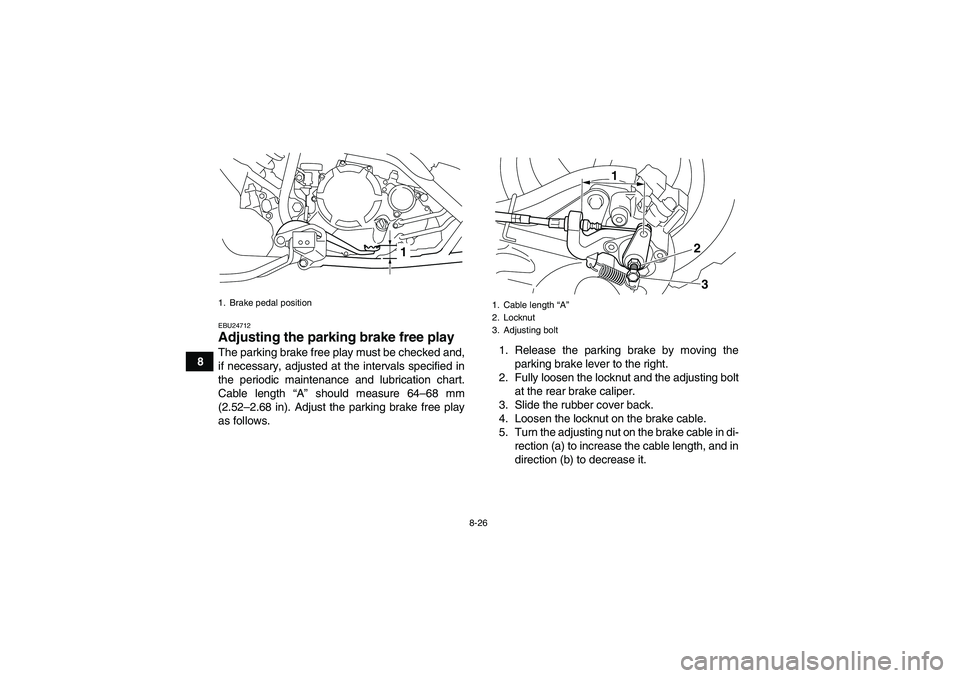
EBU24592Checking the brake pedal position The brake pedal position must be checked and, if
necessary, adjusted at the intervals specified in the
periodic maintenance and lubrication chart.
The top of the brake pedal should be positioned
40.0 mm (1.57 in) above the top of the frame as
shown. If the brake pedal is not positioned as spec-
ified, have a Yamaha dealer adjust it.1. No brake lever free play
1
U1BT61E0.book Page 25 Tuesday, April 6, 2010 1:28 PM
Page 112 of 142
8-26
8
EBU24712Adjusting the parking brake free play The parking brake free play must be checked and,
if necessary, adjusted at the intervals specified in
the periodic maintenance and lubrication chart.
Cable length “A” should measure 64–68 mm
(2.52–2.68 in). Adjust the parking brake free play
as follows.1. Release the parking brake by moving the
parking brake lever to the right.
2. Fully loosen the locknut and the adjusting bolt
at the rear brake caliper.
3. Slide the rubber cover back.
4. Loosen the locknut on the brake cable.
5. Turn the adjusting nut on the brake cable in di-
rection (a) to increase the cable length, and in
direction (b) to decrease it.1. Brake pedal position
1
1. Cable length “A”
2. Locknut
3. Adjusting bolt
1
3 2
U1BT61E0.book Page 26 Tuesday, April 6, 2010 1:28 PM
Page 114 of 142

8-28
8The brake light switch for the brake pedal can be
adjusted as follows, but the front brake light switch
should be adjusted by a Yamaha dealer.
Turn the adjusting nut while holding the brake light
switch in place. To make the brake light come on
earlier, turn the adjusting nut in direction (a). To
make the brake light come on later, turn the adjust-
ing nut in direction (b).
EBU24811Adjusting the clutch lever free play The clutch lever free play must be checked and, if
necessary, adjusted at the intervals specified in the
periodic maintenance and lubrication chart.The clutch lever free play should measure 5.0–
10.0 mm (0.20–0.39 in) as shown. If the free play
is incorrect, adjust it as follows.
1. Slide the rubber cover back.
2. Loosen the locknut at the clutch lever.
3. To increase the clutch lever free play, turn the
adjusting bolt in direction (a), and to decrease
it, turn the bolt in direction (b).
4. Tighten the locknut.
5. Slide the rubber cover to its original position.1. Rear brake light switch
2. Rear brake light switch adjusting nut
12
(b)
(a)
1. Clutch lever free play
2. Locknut
3. Clutch lever free play adjusting bolt
4. Rubber cover1
3
4
(a) (b) 2
U1BT61E0.book Page 28 Tuesday, April 6, 2010 1:28 PM