Page 32 of 140
4-7
4
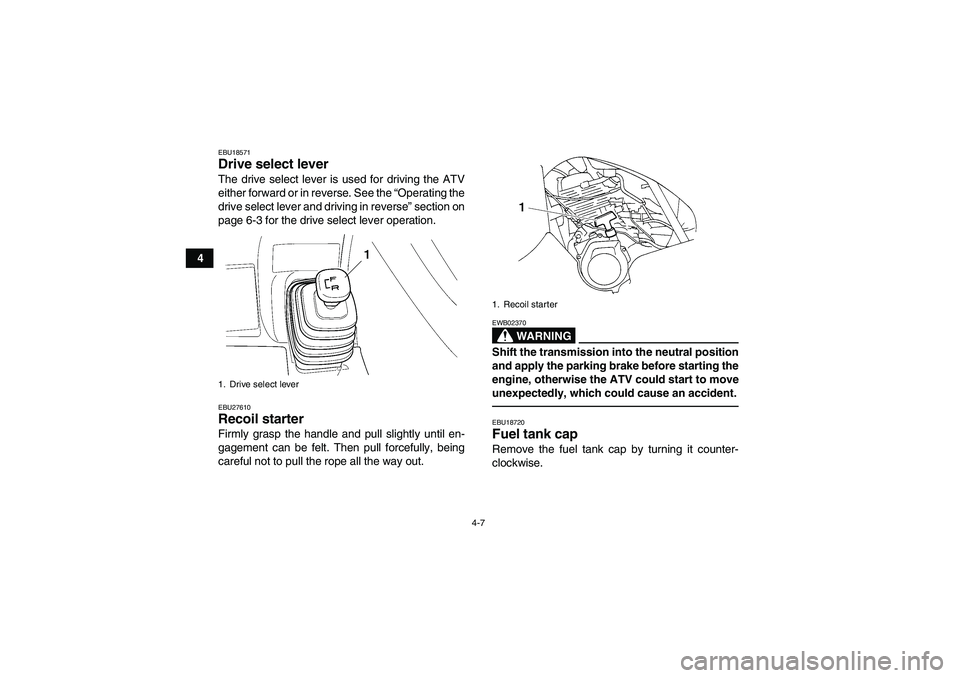
EBU18571Drive select lever The drive select lever is used for driving the ATV
either forward or in reverse. See the “Operating the
drive select lever and driving in reverse” section on
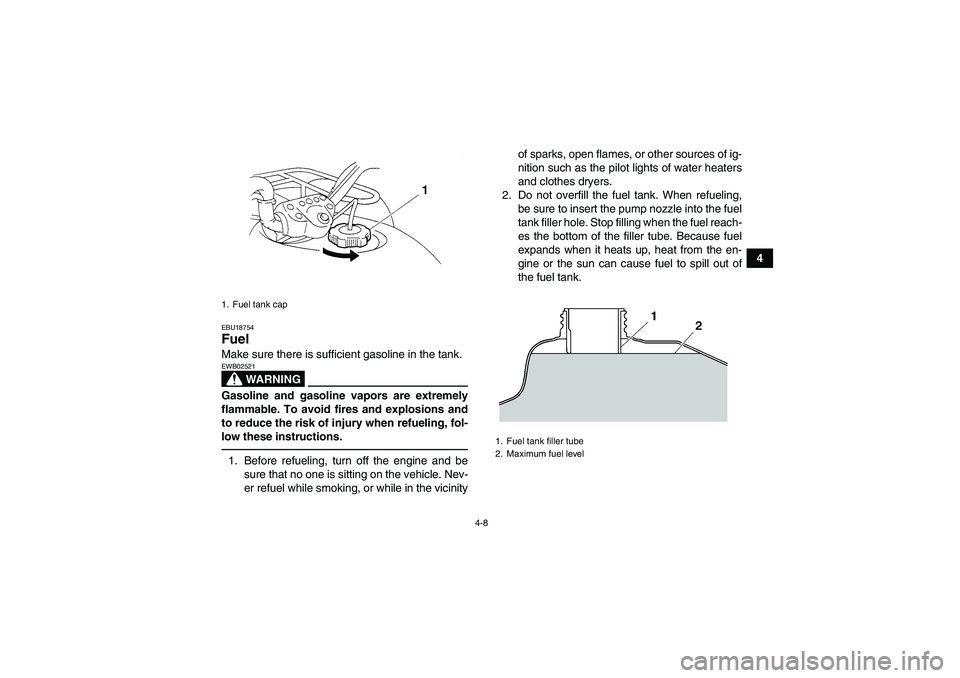
page 6-3 for the drive select lever operation.EBU27610Recoil starter Firmly grasp the handle and pull slightly until en-
gagement can be felt. Then pull forcefully, being
careful not to pull the rope all the way out.
WARNING
EWB02370Shift the transmission into the neutral position
and apply the parking brake before starting the
engine, otherwise the ATV could start to move
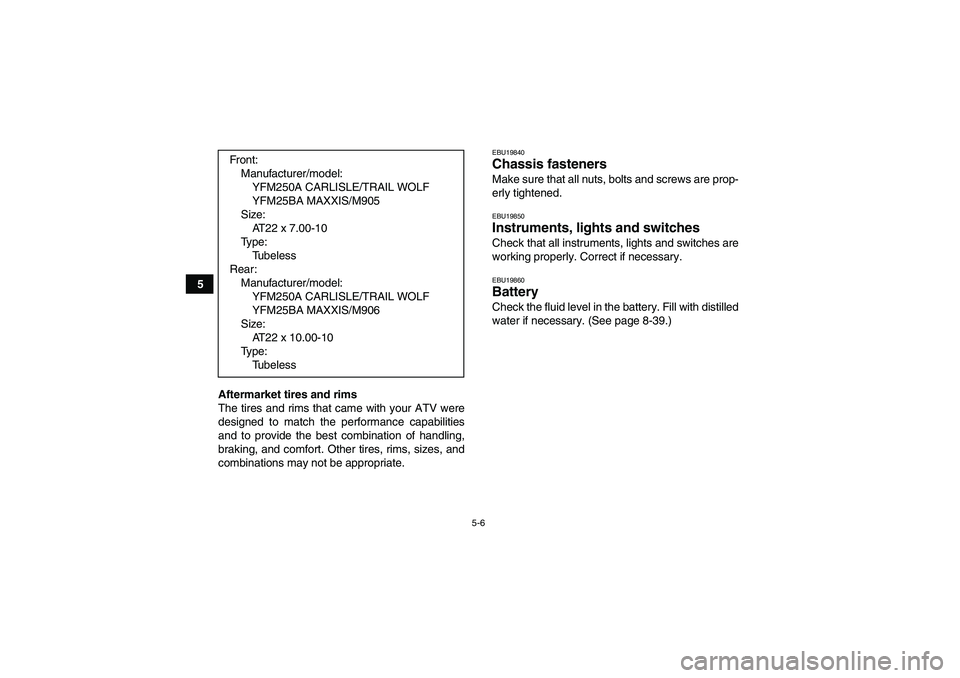
unexpectedly, which could cause an accident.EBU18720Fuel tank cap Remove the fuel tank cap by turning it counter-
clockwise.
1. Drive select lever
1. Recoil starter
U1P066E0.book Page 7 Thursday, August 5, 2010 4:15 PM
Page 33 of 140
4-8
4
EBU18754Fuel Make sure there is sufficient gasoline in the tank.
WARNING
EWB02521Gasoline and gasoline vapors are extremely
flammable. To avoid fires and explosions and
to reduce the risk of injury when refueling, fol-
low these instructions.1. Before refueling, turn off the engine and be
sure that no one is sitting on the vehicle. Nev-
er refuel while smoking, or while in the vicinityof sparks, open flames, or other sources of ig-
nition such as the pilot lights of water heaters
and clothes dryers.
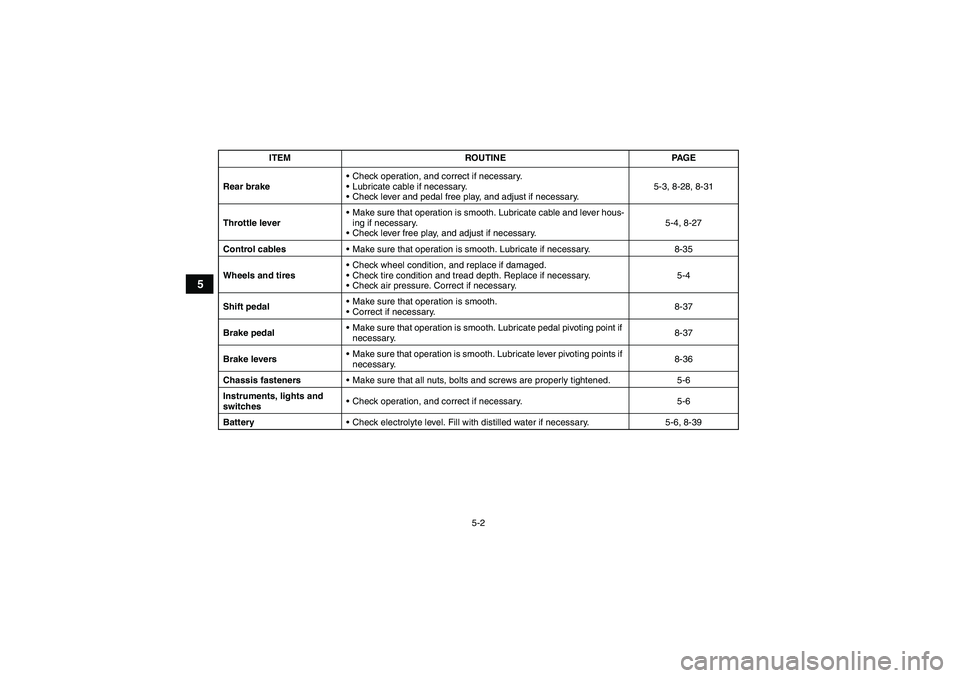
2. Do not overfill the fuel tank. When refueling,
be sure to insert the pump nozzle into the fuel
tank filler hole. Stop filling when the fuel reach-
es the bottom of the filler tube. Because fuel
expands when it heats up, heat from the en-
gine or the sun can cause fuel to spill out of
the fuel tank.1. Fuel tank cap
1. Fuel tank filler tube
2. Maximum fuel level
U1P066E0.book Page 8 Thursday, August 5, 2010 4:15 PM
Page 42 of 140
5-2
5
Rear brakeCheck operation, and correct if necessary.
Lubricate cable if necessary.
Check lever and pedal free play, and adjust if necessary.5-3, 8-28, 8-31
Throttle leverMake sure that operation is smooth. Lubricate cable and lever hous-
ing if necessary.
Check lever free play, and adjust if necessary.5-4, 8-27
Control cablesMake sure that operation is smooth. Lubricate if necessary. 8-35
Wheels and tiresCheck wheel condition, and replace if damaged.
Check tire condition and tread depth. Replace if necessary.
Check air pressure. Correct if necessary.5-4
Shift pedalMake sure that operation is smooth.
Correct if necessary.8-37
Brake pedal Make sure that operation is smooth. Lubricate pedal pivoting point if
necessary.8-37
Brake leversMake sure that operation is smooth. Lubricate lever pivoting points if
necessary.8-36
Chassis fastenersMake sure that all nuts, bolts and screws are properly tightened. 5-6
Instruments, lights and
switchesCheck operation, and correct if necessary. 5-6
BatteryCheck electrolyte level. Fill with distilled water if necessary. 5-6, 8-39 ITEM ROUTINE PAGEU1P066E0.book Page 2 Thursday, August 5, 2010 4:15 PM
Page 46 of 140
5-6
5
Aftermarket tires and rims
The tires and rims that came with your ATV were
designed to match the performance capabilities
and to provide the best combination of handling,
braking, and comfort. Other tires, rims, sizes, and
combinations may not be appropriate.
EBU19840Chassis fasteners Make sure that all nuts, bolts and screws are prop-
erly tightened.EBU19850Instruments, lights and switches Check that all instruments, lights and switches are
working properly. Correct if necessary.EBU19860Battery Check the fluid level in the battery. Fill with distilled
water if necessary. (See page 8-39.) Front:
Manufacturer/model:
YFM250A CARLISLE/TRAIL WOLF
YFM25BA MAXXIS/M905
Size:
AT22 x 7.00-10
Ty p e :
Tu b e l e s s
Rear:
Manufacturer/model:
YFM250A CARLISLE/TRAIL WOLF
YFM25BA MAXXIS/M906
Size:
AT22 x 10.00-10
Ty p e :
Tu b e l e s s
U1P066E0.book Page 6 Thursday, August 5, 2010 4:15 PM
Page 47 of 140
6-1
6
EBU19881
OPERATION
EBU19901Read the Owner’s Manual carefully before riding
the ATV. If there is a control or function you do not
understand, ask your Yamaha dealer.
WARNING
EWB00631Read the Owner’s Manual carefully to become
familiar with all controls in order to help pre-
vent any loss of control, which could cause an
accident or injury.EBU19994Starting a cold engine NOTICEECB00150See the “Engine break-in” section on page 6-6
prior to operating the engine for the first time.1. Set the parking brake.
2. Turn the fuel cock to “ON”.
3. Turn the key to “ON” and the engine stop
switch to“”.4. Shift the transmission into neutral. The neutral
indicator light should come on. If the indicator
light does not come on, have a Yamaha deal-
er check the electrical circuit.
TIPThe engine can be started under the following con-
ditions:�The transmission is in neutral.�The rear brake lever is applied with the transmis-
sion in any gear. However, it is recommended to
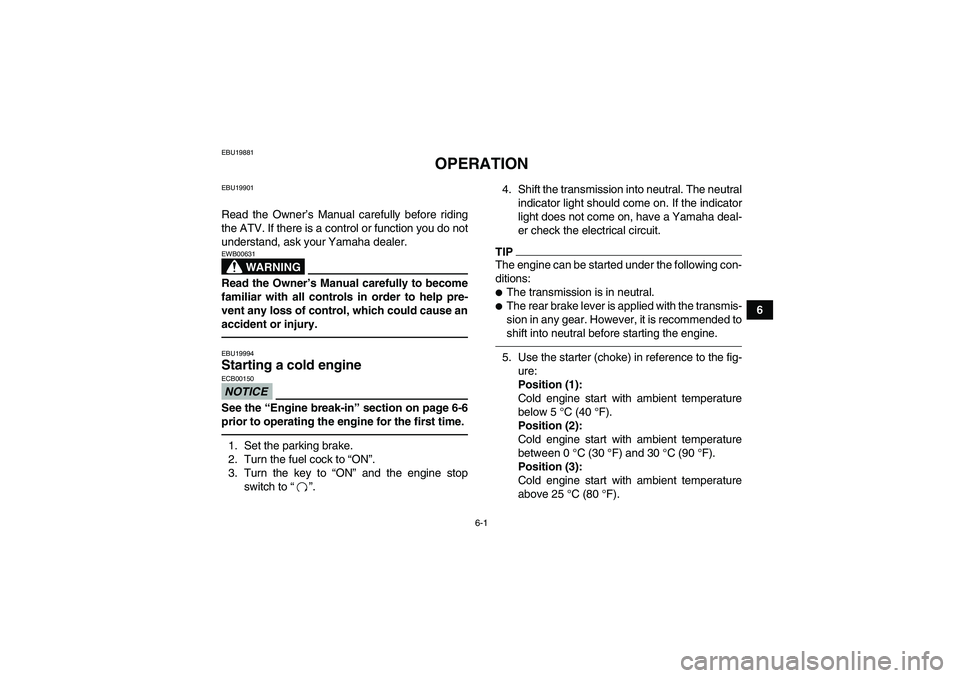
shift into neutral before starting the engine.5. Use the starter (choke) in reference to the fig-
ure:
Position (1):
Cold engine start with ambient temperature
below 5 °C (40 °F).
Position (2):
Cold engine start with ambient temperature
between 0 °C (30 °F) and 30 °C (90 °F).
Position (3):
Cold engine start with ambient temperature
above 25 °C (80 °F).
U1P066E0.book Page 1 Thursday, August 5, 2010 4:15 PM
Page 49 of 140
6-3
6
EBU20291Starting a warm engine Follow the same procedure as for starting a cold
engine, with the exception that the starter (choke)
is not required when the engine is warm. Instead,
start the engine with the throttle slightly open.EBU20321Operating the drive select lever and
driving in reverse NOTICEECB00170Before shifting, stop the ATV, otherwise the
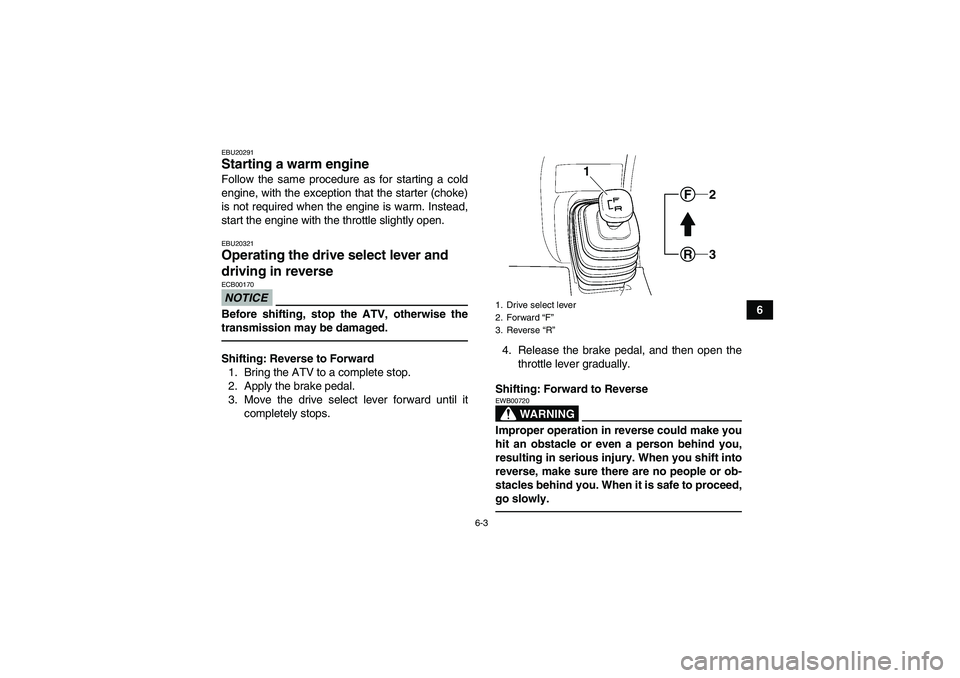
transmission may be damaged.Shifting: Reverse to Forward
1. Bring the ATV to a complete stop.
2. Apply the brake pedal.
3. Move the drive select lever forward until it
completely stops.4. Release the brake pedal, and then open the
throttle lever gradually.
Shifting: Forward to Reverse
WARNING
EWB00720Improper operation in reverse could make you
hit an obstacle or even a person behind you,
resulting in serious injury. When you shift into
reverse, make sure there are no people or ob-
stacles behind you. When it is safe to proceed,
go slowly.1. Drive select lever
2. Forward “F”
3. Reverse “R”
F
R
2
3
1
U1P066E0.book Page 3 Thursday, August 5, 2010 4:15 PM
Page 50 of 140
6-4
6
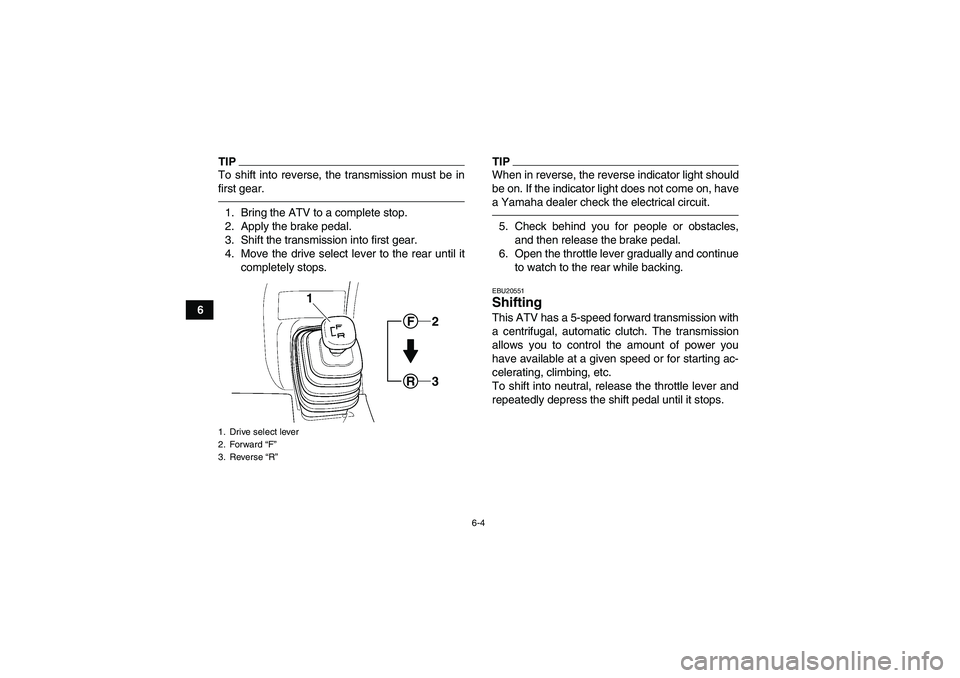
TIPTo shift into reverse, the transmission must be in
first gear.1. Bring the ATV to a complete stop.
2. Apply the brake pedal.
3. Shift the transmission into first gear.
4. Move the drive select lever to the rear until it
completely stops.
TIPWhen in reverse, the reverse indicator light should
be on. If the indicator light does not come on, have
a Yamaha dealer check the electrical circuit.5. Check behind you for people or obstacles,
and then release the brake pedal.
6. Open the throttle lever gradually and continue
to watch to the rear while backing.EBU20551Shifting This ATV has a 5-speed forward transmission with
a centrifugal, automatic clutch. The transmission
allows you to control the amount of power you
have available at a given speed or for starting ac-
celerating, climbing, etc.
To shift into neutral, release the throttle lever and
repeatedly depress the shift pedal until it stops.
1. Drive select lever
2. Forward “F”
3. Reverse “R”
F
R
2
3
1
U1P066E0.book Page 4 Thursday, August 5, 2010 4:15 PM
Page 69 of 140
7-13
7 the ATV will resist turning. A special turning tech-
nique must be used to allow the ATV to make turns
quickly and easily. It is essential that this skill be
learned first at low speed.
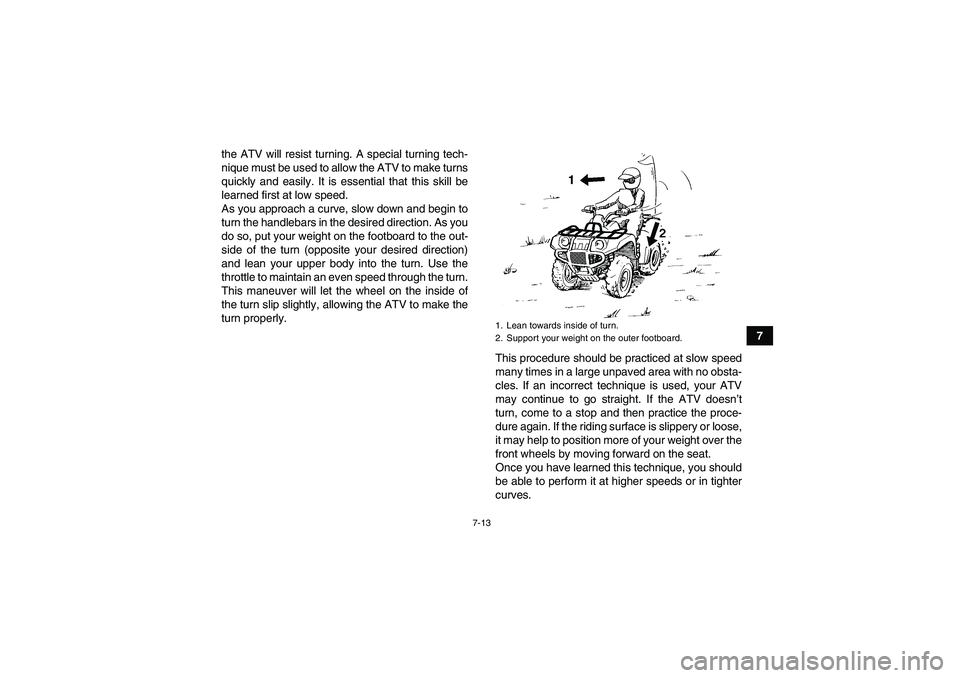
As you approach a curve, slow down and begin to
turn the handlebars in the desired direction. As you
do so, put your weight on the footboard to the out-
side of the turn (opposite your desired direction)
and lean your upper body into the turn. Use the
throttle to maintain an even speed through the turn.
This maneuver will let the wheel on the inside of
the turn slip slightly, allowing the ATV to make the
turn properly.
This procedure should be practiced at slow speed
many times in a large unpaved area with no obsta-
cles. If an incorrect technique is used, your ATV
may continue to go straight. If the ATV doesn’t
turn, come to a stop and then practice the proce-
dure again. If the riding surface is slippery or loose,
it may help to position more of your weight over the
front wheels by moving forward on the seat.
Once you have learned this technique, you should
be able to perform it at higher speeds or in tighter
curves.
1. Lean towards inside of turn.
2. Support your weight on the outer footboard.
U1P066E0.book Page 13 Thursday, August 5, 2010 4:15 PM